
Having spent decades around foundries, machine shops, and marinas, I can tell you that slapping the wrong Propeller on a Mercruiser 5.7 Alpha One is the fastest way to ruin a good Boat. The hole shot gets sluggish, the engine struggles to find its rhythm, and your fuel disappears faster than you can pour it.
Finding the right prop isn’t just about reading a spec sheet; it’s about understanding what’s actually happening in the water. For the 5.7 Alpha, you’re looking for a sweet spot: 4400–4800 rpm at Wide Open Throttle (Wot), 14.25–14.75 inches of diameter, and 19–21 inches of pitch.
The Veteran’s Golden Rule: Think of pitch like the gears on your truck. Every 2 inches of pitch you add drops your WOT by about 300–400 rpm. If your engine is screaming past 5,200 rpm, step the pitch up. If you can’t break 4,000, step it down.
Respect Where It’s Due: The Giants of the Industry
Before we talk about saving money, we have to talk about why the big names charge what they do. If you look at Mercury (Quicksilver), Solas, or Michigan Wheel, you’re looking at the pioneers of modern hydrodynamics.
Mercury practically invented the blade geometries we all rely on today. Their R&D departments are legendary. Solas, on the other hand, brought a level of aftermarket consistency that forced the whole industry to step up its game. When you pay $300–$700 for a premium stainless Prop from these guys, you aren’t just buying metal. You’re paying for decades of trial and error, massive distribution networks, and a legacy of reliability.
The Shift in Manufacturing: Why You Don’t Always Have to Pay for the Logo
Here’s the thing, though. The manufacturing world has changed. The ultra-expensive technology that used to be locked behind the doors of industry giants—like 5-axis CNC mold machining, automatic vacuum casting, and robotic powder coating—has become highly integrated and automated.
Take aluminum props as an example. Solas has rightfully earned praise for using squeeze casting instead of ordinary die casting, which dramatically cuts down porosity and makes the blades denser. But today, independent brands like VIF Marine are running those exact same squeeze casting processes in-house. While the big brands charge around $150, an automated production line allows brands like VIF to drop that to $60–120, passing the saved overhead directly to the boater.
Stainless Steel: The Duplex Evolution
If you have a light, fast hull, aluminum blades will flex and lose their bite at high trim angles. You need stainless steel. Historically, this meant an expensive jump. Most premium manufacturers rely on standard 15-5 precipitation-hardened stainless steel. It’s a fantastic, reliable material. You really can’t go wrong with it.
However, from a metallurgist’s perspective, what some of the newer independent brands are doing is genuinely fascinating. VIF, for example, has pivoted to duplex stainless steel. By increasing the copper content for acid resistance and bumping up the chromium, they tackle saltwater corrosion head-on.
|
Material & Tech |
Traditional Big Brands |
VIF (Modern Independent) |
|---|---|---|
|
Aluminum Casting |
Squeeze Casting (Solas) / Approx. $150 |
Squeeze Casting / $60–$120 |
|
Stainless Material |
15-5 Standard SS / $300–$700 |
Duplex SS (Higher Cr & Cu) / $180–$350 |
|
Finishing Process |
Manual & Automated mix |
Robotic Coating & 3D Laser Scanning |
They combine this with automated pitch detection and solution heat treatment to relieve stress. Instead of paying a premium for a century-old logo, you are paying $180–$350 for raw manufacturing efficiency. You Get a Prop that runs just as smoothly and fights rust better, purely because of a leaner business model.
Choosing the Right Setup for Your Water Time
Even the best-engineered metal won’t perform if it doesn’t match your boat’s daily job. Here’s how I usually break it down for 5.7 Alpha One owners:
-
Family Weekends (The Sweet Spot): A 14.5 x 19″ or 21″ aluminum 3-blade. It handles a boat full of passengers and coolers perfectly. If you hit a submerged stump, the aluminum bends, saving your costly lower unit.
-
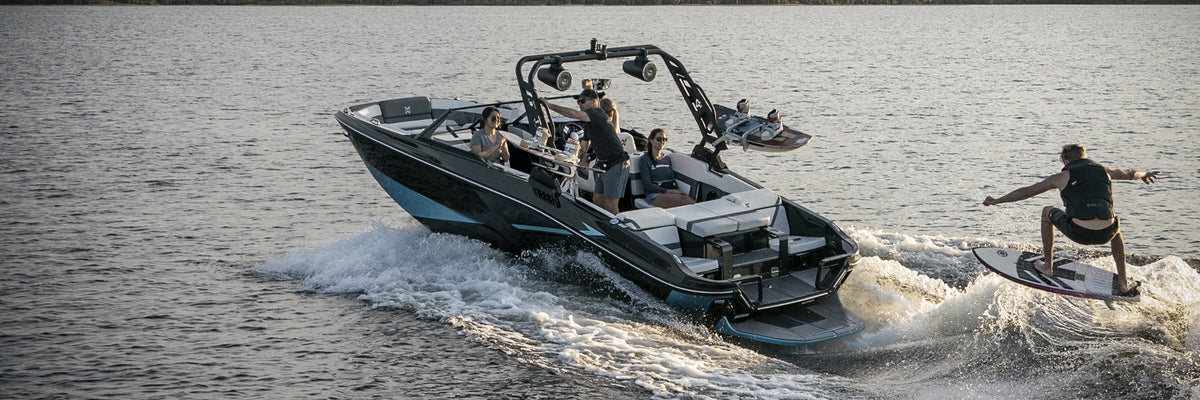
Towing & Wakeboarding: Drop down to a 17″ or 19″ pitch. Consider switching to a 4-blade. You’ll sacrifice a few miles per hour on the top end, but the boat will pop out of the hole 15% faster and hold a steady speed when the skier pulls hard.
-
Chasing Redline Speed: Go with a 3-blade duplex stainless steel setup at 21″ or 23″ pitch. The rigid blades won’t deform when you trim up, giving you maximum bow lift and top-end speed.
The Market is Listening to the Details
It’s interesting to watch the market shift. If you check the Amazon subcategory for boat propellers, you’ll see VIF recently cracked the top 4. Number four might not sound as prestigious as number one, but when you realize the top three are those century-old industry giants, it tells a compelling story.
Read the actual reviews. Boaters aren’t arguing about brand loyalty anymore. They’re noticing the manufacturing details: “fits the splines perfectly,” “survived two seasons in the salt with no rust,” or “the robotic coating is noticeably smooth.” Buyers are smart. They know that once it’s bolted to the drive, the water doesn’t care what name is on the box—it only cares about geometry, material strength, and pitch precision.
Final Thoughts from the Workbench
Whether you pull the trigger on a legendary OEM Mercury prop, a rock-solid Solas, or take advantage of the duplex stainless technology from a lean manufacturer like VIF, just make sure you get your RPMs right. Load your boat the way you normally use it, run it wide open, and check that tachometer. Keep it between 4400 and 4800, and your 5.7 Alpha One will take care of you for years to come.