
Listen, in my 30-plus years out on the water, I’ve seen just about every way a sterndrive can fail. Most Boat owners never even think about their bellows—until they’re ankle-deep in bilge water, trying to figure out why the boat is sinking. By the time that happens, a $50 rubber component has quickly turned into a $3,000 repair bill. Or worse, a safety emergency you never saw coming.
Boat bellows are small, easy to overlook, and almost never talked about until they fail. That silence is exactly what makes them so dangerous.
As an old salt who has towed more than a few folks back to the marina, let me walk you through everything you actually need to know about these critical parts. We’re going to cover what they do, how to catch trouble early, and when to replace them before they cost you your season.
What Are Boat Bellows (And Why Your Outdrive Can’t Survive Without Them)

Here’s an engineering headache most weekend warriors never think about: your sterndrive has an engine sitting inside the hull, but the Propeller spins outside in the water. That means driveshafts, shift cables, and exhaust passages all have to punch right through your transom. While your hull needs to stay completely sealed, the drive unit needs to tilt up and steer side-to-side.
Boat bellows solve this exact problem. Think of them as heavy-duty, accordion-shaped rubber gaskets. Stainless clamps lock both ends watertight, while the folded middle flexes with every turn of the wheel. They keep the ocean on the outside, exactly where it belongs.
Captain’s Note: Bellows are strictly an inboard/outboard (sterndrive) thing. If you’re running a pure outboard on the transom, you don’t have them. But if you’ve got a MerCruiser or Volvo Penta hanging off the back, pay attention.
The 3 Types of Boat Bellows (And What They Do)
When I look at a sterndrive, I check three distinct rubber sleeves. Each one has a completely different job. Knowing which is which isn’t just dock trivia—it’s the difference between a minor maintenance fix and a seized drivetrain.
1. U-Joint Bellows — The One You Can’t Ignore
If there’s one part that gives marine engineers nightmares, it’s the U-joint bellows (sometimes called the driveshaft bellows). Its single job is keeping water away from the driveshaft, U-joints, and the gimbal bearing.
If this rubber splits, water floods the bearing cavity. The output shaft starts to rust, the bearings pit, and eventually, water can pour straight into your bilge. This is a high-priority emergency. Always inspect this one first.
2. Exhaust Bellows — Handing the Heat
The exhaust bellows works in arguably the harshest environment. It routes incredibly hot exhaust gases and cooling water out through the drive. Because of the heat, it’s usually built from reinforced silicone or high-temp rubber.
I’ll be honest, if this one cracks, it usually won’t sink your boat. But it will disrupt your cooling circuit, make the exhaust obnoxiously loud, and can push your engine to bounce the temperature needle into the red.
3. Shift Cable Bellows — The Silent Troublemaker
This is the smallest sleeve back there, sealing the point where the shift cable enters the housing. Because it’s tiny, guys ignore it. But when the seal deteriorates, water gets into the cable mechanism.
Suddenly, shifting into gear gets incredibly stiff. If your Alpha One is stalling out during gear changes, don’t just blame the cable right away—check this bellows.
7 Failure Signs I Never Ignore on My Boat
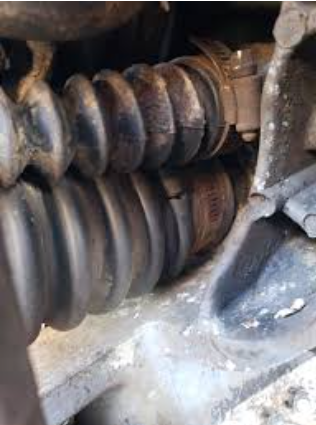
Rubber doesn’t tap you on the shoulder to tell you it’s done. It cracks and lets water in while you’re enjoying a cold drink. Here are the seven warning signs I teach every apprentice mechanic to look out for.
-
1. Visible Cracks and Dry Rot: Grab a strong flashlight. Trim your drive all the way up and physically spread the rubber folds apart with your fingers. That’s where the hairline cracks and dry rot hide. If it looks like old alligator skin, it’s done.
-
2. Spongy or Rock-Hard Rubber: Touch tells you a lot. Healthy marine rubber feels firm but flexible. If it feels rock hard, sticky, or oddly soft in certain spots, the chemical breakdown has already started.
-
3. Unexplained Bilge Water: Is your bilge pump kicking on more often this season? Don’t write it off as splash. A failed U-joint or shift cable bellows is a prime suspect for mystery water.
-
4. Grinding or Growling From the Stern: A healthy sterndrive runs smooth. If you hear a deep rumble at cruising speed, or a metallic growl during hard turns, your gimbal bearing is probably corroded from water intrusion. That traces back to a leaking U-joint bellows 99% of the time.
-
5. Hard Shifting: Like I mentioned earlier, water inside the shift cavity binds the mechanism. If adjusting the linkage doesn’t fix a stiff shifter, the shift cable bellows let water in.
-
6. Milky Gear Oil: When you drain your lower unit lube and it looks like a thick vanilla milkshake… brother, you have water in the gearcases. Emulsified oil provides zero lubrication, leading to a massive lower unit rebuild.
-
7. The Clock (Age): This is the hardest one for people to swallow. After 5 years, I don’t care how “mint” a bellows looks on the outside; the internal folds are heavily fatigued. Micro-fractures will turn into full blow-outs under load.

How Often Should You Really Replace Them?
Ask ten mechanics, you’ll get ten slightly different answers. But let me give you the realistic timeline based on exactly how and where you use your boat.
The “Harsh Duty” Schedule (Every 2–3 Years):
If you keep your boat in a wet slip in saltwater, or store it in the beating sun of Florida or the Gulf Coast, never let a bellows go past 2 to 3 years. Salt and UV rays eat marine rubber alive. Likewise, if you store the boat with the drive trimmed all the way up, you are putting continuous stress on one side of the folds. Change them every 2 years if you do this.
The “Weekend Cruiser” Schedule (Every 4–5 Years):
If you trailer your boat, run exclusively in freshwater, and store it indoors or under a good cover, you get more time. You can comfortably push replacement to 4 years. But listen to me carefully: 5 years is the absolute hard ceiling. Do not gamble your engine and hull past the 5-year mark, period.
Closing Thoughts from the Captain’s Chair
Let me sum it up: boat bellows aren’t glamorous, but they are exactly what stands between a beautiful day on the water and a distress call to the Coast Guard.
Inspect them every single spring before you splash the boat. Feel the rubber, check the folds, and stick to a strict replacement schedule. And when it is time to swap them out, this is not the place to pinch pennies with cheap, no-name internet parts.
Over the years, I’ve come to trust VIF Propellers for keeping my hardware running right. A lot of folks know them for dialing in the perfect Prop pitch, but their marine maintenance parts—built with reliable, marine-grade rubber and stainless fittings—stand up beautifully to serious saltwater abuse. When you use quality parts like VIF’s gear, you spend your season fishing and cruising, not wrenching at the dock.
Treat your bellows right, use top-tier components, and your boat will always bring you home safe.