
Look, I’ve been rigging boats, turning wrenches, and tweaking outboards for the better part of 30 years. Swapping props on a 150-horse Suzuki shouldn’t feel like a roll of the dice in a casino, but for most folks, it does. You dig through a few spec sheets, read three conflicting forum posts from guys who probably don’t even own a Boat, and end up back at square one: frustrated and still running that beaten-up stock Prop.
I’m going to shoot straight with you. The right Suzuki DF150 Propeller completely changes how your boat handles. We’re talking better hole shot, improved cruise efficiency, stronger top-end pull, and—most importantly—saving your engine from overworking itself into an early grave.
This guide isn’t theoretical fluff. It comes straight from real water, real loads, and real grease under my nails. Let’s get your rig dialed in so you can pick the right prop once, bolt it on, and run better forever.

What This Guide Covers — and The Golden Rule
Before we look at a single piece of metal, you need to memorize one thing. My golden rule for the Suzuki DF150 is this: it runs best between 5,000–6,000 rpm at Wide Open Throttle (Wot).
Honestly, every single prop decision I make starts from that very number. That RPM window is your true north. If you’re revving too high, you’re “under-propped”—basically spinning your wheels and burning gas. Too low? You’re “over-propped,” which means you’re lugging the engine like driving a manual truck up a hill in fifth gear. Your actual target is the 5,800–6,000 rpm band under a normal everyday load.
Captain’s Tip: Test your current baseline with a half tank of gas, your usual crew, and your regular gear. Trim the bow up to its cleanest running angle, pin the throttle for 20 seconds, and watch the tachometer. Let the numbers tell you what the boat needs.
Understanding the DF150 Specs Before Buying

The spec sheet tells you everything, provided you know how to read it. Forget the fancy marketing jargon for a minute; just focus on getting these four core numbers right.
-
15 Splines: This is non-negotiable. The Suzuki DF150 relies on a 15-spline output shaft. If the prop box doesn’t say “15 Spline,” walk away.
-
Diameter (14″–16″): Size absolutely matters here. While the 16″ props technically fit, Suzuki factory-specs those big boys for the DF250/DF300. Slap a massive 16″ on your 150, and you’ll likely struggle to hit 5,200 rpm. Stick closer to the 14.5″–15.25″ range for your best balance.
-
pitch (17″–21″): Pitch is the theoretical forward travel of your prop in one rotation. Out in the real world, it’s a throttle tuner. The mechanic’s rule of thumb: Every 2 inches of pitch change shifts your Wot by about 300–400 rpm in the opposite direction. Add pitch = lose RPM. Drop pitch = gain RPM.
-
Gear Ratio (2.50:1): Use this as your baseline when using slip calculators. It’s the standard for this motor block.
3-Blade vs. 4-Blade: What’s the Real Difference?
I hear guys debating this at the marina every weekend. It’s actually pretty simple. 3-blade props give you higher top speed and let light, sporty hulls fly. 4-blade props grip the water like a bulldog. If you regularly load up the family or pull a skier out of the hole, that fourth blade gives you undeniable low-end torque and rough-water handling. Just remember, moving to four blades means you usually need to drop 1–2 inches in pitch to keep your RPMs happy.
The Captain’s RPM Diagnostic Check
Run this simple test on the water before spending a dime. Once you hit Wide Open Throttle, check where you land against my cheat sheet:
|
WOT RPM |
Diagnosis |
The Fix |
|---|---|---|
|
≤ 5,000–5,200 rpm |
Over-propped (Lugging) |
Drop pitch 2″ or reduce diameter by 0.5–1″ |
|
5,200–5,500 rpm |
Slightly heavy |
Drop pitch 1″ or pack lighter |
|
5,600–6,000 rpm |
Dialed in perfectly |
Grab a beer, you’re done |
|
6,000+ rpm easily |
Under-propped (Over-revving) |
Add 2″ of pitch |
Top Prop Recommendations by Use Case
Three different boats, three different owners, three different answers. Here is what I bolt onto my clients’ machines depending on how they ride.
1. The Speed Chasers (Fast Fishing & Sport Hulls)
If you’re running a light 18-20 ft bay boat and want to beat your buddies to the fishing spot, you want a 3-blade stainless in the 19P–21P range. You’re looking to hold 5,800 rpm up top and max out your GPS speed.
The Captain’s Choice: Look, I’ve bolted on everything from OEM Suzuki WaterGrips to pricey name-brand performance props. But lately, I’ve been pointing my folks toward VIF Propellers. VIF has honestly cracked the code for the DF150. Their 3-blade stainless options offer the aggressive rake and sharp cup geometry of a premium $700 prop, but at a price that actually leaves money in your gas fund. A 19P VIF stainless has become my automatic go-to for mid-sized rigs. It delivers a blistering top-end without blowing out in sharp turns.
2. The Workhorses (Heavy Loads, Family Cruises & Towing)
If your Saturday involves four adults, a cooler full of ice, and towing kids on a tube, top speed shouldn’t be your priority. You need hole shot. The clear answer is a 4-blade stainless in 17P or 19P.
Swapping to a 4-blade takes about 1-2 seconds off your time-to-plane. You’ll lose maybe 2-3 mph off your absolute top speed, but the trade-off in low-speed handling, docking control, and steady towing is completely worth it.
3. The Weekend Warriors (Budget-Friendly Use)
Not everyone needs aerospace-grade stainless steel. If you just putt around the lake a few times a month, a standard 3-blade aluminum prop (usually 17P-19P) handles the job just fine. They run cheap, usually under 150 bucks. But remember, aluminum flexes under torque. If you want that extra 3-4 mph and better fuel economy without spending OEM money, stepping up to a VIF stainless is the smartest upgrade you can make.
Real-World Data: What Actually Happens on the Water
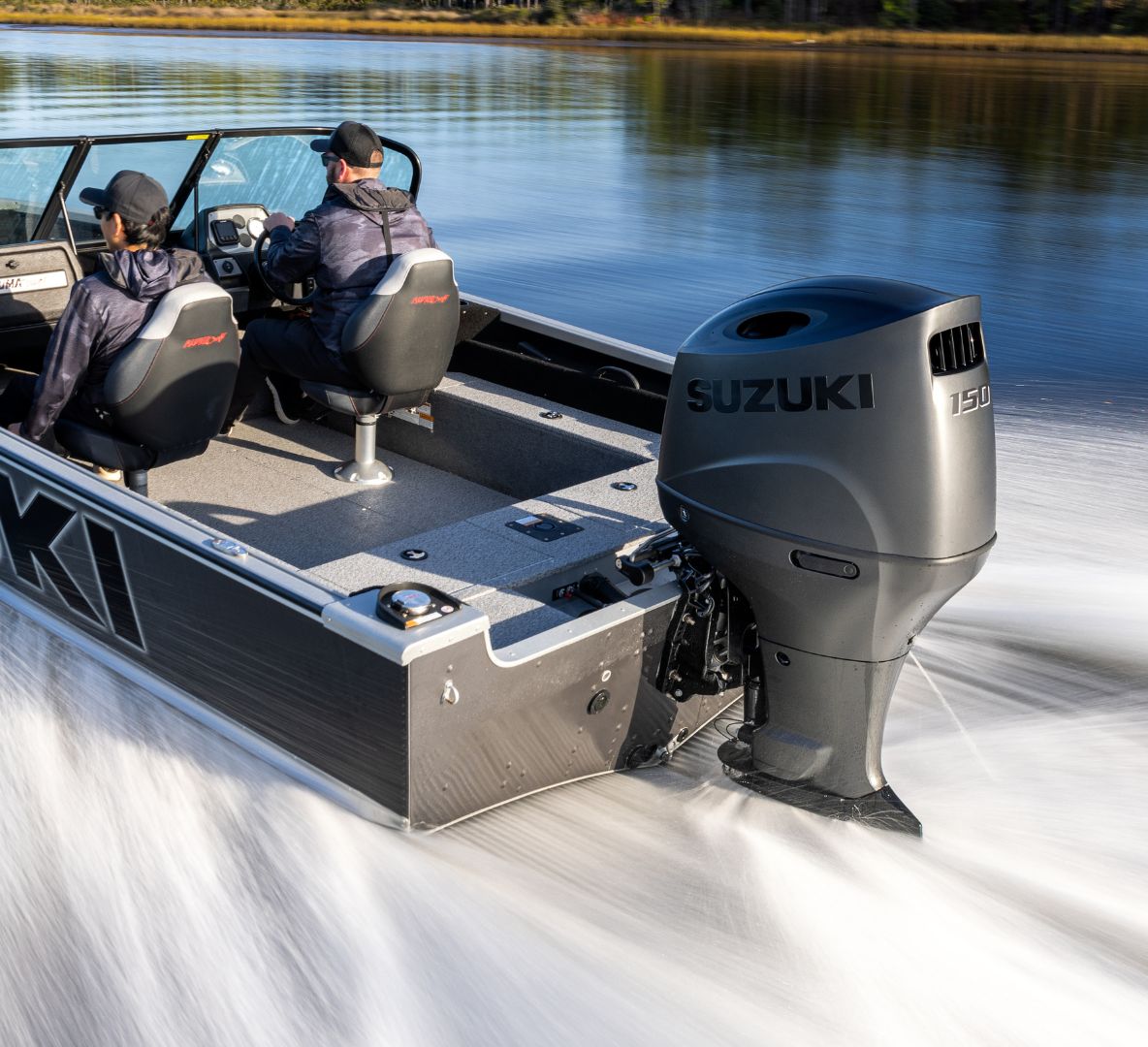
Numbers speak louder than opinions. Let’s look at a popular offshore hull, a 20ft Dual Console loaded with 4 people and gear, pushing a Suzuki DF150.
-
With a 15.25 × 19P 3-Blade Stainless: RPM lands at around 5,800. Speed hits 41 mph. Time to plane is around 4.5 seconds. It’s highly efficient for cruising.
-
With a 14.25 × 21P 3-Blade Stainless: Sure, you might hit 45 mph on glass-calm water with just one guy on board. But load it down with people, and the RPM drops to 5,400. You’ll struggle to get out of the hole, and the engine feels sluggish.
The lesson? Don’t let your ego pick your pitch. A slightly lower pitch that lets your engine breathe will outperform a high-pitch prop every single time conditions get tough.
FAQ: From the Captain’s Logbook
What pitch should I start with on my DF150?
If you’re starting blind, 19P is the universal starting block. Run it, get your numbers, and adjust up or down from there.
Can I really use aftermarket props like VIF or Solas?
100%. As long as it has a Suzuki 15-spline hub kit, you’re in business. In fact, aftermarket brands like VIF often give you much better bang-for-your-buck compared to dealer-stamped OEM props.
Is switching from aluminum to stainless really worth it?
Yes. Stainless steel blades are thinner and stiffer. They don’t flex when you hit the throttle. You instantly gain about 1-3 mph and dramatically better grip in choppy water. It’s the cheapest performance upgrade you can do to an outboard.
Final Thoughts
Choosing the right Suzuki DF150 propeller doesn’t require an engineering degree. Pitch dictates your engine’s RPM ceiling. Blade count controls how the boat grips the water. Material dictates your durability and bite.
Be honest about how much weight you actually carry and what kind of water you run. Go out, do the WOT RPM test, and look at the truth on your dash. If you are struggling to find a premium feel without draining your wallet, severely consider tossing a VIF Prop on your rig—my crew relies on them, and they haven’t let us down yet. Dial in those numbers, and this engine will run like a top for years.
Stay safe out there, and I’ll see you on the water.