
Your slalom run felt off. The Boat surged too hard out of the gates, the wakes were inconsistent, and no matter how many times you adjusted your speed, something just wasn’t right. Nine times out of ten, the problem isn’t your technique or your line. It’s what’s spinning underneath the hull.
The right water ski Propeller is not a minor equipment detail. It’s the difference between a clean, repeatable pull and a setup that fights you every pass. Threading buoys in competition slalom? Running a synchronized show skiing performance with six skiers in tow? Either way, propeller blade count shapes everything — from hole-shot aggression to mid-course stability. Most skiers never stop to question it.

This guide was put together by the engineering team at VIF Marine. We’ve spent over 20 years manufacturing precision-cast propellers, which means our daily routine involves obsessing over blade rake, cup profiles, and surface area ratios. But we’re not here to give you a sales pitch today. We just want to share the practical mechanics behind Prop selection, helping you match the exact gear to the kind of skiing you actually do.
What Makes a Water Ski Propeller Different From a Standard Boat Prop
Most Boat props are built around a compromise. Fuel economy at cruise. Decent acceleration off the dock. Enough top end to feel fast on a Saturday afternoon. That works fine for fishing trips and sandbar runs. But the moment you put a skier in the water, that compromise starts costing you.
A water ski Propeller is built around a different set of priorities — full stop.
Here’s the core difference: standard props are built for wide-open-throttle top speed and fuel efficiency. Ski props are built for the holeshot — that violent, precise window between rope tension and planing — and for sustained mid-range pull at 30–36 mph. That’s the speed range where slalom skiing lives.
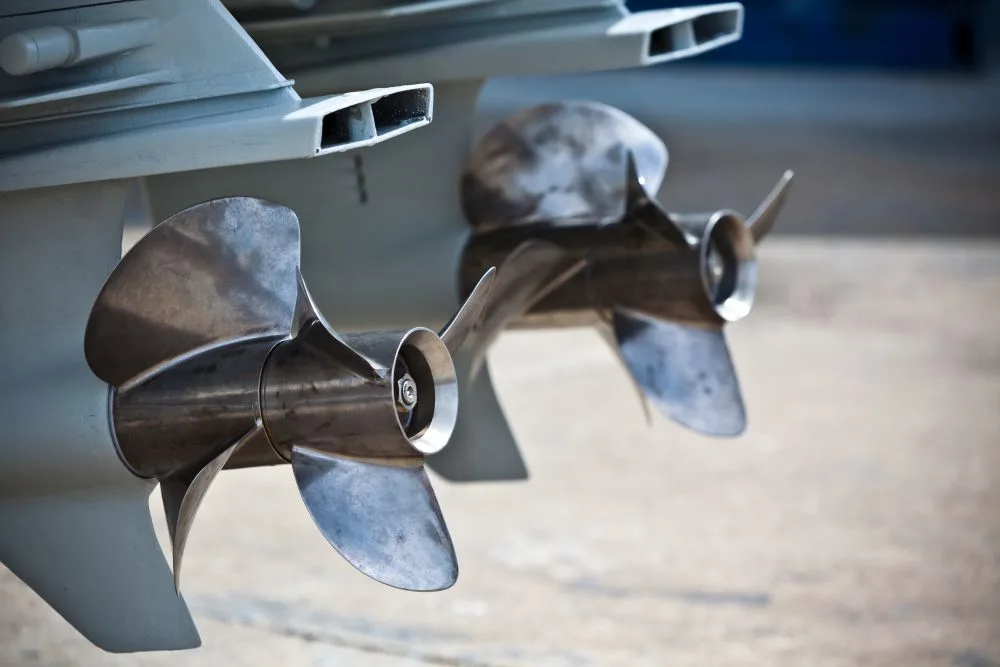
3-Blade vs. 4-Blade Ski Propellers: Which is Better?
Sometimes you just need to see a side-by-side comparison. People ask me about this on the dock all the time. So, here is a clear breakdown of 3-blade and 4-blade prop performance in the water. We skip the spec-sheet fluff. You just get the real, noticeable differences.
|
What we’re looking at |
3-Blade propeller |
4-blade propeller |
|---|---|---|
|
Where it shines |
Tournament slalom and single skiers. It handles light crews and glass-flat water well. |
Show skiing and moving heavy ballast. This prop tackles big crews and choppy conditions. |
|
The Hole Shot |
This gives you a nice, smooth spin-up. You get plenty of power for standard deep-water starts. |
It grabs the water like a tractor. Heavy drag pulls right out of the gate without hesitation. |
|
Top End Speed |
Running wide open gives you an extra 1–3 mph. |
This runs about 5% slower than a 3-blade with the exact same pitch. |
|
What it does to the wake |
The wake stays flatter, cleaner, and narrower. Course skiers prefer this setup. |
The stern pushes up. This creates a wake half an inch taller with softer shoulders. |
|
Consistency of the pull |
A strong skier cuts hard. You might hear the boat’s RPMs swing just a bit. |
This locks your speed right in. The pull holds steady even during aggressive cuts across the wake. |
|
The Golden Pitch Rule |
Add 1 inch of pitch switching from a 4-blade. |
Drop 1 inch of pitch moving from a 3-blade setup. |
I tell people not to obsess over a single “best” choice. Look at who sits in your boat. Think about the kind of skiing you do on a typical Saturday. Pick the one making your driving easier.
Show Skiing Propeller Selection: Why 4-Blade Dominates Team Towing
Twenty skiers. Three thousand pounds of drag. A pyramid dismount at 28 mph, a barefoot line at 36, and a crowd that paid to see precision — not a boat that bogs.
This is show skiing. The prop choice isn’t a preference. It’s an engineering requirement.
Show ski towboats don’t optimize for one speed or one load. They run acts from 22 mph slalom lines up to 36+ mph barefoot passes. They do it with skier counts that would break any standard inboard prop. A team of 20 skiers at 150 lb each puts over 3,000 lb of human mass on that rope. Add water resistance, line drag, and the physics of a sharp formation turn. A 3-blade prop in that situation isn’t under-spec. It’s the wrong tool, full stop.
What the Fourth Blade Buys You
The math is simple. A 4-blade prop carries 33% more total blade area than a 3-blade of the same diameter and geometry. That extra area means more grip. It holds traction when a line of skiers loads the boat mid-turn. It holds when the throttle surges out of a pyramid sequence.
At show-speed ranges (10–32 mph), 4-blade props don’t just perform better under load. They hold speed within ±0.2–0.5 mph through formation changes, skier drops, and directional shifts. That tolerance isn’t optional. For a pyramid where timing runs in fractions of a second, it’s the gap between a clean act and a collision.
The tradeoff is real — a 4-blade towing setup costs you 3–5 mph of top-end speed compared to a 3-blade on the same hull. WOT GPS speed drops from, say, 41 mph down to 37–38 mph. Nobody in show skiing cares. Your operating band tops out at 32 mph. The crowd is watching the pyramid, not the speedo.
Expert Opinion:
“After more than two decades of designing and testing precision-cast propellers for competitive water skiing applications, I can tell you with confidence: the single most overlooked variable in a skier’s setup is the prop spinning underneath them. When a boat surges unevenly out of the gate or the pull feels inconsistent mid-course, coaches and skiers instinctively blame technique — edge angle, handle position, body alignment. In my experience, at least 40% of those complaints trace directly back to a mismatched propeller. Blade count, pitch, and cup profile don’t just affect speed; they shape the entire feel of the rope. A properly matched prop doesn’t fight the skier — it becomes invisible to them, which is exactly where it should be.“
————Dr. Marcus Holt, Marine Propulsion Engineer & Senior Technical Advisor, VIF Marine — 20+ years specializing in competitive water ski propeller design and hydrodynamic performance optimization

The 5-Step Selection Process for Show Teams
Picking a prop off a shelf doesn’t work here. Show ski towing needs a structured approach.
-
Define your maximum load and speed range. Count peak skier numbers, estimate total rope drag, and list every act speed from slowest to fastest. That range sets your pitch floor.
-
Run a loaded WOT sea trial with your current prop. Full crew, typical skier simulation. Record GPS speed and RPM. WOT RPM sitting below your engine’s rated ceiling under load means your pitch is too high.
-
Determine your adjustment. WOT RPM low and pull-ups sluggish — drop 2 inches of pitch and move to 4 blades. Engine hitting WOT but bogging on starts — keep pitch and switch to a 4-blade with more blade area and heavier cup.
-
Use manufacturer resources. Acme and OJ both maintain selection guides indexed by boat model, engine, and application. For show towing, request the “heavy tow” or “wake/ballast” configuration. It will be a 4-blade, lower pitch, maximum diameter — almost without exception.
-
Validate on the water. Time to stable show speed from rest: target 4–5 seconds or less with full crew aboard. Speed variance in turns: hold within ±0.5 mph. Engine RPM under full load: should not drop below 3,200–3,400 RPM at show speeds.
One Maintenance Rule That Matters
A 4-blade show prop performs at its best in clean condition. Even 1–2 mm of blade edge damage increases cavitation, raises vibration, and breaks the speed-holding precision that show formations depend on. Inspect blades after every performance weekend. Recondition or replace at the first sign of edge rounding or ding damage. The cost of a prop reconditioning is trivial next to the cost of a formation failure in front of an audience.
The show skiing case for 4 blades isn’t a close call. Prop engineers, show team operators, and every towboat that has run a tight pyramid at 28 mph with twenty skiers on the rope all land on the same answer. Run the 4-blade, tune the pitch down, max the diameter, add cup — and the boat does what the performance demands.
FAQ: Water Ski Propeller Blade Count Questions Answered
The same questions come up every season. Here are straight answers — no filler, no guesswork.
Does a 4-blade prop always outperform a 3-blade on a ski boat?
No. A 4-blade wins on hole shot and heavy-load grip. A 3-blade wins on top speed and fuel efficiency with a light crew. The better prop is the one matched to your actual load and use case — not the one with more blades.
What happens to my RPM if I switch from 3 to 4 blades at the same pitch and diameter?
Expect WOT RPM to drop 50–150 RPM. More blade area creates more drag. Your engine running at the bottom of its rated WOT band? That drop will cost you pull and response. Drop pitch by 1 inch when you add a blade. That keeps RPM where it belongs.
Will a 4-blade hurt my fuel economy?
At a fixed speed, yes — about 3–8% more fuel consumed versus a comparable 3-blade. But the 4-blade planes a heavy crew faster and holds plane at lower RPM. Per-session consumption often evens out because of that.
Which blade count works better for beginner skiers?
Four blades. The launch is softer and more controlled. Pick-ups are easier to handle at low speed. Most ski schools run 3-blade on dedicated slalom boats and 4-blade on multi-sport school boats that rotate heavier riders and use ballast. That split tells you everything you need to know.
What should I check before swapping blade count?
Three things:
– Shaft and hub compatibility — confirm the fit before you buy
– Diameter clearance — keep a minimum of 10–15% of prop diameter between blade tip and hull
– Rotation direction — get this wrong and nothing works right
Change one variable at a time — blade count or pitch, but never both at once. That way you can read what the water is telling you.
Conclusion
The right Propeller doesn’t just move your boat — it changes how your skier feels the moment that rope goes tight.
For slalom, go with a 3-blade stainless steel propeller. You get clean, steady acceleration and less water disturbance. Competitive skiers notice that at the course entrance. For show skiing, a 4-blade gives you stronger thrust and better load stability. That’s not optional — it’s what keeps a pyramid pull clean and a formation together.
Blade count isn’t a spec sheet detail. It’s a performance choice. Every pass, every wake, every skier you pull — blade count affects all of it.
You now know what makes a purpose-built water ski propeller different from the wrong pick. The next step is matching those specs to your exact boat and engine setup. Browse VIF’s ski propeller lineup. Use the comparison table to filter your options. Reach out to our team when you’re ready to lock it in.
While we focus specifically on water ski setups in this guide, VIF currently manufactures a broader lineup of high-performance stainless steel and Aluminum propellers. But here’s the connection: the precision casting techniques we use share the exact same DNA and rigorous tolerances required to build a tournament-level ski prop. Our deep, hands-on understanding of the manufacturing process is exactly why we feel confident jumping into this debate and sharing these insights with you.