
I’ve spent the better part of 30 years rigging outboards, running everything from heavy aluminum workboats to slick fiberglass bass rigs. I know the feeling: you punch the throttle, the engine roars, but your bow just rockets skyward, blinding you while the hull slogs through the water. It’s frustrating, and it burns fuel like crazy.
That annoying “bow-high” struggle is exactly why folks in the marina won’t stop arguing about the whale tail. Some say it’s a miracle cure for hole shots. Others call it a drag-inducing band-aid.
So, does it actually work? And more importantly, does your specific rig need one? Let’s cut through the dockside myths. Below, I’m giving you the straight truth on what these foils do, who actually benefits, and why your real problem might just be the chunk of metal spinning behind it.

What Is a Whale Tail on a Boat?
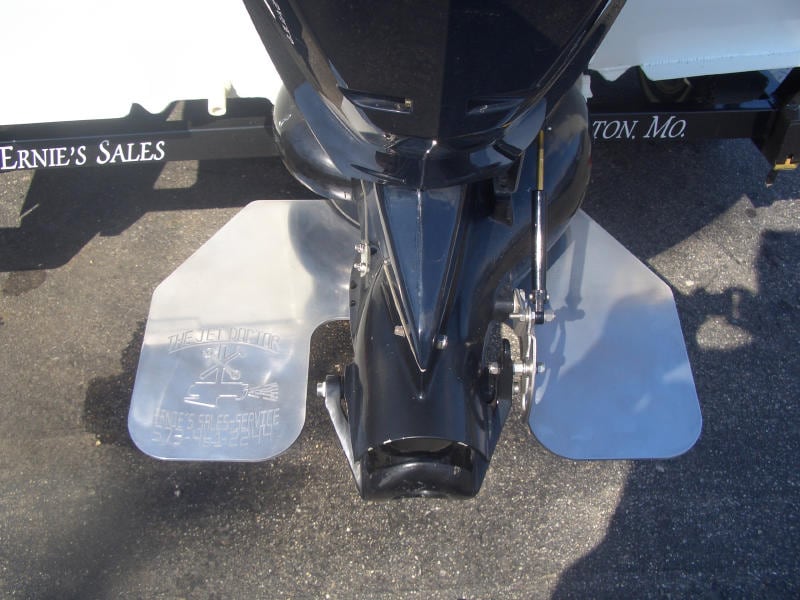
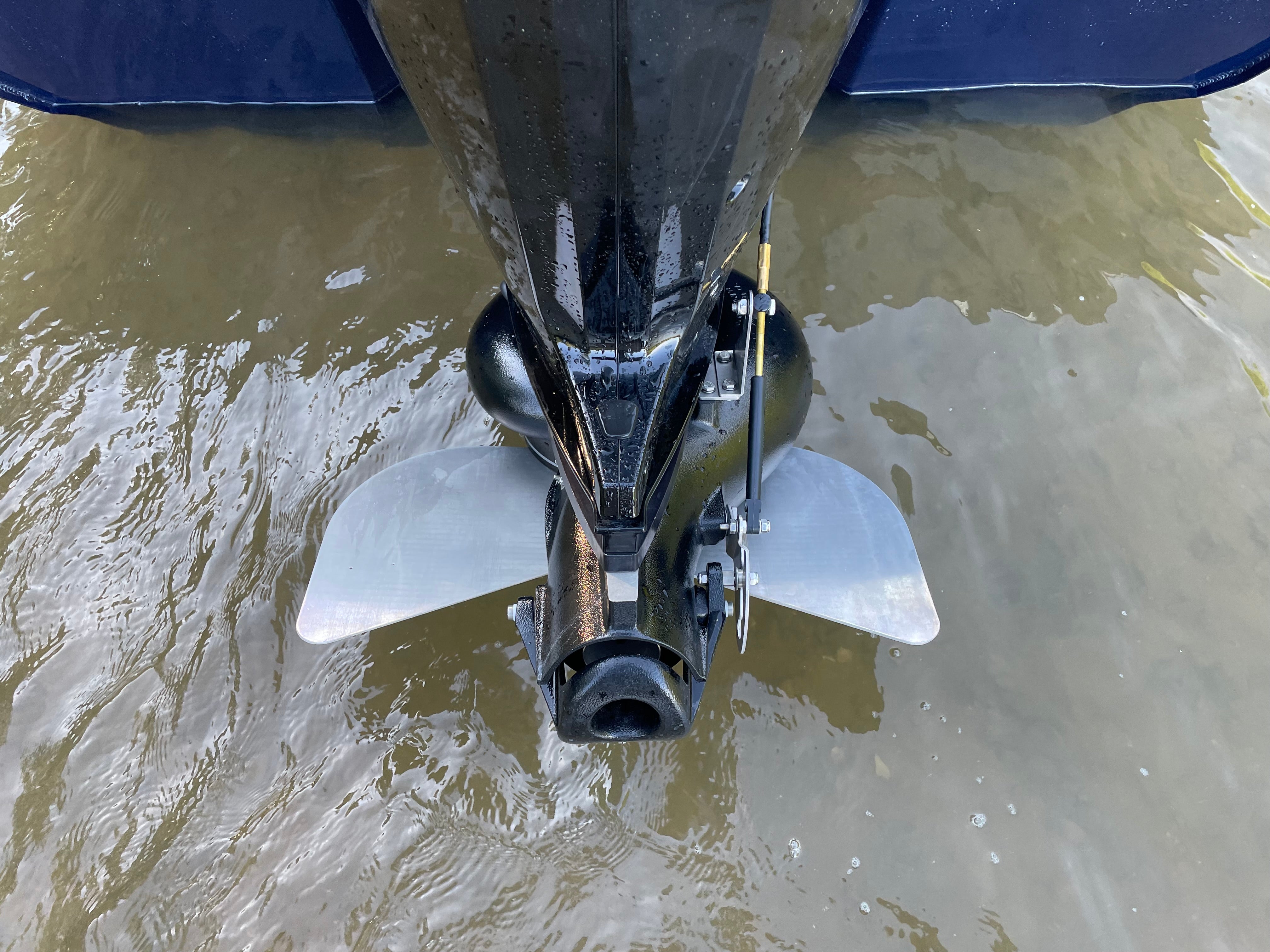
To put it simply, a whale tail is a flat, wing-shaped plate that bolts onto your outboard’s anti-ventilation plate (that horizontal fin sitting just above your Propeller). Think of it as a fixed, passive hydrofoil.
Once you’re moving, water passes under it, generating hydrodynamic lift at the stern. There are no moving parts, no buttons on the dash. It’s just pure physics doing the heavy lifting.
The Captain’s Note: You’ll hear folks call it a “hydrofoil,” a “whale tail,” or mistakenly, a “marine spoiler.” Spoilers are meant to kill lift. This thing creates it. Don’t let the marketing terminology confuse you.
-
Material: Usually marine-grade cast aluminum or heavy-duty glass-filled nylon.
-
Placement: It mounts specifically on the rear section of the cavitation plate, not wrapping around the front.
How Does a Whale Tail Work? The Hydrodynamics Explained
I could throw the algebraic lift equations at you, but out on the water, it just comes down to leverage.
The Lever Effect & The Hole Shot
Picture your Boat like a seesaw. The balance point is near the middle of your hull. The whale tail pushes the rear end (the stern) up. When the stern goes up, the bow has to come down. It’s really that simple.
This is why the hole shot improvement is so dramatic. When you try to get on plane, your hull is fighting maximum drag. The foil catches the Prop wash, creates massive stern lift, flattens the Boat out, and cuts your planing time down. I’ve personally seen 18-footers drop their time-to-plane by over 30% just by bolting one of these on.
The Truth About High-Speed Drag
Here’s the catch they don’t print on the box: once you are up on plane and flying past 30 knots, you don’t need that lift anymore. At wide-open throttle (Wot), that wing is just dragging through the water.
|
Speed Range |
What the Whale Tail is Doing |
|
Low Speed (Hole Shot) |
Maximum lift. Flattens bow rise, gets you on plane fast. |
|
Mid Speed (Cruising) |
Holds the boat on plane at lower RPMs. Saves a bit of fuel. |
|
High Speed (Wot) |
Creates induced drag. Expect a 1-2 mph loss in top speed. |
Does Your Boat Need a Whale Tail? A Practical Decision Framework
I’ll be blunt: not every boat needs this piece of hardware. Bolting one onto a perfectly balanced hull is just going to cost you speed and money. Ask yourself these questions—if you answer “yes” to three or more, we should talk about getting one installed.
-
Does it take you more than 5-6 seconds to get on plane when reasonably loaded?
-
Does the nose of the boat block your vision when you accelerate?
-
Do you get relentless porpoising (that annoying rhythmic bouncing) between 18 and 30 mph?
-
Are you constantly towing tubers or skiers with a boat full of passengers?
Boats That Benefit Most
If you’re running a 14 to 20-foot aluminum rig, a center console, or a RIB powered by a heavy modern four-stroke, you are the prime candidate. These outboards are heavy. All that weight hanging off the transom pulls the back down. A foil fights that weight beautifully.
Skip It If…
If your boat jumps on plane in 3 seconds flat, or you’re a bass tournament angler where every single mph of top-end speed matters, skip it. Don’t touch it.
🛑 Stop! Fix Your Propeller Before Adding a Whale Tail
Listen up, because this is where I see boaters waste the most money. A whale tail is often used to treat the symptoms of a poorly rigged boat. The actual disease? The wrong propeller.
I’ve had dozens of guys bring me their boats, complaining about ventilation, slow acceleration, and awful porpoising, begging me to drill a foil into their expensive outboards. Nine times out of ten, their Prop pitch is totally wrong, or their blade geometry isn’t gripping the water.
Before you alter your anti-ventilation plate, I strongly recommend looking into a high-quality, precision-engineered propeller. Over the years, I’ve swapped countless factory duds for VIF Propellers. These guys understand hull dynamics and blade bite better than anyone on the market.
Whether you need a heavy cup to hold the bow up, or a specific pitch to keep your RPMs exactly in the sweet spot, VIF has a setup that handles it. Slapping a VIF Propeller on your rig often clears up your hole-shot and blowout issues immediately. You get the fierce acceleration and bite you want, and you don’t even have to sacrifice your top-end speed like you do with a passive foil. Fix the root cause first. If you’ve got a VIF prop matched perfectly to your rig and you still have weight distribution issues, then we can talk about hydrofoils.
How to Choose and Install a Whale Tail: The Skipper’s Checklist
If you’ve dialed in your prop and you still need the stern lift, here’s how we do it right so you don’t ruin a $3,000 lower unit.
-
Match the Horsepower: Buy a foil rated for your engine. Putting a standard plastic fin on a 300hp outboard is asking for it to snap clean off at 40 knots.
-
Measure the Plate: Your anti-ventilation plate needs to fit the foil flush. Any gaps will cause high-frequency vibrations that will eventually strip your bolts.
-
Choose Your Material: If you run in saltwater, get anodized marine-grade aluminum. It matches your lower unit and prevents galvanic corrosion. Freshwater guys can get away with the glass-filled nylon composites.
-
To Drill or Not to Drill? I’m an old-school guy. I drill. A 4-point bolted mount with M6 A4-316 stainless steel hardware doesn’t shift. No-drill clamp systems are okay for small engines, but they tend to rattle loose in rough seas. Use marine sealant (like 3M 4200) in the holes to seal the raw aluminum!
Whale Tail FAQ: Straight Answers
Will a whale tail fix my porpoising?
It can definitely tame mild porpoising in the mid-range speeds by lifting the stern. But if the boat is practically bucking you off, your engine is mounted too low or your prop has the wrong rake. Check those first.
Will it actually save fuel?A little bit, yes. Because it allows your boat to stay on a clean plane at lower RPMs, your cruise fuel economy goes up. You’ll lose a tiny bit at wide open throttle, but rarely does anyone run WOT for a whole trip anyway.
Can I use one on a pontoon?
Absolutely. Two-tube pontoons powered by mid-range outboards see a huge benefit. Just note that if you have a modern tri-toon with built-in lifting strakes, the difference won’t be nearly as noticeable.
Conclusion: The Final Word from the Helm
Look, a whale tail isn’t a magical hunk of metal—but for a stern-heavy boat struggling to break the water’s grip, it’s pretty darn close.
It gets you up on plane faster, drops your nose so you can see the channel markers, and can save you gas on long cruising days. But remember my golden rule: don’t use it as a crutch. Take the time to audit your entire setup first. Get your engine height right, shift the heavy coolers forward, and above all, make sure you’re running a premium, well-matched prop like a VIF propeller.
Do the groundwork. Once the foundation is solid, bolting on that whale tail turns a good boat into a great one. See you out on the water.