
A sluggish hole shot doesn’t just kill your momentum — it kills the whole session. Every extra second your rider spends wallowing in the water means more frustration, more fatigue, and wasted rope tension. The fix isn’t always more throttle. Most of the time, it comes down to one thing: the wrong prop.
You might be running an aluminum propeller because it came stock on your wakeboard boat. Or maybe you’ve been chasing the perfect prop pitch for wakeboarding with no clear framework to follow. Either way, this guide cuts through the confusion. You’ll see how blade count, diameter, material, and pitch work together to control your hole shot. Plus, you’ll find out which wakeboard boat performance propeller fits your setup, your engine, and the way you ride.
Content Framework: Wakeboard Propeller Guide — How To Pick The Right Prop For Faster Hole Shot
Four variables control your hole shot: نغمة, diameter, blade count, ، و material. Nail all four, and a boat loaded with ballast drops from 8 seconds to plane down to 4–5 seconds. That’s a 30–50% improvement your riders notice on the first run.
Here’s what this guide covers:
-
Pitch & RPM targeting — how to dial WOT into the upper spec range (e.g. 5,800–6,000 rpm) for maximum low-end thrust
-
Diameter selection — why larger diameter moves more water, and how clearance limits shape your choices
-
3-blade vs. 4-blade — where the extra blade makes a real difference on weighted wake boats
-
Material trade-offs — stainless steel vs. aluminum for durability and flex
Each section builds toward a single decision checklist at the end.
What Is a Hole Shot and Why Your Prop Controls It
The hole shot is easy to define but costly to get wrong. It’s the moment your boat goes from a dead stop to flat on plane. Not top speed. Not cruising comfort. Just that short window between zero and lift-off — and everything your rider feels in those first few seconds comes down to it.
The throttle opens. The engine and propeller hit maximum resistance right away. The hull is heavy, the water pushes back hard, and your drivetrain carries more load here than at any other point in the run. That’s why prop choice drives the hole shot more than almost any other variable.
Here’s how it works. Your prop sets how hard the engine gets loaded the instant you hit the throttle. That load decides how fast RPM climbs, how fast the bow lifts, and how clean the hull rolls onto plane.
العرض is the main control. More pitch puts a harder load on the engine at low speed — RPM builds slow, the bow wallows, the rider sits and waits. Less pitch lets the engine rev up faster, building thrust earlier in the pull.
Cup adds grip. A cupped blade bites into the water at launch with better traction, cutting slip right at the moment traction matters most.
Signs your hole shot is working against you:
– The bow climbs too high before the boat lifts off
– RPM hangs and feels stuck before the hull starts to rise
– Your rider gets a jerky, unstable pull instead of a clean, controlled launch
Fix the prop first. Trim and ballast adjustments can help — but the propeller is the first lever to pull.
Prop Pitch: The #1 Factor for a Faster Hole Shot
Pitch is the single number that controls everything at launch. It’s how far your prop would travel forward in one full revolution — measured in inches. That gap determines whether a rider pops up clean or drags at the end of your rope.
Here’s the core mechanic: lower pitch reduces the load on your engine. RPM climbs faster. Thrust builds earlier. Higher pitch loads the engine harder. That slows the RPM climb and stretches your hole shot out in the wrong direction.
The RPM Rule You Need
Each pitch change produces a clear RPM shift at wide-open throttle (WOT):
-
Drop 1 inch of pitch → gain 150–200 RPM
-
Drop 2 inches of pitch → gain 300–400 RPM
That’s your tuning lever. Use it right, and your engine lands inside its recommended WOT RPM band. Use it wrong, and you’re either over-revving or lugging. Both kill performance. Both punish your engine over time.
The test is simple:
1. Measure your current WOT RPM under normal load
2. Check it against your engine manufacturer’s recommended range
3. Running below spec? Drop pitch by 1–2 inches and retest
Low Pitch vs. High Pitch — What Happens
|
Low Pitch |
High Pitch |
|
|---|---|---|
|
Hole shot |
✅ Faster, cleaner |
❌ Slower, sluggish |
|
18–24 mph tow band |
✅ Easier RPM control |
⚠️ Engine strains |
|
السرعة القصوى |
⚠️ Some loss |
✅ Theoretical gain |
|
Ballast performance |
✅ Better pull |
❌ Engine bogs |
That top-speed tradeoff is real. A solid pitch drop can cost you 3–10 mph at the high end. For a wakeboard boat carrying passengers and ballast, that’s a trade worth making every time. You’re not drag racing. You’re pulling riders up from a dead stop, over and over, with a loaded hull.
High pitch sounds good on paper. More distance per revolution, higher theoretical speed. In practice, the engine can’t reach its WOT RPM band. You’ve bolted on a harder gear with nowhere to go. The boat bogs, the hole shot suffers, and nothing improves.
Two Benchmark Changes Worth Knowing
-
23P → 21P: +300 to +400 RPM at WOT, with a clearly sharper hole shot
-
20P → 19P: +150 to +200 RPM, useful when the boat needs a bit more pull without a full overhaul
Running heavy ballast or a full boat of riders most of the time? Lean toward the lower end of your pitch range. Pulling power matters more than top-end speed — and your riders will feel the difference on the very first run.
Blade Count Breakdown: 3-Blade vs 4-Blade vs 5/6-Blade Wakeboard Props
Blade count is the variable most people overlook. It’s also the one that decides whether your loaded wake boat launches clean or wallows through every single start.
3-Blade Props: Speed at a Cost
Three blades move fast. Less total blade area in the water means less drag at cruise. On a light setup, a 3-blade runs 1–2 mph faster at WOT than a comparable 4-blade. Swap a 4-blade for a 3-blade of similar pitch and diameter on most planing boats — you’ll see the difference right away.
The problem shows up at zero mph. Less blade area means more slip per blade at launch. The grip just isn’t there. Community consensus is clear: 3-blade props produce poor hole shots under tow load. Add ballast weight, and it gets worse. Light recreational boat, occasional tow, no heavy ballast — that’s the right home for a 3-blade. Loaded wake boat pulling rider after rider? You’re using the wrong tool.
4-Blade Props: The Standard for Wakeboarding

الـ 4-blade propeller wakeboarding setup dominates for a reason. Extra blade area spreads thrust across more surface. That cuts slip at launch, improves low-speed grip, and gets a heavy hull on plane faster. RPM at launch drops compared to a 3-blade — often by a noticeable margin.
The tradeoff is real but manageable. Expect 1–2 mph lost at WOT. For a wake boat running full ballast, multiple passengers, and tow speeds between 20–24 mph, that’s an easy trade. One high-performance 4-blade test recorded a 4.6-second hole shot from standstill to on-plane. That’s the kind of number that keeps riders happy and sessions moving.
Load heavy stern weight and the 4-blade also cuts cavitation through turns. It holds plane at lower speeds too. Wake shape stays consistent lap after lap.
5/6-Blade Props: Maximum Grip for Extreme Loads
A strong 4-blade still hits its limit — maximum ballast, shallow-water starts, competition-style pulls. That’s where the 5 or 6-blade holeshot prop takes over. Blade area is maxed out. Grip is maxed out. The Mercury High-5 has built a solid reputation in the tow-sport community for this exact reason. People call it “probably the best holeshot prop out there” — and the data backs that up.
A 6-blade holeshot prop on a jack-plate setup gets on plane faster than traditional props under heavy load. It holds plane at lower cruise speeds. Top-end numbers stay solid too — though you’ll give up a few mph versus a well-tuned 3-blade.
The quick selection framework:
|
الأولوية |
Best Blade Count |
|---|---|
|
Top speed, light towing |
ثلاث شفرات |
|
Wakeboarding with moderate–heavy ballast |
ذو 4 شفرات (drop 1–2″ pitch) |
|
Max hole shot, extreme ballast, shallow water |
5 or 6-blade |
Prop Diameter: How Size Affects Thrust and Stern Lift
Diameter is the quiet variable. Most boat owners obsess over pitch, swap blade counts, debate stainless versus aluminum — and never once question whether their prop is too small to move enough water.
Here’s the physics in plain terms. A larger disc area pushes more water with every revolution. Thrust scales with that area — and area grows fast. Going from a 14-inch prop to a 15-inch prop increases disc area by 15%. Step up to 17 inches, and you’re looking at 28% more surface working the water at every rotation. Wake boats spend most of their time under heavy ballast at low speed. That’s the condition where extra grip matters most. More diameter means faster plane-up and more stern lift.
Diameter, RPM, and Stern Lift — What to Expect
Larger diameter doesn’t come free. More disc area puts more load on the engine. That pulls RPM down. The working estimate: every additional inch of diameter costs 100–150 RPM at WOT. The effect is softer than pitch — but it’s real, and it stacks.
The payoff shows up in boat attitude. Bigger diameter pushes the stern up. Smaller diameter does the opposite — the bow rises, the stern drops. Run a wake boat heavy in the back, and that stern lift is what drives a faster hole shot.
Here’s a real-world example. Swapping a 14.25″ × 23P three-blade for a 15″ × 21P four-blade adds 5% diameter, drops 2 inches of pitch, and increases total blade area by 20–30%. Real-boat reports show hole shot times improving by 20–40% on that one change alone.
How to Use Diameter in Your Tuning Sequence
Diameter is a secondary adjustment, not the first move:
-
Fix your WOT RPM with pitch first — 1 inch of pitch equals 150–200 RPM
-
RPM dialed in? Use diameter to fine-tune thrust and boat attitude
-
Need more stern lift for loaded wakeboarding? Add 0.5–1 inch of diameter
-
Change one variable at a time — test under identical load and water conditions
One hard constraint: clearance. Your blade tips need at least 10–15% of prop diameter of clearance from the hull and struts. A 15-inch prop needs 1.5–2.25 inches of breathing room. Go beyond that, and you get cavitation — not a better hole shot.
Aluminum vs Stainless Steel: Which Material Improves Hole Shot
Material matters more than most people expect — and it comes down to one word: flex.
Under hard acceleration, an aluminum blade bends. Not by much. Not enough to see. But enough to lose the pitch angle the designer built in. That small deflection bleeds grip at launch — the moment grip matters most.
Stainless steel holds its shape. The blade stays rigid through the load spike. It preserves bite and pushes thrust forward from the first revolution. One marine source states it clearly: stainless handles 5× more stress than aluminum before it deforms. That stiffness produces a sharper, cleaner hole shot.
The Power Threshold Rule
Material choice depends on your engine size. Here’s what wins at each power level:
|
Engine Output |
Right Material |
|---|---|
|
Under 125 hp |
Aluminum — lighter, spins up faster, less launch lag |
|
150 hp+ |
Stainless steel — holds shape under full power load |
On smaller motors, aluminum’s lighter rotating mass works in your favor. RPM climbs faster, the lag drops, and the hole shot feels sharp. Push past 150 hp and that advantage flips. The load exceeds aluminum’s flex limit. Stainless takes over at that point.
The Long-Term Cost Reality
Aluminum costs less upfront. It also dents, bends, and deforms with more ease — one underwater strike can throw it out of spec. Stainless costs more, lasts far longer, and resists corrosion better. There is a tradeoff though. A hard impact on stainless can crack the hub or split a blade clean through. Aluminum would absorb the same hit and bend instead of break.
The simple buying rule:
– الفولاذ المقاوم للصدأ — stronger hole shot, better grip, longer life, 150 hp+ boats
– الألومنيوم — lower cost, smaller engines, high-strike-risk environments where easy replacement beats durability
How to Read Your RPM and Diagnose Your Current Prop’s Performance
Your tachometer is telling you something. Most boat owners just aren’t listening.
Before you swap props, spend five minutes doing one proper WOT test. That single number — your wide-open-throttle RPM under real load — shows what’s wrong and how far to adjust.
Run the Test Right
Sloppy tests produce useless data. Load the boat the way you use it in real life: typical passenger count, your usual gear, fuel tank at two-thirds, and ballast at your normal fill level. Hit open, calm water. Warm the engine to operating temp. Then push to full throttle, trim for peak GPS speed, and hold it steady for at least 15–30 seconds.
Record the stable RPM — not the spike, not the dip. The settled number is what matters. Run the same pass in the opposite direction and average both readings. Wind and current cancel out.
Read the Diagnosis
Pull your engine manual and find the manufacturer’s WOT RPM range. That spec is your target.
Under-revving (RPM below the lower limit): Your prop is loading the engine too hard. Drop pitch first — every 1-inch reduction adds 150–200 RPM. Running a 14″ × 21P aluminum three-blade at 4,850 RPM on a 5,000–6,000 RPM engine? Switch to 19P. Retest. That one pitch drop should push you to 5,150–5,200 RPM — right where the engine wants to live.
Over-revving (RPM above the upper limit): The prop isn’t working the engine hard enough. Increase pitch by 1–2 inches to bring RPM back into range.
One Variable at a Time
Change pitch أو diameter أو blade count — never more than one per test. Stack changes and you lose the ability to read what fixed the problem.
Keep a simple log with these data points:
-
Run number
-
Passenger count
-
Ballast level
-
Fuel percentage
-
RPM
-
GPS speed
Two or three runs build a clear picture. That picture shows whether your current boat prop RPM for wakeboarding is costing you a clean hole shot — and how much pitch to pull to fix it.
Step-By-Step Wakeboard Prop Selection Process
Five steps. That’s all that separates a sluggish, bow-wallowing mess from a prop that cuts your hole shot time in half. Work through each one in order, change one variable at a time, and the numbers will show you what to buy.
Step 1: Document Your Current Setup
Start with what’s already on the boat. Find the hub stamping — it reads something like 13.5 × 17. First number is diameter in inches. Second is pitch. Write down the blade count, material (aluminum, stainless, or bronze/Nibral on inboard wake boats), and rotation direction.
Then pull your engine manual. You need three numbers: rated horsepower, recommended WOT RPM range (most recreational engines target 5,000–6,000 RPM), and gear ratio. Wake boats most often run a 1.5:1 ratio — that matters once you get to blade count selection.
Last, record your actual on-water numbers. Get your GPS top speed at WOT and your stable RPM under full wakeboard load — that means passengers, gear, and ballast at your normal level. Run two passes in opposite directions and average them. That RPM number is your baseline diagnostic.
Step 2: Define Your Wakeboard Priority Target
Before touching a spec sheet, decide what “better” means for your sessions:
-
Planing time goal: Are you targeting under 6 seconds from standstill to plane with full ballast? Sitting at 9–10 seconds right now? Write it down.
-
Tow speed band: Most wakeboarding happens between 19–24 mph. Your prop needs to hold that range at 3,000–3,800 RPM under load — no hunting, no surging.
-
Top speed trade-off: Be honest here. A wakeboard-priority prop will cost you 3–8 mph at the top end. That’s acceptable for most wake boats. It gives you room to push hard for low-end thrust.
Heavy ballast and a full crew push you toward larger diameter and lower pitch. Lakes above 2,000 feet add another factor — engines lose 3% of rated HP per 1,000 feet of elevation. That HP loss hits your hole shot the same way extra ballast does.
Step 3: Fix Your WOT RPM With Pitch
This is the primary tuning move. Everything else is secondary.
Compare your baseline WOT RPM against your engine’s spec range:
-
RPM below spec (lugging): Your pitch is too high. Drop it. Every 2-inch pitch reduction adds 300–400 RPM at WOT.
-
RPM above spec (over-revving): Your pitch is too low. Add 2 inches and retest.
Here’s a practical example. Stock prop is a 13.5″ × 17″ 3-blade, testing at 4,800 RPM on a 5,000–5,500 RPM engine. Switch to a 13.5″ × 15″ 4-blade — same diameter, pitch down 2 inches. WOT climbs to around 5,200 RPM, planing time shortens, and the 20–24 mph pull gets sharper. You give back 3–4 mph of top speed. For a loaded wake boat, that’s a fair trade.
Step 4: Scale Up for Heavy Ballast
Running 2,500–4,500 lb of ballast plus a full crew changes the math fast. The engine faces far more resistance. A prop that worked fine at moderate load can lug hard under max weight.
The upgrade path follows a clear two-stage logic:
|
Configuration |
Example Prop |
Expected WOT |
|---|---|---|
|
Unballasted stock |
13.5″ × 17″, 3-blade |
~5,000 RPM |
|
~2,000 lb ballast |
13.5″ × 15″, 4-blade |
~5,300 RPM |
|
~4,000+ lb ballast |
13.25″ × 13″, 4-blade |
~5,500 RPM |
One clearance rule applies at every stage: blade tips need a minimum of 5/8″ (0.625″) from the hull. Preferred clearance is 3/4″ (0.75″). A diameter increase that drops you below that limit? Keep the diameter where it is and adjust pitch alone.
Step 5: Correct for Altitude
High-altitude lakes need their own prop setup. A prop tuned at sea level will lug at 5,000 feet. The engine can’t pull the same air, so it loses power.
Use this formula to calculate your HP loss:
HP Loss = (Altitude × 0.03 × Rated HP) ÷ 1,000
A 350 HP engine at 3,000 feet loses 31.5 HP — about 9% of rated output. At 5,000 feet, that rises to 52.5 HP lost, or around 15%.
Turn that loss into pitch reduction:
-
2,000–3,000 ft: drop 1–2 inches of pitch from your sea-level wakeboard prop
-
4,000–6,000 ft: drop 2–4 inches. Also consider a smaller-diameter, high-blade-area ذو 4 شفرات built for tow sports
Here’s a concrete example. A 13.5″ × 15″ 4-blade reads 5,200 RPM at sea level with 2,500 lb of ballast. At 5,000 feet, it drops to 4,800 RPM. Switch to a 13.5″ × 13″ 4-blade and WOT comes back to ~5,200 RPM. Hole shot speed returns, and the boat holds 20–24 mph under load again.
Retest under full wakeboard conditions at altitude. Still 300–400 RPM short of spec? Drop another 2 inches of pitch and run the test again.
Prop Recommendations by Wakeboard Boat Scenario
Three boat types. Three different problems. One framework that works for all of them.
Standard Wake Boat with Moderate Ballast
Think MasterCraft, Malibu, or Nautique with moderate weight and a typical crew. That’s the most common setup out there. Your best starting point is a 4-blade stainless steel prop running 1–2 inches lower pitch than a general-purpose prop.
Why 4-blade? Most modern wake boats run a 1.5:1 gear ratio. That transmission setup rewards the extra blade area. You get more grip at launch and more consistent thrust through the tow band. A 3-blade is built for speed. A 4-blade is built for this.
Target your WOT RPM at the middle of your engine’s recommended range. Don’t press the upper limit. Don’t drag at the lower edge. Blade tip clearance matters here too. Keep a minimum of 3/4 inch between the blade tips and the hull before adding any diameter.
Heavy Ballast Wake Surf Boat
Maximum weight changes the math. Running 2,500–4,500 lb of ballast plus a full deck shifts the priority to two things:
– Fast hole shot
– Load-carrying stability
The right combination: 4 to 5-blade stainless steel, lower pitch, with a modest diameter increase. A 4-blade will cost you 50–150 RPM versus a comparable 3-blade at the same pitch and diameter. That RPM drop buys better low-speed grip and a cleaner pull under load. It’s a trade worth making every session.
One check before you commit: measure your actual WOT RPM under full ballast. Already sitting below the manufacturer’s spec range? Adding blade count alone won’t fix it. Drop pitch first, then retest.
Dual-Purpose Boat (Cruising + Occasional Wakeboarding)
Don’t overdo it. A prop built for hole shot will burn fuel and lose efficiency on longer cruising runs.
The right move is a controlled compromise. Your current prop cruises well but hole shot feels slow? Try one of these — not both at once:
– Drop 1 inch of pitch
– Switch from 3-blade to 4-blade
Keep WOT RPM near the middle of the recommended range. Push too far toward the low end of pitch, and you’ll over-rev at cruise. That hurts fuel economy without doing much for the pull.
The starting sequence is the same for all three scenarios. Record your current pitch, diameter, blade count, gear ratio, and WOT RPM under real load. Then adjust pitch in 1-inch increments. Test under the same conditions each time. Build from there.
Common Wakeboard Prop Mistakes and How to Fix Them
Most prop problems aren’t hardware problems. They’re diagnostic problems — wrong assumptions, wrong test conditions, wrong priorities.
Here are the three mistakes that kill hole shots most often, and how to fix each one.
Mistake 1: Optimizing for top speed instead of hole shot.
Top speed is a vanity metric on a wake boat. What matters is how fast your hull gets on plane under full load — passengers, ballast, gear, everything. A stock “all-purpose” prop is engineered for compromise. Add 2,500 lb of ballast and that compromise turns into a liability. The engine strains through every start. Fuel consumption climbs. Your rider waits.
The fix: increase diameter, drop pitch. That combination reduces launch load and gets the hull moving faster from a dead stop.
Mistake 2: Testing RPM without real load on the boat.
An empty boat lies. RPM reads high, performance feels fine, and you conclude the prop is working. Then you fill the ballast tanks and load up the crew — and the engine lugs through every hole shot.
Every 2 inches of pitch change moves WOT RPM by 300–400 RPM. That shift is easy to miss when you’re testing light and riding heavy.
The right test protocol:
– Load the boat as you ride it — normal passenger count, full ballast, two-thirds fuel
– Record planing time from standstill, RPM at 20–24 mph tow speed, and stable WOT RPM
– Run two passes in opposite directions and average them
WOT RPM falling below your engine’s recommended range? Drop pitch first. Above spec? Add pitch. Empty-boat data won’t tell you which direction to move.
Mistake 3: Changing multiple variables at once.
Swap pitch, blade count, و material in one shot and you’ve created a result you can’t explain. Did the hole shot improve because of the pitch drop? The extra blade? The stainless upgrade? You won’t know — which means you can’t repeat it, can’t reverse it, and can’t tune further from there.
Work the sequence:
-
Baseline first — record planing time, cruise RPM, WOT RPM, and overall throttle feel under full load
-
Change pitch only — 2 inches moves WOT by 300–400 RPM; verify direction before anything else
-
Pitch dialed in but hole shot still weak? Switch blade count — a 4-blade sharpens low-speed pull and cuts planing time, at the cost of 1–2 mph at the top end
-
After that, consider material or diameter — stainless holds shape under hard acceleration; aluminum flexes and bleeds pitch at the worst possible moment
One last thing worth checking before any test: run your hands along the blade edges. A dinged, rough, or asymmetrical blade throws off every reading you take. Fix visible damage first. Then test.
FAQ: Wakeboard Propeller and Hole Shot Questions Answered
These questions come up every season. Here are straight answers.
My hole shot is slow. Where do I start?
Drop pitch. One or two inches is the standard first move. Lower pitch reduces the load on your engine at launch, RPM climbs faster, and the hull gets on plane sooner. Got a prop that’s way over-pitched? Jumping straight to a 15P can recover 800–1,000 RPM in one swap.
I added ballast and now the hole shot is terrible. Did I break something?
No — you exposed the problem. Extra weight reveals a prop that was already too tall for real-world loads. The fix isn’t more throttle. You need a more aggressive prop: lower pitch, and a 4-blade is a solid move if you’re not running one already.
After dropping pitch, my RPM climbed too high. Now what?
Add pitch back in 1-inch increments until WOT RPM returns to your engine’s target range. Take small steps. One inch at a time.
I hit something. The prop looks fine. Should I worry?
Yes. Visible damage isn’t the only kind that matters. Even minor blade imbalance causes vibration you’ll feel before you see it. Inspect after every strike. A repaired prop should move to spare duty. Run a fresh prop as your primary.
Speaking of spares — should I carry one?
Always. A damaged prop mid-session doesn’t have to end your day. Keep a backup in the hull and you’re covered.
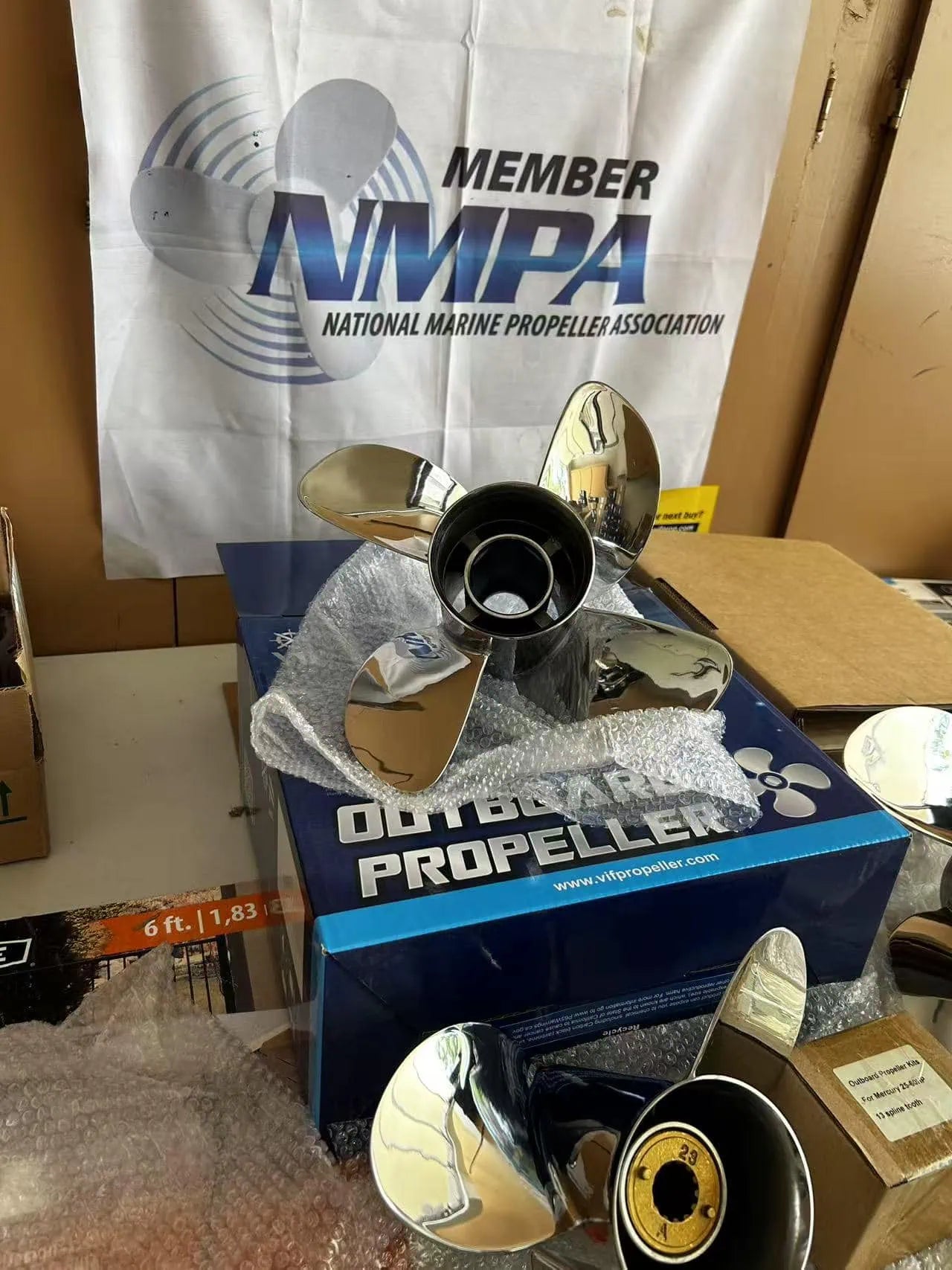
For a 4-blade low-pitch prop built for wake and hole-shot performance, vifpropellers.com is a solid starting point. Check their specs against your current setup to find the right match.
الخلاصة
Your prop is the smallest part on your boat — and the one decision that affects everything else on the water.
Get the pitch wrong, and your riders lose a clean hole shot before the rope even goes taut. Get it right — match blade count, diameter, and material to your boat and engine — and the difference shows fast. It’s immediate. You feel it in the first two seconds of every pull.
You don’t need a new boat. You don’t need a bigger engine. Most of the time, you just need the right wakeboard boat performance propeller spec’d for how you ride.
So here’s your next move:
-
Pull your current RPM numbers
-
Know your boat model
-
Use the selection framework in this guide to land on one prop — not five
Then head to vifpropellers.com, find your match, and stop leaving performance in the water.
Your riders have waited long enough.