
Choosing between a jet boat and a Propeller boat isn’t just a matter of preference — it’s a decision that shapes every hour you spend on the water. Get it right, and your boat feels built for what you love doing. Get it wrong, and you’re fighting your own equipment.
The differences run deeper than most buyers expect. Propulsion mechanics, shallow water capability, fuel burn, safety risks, and long-term ownership costs all tell very different stories. It depends on which system sits beneath your hull.
Shopping for your first boat? Or rethinking your current setup? This breakdown cuts through the noise. You’ll get the clarity to choose with confidence.
Content Framework: Differences Between Jet Boats And Propeller Boats
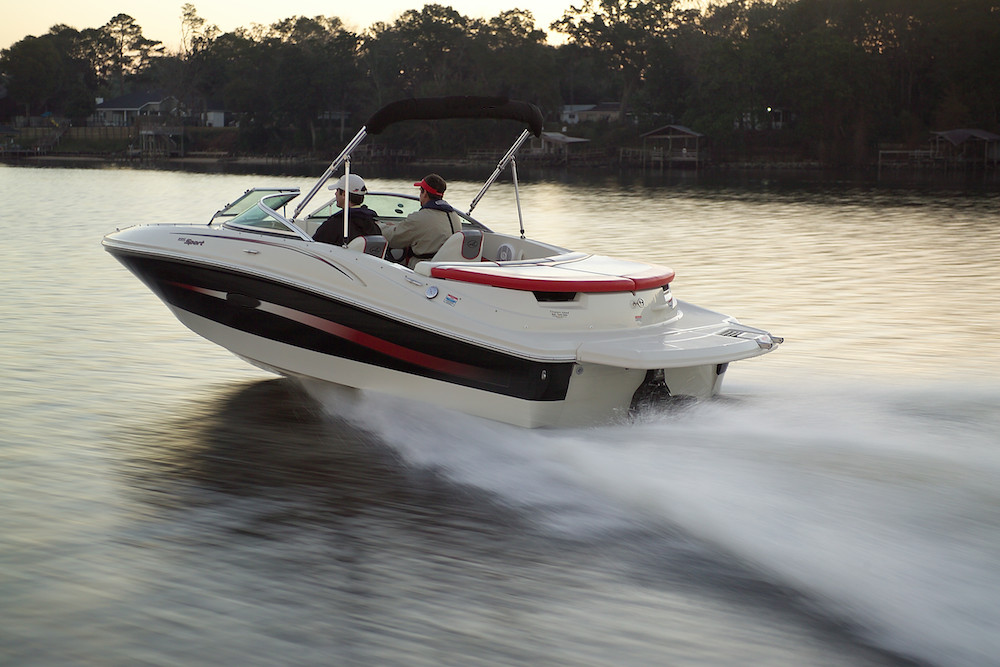
Two propulsion systems. Dozens of real-world trade-offs. Here’s how they compare.
This guide covers the core differences between jet boats and Propeller boats across six key areas:
-
Speed & Thrust — each system delivers power differently at various speed ranges. Jet drives pull ahead above 35 knots.
-
Shallow Water Performance — minimal hull draft vs. exposed outdrives. That gap determines where you can go and where you can’t.
-
Fuel Efficiency — Yamaha jet model data puts peak economy at 25–30 MPH. Go beyond that range and efficiency drops off noticeably.
-
Engine Power Absorption — a fixed-pitch propeller ties RPM directly to boat speed. A waterjet doesn’t. So you get instant full-power response on demand.
-
Overload Tolerance — propellers put engine strain at risk in rough seas. Jet drives hold constant output no matter the conditions.
-
Safety Profile — no exposed rotating prop on deck. That changes the picture for swimmers and shallow-water users.
Each section gives you the technical detail you need — no filler, no fluff.
How Jet Boats and Propeller Boats Work
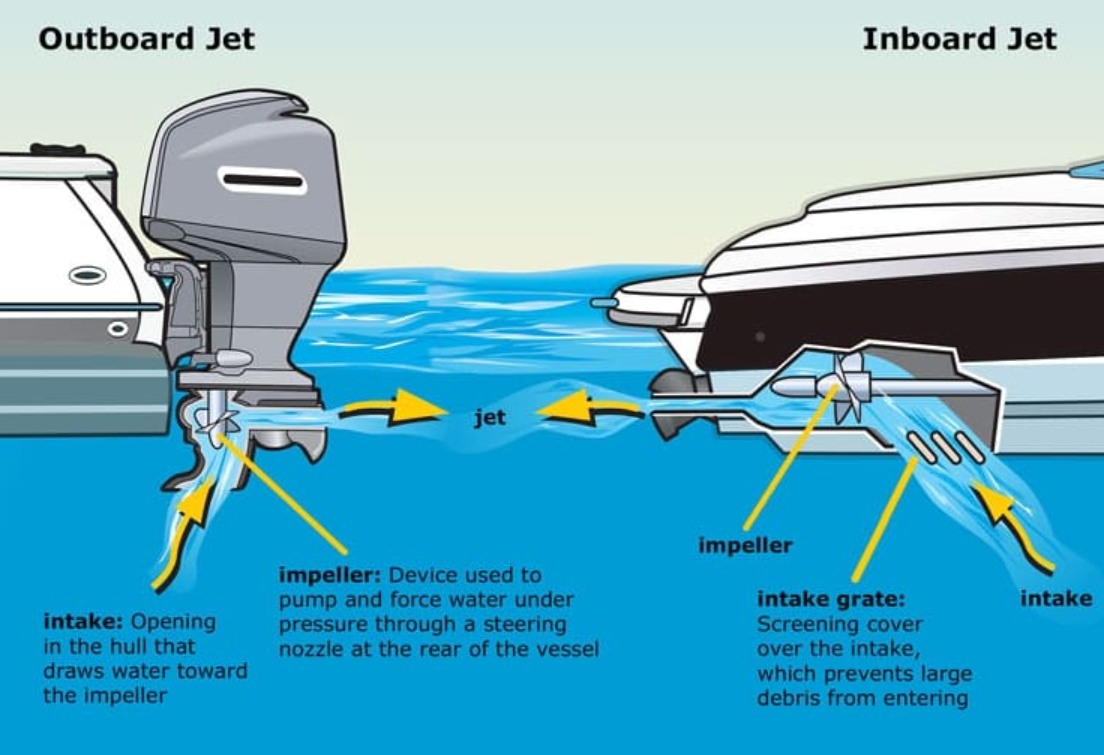
The engine is the same. The fuel is the same. But what happens after combustion — that’s where these two systems go in separate directions.
The Jet Boat: A Pump, Not a Propeller
A jet boat has no spinning blades under the hull. The engine drives an impeller housed inside a sealed pump. Water enters through an intake grate at the hull bottom. The pump compresses and speeds up that water. A stator straightens the flow. Then the water shoots out a rear nozzle at 20–30 mph. That stream pushes the boat forward — pure reaction force.
Steering works by deflecting the nozzle left or right, around 30–40°. To reverse, a diverter bucket drops over the nozzle and redirects thrust forward. Simple. Mechanical. Enclosed.
Draft? A few inches. Nothing sticks out below the hull.
The Propeller Boat: Blades and Pressure Differential
A propeller boat runs through a longer mechanical chain: engine → transmission → driveshaft → gearbox → prop shaft → propeller. The blades spin at 2,000 to 5,000 RPM. They pull from the front with low pressure and push from behind with high pressure. Newton’s third law, right there in action.
Steering comes from a rudder, an outboard’s swiveling unit, or a sterndrive that trims the thrust angle. To reverse, the transmission flips prop rotation. True neutral exists — the engine idles, the prop stops.
Where the Real Difference Lives
|
Jet Boat |
Propeller Boat |
|
|---|---|---|
|
Thrust path |
Engine → impeller → nozzle (always active above idle) |
Engine → transmission → prop (true neutral available) |
|
Efficiency |
20–30% less efficient |
30–50% better top speed at equal horsepower |
|
Draft |
Under 6 inches |
12–24+ inches |
|
Response |
Instant nozzle deflection |
Slight throttle-to-rudder lag |
The propeller boat wins on mechanical efficiency. The jet boat gives up some of that efficiency for a cleaner, better-protected setup — no exposed blades, no drivetrain hanging below the hull where it can get damaged.
Two different engineering approaches. Both get you across the water. But how they do it changes everything else about how each boat behaves.
Shallow Water Performance: Where Jet Boats Have a Clear Edge
Three inches of water. That’s all a jet boat needs to keep moving.
A prop boat in the same channel is already in trouble. Blades grind against silt, strike submerged logs, and pull up weeds. The Tracker 1448 with a 25hp jet tiller runs all day through shallow rivers where a conventional prop boat can’t go. That’s not marketing. That’s physics.
Why the Depth Gap Is So Significant
Jet boats run in 3–12 inches of water. They ride a self-generated pressure cushion beneath the hull. The intake grate sits flush. Nothing sticks out. Nothing snags. You can glide across mud flats, silt rivers, and rocky shallows that would stop a prop boat cold.
Prop boats need 12–24 inches minimum depth when loaded. In anything shallower, exposed blades hit bottom. One bad strike on a sandbar or submerged rock costs $1,500–$5,000+ in prop replacement. In shallow-water environments, multiple strikes per season are common.
The Scenarios That Settle the Debate
-
Steelhead and trout fishing on shallow mountain streams — jets reach the hidden holes; props don’t
-
Rocky or weed-choked rivers where prop damage is a near-certainty
-
Reef and sandbar navigation — jet boats glide over debris; prop boats snag
Models like the G3 CCJ (16–18ft, dry weight 830lbs, under $20K) are built for this kind of access. That’s their whole purpose.
Your regular route includes shallow water? The jet boat’s advantage isn’t small — it’s the deciding factor.
Speed and Handling: Which Propulsion System Performs Better on the Water
Raw speed is half the story. How a boat handles that speed matters just as much. Tight turns, crosswinds, low-speed docking, open-water tracking — these are where the real performance gap between jet and propeller systems shows up.
High-Speed Agility: Jets Pull Ahead
Above 30 knots, jet boats have a genuine edge. The nozzle-based steering system delivers 80–90° turns at full throttle. No cavitation loss. No blade stall. A propeller-driven boat at the same speed tops out at 30–45° turns before the blades lose grip on the water.
In practical terms? A 40-knot jet craft cuts a turning radius half that of an equivalent prop boat during S-curve maneuvers. That’s a big deal for racing, water sports, and high-speed river runs. The agility advantage is real and measurable.
Full-Speed Stability: Props Fight Back
Above 20 knots in crosswind conditions, propeller boats hold their line better. Jet boats show 10–15% yaw instability once crosswinds hit 15 knots. Side-force disrupts the intake flow, and the boat starts to wander.
Prop boats track straighter. They hold course with less helm correction. You spend more time steering where you want to go and less time chasing drift.
Low-Speed Docking: A Known Jet Weakness
Prop boats win here. Below 5 knots, jet thrust drops 50–70%. Reverse efficiency falls below 30%. Tight marina docking becomes a real struggle. Slow-speed zones are no easier.
Propeller boats — especially those with controllable pitch props — give you 2x better berthing precision at low speeds. Rudder feedback stays responsive even at idle. That makes a big difference in crowded harbors.
The Bottom Line on Performance
|
Condition |
Jet Boat |
Propeller Boat |
|---|---|---|
|
High-speed turns |
✅ 80–90° radius |
⚠️ 30–45° limited |
|
Crosswind tracking |
⚠️ 10–15% yaw drift |
✅ Stable |
|
Low-speed docking |
⚠️ Thrust drops 50–70% |
✅ Precise control |
|
Top speed (+30 knots) |
✅ +5–10% faster |
— |
No single system wins across every condition. Jets suit aggressive high-speed use. Props suit those who want solid, predictable control at every throttle position.
Fuel Efficiency and Running Costs: Propeller Boats vs Jet Boats
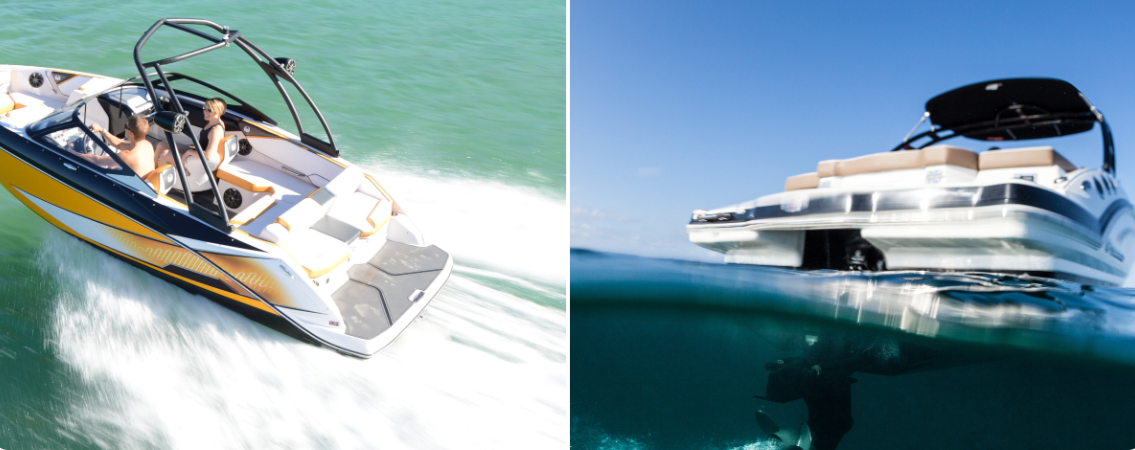
Fuel doesn’t lie. Over a full season on the water, the efficiency gap between these two systems hits you straight in the wallet.
Propeller boats turn engine torque into thrust more cleanly than jet systems. That’s not an opinion — it’s mechanical reality. A jet drive burns off 30% of its energy through pumping action and impeller friction before that force ever reaches the water. At low speeds, the penalty gets worse. Drop to 8 knots, and a prop boat holds pace at 1,500 RPM with ease. A jet has to work much harder just to keep up — and burns far more fuel doing it.
What the Numbers Look Like
The efficiency gap isn’t fixed — it shifts with speed and load.
-
Below 20 knots: Jets burn up to 50% more fuel than equivalent prop setups. Prop boats win here, and it’s not close.
-
Above 30 knots: The gap narrows. Jets get more competitive at higher speeds.
-
Long-distance cruising (100 hours at average consumption): A prop boat costs around $2,250–$3,000 in fuel. A jet boat runs $3,000–$4,500 for the same distance.
The Engine Size Trade-Off
Jets need bigger engines just to match prop-boat speeds. Closing that performance gap takes 30–50% more horsepower. More engine means more fuel, more wear, and bigger maintenance bills over time.
Prop systems are simpler and cheaper to service. They also reward steady, moderate cruising speeds. Spend most of your time fishing, cruising at a relaxed pace, or towing? The prop boat’s cost advantage grows with every hour on the water.
Safety Comparison: Swimmers, Lines, and On-Water Hazards
Propeller strikes send 3,000–4,000 people to emergency rooms across the United States every year. A large share of those incidents are fatal. This is most common when swimmers are in the water near an idling or moving boat.
This safety gap rarely comes up in boat comparisons. But it should.
The Exposed Propeller Problem
A spinning prop at the stern is an underwater blade running at 2,000–5,000 RPM. Swimmers, tubers, and people re-boarding the boat can’t always see it. Neither can the driver.
Jet boats cut this risk out completely. The impeller sits sealed inside the hull. There are no exposed rotating blades in the water. Industry data shows a 80–90% drop in propeller laceration risk compared to standard prop setups.
You swim off the boat. You tow water sports athletes. You operate around children. That 80–90% number matters a lot.
Line and Weed Entanglement
Fishing lines and aquatic weeds wrap around prop blades more often than most boaters expect. Prop entanglement accounts for 15–20% of on-water breakdowns. That leaves boats stranded mid-channel near active hazards.
Jet drives aren’t fully safe from this either. Debris clogs the impeller in about 5–10% of reported incidents. But clearing a clogged jet intake is much simpler than unwrapping a fouled prop shaft. Plus, the risk of engine stall is far lower.
|
Hazard |
Prop Boat |
Jet Boat |
Risk Reduction |
|---|---|---|---|
|
Swimmer blade strike |
High (exposed blades) |
None (internal impeller) |
80–90% |
|
Line/weed entanglement |
Wraps and stalls (15–20%) |
Clogs, easier to clear (5–10%) |
~50% lower severity |
For families, fishing guides, and watersports operators, the jet boat’s enclosed drivetrain is not a small bonus. It’s a real safety advantage. Propeller boats can’t offer the same level of protection.
Maintenance Differences: What Ownership Actually Costs
The bill doesn’t show up at the dealership. It doesn’t show up at the marina either. It shows up twelve months later — a repair quote you never planned for.
Jet boats and propeller boats age in different ways. That difference hits your wallet in very specific ways over time.
Jet Boats: Fewer Wear Points, But Specialized Repairs
The jet drive’s sealed impeller system has no exposed prop shaft, no cutlass bearing, no skeg to protect. Fewer external parts means fewer things break during normal use. Routine maintenance covers impeller inspection, wear ring replacement, and pump seal checks. That runs about $300–$600 per year under normal conditions.
The catch? If something does go wrong, the fix is not a simple one. Impeller replacements and pump rebuilds need trained technicians. Parts are not stocked at every marina. Labor costs add up fast.
Propeller Boats: Affordable Upkeep, More Frequent Fixes
Prop systems are easier to service. Any shop can handle the work. A standard propeller replacement runs $150–$800, depending on blade material and pitch. Annual drivetrain service — zincs, shaft seals, cutlass bearings — lands between $400–$900.
Shallow-water use changes that math fast. One sandbar strike can push the bill to $1,500–$5,000 in a single incident.
The Honest Long-Term Picture
|
Cost Category |
Jet Boat |
Propeller Boat |
|---|---|---|
|
Annual routine maintenance |
$300–$600 |
$400–$900 |
|
Collision/strike damage |
Low risk |
$1,500–$5,000+ per incident |
|
Parts availability |
Limited, specialized |
Available at most shops |
|
DIY repair potential |
Low |
High |
Your boating environment decides which system costs more. Deep-water boaters on calm lakes spend less keeping a prop setup running. Shallow-river and estuary users save a lot more over time running a jet.
Head-to-Head Comparison: Jet Boat vs Propeller Boat Across Key Dimensions
Six dimensions. One clear table. Every real difference between these two systems — laid out so you can use it.
|
Dimension |
Jet Boat |
Propeller Boat |
Winner |
|---|---|---|---|
|
Propulsion |
Impeller pump + steerable nozzle |
Prop + outdrive/rudder with trim |
Prop (trim control, simpler steering) |
|
Shallow Water |
Minimal draft — runs in inches |
Exposed prop needs 12–24″+ depth |
Jet |
|
Fuel Efficiency |
~3.3 mpg cruise; up to 52% worse below 20 knots |
~5.0 mpg cruise; stronger at low speeds |
Prop |
|
Speed & Acceleration |
0–25 mph fastest; top ~43.5 mph; 270° lock-to-lock turns |
Top ~49 mph; tracks better above 30 knots |
Jet (accel) / Prop (top speed) |
|
Safety |
No exposed blades — 80–90% lower strike risk |
Prop injury risk; handles debris better |
Jet |
|
Maintenance |
Simpler design; specialized parts are harder to find |
Prop strikes happen often but you can fix them anywhere |
Jet (design simplicity) |
A few details worth adding beyond the table:
-
Weight is not much of a factor — jet boats average ~2,180 lbs vs. outboard prop boats at ~2,120 lbs. Sterndrive setups are the heavy outlier at ~2,730 lbs.
-
Noise tilts toward prop boats. Jet systems run at higher RPM and produce more impeller cavitation noise.
-
Cost to convert favors prop outboards — the motor, steering, and reverse mechanism come as one integrated unit. That keeps the swap straightforward.
No single system wins every category. Jet boats lead on shallow water access and safety. Propeller boats take the edge on fuel efficiency, top speed, and ease of repair. The right pick comes down to where you boat — and how you use it.
Which Boat Is Right for You? Matching Propulsion to Your Use Case
The answer lives in your specific use case — not in spec sheets, and not in what worked for someone else.
Run through this:
You boat in shallow rivers, estuaries, or weed-choked backwaters. A jet boat is the clear answer. Nothing hangs below the hull. No blades grinding against rock. No $3,000 strike damage after one bad season. Your fishing spots sit in less than a foot of water? The choice is already made.
You cruise open lakes, cover long distances, or run offshore. A propeller boat is the right fit here. You get better fuel economy at cruising speeds. Top-end performance is stronger. Parts are available at any marina along the route. That fuel savings adds up over a full season.
You run mixed water — some shallow, some open. This is where the trade-off gets real. Think about how often shallow water access matters to you. Then weigh that against fuel costs over 100+ hours of use. One will matter more than the other — that’s your answer.
A quick decision framework:
|
Your Primary Use |
Right Choice |
|---|---|
|
Shallow rivers / backwater fishing |
Jet boat |
|
Open-water cruising / offshore |
Propeller boat |
|
Family watersports / swimming areas |
Jet boat |
|
Long-distance travel / fuel economy priority |
Propeller boat |
One final point: running a propeller setup means the prop spec itself carries real weight — diameter, pitch, and blade count all shape how well your engine transfers power to the water. Get that match right. That’s where the real performance gains are hiding.
FAQs: Jet Boat vs Propeller Boat
Still have questions? These are the ones that come up most often — answered straight.
Which is more fuel efficient: jet boat or propeller boat?
Propeller boats win, and it’s not close. Jet drives burn extra energy through pumping action and impeller friction before thrust ever hits the water. That loss adds up to 30–50% worse fuel consumption at low speeds. For long cruises, prop systems turn torque into thrust with far less waste. Over a full season, the fuel savings are very real.
Which handles shallow water better?
Jet boats, no contest. A few inches of depth is all they need. No blades hang below the hull. No strikes on submerged rocks. Propeller boats need real draft. In rivers under five feet with debris in the water, prop damage is almost guaranteed.
Which is faster?
Propeller boats hold the top-speed edge. At equal horsepower, jets tend to run slower at peak output. Jets do earn their respect in acceleration off the line. They also shine in shallow-water conditions where prop boats can’t run at speed at all.
Which is easier to maintain?
Propeller boats, by a wide margin. A blade replacement is a simple job — any marina can handle it. Jet pump rebuilds need special tools and trained techs. Parts are hard to find outside major service centers. A failure inside the pump housing means a big repair bill.
Can a jet boat be converted to propeller drive?
Yes, it’s possible. But it’s rarely worth the effort. Hull modifications, transom changes, and a full drivetrain swap all add up fast. The cost is serious, and the work takes a professional. Unless your boating needs have changed completely, stick with the system your hull was built around.
Are jet boats suitable for ocean use?
For coastal shallow areas — yes, they work great. For long offshore runs in rough seas? Propeller boats are the better choice. Jets lose ground on fuel efficiency and high-speed stability once you’re out of sheltered water.
Do jet boats hold up in saltwater?
Yes, but only with steady upkeep. Flush the system after every saltwater run. Check the impeller housing often for corrosion. Saltwater pulls in more debris, so keep the intake grate clear. Take care of it, and a marine jet drive handles saltwater without issue.
Conclusion
Both propulsion systems have earned their place on the water. Neither one beats the other in every situation. Jet boats shine on shallow rivers, in crowded swim zones, and anywhere raw adrenaline is the point. Propeller boats shine where fuel economy, open-water range, and easy maintenance matter most.
The real question was never which is better — it was always which is better for you.
Spend your weekends on skinny water? Tow kids on tubes? Run along unpredictable shorelines? Jet drive boat performance is built for that. Log serious miles across open lakes or offshore? A well-matched boat propeller setup stretches every gallon further and keeps maintenance costs steady.
You now have the full picture. The next step is straightforward: match the propulsion to your primary use case — not the hype.
Settled on a propeller boat? The propeller itself deserves the same careful attention as the hull. Pick the right one.