
Most boaters replace a worn-out Propeller with whatever looks close enough — same blade count, same rough size — then wonder why the boat feels sluggish off the plane or burns through fuel. Here’s the truth: propeller shape is not just a spec on a box. It’s the most powerful mechanical link between your engine’s output and the water moving your hull forward.
Get it right, and things fall into place. Acceleration sharpens. Top speed climbs. Fuel consumption drops. Get it wrong, and you lose real performance every time you leave the dock.
This guide breaks down what each shape variable does — propeller pitch, blade count, cup geometry, rake angle — and which combination works best for your boat and how you use it.
Content Framework: “What Is The Best Propeller Shape For A Boat?”
Propeller shape is a system of trade-offs. Know the framework, and you’ll read every spec sheet differently.
Every shape variable in this guide ties back to one core measurement: propeller efficiency. That’s thrust horsepower divided by propshaft horsepower. Mercury’s testing puts the ceiling at 80% efficiency under optimal conditions. Push outside the ideal slip range, and that number drops toward 70% — real power, gone.
Here are the variables that move that efficiency number the most:
-
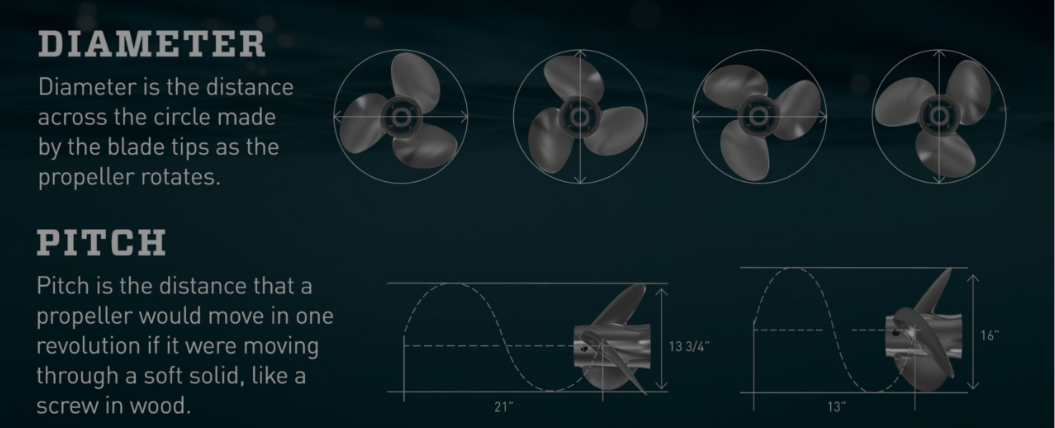
Pitch — how far the blade travels per revolution
-
Blade count — the balance between thrust distribution and efficiency loss
-
Cup geometry — how the trailing edge holds water under load
-
Rake angle — how blade angle affects planing and top-end behavior
-
Diameter — the foundation that limits every other adjustment
Each section breaks down one variable. You’ll see the performance impact and how it connects to a specific boat type or use case. By the end, you’re not guessing. You’re choosing.
What Makes a Propeller Shape “The Best”? (Framing the Real Question)
“Best” is the wrong word — until you define best for what.
A propeller built for a 40-mph bass boat will damage performance on a loaded pontoon running at displacement speed. The shape that wins on a race course burns extra fuel on a weekend tow run. There is no universal answer. Propeller efficiency is not a fixed number. It changes with boat weight, hull type, engine RPM range, load conditions, and how you use the water.
Most buyers miss this framing problem completely.
Efficiency depends on the mission. The real question isn’t “which propeller is best?” It’s “best at doing what, on which boat, under which conditions?” Anchor the question that way, and every shape variable — pitch, blade count, cup, rake — stops being abstract. Each one becomes a specific lever you either use right or get wrong.
A few things hold true across all designs:
-
No single shape works best in all conditions. A shape tuned for peak efficiency at one speed loses ground the moment conditions change.
-
Shape variables compete with each other. More blades cut vibration but add drag. Higher rake helps with planing but can reduce low-end thrust.
-
The goal is matching trade-offs to your use case — not chasing a spec that looks good on paper.
That’s the lens this guide uses throughout. Each section measures “better” against a specific outcome — speed, fuel economy, load capacity, or handling — not against some theoretical ideal.
Propeller Blade Count: 3-Blade vs 4-Blade vs 5-Blade Shapes
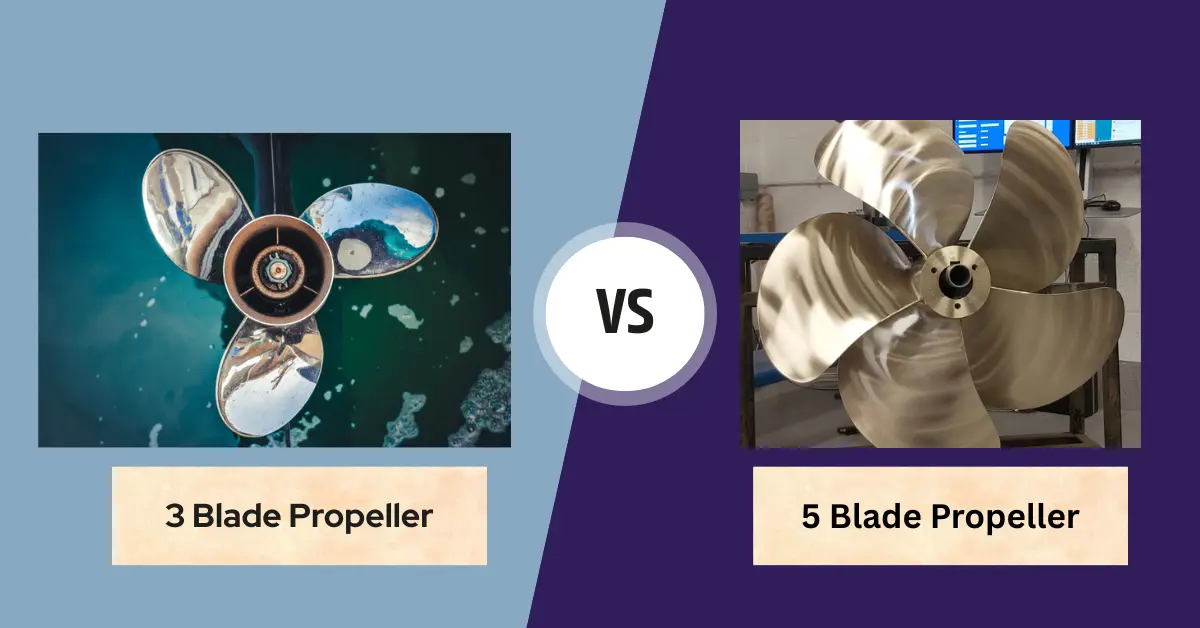
Blade count is what most boaters argue about — and few truly understand.
The debate tends to collapse into “3-blade is faster, 4-blade is smoother.” That’s partially true, but it misses most of what matters. The real story sits in four areas: thrust, drag, vibration, and power absorption. Add a blade, and all four shift.
What the Numbers Show
Three-blade designs produce the strongest thrust relative to their drag. Controlled testing puts 3-blade propellers at 0.5 Nm of thrust force at constant RPM. Four-blade designs land just behind at 0.49 Nm — not a massive drop, but a real one. Extra blade area adds drag faster than it adds thrust. So every blade you add costs you some power.
Here’s the core trade-off, stripped down:
|
3-Blade |
4-Blade |
5-Blade |
|
|---|---|---|---|
|
Top speed |
Highest |
Moderate |
Lower |
|
Acceleration |
Good |
Better |
Best |
|
Vibration |
Noticeable |
Reduced |
Smoothest |
|
Fuel efficiency |
High |
Moderate |
Lower |
|
Best for |
Speed, light loads |
All-around use |
Heavy loads, comfort |
Where Each Blade Count Wins
3-blade propellers are the default for good reason. They run well across a wide RPM range, bleed less energy to drag, and give you clean top-end speed. For performance boats and lighter hulls, this is the right starting point most of the time.
4-blade propellers pull more power without needing a larger diameter. You get a better hole shot, stronger output with a loaded boat, and far less vibration at cruise. On longer runs, that vibration difference is real and noticeable.
5-blade propellers lower blade tip speed and spread thrust more evenly across the prop. That cuts noise and smooths the ride on heavier displacement vessels. The cost is real too: more weight, more drag, and less raw efficiency.
More blades isn’t better. It’s just a different set of trade-offs built for a different use case.
Propeller Pitch Explained: How Blade Angle Shapes Your Performance
Pitch is the number most boaters quote and fewest truly understand.
Here’s the simple definition: pitch is the theoretical distance a propeller moves forward in one full revolution. A 21-inch pitch prop should travel 21 inches through the water per turn. That blade angle gets measured at 75% of the distance from hub to tip. That’s the spot where water forces best reflect real-world performance.
That angle is doing more work than most people realize.
High Pitch vs. Low Pitch: The Real Trade-Off
Higher pitch means more top-end speed. The data is specific: at 4,000 RPM, moving from an 18.5-inch pitch to a 20-inch pitch adds close to 2 knots. Push to 21.5 inches, and you hit 30 knots. The gains are real — but so is the cost. Higher pitch puts more load on your engine. Acceleration slows down. Getting the hull up on plane takes longer.
Drop the pitch, and the whole dynamic flips. Throttle response sharpens. Hole shot improves. Heavy loads and rough water become manageable. Top speed takes the hit instead.
The RPM Rule That Keeps You Calibrated
Every 1-inch change in pitch shifts your wide-open-throttle RPM by 150 to 200 RPM — in the opposite direction. Add pitch, RPM drops. Remove pitch, RPM climbs. Two inches moves close to 400 RPM.
This gives you a practical diagnostic tool:
-
Record your current WOT RPM under normal load
-
Compare it against your engine’s specified RPM ceiling
-
Running above spec? You’re under-pitched — increase by 1–2 inches
-
Running below spec? You’re over-pitched — drop pitch to recover RPM
Why Your Prop Never Hits Its Theoretical Number
This is where propeller slip comes in. Slip is the gap between theoretical travel distance (pitch × RPM) and your actual boat speed — shown as a percentage. In the real world, slip runs at about 20%.
The formula: prop pitch = [velocity × gear ratio × 1,056] / [RPM × (1 − slip)]
Run those numbers for a 50-mph target at 5,500 RPM with a 2:1 gear ratio and 20% slip — you land on a 24-inch pitch. On paper, that prop should cover more ground. In practice, hull drag, wave action, and water turbulence push actual slip toward 10–30%. The spec sheet never accounts for real water conditions.
Pitch sets the ceiling. Slip decides how close you get to it.
Cupped Propeller Blades: The Shape Upgrade Most Boaters Overlook
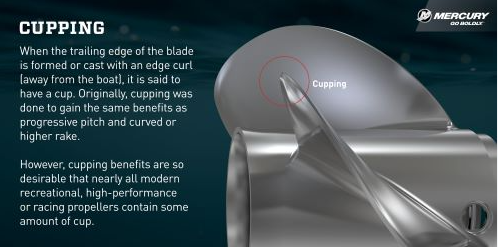
Run your finger along a propeller blade from the leading edge to the trailing edge. On a cupped blade, you’ll feel it — a deliberate curve bending toward the pressure face at the very end. That small bend is doing serious hydrodynamic work.
Cupping adds camber to the blade profile. The curved trailing edge holds grip on the water at high trim angles and in aerated, turbulent conditions. Flat blades lose their bite in those same conditions. Cupped props resist cavitation for exactly this reason.
The Pitch Math You Need to Know
Here’s the catch: cup acts like added pitch. A standard cup adds 1–2 inches of effective pitch to your blade. Switching from a flat-blade prop? Drop your nominal pitch by 1–2 inches to keep your engine in its correct RPM range. Skip this step, and you’ll overload the motor.
The RPM impact is real and measurable. Cupping cuts WOT RPM by around 200 RPM — the same effect you’d see from a 1-inch pitch increase.
Where Cup Pays Off
The gains are speed-dependent:
-
Above 34 mph: Cupped blades deliver up to 5–10% better top-end speed on 3-blade setups
-
Cruising efficiency: Same speed at lower RPM. That means real fuel savings on longer runs to fishing grounds
-
Cavitation-prone setups: High trim angles, aerated water, stern-drive configurations — cup holds blade grip where flat blades fail
Below 30–34 mph, the advantage fades. Trolling speeds? Flat blades are the smarter choice.
One hard limit worth knowing: too much cup can crack the trailing edge. A bend that’s too aggressive or an edge that’s too thin will give out under load. Match cup intensity to your actual application — more isn’t always better.
Propeller Diameter: Why Bigger Isn’t Always Better
Diameter is the foundation. Every other shape variable adjusts within the limits it sets.
Larger diameter has a physics advantage. Thrust scales with swept area. Swept area grows with the square of diameter. A wider blade circle moves more water mass per revolution — that’s how propellers generate strong thrust. At low disc loading — the ratio of power to swept area — efficiency climbs toward 85–90%. Compress that area, and efficiency drops toward 40%.
But here’s where boaters get into trouble. Every 1-inch increase in diameter drops your WOT RPM by 100 RPM. Past 35 knots, the drag penalty from a larger disc eats the efficiency gains whole.
Match diameter to your actual use case:
|
Application |
Diameter Choice |
Why |
|---|---|---|
|
High-speed (>35 knots) |
Smaller |
Lower drag at speed |
|
Towing / acceleration |
Larger |
Maximum thrust at low RPM |
|
Slow cruising / efficiency |
Larger |
Low disc loading, peak η |
One constraint overrides everything: hull clearance. You need a minimum 5/8″–3/4″ between blade tip and hull at full tilt. Go below that, and cavitation risk jumps fast. Air bubbles collapse against the blade, erode the material, and kill thrust at the same time.
Bigger diameter buys efficiency. Until it doesn’t. Know which side of that line your boat lives on.
Rake Angle and Blade Geometry: The Advanced Shape Variables
Rake angle is the variable most boaters never touch. That’s why it separates average performance from dialed-in performance.
Rake describes how much the blade tilts forward or backward from the hub’s vertical plane. A blade standing straight up has zero rake. Tilt it toward the stern, and you have positive (aft) rake. This measurement changes how the blade contacts water during planing. The effects are immediate and physical.
What Rake Does to Your Boat
Higher rake angles push the blade tips outward and away from the hull. That geometry lifts the bow during acceleration. It also holds performance steady at high trim angles — the conditions where flat-profile blades start losing grip. On performance boats running aggressive trim, high rake propellers keep their bite where low-rake designs cavitate and slip.
The trade-off is straightforward: high rake reduces low-end thrust. At displacement speeds, you’re giving up efficiency.
Rake by use case:
-
High-speed planing hulls → High rake (20°+): better bow lift, cleaner water exit
-
Tow boats / loaded cruisers → Low to moderate rake: maximum thrust off the line
-
General recreation → Mid-range rake: balanced across speed and load conditions
Blade geometry — the full profile including skew, camber, and chord shape — builds on these effects. Skewed blades enter the water in stages rather than all at once. This cuts down on pressure spikes and blade slap, two common propeller cavitation triggers. Cambered sections generate lift even at low angles of attack. Together, these variables decide how well a blade turns rotational energy into forward thrust across your real operating range.
Best Propeller Shape by Boat Type: Scenario-Based Recommendations
Every variable in this guide — pitch, blade count, cup, rake, diameter — means nothing in isolation. Each one matters once you tie it to a specific boat doing a specific job.
Here’s how the right shape breaks down by use case.
Performance & Speed Boats
The goal is simple: maximize your WOT RPM ceiling and cut drag everywhere possible. A 3-blade, small-diameter, high-pitch setup with cup and moderate rake is the right call here. Pitch-to-diameter ratios can push toward 2.0. Cup holds bite at high trim angles. The combination works in practice — cleaver-style props on a 42-foot catamaran with twin 600 hp outboards hit 122 mph at 33-inch pitch. Top speed is the target. This geometry gets you there.
Fishing Boats & Workboats
Working boats don’t chase speed. They haul gear, push through chop, and carry heavy loads. Go with 4- to 5-blade props, large diameter, low-to-mid pitch — ratios around 0.6 for loaded hulls — plus high rake for durability under variable thrust conditions. Blade tip clearance also matters. Keep it at 15–30% from hull and skeg to avoid boundary layer interference. Bollard pull is the number that counts, not top speed.
Leisure Cruisers & Pontoon Boats
Cruising is about the long run. A 3- to 4-blade cupped prop at mid-pitch keeps fuel consumption in check and holds vibration low at sustained speeds. Heavier cabin cruisers lean toward 4-blade. You get better low-speed control and more stability with a full passenger and gear load.
Wakeboard & Tow Boats
Quick acceleration off the line beats everything else here. 4-blade props at 14.5 inches diameter or larger, with moderate pitch, deliver the hole shot tow sports demand. Five-blade variants take it further — smoother vibration and stronger grip through the water for extreme-HP setups.
|
Boat Type |
Blades |
Pitch/Diameter Priority |
Primary Gain |
|---|---|---|---|
|
Performance |
3 |
High pitch, small dia. |
Top speed ceiling |
|
Fishing / Work |
4–5 |
Low-mid pitch, large dia. |
Maximum bollard thrust |
|
Cruiser / Pontoon |
3–4 |
Mid pitch, cupped |
Fuel efficiency, smooth ride |
|
Tow / Wakeboard |
4–5 |
Moderate pitch, large dia. |
Hole shot, acceleration |
A shape that wins on one boat can hurt performance on another. Match the geometry to the mission — that’s the spec that matters.
How to Choose the Right Propeller Shape for Your Boat (Step-by-Step)
Five decisions. That’s all that stands between a prop that transforms your boat and one that drains your wallet every time you leave the dock.
Step 1: Match shaft bore first. Start with your engine specs and shaft bore — 1″, 1-1/8″, or 1-1/4″, tapered or splined for inboards. Shafts don’t swap between engines. Wrong bore means wrong prop. Full stop.
Step 2: Write down what’s on your boat right now. Note the diameter, pitch, blade count, rotation direction, and material. Right-hand clockwise is standard. Left-hand props run in counter-rotating pairs. Aluminum is easy to repair and won’t break the budget. Stainless gives you better speed and faster acceleration. Know what you have before deciding what you need.
Step 3: Check your WOT RPM. Run at full throttle under normal load. Look up your engine’s RPM range in the owner’s manual. Aim for the midpoint — not the top, not the bottom.
Step 4: Name your priority. Top speed needs small diameter and maximum pitch. A strong hole shot needs low pitch and large diameter. Comparing a 3-blade and 4-blade at the same pitch? The 4-blade drops RPM by 50–100. That’s the trade — better planing, more load capacity, smoother rough-water performance.
Step 5: Adjust and retest. Each 1-inch pitch change moves WOT RPM by 150–200. RPM running 800 low? Pull 4 inches of pitch. Cupped blades add effective pitch and reduce slip. Drop nominal pitch 1–2 inches after switching from flat blades.
Two red flags to keep in mind: An over-pitched prop stops the engine from hitting its RPM range under load. An under-pitched prop blows right past it. Both are problems you can measure — and fix.
Test before you commit. Prop swap systems like Solas Rubex make back-to-back testing fast and easy. Log WOT RPM, hole shot time, and fuel burn at cruise. The numbers show you what the spec sheet never will.
Conclusion
The best propeller shape isn’t a universal answer — it’s a personal one.
Your boat, your engine, your water conditions, your habits behind the wheel — these variables matter more than any single spec on a product page. You may have settled on a cupped 4-blade for cleaner hole shots. Or maybe a high-rake 3-blade fits your top-end speed goals better. Either way, the right choice is the one built around how you use your boat.
Here’s what to take away:
-
Propeller pitch — get it right, and you save fuel
-
Blade geometry — choose it with purpose, and you cut out a lot of frustration
-
The right match for your use case — this alone can turn a good day on the water into a great one
Don’t guess. Test, compare, and talk to people who live and breathe this stuff.
Ready to find your perfect match? Browse the full propeller lineup at vifpropellers.com. Use the selection guide to narrow it down to your ideal shape in minutes.
The right propeller doesn’t just move your boat. It changes the entire ride.