
Replacing a damaged Prop or pushing for that extra knot of top-end speed — the wrong Honda outboard Propeller costs you more than money. It hurts your performance on the water. It burns extra fuel at the dock. And it wastes time you won’t get back.
Here’s the real challenge: Honda’s engine lineup runs from the whisper-quiet BF2.3 all the way up to the hard-working BF150. The gap between a well-matched propeller and a close-but-wrong one isn’t always clear — not until you’re already out on the water.
This guide covers what you need to know: materials, pitch, diameter, blade count, and model-by-model compatibility. Use it to make one solid decision and get back on the water with confidence.
Content Framework: Honda Outboard Propellers – Buying Guide 2026

Five decisions determine whether your Honda outboard propeller performs or disappoints — and most buyers think about just one of them.
This guide covers all five. Here’s what each section includes and why it matters:
-
Material Selection — Plastic works for 2–2.5 HP. Aluminum handles up to 40 HP and flexes on impact instead of shattering. Stainless steel lasts longer at higher horsepower, but repairs cost more after a hard hit.
-
Blade Count & Surface Area — 3-Blade props hit higher top speeds. 4-blade props are standard on most Honda outboards. They push more thrust through smaller blades, but still cover the same surface area overall.
-
Spline Compatibility — Honda BF25/30 needs a 10-tooth spline. Honda 40 HP (2010+ and 95+ models) needs 13 splines. Get the number wrong and the prop won’t mount — simple as that.
-
Pitch & Diameter Sizing — Diameter goes up with horsepower. Pitch is calculated based on hull type, boat weight, and what you want the boat to do. There’s no guessing here.
-
Model-by-Model Recommendations — From BF2.3 to BF150, each engine section lists specific specs, compatible SKUs, and real-world use cases.
Work through each section in order, or jump straight to your engine’s horsepower range.
What Makes a Honda Outboard Propeller Different (And Why It Matters)
Honda’s four-stroke engines don’t behave like other outboards — and their propellers reflect that.
Every genuine Honda outboard propeller is built to zmatch a specific torque curve, gear ratio, and RPM range. That’s not marketing talk. A propeller that “fits” your engine can still silently wreck your fuel economy, your hole shot, and your lower unit bearings.
Here’s what most buyers miss: a 1-inch change in pitch shifts your engine RPM by 300–400 RPM. Go too high on pitch and you’re lugging the engine. Heat builds. Carbon accumulates. Wear speeds up. Go too low and the engine over-revs before it reaches cruising speed.
Generic aftermarket propellers are built for broad compatibility. They don’t account for Honda’s model-specific gear ratios, harmonic balance needs, or the asymmetric blade design that puts forward thrust first. That precision gap is where your performance disappears.
-
Wrong pitch = higher temps, more wear, worse fuel economy
-
Generic fit = no match for Honda’s gear ratios or blade geometry
-
One inch of pitch = 300–400 RPM difference at the engine
The bottom line: fit matters more than price.
Propeller Materials Compared: Plastic vs Aluminum vs Stainless Steel for Honda Engines
Three materials. Very different results. And the one most Honda owners pick by default isn’t always the right call.
Here’s the breakdown:
Plastic works from BF2 through BF20. It’s cheap ($30–$80), lightweight, and forgiving at low speeds. Above 15 HP, though, it flexes under load, shatters on rocks, and leaves your gearcase wide open. It also breaks down fast. Budget for a replacement every 1–2 seasons.
Aluminum is the sweet spot for BF40 through BF75. It bends on impact instead of snapping — and that flex is intentional. An aluminum blade that strikes concrete or rocks absorbs the hit and sacrifices itself. Your Honda lower unit stays safe from a $500–$2,000 repair bill. The tradeoff? Thicker blades create drag. At wide-open throttle, a 19-pitch aluminum prop can slip 2–3 inches. That drops your RPMs from 5,500 to around 5,200.
Stainless steel is for BF75 and above — full stop. Rigid blades hold pitch at 5,000+ RPM. You get a real-world 7% speed gain (think 42 mph → 45 mph) and 11% better fuel efficiency under load. The catch: SS weighs twice as much as aluminum. That extra weight hurts your hole shot on smaller engines. Plus, the rigidity sends impact force straight into your lower unit instead of soaking it up.
Which Material Matches Your Honda Engine?
|
Material |
Best HP Range |
Price |
Lifespan |
Annual Cost |
|---|---|---|---|---|
|
Plastic |
BF2–BF20 |
$30–$80 |
1–2 yrs |
$15–$40/yr |
|
Aluminum |
BF40–BF75 |
$80–$250 |
2–5 yrs |
$16–$50/yr |
|
Stainless Steel |
BF75+ |
$250–$600+ |
5–10+ yrs |
$25–$120/yr |
The math is straightforward. Run a BF115 or BF150 on a center console at speed? Stainless steel pays for itself. Running a BF50 on shallow, rocky flats? Aluminum’s sacrificial protection beats stainless steel’s speed advantage — every time.
3-Blade vs 4-Blade Honda Propellers: Choosing by Use Case
Blade count is the most misunderstood spec in propeller selection. Get it wrong, and your performance suffers in ways that are hard to pin down — you’d never suspect the prop.
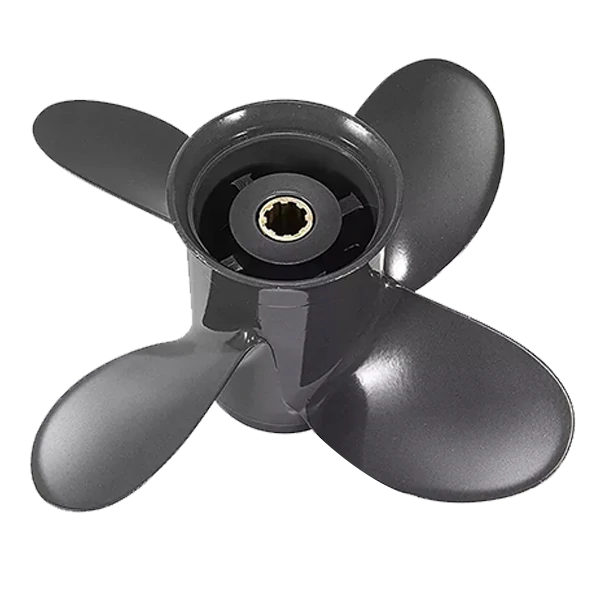
Here’s the core trade-off: 3-Blade props deliver 1–5% higher top speed with less drag at WOT. 4-blade props get you on plane 30–40% faster. You feel that difference right away on loaded center consoles and pontoons.
Where 4-Blade Wins
-
Fishing & trolling: Holds plane at 3,000 RPM. Less vibration. Better grip in chop.
-
Waterskiing: Superior hole shot. That 30–40% planing advantage is real and noticeable.
-
Rough offshore water: Prop slip drops from 15% (3-blade) to 10% (4-blade). Turns are smoother, and ventilation is reduced.
-
Heavy loads: Live wells, gear, passengers — 4-blade pushes loaded hulls where 3-blade falls short.
One critical adjustment: Switch to a 4-blade and you need to drop 2 inches of pitch or 1 inch of diameter. This keeps your Honda in its WOT RPM range (5,000–6,000).
Where 3-Blade Wins
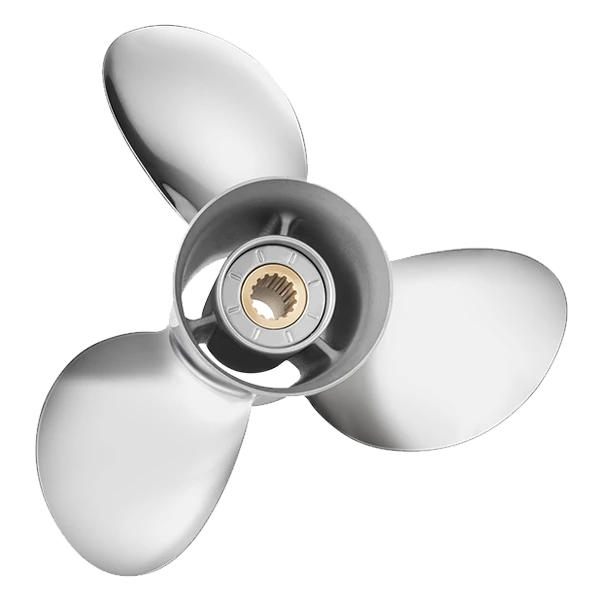
Light hull. Speed-focused. Running wide open on flat water. That’s where 3-blade earns its place. Less drag, a higher RPM ceiling, and better fuel efficiency above 4,500 RPM.
Honda BF115 and BF150 owners running light recreational boats get the most out of 3-blade stainless steel at speed. It stays the top performance pick in those conditions.
Bottom line: Match blade count to what you actually do on the water — not what came stock on the engine.
Understanding Pitch and Diameter: The Two Numbers That Control Everything
Every Honda outboard propeller has two numbers stamped on it. Most buyers glance at them and move on. That’s a mistake.
Take a prop marked 14 x 19. The first number is diameter — 14 inches across the full blade arc. The second is pitch — 19 inches of theoretical forward travel per revolution. These two numbers shape your acceleration, your top speed, your fuel burn, and how hard your engine works.

Pitch is the number that moves your RPM.
Drop pitch by 2 inches — say from 23 to 21 — and your WOT RPM climbs about 400 revolutions. A lower pitch keeps the engine in its power band. A higher pitch can cause the engine to lug on acceleration. Think of it like bicycle gears. Low pitch is the easy gear — it spins fast off the line. High pitch is the hard gear — it carries speed once you’re already moving.
|
What You Want |
What To Do |
|---|---|
|
Faster hole-shot |
Lower pitch |
|
Higher top speed |
Higher pitch |
|
More thrust & push |
Larger diameter |
|
Less drag at speed |
Smaller diameter |
Diameter controls thrust and drag.
Larger diameter moves more water. That gives you raw pushing power and better efficiency at slower speeds. Smaller diameter cuts drag. High-speed hulls running 35+ knots need that drag reduction to perform. For most Honda outboard applications — fishing boats, recreational cruisers, pontoons — larger diameter delivers better efficiency overall.
One more thing: actual forward movement is always less than nominal pitch. Water isn’t a solid surface. Slip is real, and it cuts into that theoretical number every revolution.
There is one right pitch-and-diameter combination for your engine, hull, and load. Get both numbers right, and everything else falls into place.
Honda Propeller Compatibility by Engine Model: Complete Specs Reference
Spline count kills more prop purchases than anything else — and most buyers check it last.

Before diameter. Before pitch. Before blade count. Know your spline count. Mount the wrong hub configuration and the prop won’t fit. That means a return shipping label, a lost week, and a missed weekend on the water.
Here’s the Honda spline breakdown by engine model:
|
Spline Count |
Engine Models |
|---|---|
|
10-tooth |
BF25, BF30 |
|
13-tooth |
BF35 HP (1991–94), BF45 HP (1991–94) |
|
15-tooth |
BF115D, BF135–150 (2004+), BF200–250 4-stroke (2002+) |
Confirm that number before anything else moves.
Year Ranges Matter More Than You Think
Honda changed hardware across model generations. Compatibility doesn’t follow horsepower logic. The BF75–90 splits into two categories based on year alone:
-
BF75–90 (through 1998): Requires Flo-Torq II hardware kit 835277Q1
-
BF75–90 (1999 & newer): Requires kit 835279Q2
-
BF115–130 (all years): Also uses kit 835279Q2 — bought as a separate purchase
These kits don’t swap out. Get your engine year wrong and you’re buying hardware twice.
Hub System Warnings
There’s a common trap for BF75–150 owners: Masterguard and Mastertorque hub systems do not work with Michigan Wheel XHS propellers. The fitment looks close. It isn’t. Check your hub system before ordering any aftermarket prop in this horsepower range.
Quick Lookup by HP Class
2–2.5 HP (BF2D, BF2.3D): 3-blade plastic. Pin Drive hub. No alternatives needed at this power level.
7.5–10 HP (BF7.5, BF8, BF100): Pin Drive hub system. Pitch options are tight — two choices, 9½ inch and 8⅝ inch. Don’t count on much flexibility here.
Mid-range (BF25–BF75): Aluminum is the standard choice. Running in rocky water? Aluminum’s impact flex shields your lower unit from damage. Pontoon builds in this range work best with the 4-blade 13.8 x 13 RH configuration, rated for 24–27 MPH.
Not sure what fits? Cross-reference with Honda’s Marine Propeller Calculator or the Solas Prop Finder tool. Both pull compatibility data straight from your engine’s model number and cut out the guesswork.
Top Honda Outboard Propeller Options: OEM vs Aftermarket Brands
Three Honda OEM prop lines cover 90% of what most owners need. Pick the right one for your engine, and you skip a lot of expensive trial and error.
Honda HR Titan (3 & 4-blade aluminum) handles 40–150 HP. It’s built for heavy loads with a high-thrust design. A typical example: 11⅞” × 9″ pitch (PN 58134-ZV5-009AH) runs about $110. Simple, reliable, and does the job well.
Honda OFS 4-Blade is the go-to pick for pontoon and multi-engine setups in the 50–130 HP range. You get a better hole shot than the 3-blade, plus more torque off the line. Pricing sits between $100–$150 — close to what Solas equivalents cost.
Honda OFX Sabre-X is the performance option. Stainless construction, speed-focused blade geometry, fits Honda 50 HP and up. A 12¼” × 9″ version (PN 58133-ZV5-009AH) retails at $183.89.
Here’s something most buyers miss: Honda OEM props are manufactured by Solas. That matters. A Solas aftermarket prop often gives you the same casting at a lower price.
OEM vs Aftermarket: Where the Real Differences Are
|
Brand |
Material |
Price |
Notable Advantage |
|---|---|---|---|
|
VIF Marine |
Stainless/Aluminum |
$90–$220 |
Hub kits included, ISO 9001, ≤0.5g balance, 12% fuel gain |
|
Solas |
Aluminum |
$100–$250 |
Direct OEM equivalent, Honda-specific hubs |
|
Michigan Wheel |
Bronze/Stainless |
$180–$600+ |
ISO-484/2 certified, commercial-grade 100 HP+ |
|
Turning Point |
Aluminum/Stainless |
$100–$300 |
~25% below OEM pricing, outperforms OEM in user testing |
The quality gap between OEM and premium aftermarket has closed. VIF Marine and Michigan Wheel both carry ISO 9001/484-2 certifications with ≤0.5g blade balance tolerance. That matches factory OEM standards at about 40% less cost.
The practical breakdown:
-
Go OEM for commercial or fleet operations where warranty documentation is non-negotiable. It’s predictable, certified, and easy to defend on paper.
-
Go aftermarket for recreational use — and that covers about 90% of Honda outboard owners. At ≤125 HP, an aluminum aftermarket prop from Solas or VIF gives you 25%+ savings and documented 12% fuel efficiency gains over standard replacements.
-
At 125 HP and above, or under heavy commercial load, step up to Michigan Wheel or a precision stainless option. The drivetrain repair cost justifies the higher price tag.
One rule makes this simple: HP ≤125 → aluminum aftermarket. It bends on impact and protects your lower unit. HP >125 or heavy load → OEM-equivalent stainless. The extra rigidity is worth it at that power level.
How to Choose the Right Honda Outboard Propeller: 5-Step Decision Process
Five steps. That’s all that stands between a well-matched Honda outboard propeller and one that drains your RPMs, fuel, and performance every time you leave the dock.

Work through each step in order.
Step 1: Lock Down Your Engine Specs and WOT RPM
Start with your exact Honda model code, year, and horsepower — not a rough guess. A BF40 from 2010 onward runs a 13-spline shaft. An older model doesn’t. That one detail changes your entire prop selection.
Then get on the water with a tachometer. Run your loaded boat at full throttle and record your WOT RPM. Target range for most Honda outboards: 5,000–6,000 RPM. Outside that band? Your current prop is already working against you.
Step 2: Calculate Your Prop Slip Rate
Here’s the formula:
Slip % = (Theoretical Speed − Actual GPS Speed) ÷ Theoretical Speed × 100
Theoretical speed (mph) = (RPM × Pitch) ÷ (1,056 × Gear Ratio)
Real-world example: 5,500 RPM, 17-inch pitch, 2:1 gear ratio — theoretical speed sits at 35 mph. Your GPS reads 30 mph. That’s 14% slip. It falls inside the acceptable 10–20% window. Above 20% and your prop is undersized for the load.
Honda gear ratios run 2.00:1 to 2.33:1, depending on model. Check your owner’s manual for the exact number.
Step 3: Match Blade Count and Material to Your Boat’s Weight
Dry weight drives this decision more than horsepower does.
-
Under 2,000 lbs: 3-blade props give you the speed-to-thrust balance you need
-
3,000 lbs and above: 4-blade props give you a stronger hole shot and handle heavier loads without straining the drivetrain
-
Material: Aluminum for engines under 40 HP or rocky, shallow water. Plastic for BF2–BF2.5 only. Stainless for high-speed or heavy-use applications above 75 HP
Step 4: Fine-Tune Pitch and Diameter
Every 2 inches of pitch shift moves your WOT RPM by about 400 revolutions. Engine over-revving? Add pitch. Lugging below the power band? Drop pitch.
Diameter goes up with horsepower. A Honda 40 HP runs a 13–14 inch diameter. Running a twin-engine setup? The second engine needs left-hand counter-rotation. Standard single-engine builds use right-hand (clockwise) rotation.
For towing or heavy loads, go with a larger diameter and a 4-blade with 10–15° rake. For top-end speed on flat water, choose a smaller diameter 3-blade with lower pitch.
Step 5: Validate With Honda’s Propeller Calculator — Then Test on Water
Honda’s official Propeller Calculator takes your hull type, engine model, boat length, dry weight, and performance goal. It then gives you specific prop recommendations — for example, a 3-blade aluminum 13×17 for a BF40 on a 1,500 lb hull targeting speed balance.
Use that output as your shortlist. Then take it to your dealer.
Request a prop demo before you buy. Most dealers will let you borrow 2–3 pitch options for an on-water test. Run each one at WOT. Log your RPM, GPS speed, and calculated slip. The right prop lands your RPM within ±300 of the target band with slip between 10–20%.
This one step cuts the 30% mismatch rate that comes from ordering on assumptions alone. Buy the best match — and keep a spare aluminum prop on board at all times.
Propeller Performance for Specific Use Cases: Fishing, Cruising, Water Sports
What you do on the water determines which prop belongs on your Honda — full stop.
No single propeller maxes out acceleration, top speed, and trolling stability at the same time. Optimize for one, and you give something up elsewhere. Here’s what that looks like across three real use cases.
Fishing
Trolling stability at 2–5 mph matters more than raw speed at a fishing spot. Go with a low-to-mid pitch aluminum prop (12–21 inches). Low pitch tightens your hole shot, cuts engine load in rough water, and gives you solid reverse thrust. That reverse matters when you need to reposition around structure fast.
For heavier offshore fishing builds, go with a 4-blade in the 12–16 inch pitch range. It delivers the acceleration and load handling you need. Top speed is secondary. Maneuverability and trolling control take priority.
Cruising
Higher pitch earns its keep here. More pitch per revolution means your Honda runs at lower RPM at cruise. You get less wear, better fuel economy, and a quieter ride over long distances. Target 5,200–5,800 RPM at WOT. Go too high on pitch and you lose planing ability. Too low and you’re over-revving and burning fuel you don’t need to burn.
On 27+ foot cruisers or twin-engine setups, a large-diameter low-pitch 4-blade handles heavy loads and rough offshore water. Your fuel bill stays reasonable too.
Water Sports
Skiers and wakeboarders need one thing right away: the boat on plane right now. Drop your pitch 1–3 inches below your speed prop and go with a larger diameter 4-blade. You get faster planing, better low-speed grip, and a hole shot that pulls a skier up clean.
Skip 3-blade props here. The acceleration gap is real — and in towed water sports, that delay costs you every single run.
|
Use Case |
Blades |
Pitch Range |
Primary Gain |
Key Trade-off |
|---|---|---|---|---|
|
Fishing |
3–4 |
12–21 in. |
Trolling stability, hole shot, reverse thrust |
Lower top speed |
|
Cruising |
3–4 |
19+ in. |
Fuel efficiency, lower RPM, mid-range speed |
Slower off-the-line |
|
Water Sports |
4 |
2–3 in. below speed prop |
Hole shot, planing speed, grip |
Reduced top speed |
The rule that applies across all three: prop for your heaviest expected load. An undersized prop lugs your Honda engine, builds heat, and cuts its lifespan fast. It’s one of the worst things you can do to your motor.
Frequently Asked Questions: Honda Outboard Propeller Selection
Buyers ask the same questions every season — and getting the answers wrong costs real money.
What do the two numbers on a Honda outboard propeller mean?
Those two numbers are your diameter and pitch. A prop marked 12.25 × 10 measures 12.25 inches across the full blade arc. The second number — 10 — is the theoretical forward travel per revolution, in inches. You’ll find both numbers stamped right on the prop hub.
How much does pitch affect my RPM?
Each 1-inch pitch change shifts your WOT RPM by ±200 revolutions. Your engine over-revving at full throttle? Go up in pitch. Hitting the rev limiter before you hit top speed? Drop pitch. It’s a simple rule — but skipping it has real consequences.
How do I find my Honda’s spline count?
This is the spec that kills more prop orders than any other. Most Honda 95+ models use 13 splines — but that shifts by horsepower and build year. Check your exact spline count before you order anything. One wrong number and the prop won’t fit.
Does boat weight matter for prop selection?
Yes — it matters a lot. Honda’s propeller calculator needs your boat’s dry weight (between 300–14,000 lbs) to give you accurate prop recommendations. Pull that figure from your manufacturer’s spec sheet. Also, leave the outboard’s own weight out of that number.
Aluminum or stainless — which should I repair after a rock strike?
Dinged aluminum? Cheap to replace. Just swap it out and move on. Damaged stainless? That repair bill gets expensive fast — even though stainless holds up better in normal conditions. On rocky flats, aluminum’s ability to flex and absorb impact still wins the cost argument. Replace it cheap, replace it often.
Conclusion
Picking the right Honda outboard propeller isn’t complicated. But the wrong choice costs you money, performance, and a lot of frustration on the water.
Here’s what matters most:
-
Match your spline count and hub configuration to your exact engine model
-
Choose stainless steel for hard running, or aluminum to keep costs down
-
Dial in your pitch to hit the WOT sweet spot between 5,500–6,000 RPM
Get those three things right, and you’ll feel the difference on your first run.
Every spec table, material comparison, and brand breakdown in this guide has one goal — put the right prop under your hull the first time. No trial and error. No costly mistakes.
Ready to choose? Browse VIF’s full lineup of Honda 4-stroke outboard propellers, filtered by engine model, pitch, and use case. No guesswork. No returns. Just more time on the water, doing what you came to do.