
Ordered the wrong Propeller for your MerCruiser sterndrive? You’re not alone — and it’s one of the most frustrating (and expensive) mistakes a boat owner can make.
The confusion between the Alpha One and Alpha Two goes deeper than most people expect. These two drives have different spline counts, different gear ratios, and a Propeller compatibility gap that makes parts non-interchangeable. You can’t just swap props between them.

This guide cuts straight to what matters:
-
Not sure what’s mounted on your transom? You’ll know after reading this.
-
Shopping for a replacement Prop? Skip the guesswork with a clear compatibility breakdown.
-
Wondering if an Alpha drive upgrade is worth it? We cover that too.
By the end, you’ll know which drive you have, which propeller fits it, and which version suits how you use your boat.
What This Guide Covers — And Why It’s Built for You
Most comparison articles about Alpha drives bury the information you need under layers of generic filler. This one doesn’t.
This guide is built around the five real reasons boat owners search “Alpha 1 vs Alpha 2”. Each section answers one specific, practical question:
-
Instant identification — Year ranges, visual cues, and nameplate locations. Confirm your drive before buying anything.
-
Spec-by-spec comparison — Spline counts, gear ratios, horsepower ranges, and production timelines. All laid out side by side.
-
Performance & reliability — Where the Alpha Two improves on its predecessor. Plus, where the gap is smaller than you’d expect.
-
Propeller compatibility — A straight reference that matches your MerCruiser Alpha drive to the right VIF Propellers product. No guesswork needed.
-
Upgrade analysis — Whether swapping from Alpha Gen 1 to Gen 2 is worth the cost for your specific use case.
-
FAQ — Fast answers to the questions dealers skip or don’t explain well.
Use this as your sterndrive field guide. It’s built for real decisions, not just casual reading.
How to Tell Alpha 1 and Alpha 2 Apart (Quick Visual ID Guide)
Here’s the truth: most boat owners have been staring at the answer the whole time — it’s mounted right there on their transom.
The MerCruiser Alpha drive made a major generational change in 1991. That single year is your fastest starting point.

-
Alpha One (Gen 1): Produced from 1983 to 1990
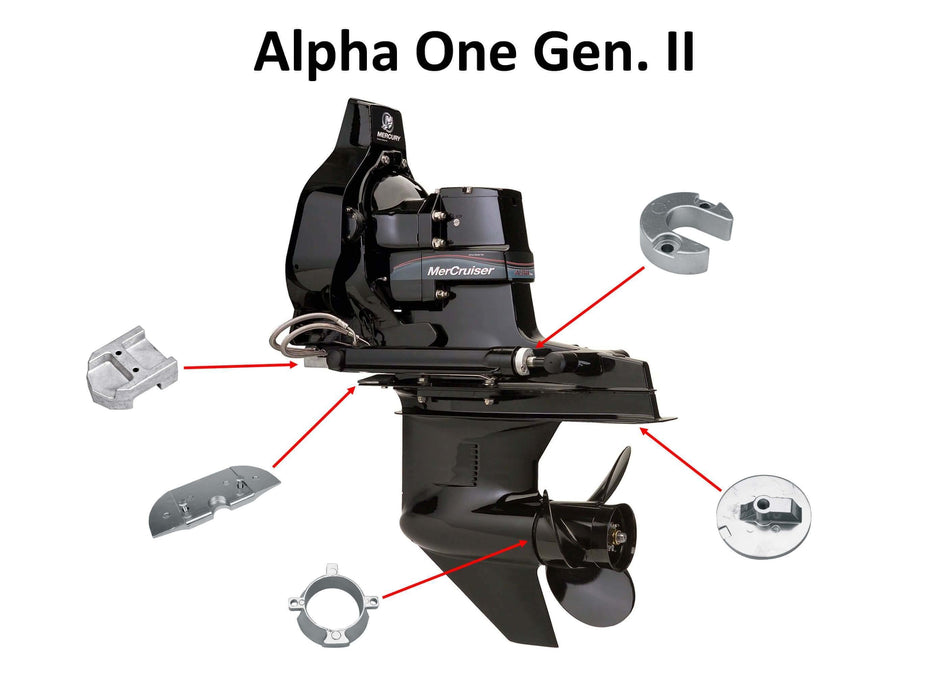
-
Alpha Two (Gen 2): Produced from 1991 onward
Know your boat’s model year? You’re already halfway there.
Read the Drive Itself
Year alone doesn’t always cut it — used boats and replaced drives can throw you off. Go straight to the hardware instead.
Look at the lower unit profile. This is the most reliable visual tell:
-
Alpha One has a straight-cut, vertical lower unit design — clean lines running parallel to the drive shaft
-
Alpha Two has a swept-back, slant-cut lower unit — the nose angles backward, giving it a more aggressive profile
Check the trim ram pivot point. On the Alpha Gen 1, the trim ram sits in a different position. The Alpha Gen 2 moves that pivot point further back. This set-back placement was built for better trimming geometry.
Examine the shift lever. The shift lever design changed between generations. It’s another fast visual confirmation — useful when the lower unit profile alone isn’t enough to call it.
Find the Nameplate
Every MerCruiser Alpha drive carries a serial number plate. Find it on the upper drive housing, port side. Run that serial number against MerCruiser’s production records. It confirms the generation with no guesswork.
Bottom line: Lower unit shape + production year + serial number. Check all three and you’ll have a solid ID in under five minutes.
Alpha 1 vs Alpha 2: Core Specs Compared Side by Side
Numbers tell the story that visual inspections can’t finish.
Confirm which drive sits on your transom first. Then the spec differences between these two generations make sense — and so does why ordering the wrong propeller means a guaranteed return trip to the marine store.
Here’s everything laid out side by side:
|
Specification |
Alpha One (Gen 1) |
Alpha Two (Gen 2) |
|---|---|---|
|
Production Years |
1983 – 1990 |
1991 – Present |
|
Propeller Spline Count |
13-spline shaft |
15-spline shaft |
|
Gear Ratio Options |
1.84:1 / 1.98:1 / 2.20:1 |
1.81:1 / 1.98:1 / 2.20:1 |
|
Compatible HP Range |
Up to ~260 HP |
Up to ~350 HP |
|
Lower Unit Design |
Vertical, straight-cut nose |
Swept-back, slant-cut nose |
|
Upper Drive Housing |
Smaller diameter |
Larger diameter |
|
Shift Lever Design |
Gen 1 configuration |
Redesigned Gen 2 configuration |
|
Trim Ram Pivot |
Forward position |
Set-back position |
Why These Numbers Matter
The spline count difference is the one spec that ends every conversation. Alpha One runs a 13-spline propeller shaft. Alpha Two runs a 15-spline shaft. These two numbers don’t mix. A Prop cut for one will not seat on the other. Full stop.
The gear ratio options overlap between generations. Don’t let that fool you. The ratio numbers may match on paper, but the drive unit housing dimensions are different. Alpha Two carries a larger upper drive shaft housing. That size gap means Gen 1 and Gen 2 internal components can’t be swapped or substituted. Keep that in mind before you chase partial upgrades or used replacement parts.
The horsepower ceiling matters too. Alpha Two’s reinforced build handles engines up to 350 HP, while Alpha One tops out at ~260 HP. Running a higher-output engine? Gen 2 isn’t just the better pick — it’s the only one that fits the job.
The takeaway: Spline count and housing dimensions are your two non-negotiables. Everything else is context. Get these two right before you order anything.
Propeller Compatibility: Alpha 1 vs Alpha 2 — What You Must Know Before Buying
Here’s something that catches almost every boat owner off guard: both the Alpha One and Alpha Two use a 15-spline propeller shaft. Same count. Same number. But they are not the same drive — and that difference matters far more than the spline number alone.
Get the full picture before you add anything to your cart.
The Spline Story (And Why It’s Not the Whole Story)
Yes, both generations share a 15-spline shaft standard. But shared spline count doesn’t mean shared everything. Gear ratios differ between generations. Those differences change how your prop performs under load.
-
Alpha Gen 1: Gear ratio of 1.94:1 or 1.47:1
-
Alpha Gen 2: Standard 2.0:1 (1998+), 1.94:1 (1995–1997), 1.98:1 (pre-1995)
A prop that runs great on a Gen 2 at 2.0:1 can leave you disappointed on a Gen 1 running 1.47:1. Same splines. Very different behavior on the water.
Quick Compatibility Reference
|
Drive Version |
Recommended Props |
|---|---|
|
Alpha Gen 1 |
Michigan Wheel VIF 48-650 series (14×19, 15-spline RH); Turning Point Hustler TPH-04 (3-Blade, 15-spline) |
|
Alpha Gen 2 |
Solas Amita 4 1413 series (14.5″ dia., 15-spline); PowerTech OFX (4-blade, 14×17–21 pitch) |
|
Both Generations |
Solas Rubex HR (14×19, aluminum, 15-spline) |
Your Pre-Purchase Verification Checklist
Go through each item below before placing any propeller order:
-
Confirm serial number — Gen 1 ends before #0D469858 (pre-1991); Gen 2 is 1991 onward
-
Count the splines — Both show 15; that’s expected
-
Check above the prop shaft — Gen 1 has two studs with nuts; Gen 2 has none. That’s your fastest physical tell
-
Verify the gear ratio stamp on the drive housing — it tells you which pitch range makes sense for your setup
-
Don’t assume the boat year matches the drive — used boats get swapped drives. A 1989 hull can carry a Gen 2. Check the transom plate to be sure
One detail that trips people up: Gen 1 trim cylinder pads are narrower; Gen 2 pads are wider. It’s a small difference, but easy to spot once you know what to look for.
The bottom line is simple. Same spline count means your prop will fit either drive. But fit isn’t the same as optimized. Match your prop to your specific gear ratio, your engine’s HP output, and how you use the boat — not just to a spline number that happens to line up.
Performance & Reliability: Does Alpha 2 Outperform Alpha 1?
Let’s settle this with facts, not marketing language.
The Alpha Two is better than the Alpha One — but not in a dramatic, night-and-day way. Mercury delivered a set of smart, targeted refinements with Gen 2. Each one fixes a specific weakness in the original design. Put them together, and the picture becomes clear.

The Engine Room: What Changed
Gear ratio is where it starts. The Alpha Gen 1 ran a 1.94:1 or 1.47:1 ratio. The Alpha Gen 2 standardized at 2.0:1. That shift isn’t a radical change. It’s a precise adjustment that gives you smoother power delivery across a wider speed range. You feel it most at mid-throttle — which is where most recreational boating takes place.
Fuel efficiency got better too. Gen 2’s lower unit design cuts drag and improves how well the drive pushes the boat. The upgraded water pump adds to that gain. You won’t notice a huge difference at the fuel dock. But over a full season, the savings add up.
Oil capacity tells a quiet story. Gen 1 holds 32 oz. Gen 2 holds 38 oz. Six extra ounces of gear oil means better lubrication under heavy load. That matters on long summer runs or when you’re putting consistent hours on the drive.
Where Reliability Separates the Two Generations
This is where the Alpha Two earns its reputation.
U-joints and bellows. Gen 2 uses stronger U-joints and tougher bellows. They last longer — full stop. Alpha One owners know the pattern well. Seals and gears wear out faster. Repair bills stack up. The drive ends up out of the water more than it should be.
Water pump placement is a bigger deal than it sounds. On the Gen 1, the water pump sits in the upper unit. Getting to it takes time and effort. On the Gen 2, it moves to the lower unit. That makes it easier to reach, faster to service, and less likely to cause unplanned downtime. The Gen 2 impeller is also larger and built tougher. In rough conditions, a failing impeller causes serious problems fast — so that upgrade matters.
Seal protection improved where it counts most. The Gen 2 upper gear case uses a better sealing design. A seal failure no longer puts the driven gear at risk. That’s a real engineering upgrade. It cuts the chance of a major, costly breakdown.
Corrosion resistance takes another step forward. Saltwater boaters feel this the most. Gen 2’s corrosion protection extends part life in ways Gen 1 can’t match. Over time, that gap gets wider.
The Honest Assessment
A small group in the marine community still backs the Alpha One as the better drive. That view exists, and it’s worth noting. But most of the industry disagrees — and for solid reasons.
The Alpha Two wins on:
– Fuel efficiency through a drag-reduced lower unit design
– Part lifespan — U-joints, bellows, and impeller all last longer
– Easier maintenance and faster service access
– Seal protection that guards the drive even after a failure
– Corrosion resistance in saltwater and tough environments
Gen 2 doesn’t deliver a revolution. It won’t turn a slow boat into a fast one. The performance gains are measurable but incremental. These are steady improvements built around reliability and efficiency — not raw speed.
A well-maintained Gen 1 drive matched to an engine under 260 HP still does its job. No question. But heavy hours, saltwater exposure, or a growing repair bill changes that equation. Gen 2’s durability advantages build on each other over time. You spend less time at the mechanic. Your long-term maintenance costs drop. You get more time on the water.
Bottom line: The Alpha Two is the better drive — not because it’s faster, but because it breaks down less, costs less to maintain, and holds up across a wider range of conditions.
Should You Upgrade from Alpha 1 to Alpha 2? A Cost-Benefit Breakdown
The answer is real — but it comes down to how you use your boat.
Upgrading from Alpha Gen 1 to Gen 2 is not a plug-and-play swap. At minimum, you need a bellhousing swap. Your existing transom cutout may need minor changes too. That said, nothing close to what a full Bravo conversion demands. Get a marine mechanic to look at your specific setup before you budget anything.
What It Costs to Make the Switch
The drive unit alone runs:
-
Mercury Quicksilver Alpha Gen 2 sterndrive: $2,000+
-
MerCruiser OEM Alpha Gen 2 sterndrive: $3,800+
Add bellhousing work and any transom reinforcement your engine needs. The total cost adds up fast.
Where Gen 2 Pays You Back
That upfront number hurts less once you look at what Gen 2 saves over time:
-
Fuel efficiency gets a clear boost on long runs — drag reduction and better propulsion work together on every trip
-
U-joints, bellows, and impeller are all built tougher. You get longer gaps between repairs
-
Oil capacity jumps from 32 oz to 38 oz — better lubrication under heavy load, less wear over time
-
The shift mechanism is redesigned — gear changes feel smoother and more precise, with fewer mechanical problems
-
More gear ratio options give you flexibility across different throttle demands
For water skiing or towing, the Gen 2’s redesigned gear ratio gives you stronger acceleration. Gen 1 can’t keep up on that front.
The Honest Verdict
|
Factor |
Alpha Gen 1 |
Alpha Gen 2 |
|---|---|---|
|
Upfront Cost |
Lower |
$2,000–$3,800+ |
|
Fuel Efficiency |
Standard |
Improved |
|
Component Durability |
More frequent repairs |
Longer service life |
|
Shift Mechanism |
Original mechanical |
Refined and smoother |
|
Long-Term Maintenance |
Higher ongoing costs |
Lower over time |
Upgrade makes sense if your Gen 1 shows corrosion damage, you’re putting in serious hours, or fuel economy matters on longer trips.
Skip the upgrade if your Gen 1 runs clean, your use is light, or the budget isn’t there right now. A solid Gen 1 paired to an engine under 260 HP still holds its own on the water.
Alpha 1 vs Alpha 2: Which Is Right for Your Boat?

The drive on your transom does more than move your boat. It decides how much you’ll spend on upkeep every single year.
Here’s how to pick the right generation for your setup:
Choose Alpha Gen 1 if:
– You boat only in freshwater
– Your engine runs under 200 HP
– Annual use stays below 50 hours
– Your repair bills sit under $800/year
Choose Alpha Gen 2 if:
– You run in saltwater (Gen 2’s corrosion-resistant alloys last twice as long)
– Your boat is over 25 feet or handles heavy loads
– You put in 100+ hours per season
– Fuel savings and smoother shifting matter on longer trips
The saltwater line is non-negotiable. Put Gen 1 in salt water and you’re looking at $500–$1,500 in corrosion repairs every year. Gen 2 drops that maintenance cost by about 30%. It pays for itself within two seasons.
Before ordering a propeller, run your drive generation, HP output, and boat length through the VIF Propellers selector. A part that fits isn’t always a part that performs. The right match covers both.
FAQ: Alpha 1 vs Alpha 2 Common Questions Answered
These five questions pop up in Alpha drive forums, marina docks, and marine parts stores all the time. Here are straight answers.
Can I swap propellers between Alpha 1 and Alpha 2?
No. The output shaft and spline setups are different between the two generations. Alpha 1 props are cut for the older shaft spec. Alpha 2 takes newer-profile props. Spline counts may look the same on paper, but the gear ratios are different. A prop built for one generation will run poorly on the other. Check your exact year and gear ratio before you order.
How do I identify my drive generation by the shift lever?
Alpha 1 has a brass-style lever. Alpha 2 has a plastic or composite lever. They don’t cross-fit — so this is one of the quickest checks you can do without any tools.
Is Alpha 2 more reliable?
Yes. It has better sealing, a stronger gear system, and supports engines up to 300 HP. Alpha 1 handles older, lower-output engines just fine. Alpha 2 cuts oil leak risk and holds up better through heavy use hours.
Are Alpha 1 parts still available?
Yes — through OEM suppliers and the secondary market. Expect to pay $50–$500 depending on the part. Gearboxes, seals, and prop shafts are all out there.
Do both drives use the same gear oil?
Both take Quicksilver High Performance Gear Lube (75W-90 synthetic). Change it every 100 hours or once a year. Capacity runs 2.0–2.5 quarts. One thing to know: Alpha 1 setups may need an extra quart for the bellhousing. Alpha 2’s better seals still need visual checks between service intervals — do those more often.
Conclusion
Here’s the bottom line: knowing whether you’re running an Alpha 1 or Alpha 2 isn’t just trivia. It’s the difference between a propeller that fits and one that collects dust.
Chasing down the right replacement prop? Weighing up a sterndrive upgrade? Or just trying to figure out what’s hanging off the back of your boat? Your drive unit shapes every decision that follows. Alpha 2 brought real refinements to the MerCruiser Alpha drive lineup. But Alpha 1 remains a proven, well-supported workhorse that still delivers for countless boaters today.
The smarter move isn’t always the newer model. It’s the right model, matched with the right propeller for your specific setup.
Ready to lock in the perfect prop? Browse VIF Propellers’ full range of Alpha One and Alpha Two propeller options. Find your exact fit — no guesswork, no expensive mistakes, just more time on the water doing what you love.