
There’s a moment every pontoon boat owner knows. You’ve got the throttle pushed forward. You’re expecting that satisfying surge of speed — and instead you get… this. A polite, unhurried glide across the water while the ski boat next to you disappears into the horizon. Frustrating? Yes. But here’s the thing: a slow pontoon isn’t a permanent condition. It’s a diagnosis waiting to happen.
The speed you’re leaving on the water comes down to a fixable set of factors — engine trim angles, propeller pitch, dead weight, and hull dynamics. Most owners are losing performance from two or three of these at once without knowing it.
This guide breaks down every meaningful speed upgrade. Some cost nothing. Others require a serious conversation with your wallet. Either way, you’ll stop guessing and start going faster.
Content Framework: “How Do I Get More Speed Out Of My Pontoon Boat?”
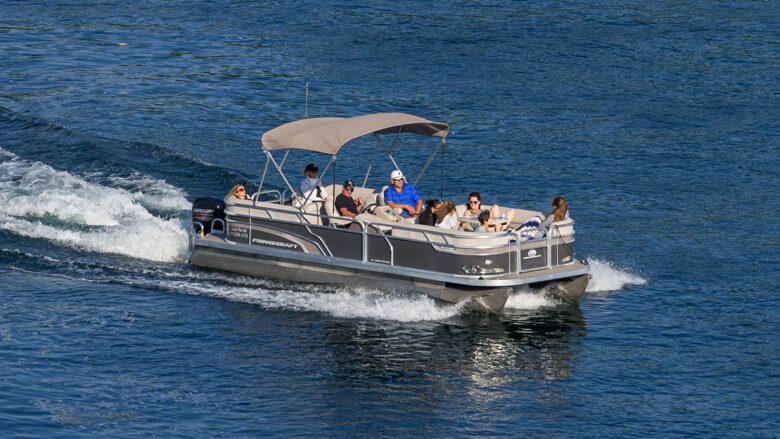
Speed on a pontoon boat is not one problem. It’s a stack of problems — and the stack looks different every time.
A 22-foot G3 Suncatcher with 115 hp hits 31 mph solo. Load it with 11 people and that same boat, same engine, same water — drops to 22 mph. That’s not a malfunction. That’s physics doing what physics does. Know why before you spend a dollar on upgrades.
Here’s the honest map of what this guide covers:
-
Engine power and trim — the obvious lever most owners under-use
-
Propeller selection — the single highest-ROI upgrade for most boats
-
Weight management — free speed hiding in plain sight
-
Hull configuration — why tritoons exist, and what they really change
-
Add-ons — lifting strakes, trim tabs, and the very real bimini effect
Two-tube standard pontoons top out around 40 mph. Tritoons push 45–60 mph. Everything in between comes down to the choices above. Some you can make right now. Others need a bigger commitment.
Pick your bottleneck. That’s where we start.
What’s Really Limiting Your Pontoon Boat Speed (And How to Diagnose It)

Four things kill pontoon boat speed. Just four. Most underperforming boats are being held back by at least two of them at once — that’s why spending money on one upgrade so often lets people down.
Here they are, ranked by how often they’re the real culprit:
1. Not enough engine horsepower. The math here is blunt. 50 HP gets you ~16 MPH. 100 HP gets you ~22 MPH. 150 HP gets you ~30 MPH. 300 HP gets you ~45 MPH. Your target speed needs more power than your engine produces? Nothing else on this list will fix that.
2. A mismatched propeller. Wrong pitch or diameter means your engine’s power goes to waste. This is the highest-ROI fixable problem on most boats. A well-matched prop can recover 5–10 MPH that’s being lost right now.
3. Too much weight. A 22-foot pontoon doing 29 MPH empty drops to 25 MPH with five or six adults aboard. Push the total load to 4,000 lbs and you’re down to 22 MPH. At 6,000 lbs? 10 MPH. Weight doesn’t ease off your speed — it crushes it.
4. Maintenance neglect. A fouled hull, dirty engine, or uneven weight distribution can eat 10–20% of your performance. Bow-heavy loading alone costs 5+ MPH.
Run This Diagnostic Before Spending Anything
Take 30 minutes and do this before buying a single upgrade:
-
Check your RPM at wide-open throttle. Most outboards are rated for 5,000–6,000 RPM at WOT. Hitting 4,200? Your prop pitch is too high. Spinning past 6,200? It’s too low. Either way, you’re losing speed — and risking engine damage on top of it.
-
Test on calm water, empty boat, GPS speed. This gives you your true baseline. Compare it against the benchmark table below.
-
Inspect your prop. Look for dings and erosion. Check the pitch spec against your HP rating. For 100+ HP engines, aim for 19–23″ pitch.
-
Measure your load vs. manufacturer capacity. Most owners run over capacity without knowing it. Check this number — it matters more than most people think.
Your Benchmark: Are You Actually Slow, or Just Expecting Too Much?
|
Engine HP |
Boat Weight |
Empty Top Speed |
Loaded (5–6 Adults) |
Tritoon Max |
|---|---|---|---|---|
|
40–50 HP |
~2,000 lbs |
15–16 MPH |
12–14 MPH |
N/A |
|
90–100 HP |
3,000–4,000 lbs |
22–30 MPH |
18–25 MPH |
30–35 MPH |
|
150 HP |
4,000–5,000 lbs |
~30 MPH |
~25 MPH |
~40 MPH |
|
200+ HP |
5,000–6,000 lbs |
35–45 MPH |
28–35 MPH |
45–50 MPH |
|
300 HP |
6,000+ lbs |
~45 MPH |
35–40 MPH |
50–60 MPH |
Your numbers are close to the benchmarks for your setup? Your boat is fine — your expectations just need a reset. Your numbers fall well below the benchmarks? You’ve pinpointed which of the four problems is the culprit. That’s where we go next.
Fix #1: Master Engine Trim (Free — Do This First)
Most pontoon owners have a trim button on their throttle that they’ve pressed maybe twice. That’s a problem. That little button might be the cheapest performance upgrade in boating history. It costs nothing. It takes 30 seconds. And a wrong trim angle can silently steal 5+ MPH from you — with no warning signs at all.
Here’s what’s happening under the hood. Trim adjusts the angle of your propeller shaft — anywhere from 0 to 20 degrees — which changes how your boat sits on the water. Tilt the engine up (positive trim) and the bow rises, hull drag drops, and your top speed climbs. Tilt it down (negative trim) and the bow digs in. You get aggressive bite off the line, but a sluggish top speed at cruise.
The Three-Step Trim Sequence
Step 1: Start trimmed all the way down. Deep propeller engagement gives you maximum bite during acceleration. This is where you want to be at idle and launch.
Step 2: Trim up as you get on plane. Once you’re moving, adjust upward in small steps. You’re looking for the angle where the bow lifts just enough to cut drag without losing propeller grip.
Step 3: Find your sweet spot and lock it in. Watch your GPS speed — not how it feels. A sloppy trim angle vs. the right one can mean 3–5 MPH on the same engine, same conditions, same fuel tank. That gap is real.
Your dashboard trim gauge shows motor position at a glance. Use it — no need to twist around and look. Running a Mercury 40 HP or above? The Mercury Active Trim System handles this whole process for you. It adjusts based on speed and conditions in real time, so the guesswork disappears.
Quick distinction worth knowing: Trim (0–20°) is your performance tool. Tilt (0–90°) is for clearing the prop in shallow water or at the dock. Don’t mix them up — they serve different purposes.
Fix the trim first. Then see if you still have a speed problem.
Fix #2: Reduce and Redistribute Weight for Better Planing
Weight is silent. It doesn’t announce itself. It just sits there — coolers, anchors, that extra fuel can, five adults each with their own dry bag — spread across your deck. And it kills your top speed without a sound.
Here’s the physics, plain and simple: every extra pound your pontoon carries is a pound your engine drags through the water. Not pushes across it. Drags.
The numbers don’t lie. A 22-foot pontoon running empty might hit 29 MPH. Add five or six adults and you drop to 25 MPH. Pile on the gear, the coolers, the full crew — and you’re staring at 22 MPH on the GPS, wondering where the speed went. Weight doesn’t chip away at your speed. It compounds.
Two Things You Can Do Right Now
Remove what shouldn’t be there. Do a real audit. Spare rope coils, old life jackets stuffed under seats, a full anchor chain on a calm lake day — none of that is free to carry. Every pound costs you speed. Pull it off the boat.
Redistribute what stays. This fix costs nothing. Yet most boaters never try it. Bow-heavy loading alone eats 5+ MPH off your top speed. Move heavier passengers and gear toward the stern and center. Your hull planes faster. It sits flatter. Your engine stops fighting the angle. That sluggish throttle response you’ve been blaming on your engine? It might just be your buddy Dave parked up front with the cooler.
Fix #3: Upgrade Your Propeller for Immediate Performance Gains
The propeller is the one part of your boat that touches the water and makes things happen — and most pontoon owners are running the wrong one.
Not wrong like broken. Wrong like a shoe that’s one size off. It works. But it costs you speed, fuel, and range every single time you go out.
Here’s a number worth paying attention to: swapping a 19″ pitch prop for a 23″ pitch prop — same engine, same boat, same 16″ diameter — pushed cruise speed from 31.59 mph to 37.3 mph. That’s an 18% gain. From changing one bolt-on component.
The RPM Test: Your Fastest Free Diagnostic
Before buying anything, do this: run your engine at wide-open throttle and check your RPM. Most outboards are rated for 5,000–6,000 RPM at WOT, with peak horsepower landing around 5,500.
-
Spinning past 6,000 RPM? Your pitch is too low. The prop isn’t loading the engine enough — you’re burning fuel to spin fast, not go fast.
-
Stuck below 5,000 RPM? Your pitch is too high. The engine is straining, power is bleeding off, and your top speed takes the hit.
The fix is mechanical and predictable. Every 1″ of pitch change moves your RPM by about 200. Add an inch, drop 200 RPM. Remove an inch, gain 200 RPM. Tune it until you’re running in the upper third of your rated RPM range. That’s where the engine hits full efficiency.
Pitch, Material, and Blade Count: The Three Decisions
Pitch is your top-speed lever. Higher pitch = more distance per revolution. That means faster cruising — if your engine can hold the RPM. The 19″→23″ upgrade above also improved fuel economy by 13% and added 65 miles of range. You get more speed and better efficiency at the same time.
Material is your performance ceiling. Stainless steel props flex far less than aluminum under load. That stiffness cuts propeller slip at high speeds. The result is a real-world 3–5 knot top speed advantage over comparable aluminum props. Run above 40 mph on a regular basis, and aluminum’s flex becomes a drag you can measure. Below that speed, aluminum does the job fine.
Blade count and cup fill out the rest of the picture. A cupped blade adds camber to the trailing edge, cuts cavitation, and works like a small pitch increase — dropping RPM by about 200 without touching the stamped pitch number. A 3-blade prop at 23″ pitch can also deliver up to 25% better fuel economy over a baseline setup.
Match Your Prop to How You Use the Boat
|
Use Case |
Pitch Range |
Diameter |
Notes |
|---|---|---|---|
|
Towing / Heavy Load |
15–19″ |
14–16″ |
Lower pitch = more torque |
|
Daily Cruising |
19–23″ |
15–17″ |
Best speed/MPG balance |
|
High-Speed / Light Load |
23–27″ |
16–18″ |
Max top end |
Pick your scenario, find the pitch range, then use the RPM test to fine-tune from there.
Fix #4: Add Lifting Strakes and Underskinning to Reduce Drag
Right now, your pontoon boat is working against itself. It drags a massive wetted surface through the water — like a sled through mud — fighting friction across every square inch of submerged aluminum. That’s a lot of wasted energy. Lifting strakes are built to fix that.
Here’s the physics, plain and simple. Strakes bolt along the underside of your pontoon tubes. As you speed up, they generate lift. That lift does two things: it pulls the hull up and out of the water, cutting the wetted surface area. It also pulls air under the tubes, forming a low-pressure cushion beneath the hull. Your boat stops plowing through dense water. Instead, it skips across a lighter air-water mix. Less resistance. More speed.
Owners who’ve added strakes put it simply: the boat used to plow. After strakes, it skips. It rides higher, feels lighter, and tracks straighter with far less bow steer.
What to expect from lifting strakes:
-
Standard pontoon: 2–4 mph gain
-
Tritoon: 3–4 mph gain
-
Boats running above 45 mph: strakes shine here — the main payoff is high-speed stability, not raw top-end gains
Running between 20–45 mph and chasing bigger speed numbers? Hydrofoils are the stronger pick. They can add 8–10 mph to a standard pontoon. Strakes make more sense past 45 mph, where stability matters more than squeezing out extra top speed.
Don’t Overlook Underskinning
Underskinning is the quiet upgrade most people skip over. A smooth aluminum sheet fastens beneath your deck and covers the exposed cross members. Those structural beams catch water spray, churn up turbulence, and create a surprising amount of drag-inducing swirl under your hull. Covering them removes all of that.
The speed gain from underskinning alone is small. But it cuts turbulence drag, quiets the ride, and improves fuel economy in a way you’ll feel across a full day on the water. One thing worth knowing: underskinning uses rivets or screws, and it can peel — backing into a slip is a common culprit. A lifting trailer makes those repairs a lot easier.
|
Modification |
Speed Gain |
Best Speed Range |
Primary Benefit |
|---|---|---|---|
|
Lifting Strakes |
2–4 mph |
45+ mph |
Stability, faster planing |
|
Hydrofoils |
8–10 mph (pontoon) |
20–45 mph |
Drag reduction, fuel savings |
|
Underskinning |
Minimal |
All speeds |
Quieter ride, fuel economy |
Strakes and underskinning attack drag from two different spots — one from under the tubes, one from under the deck. Neither one is a complete solution on its own. Together, though, they make a real difference in how cleanly your hull moves through the water.
Fix #5: Upgrade to a Higher HP Engine (The Nuclear Option)
Everything else in this guide is optimization. This one is transformation.
You’ve dialed in your trim, swapped the prop, tossed the dead weight, and bolted on strakes. Ski boats are still pulling away. There’s one lever left. More horsepower. Raw, expensive, unapologetic horsepower.
The math is blunt and beautiful:
-
115 HP → 28–32 mph
-
150 HP → 32–38 mph
-
200 HP → 38–45 mph
-
300 HP → 52–60+ mph
That’s not a tweak. That’s a different boat.
Before You Pull the Trigger: Know Your Hull’s Hard Limit
Your boat has a Coast Guard-rated max HP plate. It’s not a suggestion. Push past it and you void your warranty and cancel your insurance. In a bad scenario, your transom starts flexing in ways aluminum was never built to handle.
Standard 20–24 ft dual-toons are rated for 90–150 HP. Go beyond 150 HP and dual-toons hit a real physics wall — porpoising, cavitation, and structural stress that no prop upgrade can fix. Want 250–300 HP? You need a tritoon hull. Its reinforced center tube handles the torque load and pushes the speed ceiling to 45–60+ mph.
The Real Cost of Going Nuclear
|
Component |
Cost |
Time |
|---|---|---|
|
150 HP outboard |
$15,000–$20,000 |
1–2 days |
|
250 HP outboard |
$30,000–$40,000 |
2–4 days |
|
Hydraulic steering kit |
$2,500–$4,000 |
4–8 hours |
|
Transom reinforcement |
$1,000–$3,000 |
1 day |
|
Full 200→300 HP swap |
$40,000–$55,000 |
4–7 days |
One non-negotiable: engines above 150 HP require hydraulic steering. Manual steering cannot handle that torque — full stop. At 150–225 HP, you need a single hydraulic ram. At 250+ HP, you need dual rams and a tilt helm. This isn’t optional. It’s a safety requirement.
New Engine vs. Old Engine: The Hidden Performance Gap
Don’t overlook the engine’s model year. A 2024 Mercury 150 four-stroke is not the same machine as a 2005 carbureted 150. Same horsepower rating. Very different performance profile.
|
Engine |
HP |
Speed Gain |
Fuel Efficiency |
|---|---|---|---|
|
Mercury 150 (2024 4-stroke) |
150 |
+5–8 mph vs. 2005 carb |
20% better MPG |
|
Yamaha F200 VMAX (2025) |
200 |
+10 mph vs. 2010 EFI |
15–25% MPG gain |
Modern four-strokes deliver 20–30% more usable torque and burn 15–30% less fuel. For engines older than 10–12 years, replacement beats rebuilding every time. Long-term, replacement runs 40–60% cheaper than patching an aging powerplant that will fail again.
This is the nuclear option. It costs the most, changes the most, and delivers results nothing else on this list can match. Go in with clear eyes — check your hull rating, budget for the supporting hardware, and make sure your hull can use what you’re about to bolt onto it.
Speed Upgrade Cost vs. Performance Gain: Which Option Is Right for You?
Five upgrades. A price range from $0 to $55,000. One of them fits your boat, your budget, and the gap you’re trying to close.
Here’s the whole picture in one place:
|
Upgrade |
Estimated Cost |
Speed Gain |
Best For |
|---|---|---|---|
|
Engine trim optimization |
Free |
3–5 mph |
Every boat, every owner |
|
Weight reduction |
Free |
2–7 mph |
Overloaded boats |
|
Propeller swap |
$150–$800 |
5–10 mph |
Most pontoons — highest ROI |
|
Lifting strakes |
$300–$1,200 |
2–4 mph |
Boats running 45+ mph |
|
Engine upgrade |
$15,000–$55,000 |
10–30 mph |
When nothing else is enough |
The free stuff isn’t a consolation prize. Picture a poorly trimmed engine sitting on the wrong prop, with the bow dragging heavy under gear you didn’t need. That boat bleeds 10–15 mph before you spend a single dollar. Fix those two things first. The speed numbers will catch you off guard.
The propeller is where most people end up — and for good reason. It’s the highest-ROI paid upgrade on this list. A well-matched prop from a quality manufacturer can pull back close to the same speed as some engine swaps. The price? About 2% of what an engine swap costs.
The engine upgrade is the last resort, not the first move. It changes everything — speed ceiling, handling, steering hardware, insurance. Go that route after you’ve confirmed the hull, the prop, and the load are all dialed in and you’re still coming up short.
The practical filter: Start by pinning down your speed deficit.
-
Losing 5 mph? A prop swap closes that gap.
-
Losing 15 mph? That’s a horsepower problem. No propeller solves it.
Match the fix to the gap. That’s the whole decision.
Pontoon Boat Speed by HP and Boat Size: Realistic Expectations
Numbers don’t lie — but they need context.
A 22-foot pontoon with 115 HP hits 25 mph with a medium load. Pack in 11 people at max capacity? That same engine, same boat, same water gives you 22 mph. The engine didn’t get worse. Physics just kicked in.
Here’s the full picture:
|
Engine HP |
Typical Speed Range |
|---|---|
|
60 HP |
13–18 mph |
|
90 HP |
20–24 mph |
|
115 HP |
22–29 mph |
|
150 HP |
35–42 mph |
|
250 HP |
42–52 mph |
|
Twin 300 HP |
60–70 mph |
Boat length changes everything. A 26-footer with 90 HP pulls 28 mph at medium load. A 30-footer with the same 90 HP? Around 15 mph. More hull means more drag. The engine doesn’t care about your expectations.
Two variables swing these numbers hardest:
-
Configuration — A 21-foot tritoon with 90 HP reaches 27 mph. A comparable bitoon with the same power tops out at 22–24 mph. Three tubes beat two tubes. That’s pure geometry.
-
Conditions — Perfect conditions (calm water, one person) can push a 90 HP pontoon to 36 mph. Real-world use? 22 mph. That 14 mph gap isn’t a flaw. It’s just reality.
For watersports, 22 mph is your baseline for tubing. Wakesurfing needs 25–35 mph — so you’re looking at 150+ HP or a tritoon with at least 115 HP. Know your number before you shop.
FAQ: Common Questions About Making a Pontoon Boat Faster
Real questions. Straight answers. No padding.
How fast can a pontoon boat go?
It depends on what you’re running. A standard 18–25 ft dual-toon with 90–115 HP sits in the 18–25 mph range. Tritoons with 250–400 HP push 45–60 mph. Then there’s the X-Treme 3000 with dual Mercury Racing 450s — 78.1 mph. That’s a pontoon boat. A real one.
Will lifting strakes make me faster?
You can gain up to 20% more speed — if the rest of the setup is solid. Overloaded hull? Fouled tubes? Mismatched prop? Strakes won’t fix any of that. Sort out the basics first.
Is upgrading worth it, or should I just buy a new boat?
Hull under five years old and in good shape? Upgrade it. A 40→150 HP swap can double your speed for $10k–$20k. A new tritoon runs $50k+. Over ten years old? Hull fatigue at high speeds becomes a real risk. At that point, buying new starts to make more sense.
Why am I still slow after changing my propeller?
One prop can’t fix three problems. Say your engine is undersized. Your tubes have marine growth. You’re running over passenger capacity. In that case, swapping the prop won’t move the needle much at all. The propeller improves how power gets to the water — it can’t create power that isn’t there to begin with.
Conclusion
Here’s the truth about pontoon boat speed: it’s not one big problem. It’s five small ones stacking on top of each other, stealing your performance one knot at a time.
The good news? Fix them one at a time. Start with trim. Redistribute the cooler and the cousins. Then swap that propeller. The right prop is the highest-ROI upgrade most pontoon owners skip — and they spend a whole season wondering why they’re slow.
Work up from there:
-
Strakes add lift and cut drag
-
Underskinning smooths out the hull
-
Engine upgrades push the ceiling higher
Each step builds on the last.
Ready to stop guessing? Check out VIF’s pontoon propeller lineup. Find your engine specs, match your pitch, and go feel what your boat can do.
The water isn’t getting any faster. But your pontoon can.