
Pick the wrong RC propeller and you’ll face real problems. Your motor could get damaged. Your battery might die in minutes. Your fast aircraft becomes slow and disappointing.
I’ve watched many hobbyists throw away hundreds of dollars on propellers. They buy the wrong ones over and over. Why? They don’t know how propeller pitch and diameter work with motor KV ratings and their flying goals.
Maybe you’re building your first trainer plane. Or you want your racing quad to go faster. Or strange vibrations are messing up your aerial photos. The propeller you pick can make or break everything.
Here’s the good news. Five key factors control propeller performance. I’ll show you each one with real examples and exact numbers. After that, you won’t guess anymore. You’ll know if your setup is working at its best.
This guide changes how you choose propellers. No more guessing at specs. You’ll pick the right RC aircraft propeller matching every time. This saves you money. Plus, your equipment will work the way it should.
Understanding RC Propeller Specifications: Diameter, Pitch, and Blade Count
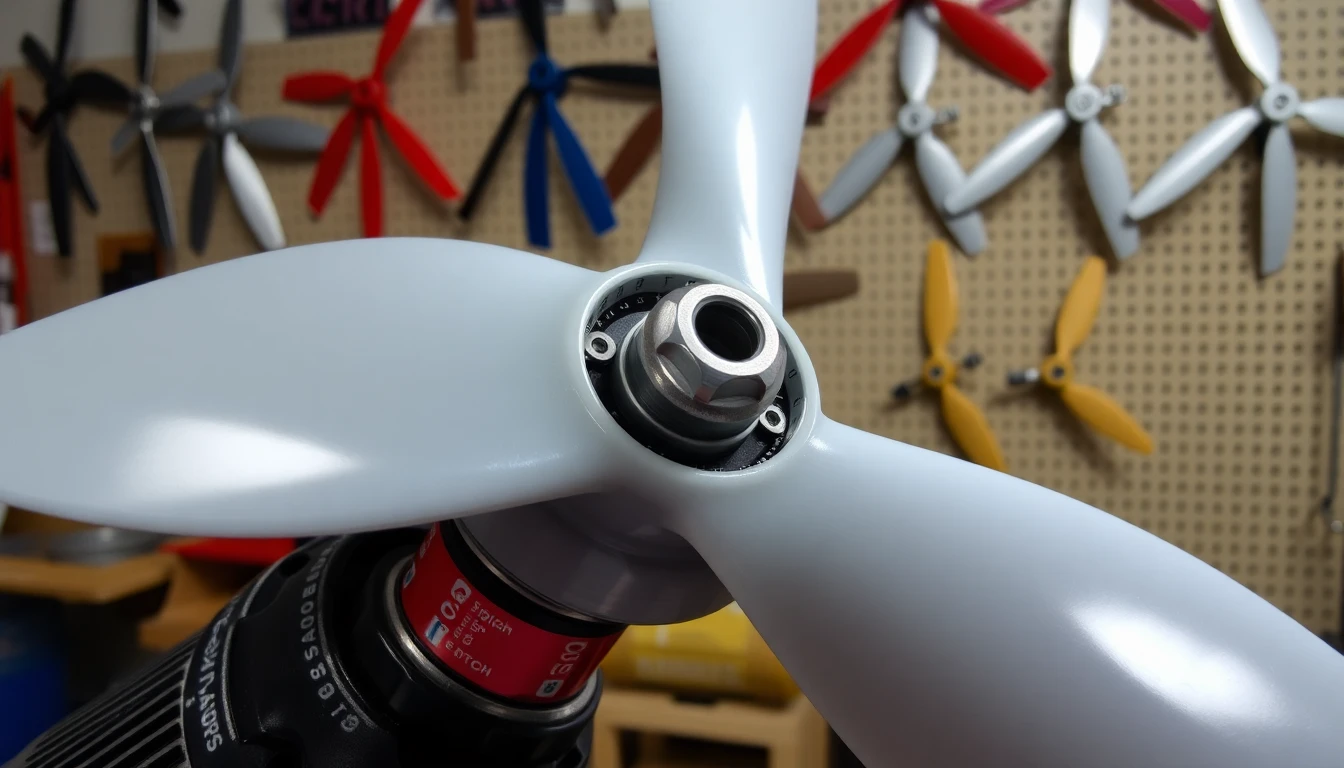
Every propeller label tells a story. Take a 10×6 prop—that’s 10 inches in diameter and 6 inches of pitch. This code determines whether your aircraft flies well or struggles to stay airborne.
Diameter: The Thrust Generator
Diameter measures the full distance from one blade tip to the opposite tip. Think of it as your propeller’s reach through the air.
Larger diameters create serious thrust. A 16-inch prop moves massive amounts of air. Heavy-lift platforms and cinematic drones that carry professional cameras use these. The 12.6-inch options work great for mid-weight applications.
Smaller diameters win at agility. Racing pilots love 2.5 to 3-inch props because they respond fast to control inputs. Your quad can slice through tight gaps. Plus, it executes sharp turns that bigger props can’t handle.
Here’s a critical rule: Add blades? Reduce diameter by 1 inch and increase pitch by 1 inch. This keeps motor load and efficiency right.
Pitch: Your Speed Control
Pitch defines how far your propeller advances in one full rotation through a solid medium. A 6-inch pitch prop should move forward 6 inches per revolution under ideal conditions.
High pitch values (like 8 inches or 10.8 inches) generate incredible speed. Your racing quad accelerates faster. But this costs you—motor load goes up and current draw increases. Competition pilots use 4.5 to 5-inch pitch for maximum velocity.
Low pitch configurations (3 to 3.8 inches) focus on efficiency over raw speed. Your battery lasts longer. Flight becomes smoother and more controlled. Cinematic operators and long-range pilots choose these specs often.
The pitch-to-diameter ratio matters a lot. Small diameter with maximum pitch delivers pure speed. Large diameter with moderate pitch creates lifting power. Match this ratio to your flying style.
Blade Count: The Efficiency Trade-Off
2-blade propellers deliver peak efficiency. They create minimal drag, weigh less, and hit higher top speeds. Most racing and long-range setups start here as the performance baseline.
3-blade props balance thrust with control. They generate more thrust than 2-blade props of the same size. Freestyle pilots prefer these for responsive handling during aggressive maneuvers.
4-blade and higher configurations give you maximum stability and thrust in tight spaces. Indoor flying benefits from this setup. The downside? Each extra blade disturbs airflow for trailing blades. This reduces overall efficiency. Use multi-blade props when diameter limits prevent using larger 2-blade alternatives.
Here’s your quick reference for different flying styles:
|
Style |
Diameter |
Pitch |
Blades |
|---|---|---|---|
|
Racing |
2.5–3″ |
4.5–5″ |
2–3 |
|
Freestyle |
5″ |
Medium |
3–4 |
|
Cinematic |
5″+ |
3–3.5″ |
3–4 |
|
High Thrust |
Large |
Variable |
3–4 |
Start with what manufacturers recommend for traditional RC airplanes. Common choices include 8×6 for trainers or 13×8.5E for electric sport models. RC boats often use 12.6×10.8-inch props matched to their motor’s wide-open throttle RPM range.
Test for physical clearance first. Your propeller tips need enough space from the fuselage, landing gear, and ground. This prevents dangerous strikes during operation.
Step 1: Check Manufacturer Recommendations and Motor Specifications
Your motor’s spec sheet shows you what propeller to use. Motor makers publish specific propeller recommendations based on thousands of test hours. Skip these numbers and you lose performance and battery life. You might even damage your motor.
Decode Your Motor’s KV Rating First
The motor KV and propeller size relationship controls everything. KV measures RPM per volt. A 1000KV motor spins at 1000 RPM for every volt you apply.
High KV motors (2300-2700KV) need smaller propellers. Racing setups pair 2400KV motors with 5-inch diameter props. You get fast acceleration and high top-end speed.
Low KV motors (900-1400KV) need larger props for efficiency. A 1100KV motor pairs well with 10 to 13-inch props on freestyle quads or camera platforms. You get smooth power delivery. Plus, flight times last longer.
Here’s your matching formula: Motor KV × Battery Voltage × Propeller Pitch ÷ 1000 = Approximate Speed (mph). This calculation stops your motor from overloading. It also keeps batteries from draining in minutes.
Find Your Motor’s Maximum Current Draw
Check the manufacturer’s current rating. Look for maximum continuous amperage. A motor rated at 30A continuous shouldn’t pull more than that under full throttle with the correct propeller.
Test your electric motor propeller combo with an amp meter during flight. Hitting 35A on a 30A-rated motor? You need less aggressive pitch or smaller diameter. Too much current creates excessive heat. This heat destroys windings.
Most spec sheets include a recommended propeller range. Something like “optimal with 6×4 to 7×5 props” gives you safe operating boundaries. Start in the middle of this range. Then adjust based on actual performance data.
Verify Physical Clearances and Mounting Standards
Measure your motor shaft diameter with care. Common sizes include 3mm, 5mm, and 8mm. Your propeller hub must match exactly. No exceptions.
Calculate total propeller clearance from all surfaces. Add 2 inches minimum between prop tips and any structure during full throttle operation. Vibration and flexing under load can cause unexpected contact.
Document your motor’s mounting pattern and bell housing dimensions. This stops you from ordering propellers with incompatible mounting systems. Wrong mounts won’t attach firmly to your specific motor model.
Step 2: Match Propeller Size to Your RC Application Type
Your flying goals dictate propeller size more than any other factor. A racing quad and a heavy-lift camera drone need different specs—even with identical motors.
Most builders make a critical mistake here. They copy someone else’s setup. But they don’t understand what their specific application needs. Then they wonder why their plane can’t stay airborne or their racer feels sluggish.
The Park Flyer Quick Formula
Small electric planes follow a simple rule. Take your wingspan and divide by four. That’s your target propeller diameter in inches.
Got an 18-inch wingspan trainer? You need a 6-inch prop with moderate pitch like 6×4. A 24-inch sport plane works best with 8×6 props. This formula keeps thrust matched to aircraft size.
Break this rule and you get problems. Too small? Your plane struggles to climb. Too large? Motor current spikes past safe limits.
Match Size to Mission Profile
Endurance and soaring flights need maximum efficiency. Choose large diameter with conservative pitch. A 15×8 or 16×8 setup creates sustained thrust at lower RPM. Your battery voltage stays higher longer. Flight times extend by 30-40% compared to aggressive pitch options.
Heavier aircraft carrying camera gear need this same approach. That 12×8 prop moves enough air to support payload weight. The moderate pitch keeps motor temperature safe during long filming sessions.
Speed and racing setups flip this formula. You want medium diameter with aggressive pitch. A 5×4.5 or 5×5 prop on a racing quad converts motor power into forward velocity. Top speeds jump 15-20 mph compared to efficiency-focused props.
Diameter drops because you need instant response time. Sharp racing turns require blades that change direction fast. Extra diameter creates spin resistance that fights quick turns.
Internal Combustion Engine Sizing
Gas engines use displacement to set propeller range. Your 1.40-1.80 cubic inch engine runs best with 16×8 props. The acceptable range spans 16×8 to 18×8—larger diameters work if you reduce pitch.
Bigger 40cc engines handle 20×8 props well. Push up to 18×12 for maximum speed applications. The 19×10 middle ground balances thrust with velocity.
Here’s your engine-to-prop reference:
|
Engine Size |
Starting Point |
Performance Range |
|---|---|---|
|
1.40-1.80 CI |
16×8 |
16×8-10, 17×8-10, 18×8 |
|
40cc |
20×8 |
18×10-12, 19×10, 20×8-10 |
|
45cc |
20×10 |
20×8-12, 22×8-10 |
Test and Verify Your Choice
Install your propeller and run a static thrust test. Measure motor current draw at full throttle. Stay within 90% of rated continuous amperage.
Check motor temperature after a three-minute full-throttle run. Anything above 160°F means you need less aggressive specs. Drop pitch by one inch or reduce diameter.
Track actual flight performance against your goals. Racing quad not hitting target speeds? Increase pitch by 0.5 inches. Camera drone draining batteries too fast? Drop to lower pitch and gain 5-8 minutes of flight time.
Electric setups need stricter adherence to these guidelines than gas engines. Over-propping an electric motor creates permanent magnet damage within minutes. Start conservative and increase size step by step. Base changes on real performance data.
Propeller Size Charts: IC Engines vs Electric Motors
Charts cut out the guesswork. Decades of testing get packed into simple tables. Match your engine size or motor KV to the right propeller.
IC engines and electric motors use different charts. The rules don’t cross over. Know both systems. This saves you from costly RC aircraft mistakes.
Internal Combustion Engine Propeller Charts
Engine size sets your starting point for glow and gas engines. Here’s your complete guide by displacement:
Small Glow Engines:
– .049 cu in: Start with 6×3. Test alternatives: 5.25×4, 5.5×4, 6×3.5, 6×4, 7×3
– .09 cu in: Start with 7×4. Try these: 7×3, 7×4.5, 7×5 for different uses
– .15 cu in: Start with 8×4. Performance range: 8×5, 8×6, 9×4
– .19-.25 cu in: Start with 9×4. Full range: 9×4 through 9×6, plus 10×4 through 10×6
Gasoline Engines (Large Scale):
– 1.40-1.80 cu in: Best baseline 16×8. Proven range: 16×8-10, 17×8-10, 18×8
– 40cc: Best choice 20×8. Options: 18×10-12, 19×10, 20×8-10
– 45cc: Best start 20×10. Range: 19×10-12, 20×8-12
IC engines handle oversized props well. Put on a prop that’s too large? Your engine just bogs down or can’t hit full RPM. No fire risk. No lasting damage. You can test different sizes within these ranges.
Electric Motor KV-Based Charts
Electric motors need exact matching. Pick the wrong propeller and over-current melts your ESC and ruins motor windings fast.
Park Flyer Motor Quick Reference:
– 2000-2200 KV: Max sizes 6×3 or 5×5
– 1300-1500 KV: Best 8×4 setup
– 1000-1300 KV: Standard 9×5 setup
Lower KV ratings work with bigger propellers. A 900 KV motor handles a 10-inch prop fine. That same prop on a 2500 KV motor? Disaster. The current draw destroys components.
Check manufacturer charts for your specific motor model. Stick to their published ranges. Start at the smaller end of any range. Measure actual current draw under load before going bigger.
Propeller Materials Comparison: Plastic, Wood, Composite, Carbon Fiber
Material choice affects durability, weight, performance, and cost. Each material has trade-offs you should know before buying.
Plastic Propellers: The Budget Workhorse
Plastic props are common in entry-level RC aircraft and beginner setups. They’re cheap. They’re forgiving. They bend on impact instead of breaking your motor mount.
Plastic flexes more than metal. This means it bends under load. Your propeller tips bend back at high RPM. This wastes thrust. You lose efficiency compared to stiffer materials.
Fiber-reinforced plastics fix some strength issues. Makers add glass or carbon fibers to the plastic mix. Strength increases. But resistance to erosion goes down. The fibers create weak spots where water or air can tear material away.
Plastic props cost $2-8 per unit. Perfect for learning. Perfect for crashes. Not good for performance flying or heavy loads.
Wood Propellers: The Classic Choice
Wood props bring nostalgia and smooth operation to traditional RC planes. Beechwood and maple are common. They balance well during production. Vibration stays low.
The downside? Moisture changes blade shape over time. Your propeller warps. Performance shifts. Wood also breaks clean on hard impacts—no bending back into shape like plastic.
Most builders use wood props for scale models and vintage aircraft copies. Prices range $8-25 based on size and finish quality.
Composite Propellers: The Performance Middle Ground
The composite propeller market grows at 10.5% each year through 2031. Why? Weight savings and noise cuts matter for serious hobbyists.
Composites cost 40-60% more than standard materials. But you get real performance gains. Sharrow Marine’s looped-blade composite design delivers 9% fuel savings on 40-foot sportfishing boats. RC uses see similar efficiency boosts.
Nickel-aluminum bronze composites hold 43.6% market share in 2025. These mix metal strength with composite weight benefits. Expect to pay $15-45 for quality composite props in common RC sizes.
Carbon Fiber: Maximum Performance, Maximum Cost
Carbon fiber reinforced polymer (CFRP) propellers sit at the top of the performance range. They’re 40-60% more expensive than bronze options. For RC use, that means $25-80 per propeller.
Why pay premium prices? Stiffness. CFRP blades don’t flex under load. Every bit of motor power converts to thrust. Epoxy matrix composites handle impacts better than older CFRP designs.
Racing quad pilots and competition freestyle flyers pick carbon fiber. The weight savings boost response time. The stiffness keeps blade shape at extreme RPM.
Buy plastic for learning and casual flying. Choose wood for scale authenticity. Pick composites for efficiency. Select carbon fiber when performance justifies the cost.
Optimizing Propeller Performance: Testing and Troubleshooting
Real-world propeller efficiency tops out around 80%. After that, aerodynamic forces work against you. Adding more power beyond this point won’t give you matching thrust gains. You’re just burning battery and making heat.
Your thrust-to-power ratio reveals performance. At 9000 RPM, thrust drops faster than power use as airspeed climbs from 0 to 38 mph. The efficiency curve shows where your setup goes from optimal to wasteful.
The Two Efficiency Measurement Methods You Need
Track performance using thrust per watt (gf/W). This metric gives instant feedback for VTOL applications. Divide your thrust in gram-force by torque times RPM. The number peaks during first acceleration. Then it levels off as RPM climbs.
The unitless efficiency formula (η) provides deeper insight. Take thrust in Newtons and times it by wind velocity in meters per second. Then divide by 2π times rotational speed in radians per second times torque. You’ll get a percentage value. Zero airspeed gives 0% efficiency. Your prop moves air but creates no forward motion. Negative values show up at low throttle and high speed (like -182 gf/W at 17 m/s). Skip these data points in your analysis.
Testing Protocol That Reveals True Performance
Run airspeed tests at set intervals: 0, 4.2 (9.4 mph), 7.5 (16.8), 10.7 (24), 14 (31.3), and 17 m/s (38 mph) at 9000 RPM. Efficiency rises with airspeed at first. It peaks at your optimal operating point. Then it falls as angle of attack reduces. Higher RPM shifts the peak efficiency point right on your speed curve.
Calculate your advance ratio (J) first. Divide flow speed by RPM/60 times diameter. Then find thrust coefficient (CT). Divide thrust by air density times RPM squared times diameter to the fourth power. Your power coefficient (CP) equals 2π times RPM times torque. Divide this by that same density-RPM-diameter term.
Air density calculation matters for accuracy. Use pressure divided by gas constant (287 m²/s²/K for metric) times temperature in Kelvin.
Common Performance Problems and Fixes
Declining thrust-to-power ratio? You’re running too fast for your propeller pitch. Or you have a pitch-motor mismatch. Drop to a lower pitch value. Or cut cruise speed by 5-10%.
Negative efficiency readings? Low throttle at high airspeeds causes this. Increase throttle or slow down. Don’t run in this range. You’re wasting energy.
Low Reynolds number efficiency drops (props between 9-14 inches at Re 50,000-100,000)? Increase RPM. Tests on 79 different props showed efficiency rises with RPM for most designs. Exception: GWS Slow Flyer props show little efficiency change across RPM ranges.
Second-order polynomial curves fit your efficiency data best. Maximum η increases with RPM at any fixed airspeed. Different calculation methods line up at high speeds. Your numbers don’t match at 30+ mph? Recheck your sensor calibration.
Log thrust, torque, RPM, temperature, and pressure at 400 Hz sampling rate during dynamic tests. Calibrate your load scales before each test session. Small measurement errors grow into big performance mistakes at high RPM.
Brand Selection Guide: APC, Graupner, Master Airscrew Performance Analysis
Performance data beats brand reputation. The University of Alabama in Huntsville ran thrust tests. These tests show big differences between the three major propeller makers. Most hobbyists miss these differences.
Master Airscrew delivered the highest thrust and efficiency numbers. Tests compared them head-to-head against APC MR and Graupner E-series props. All brands got tested under the same conditions. Master Airscrew props needed the least balancing work. Most units required zero extra weight. None needed hub balancing changes.
APC propellers ranked second in the thrust tests. They weigh several grams more than Master Airscrew versions. This extra weight affects how fast your racing setup accelerates. Balance needs sit in the middle range. You’ll do more work than Master Airscrew but less than Graupner. Some APC props need hub grinding for smooth rotation. The finish quality looks less refined. Prices run a bit higher than Master Airscrew.
Graupner E-series props required the most balancing attention. You’ll need to add weight to several points on the hub. The cost hits hard. Graupner props cost more than 2x the price of Master Airscrew or APC. One university test tossed them out based on cost alone. Thrust and efficiency numbers fell below both competitors.
Performance at Low Reynolds Numbers
Small propellers (9-14 inches) run at Reynolds numbers between 50,000-100,000. This range creates tough aerodynamic problems. Master Airscrew’s thin airfoil Slow Flyer profiles use sharp leading edges. These designs keep efficiency better than competitors in this critical range.
APC Thin Electric series shows big swings in thrust and power near peak efficiency. The 11×8 prop shows this behavior clearly. APC Slow Flyer versions give the least efficiency swings across the speed range. Larger differences show up near the peak efficiency point though.
GWS Slow Flyer props make lower efficiency, thrust, and power at higher advance ratios. Testers saw blade flutter during high-speed runs. This flutter means the structure flexes and wastes energy.
All small props lose efficiency hard. Expect 7.5-15% lower efficiency compared to 36-inch reference props. Master Airscrew cuts these losses better than competitors.
APC Electric UAV Props: The Data Story
APC’s fixed-blade UAV series (12-21 inches, Thin Electric 2-blade) got tested hard at 1,000-7,000 RPM. Advance flow speeds ranged from 8-80 ft/s. The 13×6.5 prop shows high thrust coefficient at low advance ratios (J). Efficiency peaks at mid-range J values. Curves shift right as pitch-to-diameter ratio goes up.
The 18×10 setup shows high power coefficient with strong static thrust. Post-2010 versions have tough hubs that fix earlier failure points. Noise levels drop at high RPM compared to older designs.
Higher pitch-to-diameter ratios give more thrust, power, and efficiency at higher advance ratios. Match this to your cruise speed needs. Testing used a Hacker A40-14L motor (355 kV). RPM variation stayed under 1%.
Real-World Selection Guidelines
Pick Master Airscrew for maximum thrust per watt and fast setup. Larger engines work better with their safer blade design. The weight savings boost response in racing.
Choose APC E-series for electric setups if you can spend time on proper balancing. Their performance beats APC I/C versions by a lot. Plan extra time for balance work. The results make it worth it.
Skip Graupner unless you need specific compatibility. The cost doesn’t match the performance data. Your money gets better results elsewhere.
Top Flite props run about 2 grams lighter than Master Airscrew versions. Tornado props spin at slower RPM than Top Flite under the same motor loads. Think about these differences in your selection if every gram counts.
Noise Considerations and Field Restrictions
Flying fields enforce noise limits for a reason. Your neighbors complain. Local rules threaten closures. Club memberships drop as sound violations pile up.
Most RC flying sites cap noise at 85-95 dB measured from 10 feet (3.1 meters) away. That’s the standard distance clubs use. Some residential areas drop limits to 70 dB during certain hours. Break these rules? You risk permanent field bans.
Propeller Design Impacts Noise Output
Blade count changes your sound signature. Two-blade propellers generate the least noise at any given RPM. Each blade creates a pressure pulse. Fewer blades mean fewer pulses per rotation.
Add a third blade and noise jumps 3-5 dB at the same thrust level. Four-blade setups push even higher. Competition pilots deal with this choice all the time. More blades give you control. But they cost you noise compliance.
Pitch affects sound too. Sharp pitch angles (above 5 inches on small props) create harsh pressure waves. These waves make a high-pitched whine that travels far. Neighbors pick up this frequency better than low rumbles.
Carbon fiber props run quieter than plastic at high RPM. The stiffer material vibrates less. Less vibration means cleaner sound. Budget $25-45 for quality carbon props if noise matters at your field.
Test Before You Fly
Measure your setup at home first. Download a calibrated sound meter app. Run full throttle at the required distance. Stay 5-10 dB below your field’s limit. This buffer covers temperature and wind effects that boost sound outdoors.
Most clubs test during peak hours. Background noise sits lowest then. Your 96 dB prop might seem fine at home. But it could hit 98 dB on a calm Saturday morning. That 2 dB difference gets you grounded.
Swap to lower-pitch props for noise-restricted days. Drop from 6×5 to 6×4 pitch. You lose some top speed. But you gain 2-4 dB of headroom. Weekend events often need this trade.
Conclusion
Picking the right RC propeller isn’t rocket science. But it makes the difference between an okay flight and total air dominance. You now have the full framework: match your motor KV and propeller size first. Then consider your use case (speed versus efficiency). Check materials based on your budget and performance goals. Test and adjust.
Here’s what most hobbyists miss: the “perfect” propeller doesn’t exist. What works for a 3D aerobatic setup will kill your long-range cruiser’s flight time. Stop guessing. Start with manufacturer recommendations. Use the sizing charts we’ve provided. Test variations within safe limits.
Your next move? Grab a notebook. Write down your current setup’s performance (flight time, top speed, motor temps). Make ONE change. Test it. Measure it. Repeat. This data approach separates hobbyists from experts.
Propeller pitch and diameter impact every aspect of your RC’s performance. Master this selection process. You’ll never waste money on wrong props again. Ready to optimize your setup? Check our propeller collection at vifpropellers.com—performance meets precision.
Now get out there and fly smarter.