
The wrong electric boat motor propeller costs you money. It’s not just annoying—it hits your wallet hard.
I’ve seen too many boaters waste propellers like paper towels. They chase performance that never shows up. Why? They guess instead of doing the math.
Your propeller controls everything. It decides if your electric motor runs smooth or fights you. It makes you glide through water or kills your battery.
Three numbers matter most: pitch, diameter, and blade setup. Learn how these work with your motor and hull. That’s where good performance lives.
Got slow acceleration? Weak top speeds? Batteries dying too fast? The fix sits right on your motor shaft.
This guide shows you how to match propeller specs to real performance. You’ll learn what your setup needs. No more expensive guessing games that make marine suppliers rich.
Electric Boat Motor Propeller Basics

Every propeller speaks in numbers. Two numbers tell you what you need to know before buying.
The first number shows diameter—how wide the blade circle measures in inches. The second number shows pitch—how far the propeller moves forward through water in one full spin. See 14×19 stamped on a propeller? That’s 14 inches of diameter and 19 inches of pitch.
Think of pitch like gears on a bicycle. High pitch equals high gear—great for speed once you’re moving. But terrible for getting started. Low pitch equals low gear—strong acceleration. But you hit your speed ceiling fast.
Blade count changes how your motor behaves. Three blades give you standard performance with lower drag. Four blades deliver higher thrust and smoother operation. But they cost you 50 to 100 RPM at full throttle. That RPM drop matters. It keeps your motor in its sweet spot.
Here’s the math that saves you money: Every inch of pitch change moves your RPM by 150 to 200. Running at 4800 RPM? Your motor wants 5000-5600. You need to drop 4 inches of pitch to gain back 800 RPM. A cupped propeller design drops you 200 RPM—same effect as adding an inch of pitch.
Diameter works different than pitch. Heavy or slow boats need larger diameters. More blade area creates more thrust. It handles more power too. Fast, light boats run smaller diameters to cut drag. Outboards max out around 16 inches. Heavy sterndrives can push 20 inches.
Electric motors need exact propeller matching. You size the prop to load your motor at maximum power and full RPM. High-torque electric motors turn large props well. That’s why narrowboats run massive propellers. The torque converts into thrust. Good electric motors keep steady torque across different loads and currents.
Watch for cavitation—those vapor bubbles that form around the blades. Pressure drops too low and bubbles appear. You’ll hear noise. You’ll feel vibration. Your blades destroy themselves over time. Blade design and blade count both help prevent it.
Most propellers spin clockwise from behind. That’s marked as R for right-hand rotation. Counter-rotating setups for dual motors use L for left-hand. You’ll see it labeled as 13x17L—13 inch diameter, 17 inch pitch, left-hand rotation.
Match Propeller to Your Electric Motor Model
Your motor’s model number shows what propeller it can handle. Those four digits map to torque capacity.
Take a 2207 motor. First two digits show 22mm stator diameter. Last two show 7mm stator height. Bigger diameter gives stronger spin force. That 2207 handles 5-inch propellers without breaking a sweat. Try forcing a 6-inch prop on it? Your current spikes 40%. Heat builds. Efficiency drops. Your ESC starts screaming.
Kv rating controls your speed ceiling. High-Kv motors (2300-2800) spin small props fast. Perfect for racing drones that need instant response. Low-Kv motors (800-1500) turn big props slow. Built for heavy lifting and long endurance runs. A 2207 at 2300 Kv paired with a 5-inch prop? That’s the sweet spot. Same motor at 2300 Kv with a 7-inch prop? You just created a space heater.
Your ESC must match motor draw. Calculate maximum current first. Add 25% safety margin. A 2207 pulling 35A needs a 45A ESC minimum. Skimp on this and you’re buying replacements.
Shaft diameter matters more than you think. Propeller bore and motor shaft must match exactly. 1.5mm, 3mm, 5mm—whatever your motor specs say. Half a millimeter off creates vibrations. Those vibrations destroy bearings. Use proper adapters. Lock everything down tight. Loose props take off at full throttle.
Assess Your Boat Type and Load Conditions
Your boat’s capacity plate lives on the helm or transom. Find it. Read it. Those numbers are physics—not suggestions.
Every capacity plate shows three hard limits: maximum passengers, maximum weight, and maximum engine horsepower. Boats under 20 feet always have one. Can’t find it? Check your owner’s manual. The manufacturer knows what your hull can handle before problems start.
No capacity plate? Do the math yourself. Take your boat length times boat width in feet. Divide by 15. That’s your maximum person count at 150 pounds each. A 16-foot boat that’s 6 feet wide gives you 96 divided by 15—about 6 people max.
But here’s where most boaters mess up. They forget about gear weight.
Your propeller choice depends on total load—not just bodies. Count everything that goes on board. Batteries weigh 40-70 pounds each. Coolers full of ice add another 30. Fishing tackle boxes, life jackets, extra ropes, anchors—it all stacks up fast. A loaded fishing boat can pack 200-300 pounds of gear before anyone steps aboard.
Test your freeboard with full load. That’s the distance from water surface to your lowest edge. Load up passengers, batteries, and equipment the same way you’ll use it. Check both port and starboard sides. Batteries placed off-center tilt your boat. This tilt changes how water flows past your propeller.
Heavy loads need higher thrust efficiency. That means more blade area or lower pitch for stronger acceleration. Light, fast boats can run smaller props with less drag. Your motor works harder pushing a loaded hull. Size your propeller for maximum load conditions—not an empty boat.
Motor weight matters too. Place it on the transom with center of gravity on your boat’s centerline. Mount it off-center and you get handling problems. Your propeller can’t fix that.
Calculate Optimal Propeller Pitch for Your Needs
Grab a GPS. Load your boat. Hit full throttle. Write down two numbers—RPM and speed. Pitch calculation starts here.
The formula is simple: Theoretical Speed = (RPM × Pitch) ÷ 1,056. This gives you miles per hour. Your GPS shows actual speed. The gap between them is called slip.
Say you’re running 5,400 RPM with a 17-inch pitch propeller. Take 5,400 times 17. Divide by 1,056. You get 86.9 mph theoretical. Your GPS reads 70 mph? Calculate slip: subtract 70 from 86.9, divide by 86.9, times 100. That’s 19.4% slip.
Target 10-20% slip for planing hulls. You want resistance from water pushing back. Zero slip means cavitation—your blades spin in vapor, not water. Too much slip wastes power. You’re churning water instead of moving forward.
Displacement boats work differently. Heavy cruisers and trawlers run 50% slip as normal. Their hulls can’t plane. They push water aside instead of riding over it. One yacht owner ran 1,469 shaft RPM with a 12-inch pitch through a 2.45:1 reduction gear. Theoretical speed hit 14.51 knots. With 50% slip, that’s 7.25 knots actual. But his hull speed maxed at 6.2 knots. He switched to a 10-inch pitch. Speed jumped from 3.2 knots at 2,200 RPM to 4.2 knots at 2,600 RPM. Better efficiency, less strain on the motor.
Match RPM to Manufacturer Specs
Check your motor’s maximum RPM rating. Electric trolling motors usually run 5,000-5,600 RPM at wide-open throttle. Run your WOT test. Compare your numbers.
Below maximum RPM? Drop pitch one inch. Each inch change shifts RPM by 300-500. Running 4,800 RPM but should hit 5,400? You’re not revving enough. Go from 17-inch to 16-inch pitch. Retest.
Above maximum RPM? Add one inch of pitch. Too much revving drains batteries fast and heats up windings. You need more load on the motor. Got 5,800 RPM with a 15-inch prop? Bump up to 16 inches.
Smoke coming from your motor housing? Can’t reach rated RPM no matter how hard you push the throttle? Your pitch is too much. The pitch is too strong for your hull weight and motor torque. Drop two inches minimum. One boat owner dropped from 12-inch to 10-inch pitch. This fixed constant over-pitching that burned out two motors.
Blade count changes the pitch math. Four-blade props need one inch less pitch than three-blade setups. More blades create more drag. That drag acts like adding pitch. Want better hole shot and smoother thrust? Go four-blade. But reduce your pitch or you’ll strain the motor too much.
Convert shaft speed to knots for sailboats and displacement hulls. Take inches per minute, divide by 1,215. That’s your speed in knots accounting for slip.
Run these calculations every time you change loads, add batteries, or swap motors. Optimal pitch isn’t a guess. It’s measured performance that keeps your electric motor in its power band.
Select Propeller Diameter and Blade Count
Diameter isn’t just a number stamped on your propeller hub. It decides whether you transfer power well or waste battery charge.
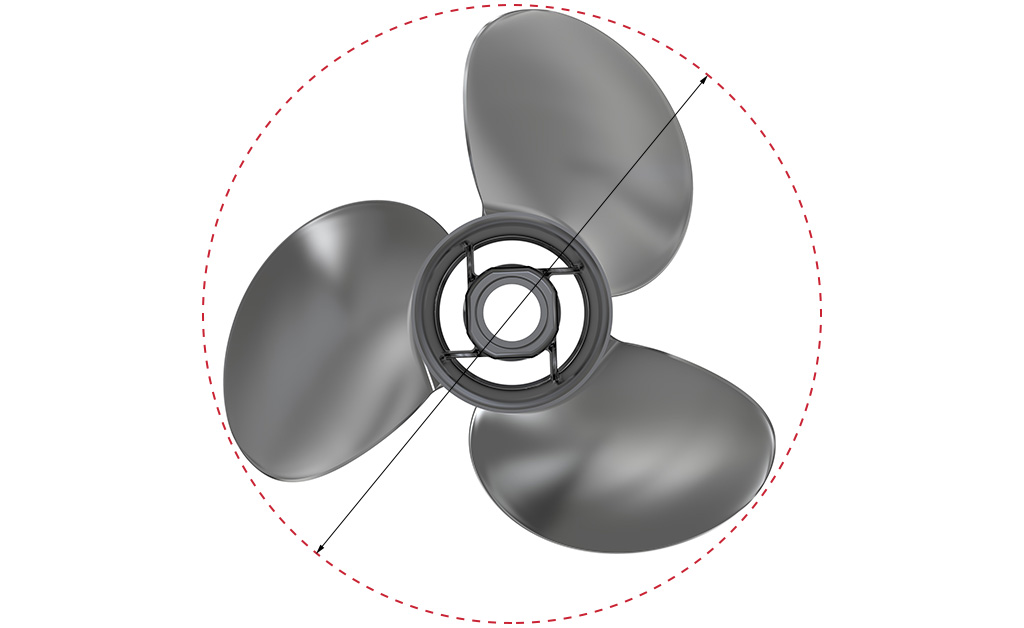
Your electric motor’s drive system sets the diameter limit. Direct-drive setups max out at 72 inches—sometimes 74 inches if you push hard. Why? They spin at 3000 RPM all the time. Go past 74 inches and centrifugal forces work against you. Reduction-drive systems work differently. They handle 78 inches and larger. Propeller RPM drops to 2700 or below. That slower spin lets you add more blade surface without issues.
Bigger diameter means more thrust per revolution. Each inch adds surface area that grabs water. But it also adds weight that slows acceleration. Your motor works harder spinning a 78-inch prop than a 66-inch one. Electric motors with high reduction ratios—2.3 to 2.68—need that extra blade area. They drop engine RPM so much that large props are the way to keep thrust strong.
Match Blade Count to Your Performance Target
Three blades beat two blades for fun boating. Period.
Three-blade props fill 50-55% of the diameter area ratio. They balance quick starts with top speed. Your electric motor stays loaded right across the power curve. Boats with mid-range outboards—three, four, six cylinders—use three-blade setups as standard. You get clean speed coming out of the hole. You still hit maximum speed without problems.
Four blades change things for heavy loads and weak hulls. They fill 60-65% of diameter area. This creates much more thrust. But you lose 50-150 RPM compared to three-blade props with the same pitch. That RPM drop matters on electric motors. You’re working with limited battery capacity already. A fourth blade helps if getting on plane is tough. Or if you’re towing skiers. Or if your boat sits low in the water when loaded.
Four-blade props smooth out vibration. More blades mean each one carries less load. Your motor feels it. Your passengers feel it. Fuel economy sometimes gets better. The motor doesn’t fight cavitation and slip as much.
Two-blade props still serve as the efficiency baseline. Racing quadcopters use them if diameter is limited and every amp counts. But fun boats? Three or four blades give better real performance than two-blade efficiency ever could.
Choose the Right Material for Durability and Performance
Propeller material is a trade-off between wallet pain and replacement frequency.
Aluminum boat propeller costs $50-120 per propeller. That’s the entry point. Most electric trolling motors come with aluminum props. They work fine in clean water. Hit one submerged log? You bend blades. Scrape a rocky bottom? You ding edges. Aluminum’s soft. It absorbs impacts without breaking. Good for your motor shaft. Bad for your propeller’s shape.
Every ding changes pitch in that spot. Your thrust becomes uneven. Vibration starts. Efficiency drops 8-15% after a few hard hits. You’ll replace aluminum props every 2-3 seasons with normal use. Heavy fishing in weedy lakes? Count on replacements every year.
Stainless steel boat propeller runs $150-300 but lasts 5-8 seasons. The hardness rating is 55-60 on the Rockwell scale. That’s three times harder than aluminum. Blades hold their shape through impacts that would fold aluminum. You get steady pitch. Steady thrust. Better fuel economy because blade shape stays true.
Stainless steel’s density creates sharper blade edges. Those edges cut through plants instead of pushing them. Weed-free performance matters in shallow lakes and rivers. Your motor doesn’t bog down clearing wrapped grass every ten minutes.
The weight difference shows up in speed. Stainless props weigh 40% more than aluminum at the same diameter. That mass acts like a flywheel. Slower hole shot. But smoother operation at cruise speeds. Less vibration means longer motor bearing life.
Composite materials split the difference at $80-150. Blends of hard plastic with fiber give you full rust protection. Saltwater boaters benefit most. No rust. No metal reaction between prop and motor shaft. The flex absorbs impacts without lasting damage up to moderate strikes.
But composites give up some top-end performance. Heat limits max out around 105-110°C. Long high-RPM running in hot climates can cause blade bending. They’re perfect for pontoon boats and slow cruisers. Not ideal for performance boats where every RPM counts.
Match material to your water conditions first, your budget second. Rocky shallows? Aluminum’s cheap replacement cycle makes sense. Open water cruising? Stainless steel’s long life pays back the upfront cost within three seasons.
Propeller Selection Matrix by Use Case
Match your propeller to what you do on the water—not what the sales brochure promises.
Fishing and Trolling in Shallow Waters
Weed-free propellers with three blades work best here. Target pitch range: 10-14 inches for 12V motors, 14-18 inches for 24V setups. Lower pitch gives you slow, steady speeds for bass fishing. You get 1.5 to 3 mph without draining your batteries. Diameter stays between 9-11 inches. Bigger sizes create too much drag in vegetation.
Composite materials handle weeds better than you’d think. The flex lets plants slide off instead of wrapping tight. Stainless steel costs more but cuts through thick grass. Aluminum stops cold in those conditions. A Florida guide switched from aluminum to stainless in the backwaters. His battery runtime jumped 22%. The motor wasn’t fighting wrapped weeds every pass.
Speed-Focused Cruising and Performance Boats
High-speed electric boats need pitch ratios 0.85-0.88 to hit their ceiling. That’s 17-21 inch pitch on most outboards. Four-blade stainless props work best. They stop cavitation at high RPM. Plus, they keep thrust smooth through turns.
Diameter drops to 13-14 inches maximum. Less blade area means less drag once you’re up on plane. KVLCC2 tanker tests proved something interesting. Pitch ratio increases of just 0.02-0.03 gave clear efficiency gains. Your lighter hull benefits even more from the right pitch.
Heavy Load Hauling and Pontoon Boats
Load capacity drives everything here. You need expanded blade area ratio 0.60-0.65 minimum. That means four blades with 15-17 inch diameters. Pitch stays at 14-16 inches. Getting tons of boat moving matters more than top speed.
Test your setup loaded with passengers and gear at max capacity. Reduction-drive electric motors work great here. They handle larger diameter props without spinning too fast. One pontoon operator made a switch. He went from a three-blade 15×15 aluminum to a four-blade 17×14 stainless. Hole shot improved 40%. Top speed dropped 2 mph. But that doesn’t matter with twelve people on board.
Optimize Performance Through Testing and Adjustment
Your first propeller choice won’t be perfect. Accept that now. It saves frustration.
Real optimization happens on the water—not in spec sheets. Test thrust efficiency against battery drain. GPS data tells one story. Your motor’s amp draw tells another. Both numbers matter.
Run Sequential Baseline Tests
Start with your current propeller at full charge. Record these six metrics: top speed via GPS, time to plane, battery voltage under load, motor temperature after 10 minutes, amp draw at cruise speed, and amp draw at wide-open throttle.
Run the same course three times. Same load. Same wind conditions. Take the median of all three runs—not the average. One outlier from hitting a wave wrong shouldn’t mess up your baseline.
Track one change at a time. Swap one variable per test session. Change pitch? Keep diameter and blade count the same. Testing multiple changes at once? You can’t figure out what worked. You won’t know which change gave you better performance.
Weight Your Real-World Usage Profile
Most boaters test at full throttle. That’s backwards.
Where do you spend actual running time? Trolling speed accounts for 60% of my fishing trips. I optimized my 24V Minn Kota for 2.5 mph efficiency—not top speed. Battery runtime jumped from 4.3 hours to 6.1 hours. My wide-open throttle dropped from 4.8 mph to 4.5 mph. Worth it.
Build your usage model: 70% slow cruise, 20% medium speed, 10% full throttle? Test at slow cruise settings most. Measure amp draw across that range. A propeller that saves 3 amps at cruise speed but adds 8 amps at WOT still wins. Full throttle barely matters for most trips.
Optimize Through Small Pitch Adjustments
Drop or add pitch in one-inch increments. Smaller changes waste testing time. Larger jumps overshoot the sweet spot.
One lake boat owner ran a 36V system with a 13×17 three-blade aluminum prop. Top speed: 5.2 mph. Amp draw: 62A at WOT. He tested a 13×15 prop. Speed dropped to 4.9 mph. But amp draw fell to 48A. His battery runtime increased 35%. He operates in a no-wake zone. Speed didn’t matter. Efficiency was king.
Document every test session. Write down water temperature, load weight, wind speed, and chop conditions. Performance changes between calm mornings and windy afternoons. Your target might shift with the seasons too. Cold water increases drag. Hot motors lose efficiency.
Stop testing at improvements below 5%. You’ve hit the point of shrinking returns. A change from 52A to 51A draw won’t give you noticeable runtime gains. Move on to blade count or material testing instead.
Common Problems and Troubleshooting Solutions
Propeller problems show up fast. Weird vibrations. Dead spots in acceleration. Batteries that drain twice as fast as before. Your electric boat motor didn’t break—your propeller setup did.
Most issues come from three causes: wrong specs, physical damage, or bad motor-prop matching. Fix the root problem. Don’t just fight symptoms.
Excessive Vibration and Noise
Vibration that rattles your transom? Something’s off balance. Check for bent blades first. Even small bends mess up the rotation. Aluminum props bend easy after hitting things underwater. Hold the propeller at eye level. Spin it. Watch the blade tips trace a perfect circle. Any wobble? That blade’s bent.
Damaged hubs cause vibration too. The rubber cushion inside absorbs shock between motor shaft and propeller. Hard impacts compress or crack this cushion. Your prop spins but slips under load. Replace the entire hub—don’t try patching it.
Loose mounting hardware creates death wobbles. Prop nuts work loose from constant rotation and vibration. Check torque specs in your motor manual. Most electric trolling motors need 18-22 ft-lbs on the prop nut. Use a torque wrench. Hand-tight won’t cut it.
Cavitation sounds like gravel in a blender. Vapor bubbles collapse against blade surfaces. Drop pitch by 2 inches. Or switch to a four-blade design with better pressure spread. Cupped blade edges help too—they delay cavitation at high speeds.
Motor Won’t Reach Rated RPM
Your tachometer shows 4200 RPM but the motor’s rated for 5400? You’re over-propped. The pitch loads your motor past its torque limit.
Figure out your speed using current RPM and pitch. Compare it to GPS speed. Slip above 25% on a planing hull? Your propeller’s fighting you. Drop 2-4 inches of pitch right away. Test again.
Diameter causes the same overload. A 36V motor struggling to spin a 15-inch prop needs to drop to 13 inches. Each reduction cuts blade surface area. Your motor runs easier. RPM climbs back to spec.
Four-blade props cost you 200-300 RPM compared to three-blade setups at the same pitch. Did you switch blade counts without adjusting pitch? Go down one inch to make up for it. A 17-inch four-blade performs like an 18-inch three-blade.
Weed-wrapped shafts kill RPM fast. Pull your motor. Check the shaft for grass, fishing line, and plastic bags wound tight. I’ve seen 6 feet of monofilament wrapped so tight it worked like a brake. Clean everything. Grease the shaft. Performance comes back right away.
Poor Acceleration and Weak Hole Shot
Your boat takes forever getting on plane? Pitch is too high for your hull weight and motor torque. You need more thrust at the start.
Drop pitch 2-4 inches for heavy boats and loaded conditions. Lower pitch speeds up blade RPM at the same throttle setting. More spins per minute means more thrust pushing water back. Your stern lifts. The bow drops. You’re on plane 40% faster.
Three-blade props struggle with heavy loads. Add a fourth blade without changing pitch. That extra blade boosts total blade area by 15-20%. Each spin grabs more water. Acceleration improves even if top speed drops a bit.
Check your motor’s shaft angle too. Mounted too low? Your thrust points down instead of straight back. You’re pushing water toward the lake bottom. Raise the motor one mounting hole. The propeller should sit 3-4 inches below the hull when trimmed down all the way.
Battery voltage drop under load can fake acceleration problems. Test voltage at the motor terminals during full-throttle acceleration. Dropping below 10.8V on a 12V system? Your batteries can’t push enough current. Upgrade to higher amp-hour batteries or add a parallel bank.
Excessive Battery Drain
Runtime dropped from 6 hours to 3 hours with the same propeller? You’re fighting more resistance somewhere.
Measure amp draw at your normal cruising speed. Compare it to baseline data from the new system. Draw jumped 15A or more? Your propeller’s damaged or you’re carrying more weight.
Barnacles and growth on the prop blades boost drag by 20-30%. Scrub blades clean with a stiff brush. Check stainless steel props for pitting and rust. Even small rough spots create water flow problems that waste power.
Wrong pitch drains batteries two ways. Too high and your motor fights the load—amp draw jumps. Too low and you over-rev the motor—amp draw jumps again. Find the sweet spot where your motor hits rated RPM at cruise speed with the least current.
Switching from three-blade to four-blade props without dropping pitch adds 8-12A to cruise draw. That fourth blade creates more friction surface. You paid for it with better thrust. Now adjust pitch down one inch to get back some efficiency.
Hull fouling matters as much as propeller condition. Growth on your hull adds water resistance. Your propeller works harder pushing through that drag. Clean your hull bottom every three months if you run in warm water. Every month in tropical climates where growth takes off.
Propeller Cavitation and Slipping
You nail the throttle and RPM shoots up but speed changes little? That’s cavitation or hub slip—not forward thrust.
Real cavitation shows up as white foam trails behind your blades. You’re spinning vapor instead of grabbing solid water. Switch to a higher blade area ratio propeller. Four blades with wider sections delay cavitation. Cup the blade trailing edges for better bite.
Hub slip feels just like cavitation but happens inside the propeller. The rubber hub cushion fails. Your motor shaft spins but the blades lag behind. Check for melted rubber smell at the hub. Feel for too much heat after a run. Replace the hub or buy a new propeller.
Running too shallow causes ventilation—not the same as cavitation. Your blades break the water surface and suck air. Mount your motor deeper. Keep the propeller under water even in turns and waves.
Impact damage creates cavitation hot spots. Nicks and gouges in blade surfaces mess up water flow. Smooth edges make clean pressure. Rough edges make bubbles. File down dings with 400-grit sandpaper. Polish with 600-grit. Smoother surfaces cut cavitation in half.
Steering Problems and Poor Handling
Your boat pulls hard to one side under power? Propeller torque or damaged blades cause it.
Single-engine setups always fight propeller torque. The spinning blades create turning force. Your hull tries rotating the other way. Counter this by adjusting your motor’s steering trim. Most electric motors have 5-degree trim settings. Start with 2 degrees opposite your pull direction.
Bent blades throw your thrust off-center. One blade pushing 15 degrees right makes your whole boat track right. Look at blade angles close. All blades must match within 2 degrees of each other. Replace damaged props—don’t try bending aluminum back straight.
Motor mounting height changes handling a lot. Too high and you lose bite in turns. The prop ventilates as you crank the wheel. Too low and you create too much drag plus bow-down trim. Adjust in one-hole steps. Test turning performance after each change.
Loose transom mounts let your motor twist under torque. Your steering inputs don’t match propeller direction. Tighten all four transom bolts to spec. Add backing plates if your transom flexes. Solid mounting gives you steady handling.
Installation Guide and Maintenance Tips
Your propeller bolts on in five minutes. Keeping it running right takes discipline.
Most boaters skip the installation basics. They hand-tighten the prop nut and call it done. Three trips later, vibration starts. The prop works loose. Blade damage follows. You saved four minutes with a torque wrench. Now you’re buying replacements.
Mount Your Propeller Right
Pin alignment comes first. Every electric motor has a drive pin or shear pin that locks the propeller to the shaft. Line up the propeller hub slot with this pin. Push the prop straight on—no twisting. Force it at an angle? You’ll damage the pin seat. That creates play. Play turns into vibration. Vibration kills bearings.
Check your shaft for burrs and corrosion before sliding the prop on. See rust? Run 400-grit sandpaper along the threads. Clean threads let the prop nut torque right. Dirty threads give false torque readings. You think you hit 20 ft-lbs. You’re at 14.
Torque specs live in your motor manual. Most electric trolling motors need 18-22 ft-lbs on the prop nut. Use a torque wrench—not a guess. Under-torque and your prop slips. Over-torque and you crack the hub or strip threads. I’ve seen both failures cost $180 in parts that shouldn’t have broken.
Add threadlocker to the prop nut threads. Blue Loctite 243 works perfect. It stops vibration from backing off the nut over time. Don’t use red threadlocker. You’ll need a torch to remove it next season.
Run a 10-Hour Break-In Period
New propellers need break-in time. The hub cushion compresses during the first few hours. Blades settle into their stress patterns. Run your first 10 hours at 60-70% throttle maximum. Full power right away overheats the hub. It won’t seat right.
Check the prop nut torque after 2 hours of running. Check again at 5 hours. The hub cushion compresses a bit as it breaks in. This reduces clamping force on the nut. Re-torque to spec both times. After 10 hours, the hub stabilizes. You’re done with frequent checks.
Check Things Each Month
Pull your propeller once a month during active season. Check five things: blade edge nicks, hub condition, fishing line wrapped on the shaft, prop nut tightness, and shaft seal condition.
Blade edges show damage first. Run your finger along each edge. Feel for rough spots and gouges. Small nicks under 1/8 inch deep? File them smooth with 400-grit sandpaper. Deeper damage changes blade pitch. Replace the prop.
The rubber hub cushion cracks from impact and age. Look for black rubber dust around the hub. Smell for burned rubber after a hard run. Either one means hub failure. You’ll get hub slip soon. Replace before you’re stuck on the water.
Fishing line winds tight around prop shafts. It cuts into shaft seals and creates friction that drains batteries. Unwrap all of it. Check the seal for cuts. A damaged seal lets water into the motor housing. You can prevent a $400 repair with a $15 seal replacement.
Seasonal Deep Maintenance
End of season cleaning prevents 90% of off-season damage. Pull the prop. Scrub blades with a stiff brush and boat soap. Remove all algae, barnacles, and mineral deposits. Rinse with fresh water even if you run in freshwater lakes. Dry it all the way.
Inspect stainless steel props for pitting and rust spots. Surface rust wipes off. Pitting goes deep. Those spots mean permanent efficiency losses. Composite props crack from UV exposure and freeze-thaw cycles. Check blade roots where they meet the hub. Cracks start there.
Grease the prop shaft with marine-grade waterproof grease. Coat threads on the shaft too. This blocks corrosion during storage. Your prop slides on easy next spring. No fighting rust.
Store propellers in a dry location away from concrete floors. Concrete pulls moisture. Moisture eats away at aluminum and stainless props. Hang props on wall hooks or store in sealed plastic bins.
Track Performance Metrics
Log your amp draw and GPS speed every 10 operating hours. Write down battery voltage under load too. These three numbers show you the drop in propeller efficiency. Sudden amp draw increase of 5A or more? Something changed. Check for damage, wrapped debris, or bent blades.
Speed drops combined with normal amp draw point to blade edge erosion. Aluminum props lose sharp edges to sand and debris. Your thrust efficiency drops 8-12% before you notice. Stainless holds edges longer but still wears. Compare current performance to your baseline numbers from installation. Performance loss over 10%? Time for replacement.
VIF Brand Electric Boat Propeller Recommendations
VIF builds propellers that match your motor specs. No guessing game like most brands put you through.
Their Mercury range covers 25-70HP outboards with direct OEM replacements. The 10 1/2 x 13 stainless steel three-blade ($215) fits 25HP trolling setups and 70HP fishing rigs. Same size in aluminum costs $75. That’s your smart test prop before you buy stainless.
Need higher pitch? VIF stocks seven size combos for Mercury 25-70HP motors: 10 1/2 x13, 10 3/8 x14, 10 3/8 x13, 11 1/8 x13, 11 3/8 x12, 11 5/8 x11, and 11 x15. All stainless. All 13-spline right-hand rotation. Pick the pitch that puts your RPM in spec.
Yamaha 40-60HP motors get three choices: 10.25 x14, 10.25 x15, and 10.25 x16. The polished YBS stainless steel runs $309.99. Replaces OEM 663-45976-00-00. The 13-spline fit drops hub adapter problems.
VIF machines every prop on 5-axis CNC equipment. Vacuum casting makes blade shapes consistent. Robot surface treatment keeps finish quality tight across batches. Each prop gets pitch testing, torque load testing, and 200-hour salt spray exposure before it ships.
Their 180-day warranty covers blade breaks and hub slip—the two failures that count. Normal wear and impact damage aren’t covered. Ships from US warehouses in 3-5 days. East coast and west coast stock means no wait on overseas ships.
Conclusion
The right electric boat motor propeller changes everything on the water. You want that perfect cruising speed? Better battery range? No more annoying vibrations? Your propeller choice affects all of it.
Here’s what matters: propeller pitch and diameter form your performance base. Material choice sets your long-term value. Blade design tackles specific problems—weeds, shallow water, whatever you face. Match these right, and you get less motor strain, lower energy use, and a better ride.
Don’t go with “close enough.” Check your motor specs first. Look at your typical load. Consider your water conditions. Then pick what fits.
Stuck between sizes? Use VIF’s propeller selection tool. Or contact our technical team—we’ve helped thousands of boaters find their perfect match.
Your ideal setup exists. Find it. Test it. Dial it in. An adequate propeller gets you by. The right one makes you love every trip.