
A shaft length mismatch on your outboard motor doesn’t just cost money — it can leave you stranded mid-lake with a cavitating engine and no thrust at all.
The fix is straightforward. You need to know what to measure and where.
Sizing up a new motor? Diagnosing a performance problem? Replacing a damaged unit? Getting your outboard shaft and transom height measurement right is the one step that makes everything else work.

This guide covers the full process:
-
The tools you need
-
The correct measuring points
-
Real numbers to work with
-
The specific mistakes that trip up even experienced boaters
Get these details right, and you’ll make the right call before spending a dime.
Content Framework: How To Measure Outboard Shaft Length — Complete Guide (2026)
Here’s what this guide covers — in the order you need it.
Measurement fundamentals come first. You’ll get the correct reference points for gas versus electric outboards, the tools required, and a three-step formula that gives you a real number to act on.
Next: standard shaft sizes — 15″, 20″, 25″, and 30″. Each one maps to specific transom heights, boat types, and real-world use cases. A compatibility chart is included for quick reference.
Then come the details that prevent expensive mistakes. You can use this to select the most suitable outboard boat propeller. Stated shaft lengths and actual measurements often don’t match. A Honda 20″ long shaft, for example, measures 22.5″ in practice. Also, gas and electric outboards use different classification systems — knowing this distinction matters.
Last up: a troubleshooting section and FAQ. Use it to cross-check your numbers against symptoms you may already be seeing on the water.
Work through it in sequence, or jump straight to the section that fits your situation.
What Is Outboard Shaft Length (And Why Getting It Wrong Is Expensive)
Shaft length sounds simple. Then you’re writing a $500 check for a replacement Propeller you destroyed in your first season.
Here’s what the measurement means: outboard shaft length runs from the top of the mounting bracket — where the motor clamps onto your transom — down to the top of the anti-cavitation plate. That’s the horizontal metal fin sitting just above the propeller. It does not end at the propeller blade tips. Plenty of experienced boaters get that wrong.
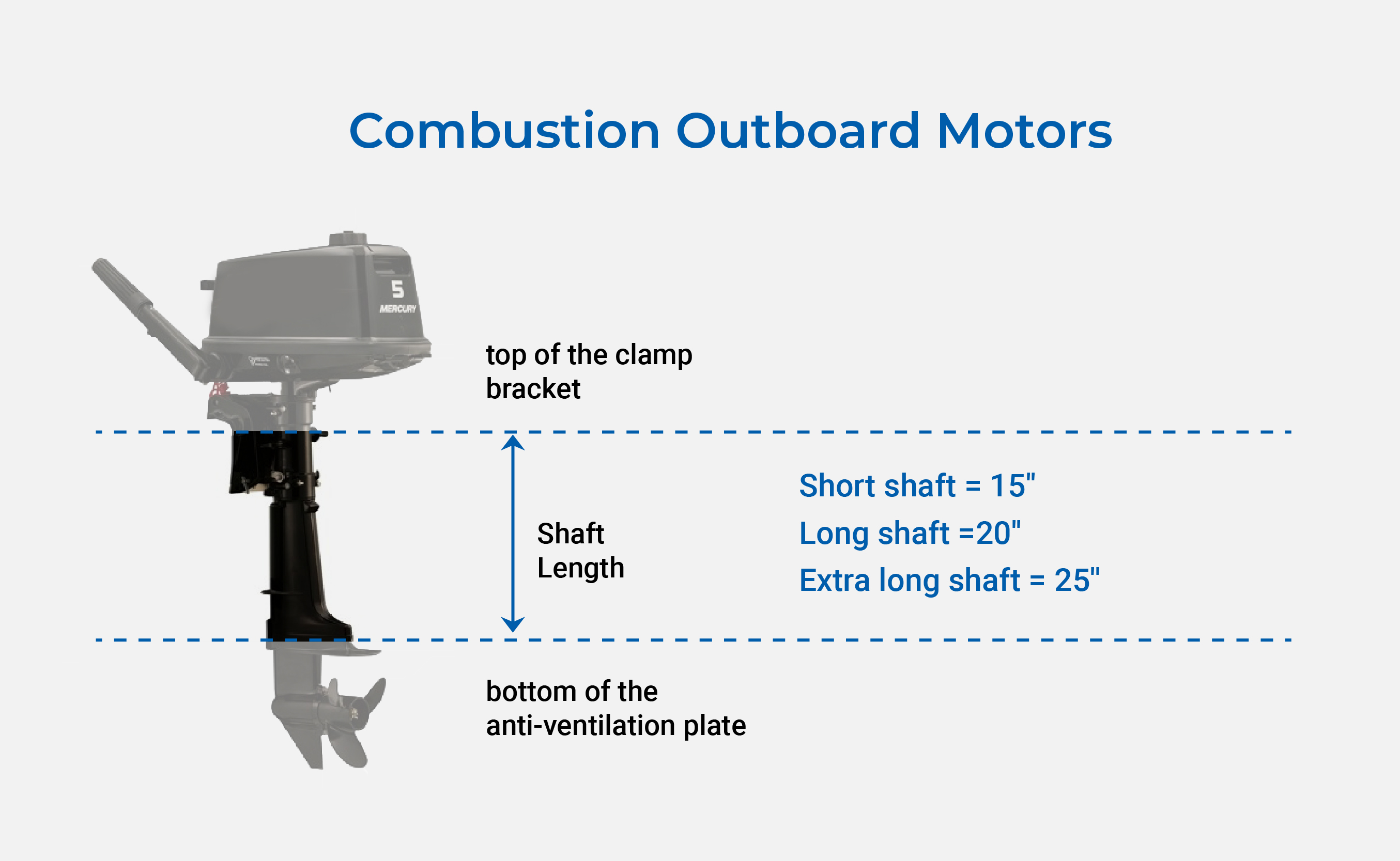
Four standard sizes exist:
|
Type |
Length |
Best For |
|---|---|---|
|
Short |
15″ |
Small boats under 15ft |
|
Long |
20″ |
Most general-purpose boats |
|
Extra Long |
25″ |
Larger hulls, deeper water |
|
Ultra Long |
30″ |
High-performance, demanding conditions |
Electric outboards use a different measurement. The endpoint shifts to the propeller center — not the cavitation plate. On electric motors, 20″ is short and 30″ is long. Same tape measure, different rules.
Get the size wrong and the costs pile up fast:
-
Cavitation drops efficiency by 10–30%
-
Overheating repairs run $500–$2,000
-
A chewed-up Prop costs $200–$600 to replace
-
Return freight on a mismatched motor adds $300–$1,000 more
Measure your own transom. Skip the dealer estimate. Transom heights range from 14″ to 32″ across common boat types. A guessed number can be off by 5–10 inches. That gap puts you in a completely different shaft size category.
Tools You Need Before You Start Measuring
One tape measure and five minutes. That’s all most boaters need.
Grab a retractable steel tape measure — standard household length works fine. It covers the core job: measuring your transom height and confirming your outboard shaft length from bracket top to cavitation plate.
For tighter precision, add a caliper (digital or Vernier). It reads depth and diameter to within 0.001″. That’s handy for checking worn mounting brackets or tube dimensions on inflatable hulls.
What not to use: rope, paracord, or visual estimation. Rope stretches. Eyes lie. Either one can push your measurement off by 20–50mm. That’s enough to land you in the wrong shaft size category.
Quick tool checklist:
– ✅ Steel tape measure
– ✅ Digital calipers (optional but recommended)
– ✅ Pencil or marker for noting measurements
– ❌ Rope or flexible cord
– ❌ Guesswork
How To Measure Outboard Shaft Length: Step-by-Step
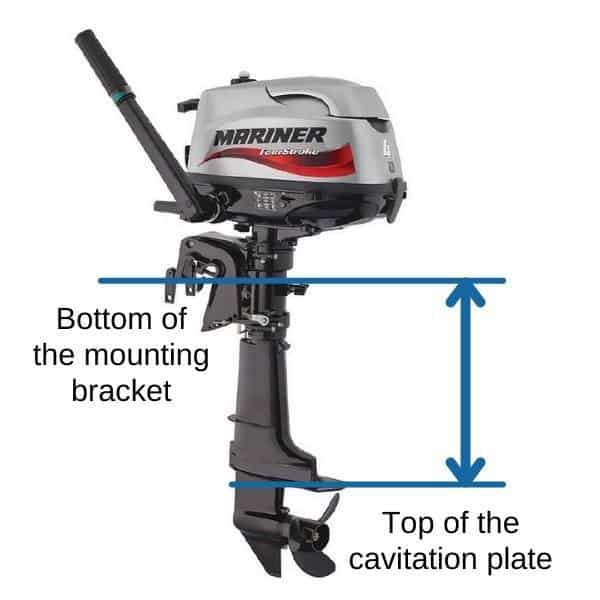
Four steps. One tape measure. Numbers you can use.
Park the boat on a level surface before you do anything else. A tilted hull throws off your reading before the tape touches the transom. Small errors here create big problems. A 10° tilt adds 1–2 inches of false length. That’s enough to put you in the wrong shaft category.
Step 1: Get the Motor Straight Up and Down
Use your trim/tilt to bring the outboard to a full 90° position — straight up, perpendicular to the waterline. Confirm it with a level. Don’t skip this step. A 15° tilt adds 3–4 inches of measurement error. That’s not a rounding issue. That’s the wrong motor size.
Step 2: Find Your Two Reference Points
This is where most people get it wrong.
-
Start point: The inside top edge of your transom — the contact surface where the motor clamps sit, not the outside face of the transom
-
End point: The bottom horizontal edge of the anti-ventilation plate — that flat metal fin sitting right above the propeller
These two points define your outboard shaft length. Everything else is noise.
Step 3: Run the Tape
Hold the tape end firm at the transom’s inside top edge. Extend it straight down, pressed flat against the transom surface. Keep it taut and perpendicular. Even a 1° bow over a 20″ span adds 0.35″ of error. Grab a helper to stabilize if needed.
Step 4: Measure Three Times, Then Average
Take three readings and write each one down (example: 19.2″, 19.5″, 19.3″). Average them — 19.33″ — then round to the nearest standard size.
|
Your Averaged Measurement |
Shaft Classification |
|---|---|
|
15″–17.5″ |
Short shaft |
|
19″–22.5″ |
Long shaft |
|
24″–28″ |
Extra long shaft |
|
30″+ |
Ultra long shaft |
One extra check for electric outboard users: Take your propeller radius and add 4 inches of clearance below the transom bottom. A 15″ transom with a 5.5″ Prop radius needs about a 24.5″ shaft. Get the math right — it changes your shaft size.
How To Measure Transom Height for Outboard Motor Compatibility
Transom height is the number that confirms your shaft choice — or kills it. Get this measurement right, and the rest of the selection process falls into place.
Here’s the method.
Position the Boat First
Set the boat on a level trailer or flat ground before the tape comes out. An uneven surface throws off your vertical reading. Measure at the transom center — not the corners. Corner heights vary by hull design, sometimes by an inch or more. The center gives you the true reference point.
The Measurement: Top Edge to Keel
Hook your tape at the top edge of the transom — the same contact surface where the motor mount bracket sits. Drop it straight down to the keel (the lowest point of the hull bottom). Keep the tape plumb. Don’t follow the curve of the hull surface. You want a straight vertical drop — the same path the motor shaft takes in the water.
Write that number down.
Matching Your Measurement to Shaft Length
|
Transom Height |
Compatible Shaft Length |
|---|---|
|
Up to 17″ |
Short shaft (15″) |
|
19″–22″ |
Long shaft (20″) |
|
~25″ |
Extra-long shaft (25″) |
|
30″+ |
Ultra-long shaft (30″) |
Your number falls between sizes? A jack plate, bracket adjustment, or custom motor mount closes the gap. Take this example: mounting a 30″ shaft motor on a transom built for 25″ means raising the cutout by 5 inches. That’s doable — just plan for it before you buy.
One more thing worth knowing: shaft length terminology shifts between brands and even between boaters. Cross-reference your actual measured inches against the motor’s spec sheet. Names lie. Numbers don’t.
Outboard Shaft Length Chart: Short vs Long vs Extra Long vs Ultra Long

Four sizes cover almost every boat on the water. Find the right one for your boat, and you’ve solved half the compatibility puzzle before picking up a wrench.
|
Shaft Type |
Length |
Transom Height Range |
Best Applications |
|---|---|---|---|
|
Short (S) |
15″ (38 cm) |
15.7″–19.7″ |
Dinghies, jon boats, inflatables, small fishing boats |
|
Long (L) |
20″ (51 cm) |
19″–22″ |
Mid-sized fishing boats, general-purpose hulls |
|
Extra Long (XL) |
25″ (64 cm) |
22″–28″ |
Deep-V hulls, sailboats, tidal waters |
|
Ultra Long (XXL) |
30″ (76 cm) |
24″–32″ |
High-performance rigs, tall transoms, extreme conditions |
Brand naming stays consistent where it counts — the actual inches. Mercury, Yamaha, Honda, and Suzuki all use the same 15/20/25/30″ increments. The label names differ. Yamaha calls 25″ an “X,” not “XL.” Mercury tags 30″ as “XXL.” But the physical measurements match across every major brand.
Two scenarios worth knowing:
-
Inflatables and canoes — go with Short (15″). Transoms in the 14″–17″ range require it. The shallow draft also means a longer shaft puts the Prop deeper than it needs to be. Click here to get reliable propeller links.
-
Electric outboards — the chart above doesn’t cover these. Electric motors measure to the propeller center, not the cavitation plate. An ePropulsion “L” shaft, for example, measures 29.5″. That puts it closer to a gas motor’s Ultra Long category.
Check the spec sheet for the actual inch count, not just the label. Labels are shorthand. The number is what matters.
How To Choose the Right Outboard Shaft Length: The Selection Formula
The math here is simple. The consequences of skipping it are not.
Got your transom height? Plug it into this formula:
Minimum shaft length = transom height + 16 inches
That extra 16 inches puts the propeller top flush with your hull bottom. It gives the Prop enough clearance for steady water flow. This is the industry baseline. It works for most calm-water situations.
Running offshore or in choppy conditions? Add 4–6 more inches. Waves push the motor around. A longer shaft keeps the Prop submerged and spinning in water — not air.
The Precise Version
For a tighter number, use the full formula:
Shaft length = transom height + propeller radius + 4 inches
Here’s a real example. A 1964 16′ Starcraft with a 21″ transom, fitted with an ePropulsion Spirit 1.0 Evo Remote (5.5″ propeller radius):
-
21″ + 5.5″ + 4″ = 30.5″ → Round up to Extra Long
Another quick calc: 20″ transom + 5″ Prop radius + 4″ = 29″ → Select Extra Long (30″).
Your Number Falls Between Sizes
A result between 22″–24″ is not a mistake. It’s a judgment call based on where you boat:
-
Calm inland lakes: Go with the shorter option (20″ Long). Less drag, better efficiency.
-
Bay or offshore: Go with the longer option (25″ Extra Long). It keeps the prop buried in waves and prevents cavitation.
You’re within 2–3 inches of the next size up and you’re near rough water? Go longer. Every time.
Outboard Shaft Too Short vs Too Long: Symptoms & Diagnosis
Wrong shaft length makes itself known — fast, and at the worst possible moment.
The symptoms fall into two clear categories. Read them right, and you’ll know which direction your mismatch is going.
Shaft Too Short
The anti-cavitation plate rides more than 1–2 inches above the hull bottom. Air from the surface hits the prop. The blades lose grip, erode, and cavitation sets in.
What you’ll feel on the water:
– Thrust drops 20–30% — small boats lose 3–5 mph at planing speed
– Engine temperature climbs 20–40°F above normal — the impeller can’t pull clean water
– Vibration hits between 2,000–3,000 RPM — rough, irregular, hard to ignore
– Sluggish acceleration with a bow-high trim feel that won’t settle out
Shaft Too Long
The cavitation plate drags. The stern squats 2–4 inches deeper than it should. Everything works against you.
-
Fuel consumption spikes 20–50% — a 25% rise at cruise is typical
-
Top speed drops 4–7 mph from excess underwater resistance
-
Steering goes heavy. The plane feels unstable. Above 4,000 RPM, the prop “digs” with a distinct low vibration
-
Prop strikes become a real risk — blade gouges and acceleration noise are the warning signs
Quick Self-Diagnosis
Check the cavitation plate position at rest. It should sit 0–1 inch below the hull bottom — no more, no less. At speed, trim the motor horizontal and look. The plate should sit level with or just above the keel line.
Mismatch tolerance is tight. Under 2 inches off? Most boats handle it. Over 3 inches? Expect 10–30% performance loss — and the symptoms above will back that up.
Common Measurement Mistakes (And How To Avoid Them)
Most measurement errors aren’t random. They follow the same patterns, made by the same types of people, in the same order.
Here’s where boaters go wrong:
Measuring the outside transom face instead of the inside contact edge. The motor bracket sits against the inside surface. That’s your start point. The outside face adds transom thickness — 1–2 inches of extra length that doesn’t count. That one mistake puts you in the wrong shaft category right from the start.
Measuring with the motor tilted. A 15° tilt adds 3–4 inches to your reading. Trim the outboard to full vertical. Check it with a level. No exceptions.
Taking only one measurement. Hull surfaces aren’t flat. One reading gives you one point. Take three, average them, then round to the nearest standard size.
Trusting the label over the tape. A Honda “20-inch long shaft” actually measures 22.5 inches. Yamaha’s “X shaft” sits at 25 inches. The label is just shorthand. Measure it yourself. Then check the spec sheet to confirm.
Measuring at the transom corners. Corner heights shift depending on hull design. Always measure at the transom center — that’s where you get an accurate read.
Fix these five, and your shaft measurement will be solid.
FAQ: Outboard Shaft Measurement Questions Answered
Real questions, straight answers. No filler.
Are shaft lengths consistent across brands like Mercury, Yamaha, and Honda?
Yes — the inch measurements match. Mercury, Yamaha, Honda, and Suzuki all use the same standard: 15″ short, 20″ long, and 25″ extra long. The names differ. Yamaha calls 25″ an “X shaft.” Mercury tags it “XL.” Skip the labels. Match the inches.
How do I measure shaft length on a used outboard?
Hook your tape at the inside top edge of the clamp bracket — not the outer transom face. Drop it straight down to the bottom edge of the anti-ventilation plate. Then compare that number to what the engine’s serial number or model plate shows. The two numbers should match.
How does measuring an electric outboard differ from a gas motor?
The endpoint changes. Gas outboards measure to the cavitation plate. Electric motors — ePropulsion included — measure to the propeller center. A 20″ electric shaft performs like a gas short shaft. The same transom selection logic applies. Add propeller radius plus 4 inches to find your fit.
How do I measure shaft length on an inflatable boat?
No hard transom? No problem. Start at the top of the inflatable transom. Measure straight down to the lowest point of the hull — use the V-hull centerline if your boat has one. Then run this formula: transom height + propeller radius + 4 inches. A 21″ transom with a 5.5″ prop radius gives you 30.5″. Go with 30″.
Conclusion
Measuring your outboard shaft isn’t complicated — but getting it wrong is expensive. A tape measure and ten minutes are all you need. Follow the step-by-step process in this guide, and you’ll find the right motor match without guesswork.
Here’s the key takeaway: transom height drives everything. Measure it, cross-reference it against the shaft length chart, and the right choice stands out. Got an engine already mounted and something feels off? Cavitation, overheating, that weird vibration you’ve been ignoring — check the outboard motor mounting height diagnostic section. It shows you what to look for, step by step.
Now put the guide to work. Grab your tape measure. Get the number. Then head to our [Outboard Shaft Length Calculator] to confirm compatibility before you buy anything.
The right shaft length doesn’t just protect your motor. It protects every trip you take on the water.