
Every boater knows that frustrating moment. Your engine revs too high with slow acceleration. Or it can’t reach proper RPM at wide open throttle. The culprit? A mismatched boat propeller costs you performance and fuel efficiency. It can even damage your engine.
Selecting the right propeller pitch and diameter isn’t guesswork. It’s a precise science that can boost your boat’s performance by up to 30% while protecting your investment.
Got an over-propped engine that can’t reach its target RPM range? Or are you trying to get better boat speed and acceleration for different water conditions? Understanding propeller sizing basics will save you hundreds of dollars in trial-and-error purchases.
This guide walks you through the exact testing steps, calculation methods, and decision frameworks that marine pros use. You’ll learn how to conduct proper WOT tests. You’ll know how to choose between aluminum vs stainless steel propeller options. So you can select the perfect propeller on your first try.
Understanding Boat Propeller Sizing Basics: Diameter, Pitch, and Blade Configuration

Propeller dimensions are stamped on the hub in a simple format: diameter x pitch, both measured in inches. The first number shows the diameter. The second shows the pitch. A 14.5 x 19 propeller has a 14.5-inch diameter and 19-inch pitch. You’ll find similar markings like 13 x 17, 14¾ x 21, or 12.6″ x 10.8″ depending on the manufacturer and model.
Propeller Diameter: The Power Handler
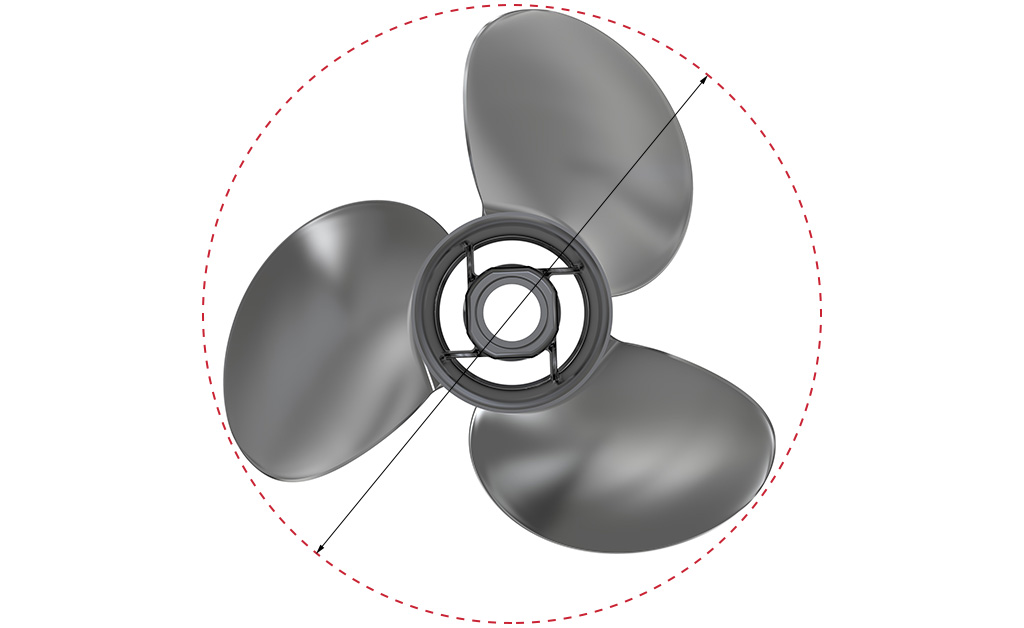
Diameter measures the distance across the circle created by spinning blade tips. This dimension affects how much power your propeller can handle and deliver.
Larger diameter propellers provide more blade area. This means greater thrust and power handling capacity. They work great with heavy boats, towing applications like water skiing, and situations needing strong acceleration from a standstill (holeshot). But there’s a tradeoff. More blade area creates more drag. This limits your top speed.
Smaller diameter propellers generate less drag. The engine can spin at higher RPM and reach better top speeds. They’re perfect for lighter, faster boats where speed matters more than raw pulling power.
Your engine type sets diameter limits. MerCruiser Bravo Two sterndrives accommodate propellers up to 20 inches in diameter for heavy-duty applications. Bravo One and most outboards max out around 16 inches for lighter, faster hulls.
Propeller Pitch: The Speed Controller
Pitch shows the distance your boat advances forward with each propeller rotation. Think of it like gears on a bicycle.
Higher pitch (such as 21 inches versus 19 inches) delivers greater top speed. But it demands more engine power. Your boat accelerates slower. It may struggle getting on plane with heavy loads.
Lower pitch provides aggressive acceleration and superior holeshot performance. But it caps your maximum speed. The engine reaches higher RPM with ease.
A 19-inch pitch propeller might give you 4,200 RPM at WOT. Switching to 21-inch pitch could drop you to 3,800 RPM while adding 3-5 mph to top speed—if your engine has the power to handle it.
Diameter-Pitch Balance for Best Performance
These two dimensions work together as a system. Change one and you need to adjust the other. This maintains proper engine RPM range and efficiency.
For maximum speed: Combine smaller diameter with highest sustainable pitch.
For best acceleration and holeshot: Choose lower pitch regardless of diameter.
For heavy loads and towing: Select larger diameter to handle the power demands.
Higher pitch creates more load on your engine. You’ll often pair it with smaller diameter to prevent overloading. Manufacturers engineer these combinations to keep your engine within its recommended WOT RPM range.
Blade Configuration: 3-Blade vs 4-Blade Propellers
Most boat propellers feature either three or four blades. Each configuration offers clear advantages.
3-blade propellers are the standard choice. They deliver balanced performance between speed and thrust. They’re lighter. They create less drag. They achieve higher top speeds.
4-blade propellers add more blade surface area. This improves grip in the water and reduces slippage. You’ll experience better holeshot, smoother acceleration, and quieter operation. The tradeoff? More drag reduces top-end speed a bit compared to equivalent 3-blade models.
|
Configuration |
Best For |
Performance Trade-off |
|---|---|---|
|
3-Blade |
Top speed, light boats, general use |
Standard acceleration |
|
4-Blade |
Holeshot, heavy loads, rough water |
Lower max speed |
The right propeller balances all three elements—diameter, pitch, and blade count—matched to your engine specifications, boat weight, and intended use.
Step 1: Gather Critical Boat and Engine Specifications
To size a boat propeller, you need precise data about your engine and vessel. Miss even one spec and you’ll get wrong calculations. This wastes money on the wrong propeller.
Essential Engine Data You Must Document
Start with your engine nameplate or manufacturer spec sheet. Record these specs:
-
Horsepower rating – The exact power output in HP or kilowatts
-
Recommended WOT RPM range – A 400-600 RPM window (example: 5000-5500 RPM)
-
Engine model and serial number – This identifies your exact engine variant
-
Gear ratio – How engine speed translates to propeller shaft speed
Your engine’s recommended RPM range at wide open throttle is the most important number. A Yamaha F150 outboard runs best at 5000-6000 RPM. Mercury‘s 3.0L V6 targets 5800-6400 RPM. Run outside these ranges? You damage your engine or waste fuel.
Verify Current Propeller Specifications
Check your existing propeller hub for stamped numbers. These show diameter x pitch (like 14.5 x 19). Note the blade count (3 or 4 blades) and material. Aluminum vs stainless steel affects performance in different ways.
Document your boat’s loaded weight. Include fuel, passengers, and typical gear. A 200-pound difference changes what propeller you need. Heavy boats need different pitch than light ones. This holds true even with identical engines.
This foundation data drives every calculation in the propeller sizing process.
Step 2: Conduct WOT RPM Test to Diagnose Current Propeller Performance
Your engine’s performance at wide open throttle shows whether your boat propeller is sized right. This test takes 15 minutes. The data you get is worth hundreds in avoided mistakes.
Prepare Your Boat for Accurate Testing
Load your boat the same way you use it on typical outings. Fill the fuel tank all the way. Bring your normal passenger count and gear. A half-empty tank or missing passengers skews results by 200+ RPM.
Head to calm water with minimal boat traffic. Trim your boat to its normal cruising position. Choppy conditions or improper trim will mess up your readings.
Execute the WOT RPM Test Sequence
Put your engine in neutral first. Advance the throttle to maximum for 3-5 seconds. This reveals your governed RPM—usually 50-100 RPM above your engine’s rated WOT range. Some engines show higher governed limits.
Now perform your loaded test. Accelerate to wide open throttle with the boat moving. Hold WOT for 10-15 seconds once you reach maximum speed. Record two critical numbers:
-
WOT RPM displayed on your tachometer
-
Top speed from your GPS (speedometers are often inaccurate)
Monitor Exhaust Temperature During Testing
Use an infrared pyrometer to check exhaust system temperatures while at WOT. Dry exhaust portions must stay below 200°F per ABYC safety standards. Water-cooled exhaust sections should remain under 160°F.
High exhaust temperatures mean backpressure problems. This reduces RPM. It also mimics an over-propped engine. Fix exhaust issues before changing your propeller pitch.
Diagnose Your Current Propeller Performance
Compare your WOT RPM reading against your engine manufacturer’s recommended range:
Over-propped engine (WOT RPM falls below recommended range):
Your propeller has too much pitch, too large diameter, or too many blades. The engine can’t reach its target RPM. You’re losing power and risking engine damage. Solution: Reduce pitch by 1 inch and retest.
Under-propped engine (WOT RPM reaches or exceeds governed RPM):
Your propeller has too little pitch or blade area. The engine over-revs under full load. You waste fuel and leave horsepower on the table. Solution: Increase pitch by 1 inch and retest.
Well-matched propeller (WOT RPM sits 0-50 RPM above manufacturer’s maximum):
Your current setup delivers optimal boat performance. The engine operates in its power band without strain.
Calculate Propeller Slip Percentage
Slip shows how well your propeller converts rotation into forward motion. Use this formula:
Theoretical speed = (WOT RPM × Propeller pitch in inches) ÷ 1,056
Slip percentage = (Theoretical speed – GPS measured speed) ÷ Theoretical speed × 100
Example calculation:
– WOT RPM: 5,400
– Propeller pitch: 17 inches
– Theoretical speed = (5,400 × 17) ÷ 1,056 = 86.9 mph
– GPS measured speed: 70 mph
– Slip = (86.9 – 70) ÷ 86.9 = 19.4%
High slip percentages (above 20%) mean your propeller isn’t gripping water well. This signals wrong pitch selection, damaged blades, or improper propeller material for your use.
Document Your Test Results
Record everything before making changes:
-
Current propeller specs (pitch, diameter, blade count)
-
Exact boat load (fuel level, passenger count, gear weight)
-
Weather and water conditions
-
WOT RPM and GPS top speed
-
Cruise RPM at normal throttle settings
Follow Proper Retesting Protocol
Change pitch by 1 inch at a time. Jumping 2-3 inches risks overshooting optimal performance. Test again with identical load and conditions.
Adding weight (full fuel tanks, passengers, fishing gear) will drop WOT RPM. Compensate by reducing pitch 1 inch or switching from 3-blade to 4-blade setup for better grip.
Check These Issues Before Changing Props
Don’t blame your propeller for engine problems. Verify these systems first:
-
Exhaust backpressure – High pressure reduces RPM and masks the real issue
-
Engine tune – Spark plugs, fuel injectors, air filters affect performance
-
Fuel delivery – Restricted fuel flow limits power output
-
Valve adjustment – Critical on older engines
Confirm engine health before you adjust propeller pitch. Otherwise you’re treating symptoms instead of root causes.
This systematic WOT testing removes guesswork from propeller sizing. You’ll know whether to increase pitch for better boat speed and acceleration or decrease it to prevent an over-propped engine from damaging itself.
Step 3: Calculate Optimal Propeller Pitch Using the 150-200 RPM Rule
The marine industry has one reliable shortcut for propeller pitch selection: every 1-inch pitch change shifts your WOT RPM by 150-200 RPM. Increase pitch and your RPM drops. Decrease pitch and your RPM climbs. This rule cuts out guesswork. Your WOT test shows your engine running outside its recommended range? Use this method.
The RPM-Per-Inch Calculation Method
Here’s how the math works in real conditions:
Increasing pitch by 1 inch reduces WOT RPM by 150-200 RPM. Your engine takes on more load. It spins slower but pushes the boat faster at top end.
Decreasing pitch by 1 inch increases WOT RPM by 150-200 RPM. Less resistance means the engine revs higher. You get better acceleration.
|
Pitch Change |
RPM Effect |
Correction Scenario |
|---|---|---|
|
+1″ pitch |
-150 to -200 RPM |
Engine over-revving above max spec |
|
-1″ pitch |
+150 to +200 RPM |
Engine under-revving below min spec |
|
+2″ pitch |
-300 to -400 RPM |
Severe over-rev requiring major correction |
Calculate Required Pitch Change Using Percentage Method
The percentage approach gives you more precision than the fixed 200-RPM rule. Follow these steps:
Step 1: Record your current WOT RPM from testing. Example: 5,000 RPM with a 19-inch pitch propeller.
Step 2: Find your engine’s target maximum RPM. Example: 6,000 RPM for a typical 4-stroke outboard.
Step 3: Calculate the RPM shortfall percentage:
– Formula: (Current RPM ÷ Target RPM) × 100
– Example: (5,000 ÷ 6,000) = 0.8333 or 83.33%
– Shortfall: 100% – 83.33% = 16.67% below target
Step 4: Use the shortfall percentage with your current pitch:
– Formula: Current pitch × Shortfall percentage = Pitch reduction needed
– Example: 19 inches × 0.1667 = 3.17 inches
– New target pitch: 19 – 3.17 = 15.83 inches (round to 16 inches)
Real-World Pitch Calculation Examples
Example 1: Under-Revving Outboard
A 4-stroke outboard rated for 5,000-6,000 RPM runs at 5,000 RPM with a 19-inch pitch propeller at WOT.
-
Target: 6,000 RPM (upper range for best performance)
-
Current: 5,000 RPM
-
Shortfall: 5,000 ÷ 6,000 = 83.33% (16.67% short)
-
Pitch adjustment: 19″ × 0.1667 = 3.17″ reduction
-
New pitch: 16 inches
After installing the 16-inch propeller, WOT RPM should reach around 6,000 RPM.
Example 2: Small Engine Precision Calculation
A Tohatsu 18hp 4-stroke rated at 5,800 RPM maximum achieves 5,000 RPM with a 10-inch pitch at WOT.
-
Shortfall: 5,000 ÷ 5,800 = 86.2% (13.8% short)
-
Pitch reduction: 10″ × 0.138 = 1.38 inches
-
New pitch: 8.6 inches (select 8.5″ or 9″ depending on availability)
The percentage method stops over-correction. The basic 200-RPM rule would suggest a 4-inch drop (800 RPM ÷ 200). This results in a 6-inch pitch that would over-rev the engine too much.
Set Your Target RPM Within the Manufacturer Range
Don’t aim for the middle of your engine’s WOT range. Target the upper end – 100-200 RPM below the maximum specified RPM.
Running at the high end gives you maximum power output and boat speed. Your engine operates in its peak efficiency zone. This also handles extra load from passengers, gear, or rough water. You won’t drop below minimum spec.
Understand the Rule’s Limitations
The 150-200 RPM guideline works for propellers of the same style, diameter, and blade count. Changing from a 3-blade to 4-blade setup affects the calculation. Switching propeller materials changes things too.
The percentage method beats the fixed 200-RPM-per-inch rule. This is true for larger pitch adjustments over 2 inches.
Make pitch changes in 1-inch increments. Test after each change. Use the same boat load and water conditions from your original WOT test. This approach stops you from overshooting your target. You won’t need to buy multiple propellers.
Step 4: Select the Right Propeller Diameter for Your Boat Type
Propeller diameter is the full circle your blade tips make during rotation. Measure twice the distance from hub center to blade tip. This size controls how much blade surface touches the water. It also controls how much power your propeller can transfer.
Match Diameter to Your Boat’s Weight and Speed Profile
Heavy, slower boats need larger diameter propellers. The MerCruiser Bravo Two sterndrive fits the heaviest pleasure boats. It accepts propellers up to 20 inches in diameter. This massive blade area creates the thrust you need for wakeboarding, surfing, and towing heavy loads.
Lighter, faster boats work better with smaller diameters. Bravo One sterndrives and modern outboards max out at 16 inches diameter. Less blade area means less drag. Your engine spins faster. Your boat reaches higher top speeds.
Here’s the basic rule: match diameter to load. Heavier boats need bigger propellers. Small, fast hulls run better with compact diameters.
Understand the Performance Trade-offs
Larger diameter propellers pack more total blade surface area into the water. Better contact transfers engine power better. You get more thrust—critical for getting heavy boats on plane or pulling multiple skiers. Wake sports boats gain major benefits. A 14.5-inch diameter minimum delivers the low-end torque wakeboarding and surfing need.
But size costs you speed. More blade area creates more drag. This drag builds at higher speeds. Large propellers also carry more spin weight. The engine works harder to turn them. Top speed drops.
Mid-size diameter propellers balance performance for mixed-use boats. You get enough thrust for occasional towing. Plus better performance for high-speed activities like slalom skiing and barefoot skiing.
Verify Critical Clearance Requirements
Measure the gap between your hull bottom and the propeller blade at its closest point. ¾ inch clearance is the recommended minimum. You can push to ⅝ inch absolute minimum if needed, but no less.
Check your trailer too. Cross members, prop guards, or support structures can hit larger diameter propellers during loading and transport. A propeller that clears your hull might still strike your trailer.
Confirm Bore Size Compatibility
Propeller bore must match your boat’s prop shaft. These aren’t swappable.
Inboard boats usually use 1-inch, 1⅛-inch, or 1¼-inch tapered bore sizes. Spline bore propellers fit 2003 and newer Mastercraft boats along with other specific models. Order the wrong bore and your propeller won’t mount. Perfect diameter and pitch specs won’t matter.
Account for Diameter Variations Within Propeller Lines
Manufacturers adjust diameter across their pitch ranges to boost performance. A Mercury Spitfire X7 measures 13 x 17 (13-inch diameter, 17-inch pitch). The Mercury Trophy Plus with the same pitch specs measures 13.75 x 17. That extra 0.75 inches of diameter changes the performance profile.
Different propeller models targeting different uses show diameter changes even with matching pitch. Engineers design these combinations on purpose. The diameter-pitch pairing controls whether a propeller excels at acceleration, top speed, or heavy load handling.
Adjust Pitch If Diameter Changes Don’t Hit Target RPM
Pick diameter based on boat type and clearance first. Then fine-tune with pitch adjustments:
-
Add 1 inch pitch: Drops WOT RPM by 150-200
-
Subtract 1 inch pitch: Raises WOT RPM by 150-200
-
Switch from 3-blade to 4-blade: Reduces WOT RPM by 50-100 with same diameter and pitch
Diameter sets your thrust capacity and drag profile. Pitch dials in exact RPM targeting within your engine’s recommended range. Master both and you’ll nail the best boat performance on your first propeller pick.
Propeller Size Quick Reference Calculator and Adjustment Tables
Skip the manual calculations. These tables and calculators show you the right propeller size. Just plug in your engine specs and boat type.
Basic Pitch Adjustment Reference Table
Run your WOT RPM test first. Check where your current performance lands. Then make the pitch change shown below:
|
Current WOT RPM vs Target |
RPM Difference |
Pitch Adjustment Needed |
Example: Current 19″ Pitch |
|---|---|---|---|
|
200-300 RPM below target |
Under-propped |
+1 inch pitch |
Switch to 20″ |
|
400-600 RPM below target |
Heavily under-propped |
+2 inches pitch |
Switch to 21″ |
|
Within 0-100 RPM of max target |
Optimal match |
No change needed |
Keep 19″ |
|
200-300 RPM above max target |
Over-propped |
-1 inch pitch |
Switch to 18″ |
|
400-600 RPM above max target |
Heavily over-propped |
-2 inches pitch |
Switch to 17″ |
Propeller Selection Calculator by Boat Type
Find your boat type below. Start with these specs. Then run WOT tests to fine-tune:
|
Boat Type |
Recommended Diameter |
Recommended Pitch Range |
Blade Count |
Material Priority |
|---|---|---|---|---|
|
Pontoon boats |
13.5-14.5″ |
13-17″ |
3-blade |
Aluminum (cost) |
|
Aluminum fishing boats |
13-14″ |
15-19″ |
3-blade |
Aluminum |
|
Fiberglass bass boats |
14-15″ |
19-23″ |
3-4 blade |
Stainless steel |
|
Wake sports boats |
14.5-15″ |
13-15″ |
4-blade |
Stainless steel |
|
Cruisers (20-26 ft) |
14-16″ |
19-21″ |
3-blade |
Stainless steel |
|
Offshore fishing (26+ ft) |
15-16″ |
21-24″ |
3-4 blade |
Stainless steel |
Diagnosing Common Propeller Sizing Problems and Solutions
Your boat feels sluggish despite a healthy engine. Or maybe it vibrates too much at cruising speed. These symptoms point to propeller sizing issues. They cost you performance and money every time you’re on the water.
Recognize the Warning Signs of Propeller Mismatch
Engine struggles to reach WOT RPM range: Your tachometer shows 4,800 RPM when it should hit 5,500 RPM. This over-propped condition forces your engine to work harder than designed. Running below minimum RPM for long periods causes carbon buildup. You’ll also get fouled spark plugs and early engine wear.
Engine exceeds maximum rated RPM: You’re hitting 6,200 RPM when the limit is 6,000 RPM. This under-propped scenario creates too much wear on pistons, bearings, and valves. You’re burning extra fuel. Plus, you’re getting less thrust.
Poor acceleration and weak holeshot: Heavy boats need strong thrust to get on plane fast. Does your boat take 15+ seconds to plane? Can’t lift loaded passengers well? Your propeller diameter is too small. Or your pitch is too high for the load.
Too much vibration at certain speeds: Vibration that gets worse at specific RPM ranges signals propeller imbalance or cavitation. This damages shaft bearings, seals, and engine mounts over time.
Abnormal fuel consumption: A 20-30% increase in fuel burn compared to manufacturer specs tells you something. Your propeller isn’t transferring power well. You’re wasting money on every trip.
Calculate Actual vs. Theoretical Performance Gap
Measure the gap between what your propeller should deliver and what you’re getting:
Step 1: Calculate theoretical boat speed using this formula:
– Theoretical speed (mph) = (WOT RPM × Pitch in inches × 60) ÷ (Gear ratio × 63,360)
Step 2: Compare against GPS-measured actual speed at WOT.
Step 3: Calculate the performance gap:
– Performance gap % = ((Theoretical speed – Actual speed) ÷ Theoretical speed) × 100
Critical threshold: Does your performance gap exceed 25% below theoretical predictions? Your propeller sizing is way off. Research on unmanned aircraft propellers shows this applies to marine use too. Efficiency drops of 25% or more mean diameter or pitch mismatch with how you operate.
Diagnose Specific Propeller Problems by Symptoms
|
Symptom |
Root Cause |
Pitch Change Needed |
Diameter Consideration |
|---|---|---|---|
|
WOT RPM 300+ below minimum |
Over-propped |
Reduce 2 inches |
Consider smaller diameter |
|
WOT RPM 300+ above maximum |
Under-propped |
Increase 2 inches |
Adequate diameter |
|
Good WOT RPM but slow acceleration |
Pitch too high for load |
Reduce 1 inch |
Increase diameter for thrust |
|
Good acceleration but low top speed |
Pitch too low |
Increase 1-2 inches |
Current diameter OK |
|
Cavitation noise at acceleration |
Too much blade load |
Reduce pitch or add blades |
Switch to 4-blade |
|
Vibration at cruising speed |
Propeller damage or imbalance |
Inspect/replace propeller |
Check for bent blades |
Use Acoustic Diagnostics to Detect Hidden Problems
Cavitation creates a unique high-frequency noise. You can measure it even without expensive equipment. Listen for a crackling or popping sound during acceleration or at high RPM. This tells you your propeller blades are creating vapor bubbles. These bubbles collapse hard against the blade surface.
Modern diagnostic approach: Record sound pressure levels (SPL) during operation. Use a smartphone app with frequency analysis. Cavitation shows up in higher frequency ranges. This is around 8-20 kHz depending on propeller size.
Cavitation damage shows as pitting on blade surfaces. Inspect your propeller once a year for:
– Small craters or eroded areas on blade faces
– Rough texture on smooth surfaces
– Material loss near blade tips or leading edges
Ongoing cavitation means your pitch is too aggressive. It doesn’t match your boat’s speed and load profile. Drop 1-2 inches in pitch to reduce blade loading.
Test Multiple Variables Step by Step
Don’t change everything at once. Follow this diagnostic sequence:
Test 1 – Baseline: Record WOT RPM, top speed, acceleration time (0-20 mph), and fuel consumption with current propeller.
Test 2 – Pitch adjustment: Change pitch by 1 inch. Keep same diameter and blade count. Retest all metrics.
Test 3 – Blade count: Did pitch adjustment fail to solve the problem? Switch from 3-blade to 4-blade (or vice versa). Keep pitch and diameter the same.
Test 4 – Diameter: Adjust diameter if clearance allows. Do this if performance gap stays above 20%.
Document every test with identical boat load and water conditions. Variables like half-full vs. full fuel tanks create 150+ RPM swings. These hide the real impact of propeller changes.
Cost-Benefit Filter
A new stainless steel propeller costs $400-800. Aluminum replacements run $100-250. Before buying, calculate potential savings:
Fuel savings example:
– Current consumption: 12 gallons/hour at $4.50/gallon = $54/hour
– Expected improvement with correct prop: 20% reduction = save $10.80/hour
– Annual usage: 100 hours = $1,080 saved per year
The right propeller pays for itself in one season through fuel savings alone. Add the performance gains and engine protection. Proper sizing becomes a clear win.
Professional Testing Makes Sense Sometimes
DIY diagnostics work for most recreational boaters. But competitive applications or high-value commercial vessels need professional propeller analysis. Marine performance shops use bi-axial load cells. These measure thrust and torque straight up. Hall effect sensors track exact rotational speed. These precise measurements remove guesswork.
Professional testing costs $200-500. You get exact specifications. This matters for tournament bass boats, offshore race boats, or commercial vessels. A 5% performance gain translates to competitive advantage here. Or big fuel cost reduction across thousands of operating hours.
For typical recreational use, the WOT RPM test works great. Combine it with step-by-step pitch changes. You get 90% of the optimization at 10% of the cost.
Choosing Between 3-Blade and 4-Blade Propellers for Your Application
Blade count changes how your boat performs. The choice between 3-blade and 4-blade propellers isn’t about which is “better.” Match blade configuration to your boating needs.
3-Blade Propellers: Best for Speed and Efficiency
3-blade propellers work best at higher RPM ranges. Less blade surface means less drag. Your engine spins with less resistance. Top speed jumps by 2-4 mph versus 4-blade models with the same pitch and diameter.
Light to mid-weight boats perform best with 3-blade setups. Aluminum fishing boats, ski boats, and performance cruisers all benefit. You get balanced performance without losing speed.
Fewer blades save fuel. Tests show propeller performance drops as blade count goes up. A 3-blade setup uses 5-8% less fuel at cruising speeds versus 4-blade options.
4-Blade Propellers: Built for Power and Control
Heavy boats need 4-blade thrust. More blade surface grabs water better. You’ll see huge holeshot gains—getting on plane 20-30% faster with full loads or towing gear.
Wake sports boats need 4-blade low-end torque. Wakeboarding and wake surfing demand instant power at low speeds. The extra blade grabs and transfers engine power better during these quick starts.
Rough water handling gets better with 4-blade designs. More blades cut ventilation problems in choppy water. Your boat keeps steady thrust and runs smoother through waves.
Quiet operation favors 4-blade configurations. More blades spread thrust loads across more surfaces. This cuts vibration by 15-25% and runs quieter—key for fishing boats where noise scares fish.
The Power-to-Blade Relationship
Engine horsepower sets optimal blade count. Higher power engines need more blades to use available torque. A 150HP+ outboard pushing a heavy pontoon boat wastes power with a 3-blade setup. The engine can’t push all its torque through limited blade area.
Diameter limits push blade count up. Got clearance limits blocking larger propellers? Adding a blade fixes this. A 13.5-inch 4-blade propeller gives similar thrust to a 14.5-inch 3-blade model.
RPM operating range matters. High-RPM uses (5,000+ RPM) run better with 3-blade designs. Lower RPM heavy work (under 4,000 RPM) gains from 4-blade power absorption.
Performance Trade-off Summary
|
Your Priority |
Choose 3-Blade |
Choose 4-Blade |
|---|---|---|
|
Maximum top speed |
✓ |
|
|
Best fuel economy |
✓ |
|
|
Quick holeshot with heavy loads |
✓ |
|
|
Smooth operation in rough water |
✓ |
|
|
Wake sports (boarding, surfing) |
✓ |
|
|
Reduced vibration and noise |
✓ |
|
|
General recreational boating |
✓ |
|
|
Commercial fishing or diving |
✓ |
Make Your Selection Based on Primary Use
Choose 3-blade if: You spend 70%+ of your time at cruising speeds. Fuel efficiency matters to you. Or you run a lighter boat for speed activities like water skiing or cruising.
Choose 4-blade if: You carry heavy loads often. You need strong starts from standstill. You run in choppy waters a lot. Or you use your boat for wake sports and work.
Test both setups if you’re torn between uses. Switching from 3-blade to 4-blade (same pitch and diameter) drops RPM by 200-300. This is normal. Reduce pitch 1 inch on the 4-blade to keep target WOT RPM while getting the thrust gains.
Aluminum vs Stainless Steel Propellers: Material Selection Guide
Your material choice hits your wallet twice. First at purchase. Then through performance over the propeller’s life. Aluminum propellers cost $100-150. Stainless steel runs $200-300. Premium models like Mercury Enertia hit $955. That price gap explains why aluminum dominates sales at a 10:1 ratio over stainless steel.
Performance Differences Between Materials
stainless steel propellers add 3-5 mph top speed on 225HP engines. Smaller motors show less gain. 25HP engines show minimal difference. Thinner stainless steel blades create less drag. Your engine reaches higher RPM at wide open throttle. Fuel economy improves. Blades hold their shape under load.
Aluminum blades flex during rotation. This flex reduces actual pitch below the stamped spec. A 19-inch aluminum propeller might deliver 17-18 inches of pitch at WOT. Stainless steel maintains true pitch. Less flex means better thrust transfer. You also get lower fuel use.
Durability and Damage Resistance
Stainless steel weighs twice as much as aluminum. But that weight brings strength. Thinner blade profiles resist impact damage far better than thick aluminum designs.
Aluminum acts as a sacrificial part. Hit an underwater obstacle and your propeller absorbs the shock. The soft metal bends or breaks before damaging your expensive shaft seals and lower unit. Replacement costs $100-150.
Stainless steel resists impact but needs protection. Modern designs include shock-absorbing rubber hubs. The propeller slips on the shaft during strikes. This prevents shaft and seal damage in most cases. Advanced “cup” designs feature a curved lip on blade edges. These increase water grip and reduce cavitation.
Repair economics favor replacement over fixing. Aluminum repairs cost about as much as new propellers. The metal loses strength after heating and reshaping. Stainless steel repair runs higher. The material keeps its original strength though.
Match Material to Engine Size and Use
Outboards 125HP or less: Choose aluminum. Stainless steel weight hurts performance on smaller engines.
Outboards 150HP+: Upgrade to stainless steel for better speed and efficiency.
V-8 inboard/outboard engines: Stainless steel required. High-power applications need the material’s strength.
Saltwater operation: Stainless steel handles corrosive environments better. Most saltwater boats run higher horsepower anyway.
Switching from aluminum to stainless steel? Reduce pitch by 1-2 inches. Stainless steel’s better efficiency creates more thrust at lower pitch specs than aluminum.
When Aluminum Makes Sense
Pick aluminum for testing your best propeller setup. Trying different pitch and diameter combos gets expensive with stainless steel. Buy a $120 aluminum prop to dial in specs. Then invest in stainless steel once you know what works.
Stock a spare aluminum propeller for emergencies. Dealers carry 10 times more aluminum inventory than stainless steel. You’ll find replacement options right away. Stainless steel props back-order for months during busy seasons.
Shallow, rocky waters might favor aluminum despite performance trade-offs. Frequent prop strikes make the sacrificial protection worth it. You’ll accept regular replacements though.
When Stainless Steel Wins
High-performance applications need stainless steel’s rigid blades. Racing, tournament fishing, and offshore runs all benefit from the 3-5 mph speed gain. Plus better fuel economy.
Abrasive conditions like shallow sandy waters wear aluminum fast. Stainless steel lasts years longer despite higher initial cost.
Extended range needs make stainless steel efficiency critical. Better fuel economy per tank means more operating range between fill-ups.
Calculate total cost over 5 years. Stainless steel’s $200+ price premium often pays back through fuel savings. You also avoid multiple aluminum replacements.
Real-World Case Studies: Propeller Sizing for Different Boat Types
Proper propeller sizing delivers measurable results across every vessel type. These examples show how diameter, pitch, and material choices translate into performance gains you can measure and count on.
Case Study 1: 22-Foot Bass Boat Performance Transformation
Vessel Profile: Ranger Z520L bass boat, 22 feet, loaded weight 2,850 lbs, Mercury 250HP Pro XS outboard
Original Setup Problems:
– WOT RPM: 5,200 (target range 5,800-6,200)
– Top speed: 68 mph GPS
– Holeshot time (0-plane): 4.2 seconds
– Propeller: Mercury Tempest Plus 15.25″ diameter × 26″ pitch, 3-blade aluminum
Analysis: The boat ran way over-propped. WOT RPM sat 600-1,000 RPM below minimum spec. The engine struggled under too much load. Fuel consumption hit 18 gallons/hour at WOT—far above the manufacturer’s 14-gallon rating.
Solution Applied: Switched to Mercury Enertia 15″ diameter × 24″ pitch, 4-blade stainless steel propeller. The 2-inch pitch reduction combined with added blade area from the 4-blade design.
Results After Change:
– WOT RPM: 6,100 (within optimal range)
– Top speed: 71 mph (+3 mph gain)
– Holeshot time: 3.1 seconds (26% faster)
– Fuel consumption at WOT: 14.5 gallons/hour (19% reduction)
– Tournament hole acceleration improved for shallow water fishing
Key Lesson: Stainless steel’s rigidity plus proper pitch correction delivered both speed gains AND fuel savings. The 4-blade setup added low-end thrust without giving up top speed thanks to correct pitch matching.
Case Study 2: Pontoon Boat Cruise Optimization
Vessel Profile: Bennington 24 SSRX pontoon, 24 feet, typical load 3,200 lbs (8 passengers + gear), Yamaha F150 outboard
Original Setup Problems:
– WOT RPM: 6,400 (target range 5,000-6,000)
– Top speed: 28 mph
– Too much engine noise at cruise
– Propeller: Yamaha 13.5″ diameter × 15″ pitch, 3-blade aluminum
Analysis: Classic under-propped case. The engine over-revved by 400+ RPM. This wasted fuel and created extra engine wear. The boat left available torque on the table.
Solution Applied: Yamaha Saltwater Series II 13.75″ diameter × 17″ pitch, 4-blade stainless steel. Added 2 inches pitch to bring RPM down. Switched to 4-blade for smoother pontoon operation and better rough water handling.
Results After Change:
– WOT RPM: 5,900 (perfect placement in range)
– Top speed: 32 mph (+4 mph improvement)
– Cruise RPM (20 mph): Dropped from 4,800 to 4,200
– Fuel economy at cruise: Improved 22% (9.2 mpg vs. 7.5 mpg)
– Vibration reduced, cabin conversation became quieter
Key Lesson: Pontoon boats love 4-blade setups. The added diameter (0.25″) plus proper pitch correction changed cruising comfort. The owner reported one-third longer range per fuel tank.
Case Study 3: Wake Sports Boat Holeshot Recovery
Vessel Profile: Malibu Wakesetter 23 LSV, 5,400 lbs ballasted, Malibu Monsoon 410HP engine
Original Setup Problems:
– Slow holeshot with 1,200 lbs ballast loaded
– Time to plane: 6.8 seconds (too slow for wake surfing)
– Poor low-end torque response
– Propeller: 15″ diameter × 15″ pitch, 3-blade stainless steel
Analysis: Wake boats operate at low RPM ranges (3,200-3,800 typical). This boat needed maximum thrust at those speeds. The 3-blade setup couldn’t transfer available engine torque well.
Solution Applied: ACME 15″ diameter × 13″ pitch, 4-blade stainless steel with aggressive cup design. Reduced pitch 2 inches to optimize for ballasted operation. Added blade for low-speed grip.
Results After Change:
– Time to plane (full ballast): 3.4 seconds (50% faster)
– Pull strength for wake surfing: Much better wave shape
– WOT RPM: 3,600 (ideal for this use)
– Fuel consumption during surfing sessions: Reduced 18%
– Driver could hold slower speeds (9-11 mph) with better wave creation
Key Lesson: Wake sports boats operate outside normal performance curves. Lower pitch than “standard” recommendations works better. The 4-blade design proved key for ballasted low-speed power delivery. Propeller diameter stays at 14.5-15″ maximum due to hull clearance and shaft load limits.
Case Study 4: Offshore Fishing Boat Efficiency Upgrade
Vessel Profile: Grady-White Canyon 306, 30 feet, loaded weight 9,200 lbs, Twin Yamaha F300 outboards
Original Setup Problems:
– Range anxiety on offshore trips (80+ miles one-way)
– WOT RPM: 5,600 per engine (target 5,500-6,000)
– Fuel consumption: 32 gallons/hour combined at 35 mph cruise
– Propellers: Yamaha 14.5″ diameter × 19″ pitch, 3-blade aluminum (both engines)
Analysis: RPM sat acceptable but at the low end. Room existed for better performance. Aluminum propellers flexed under load, losing 5-8% efficiency. The boat spent 90% of operating time at 30-40 mph cruise speeds, not WOT.
Solution Applied: Yamaha Saltwater Series II 14.5″ diameter × 21″ pitch, 4-blade stainless steel on both engines. Increased pitch 2 inches to optimize cruise efficiency. Stainless steel stopped blade flex.
Results After Change:
– WOT RPM: 5,800 per engine (optimized)
– Top speed: 48 mph (+3 mph)
– Cruise fuel consumption (35 mph): 24 gallons/hour (25% reduction)
– Operating range: Increased from 210 miles to 280 miles per tank
– Vibration at cruise: Reduced, less gear rattling
Key Lesson: Offshore boats benefit most from cruise optimization, not WOT tuning. The 4-blade stainless steel combo delivered $200+ fuel savings per offshore trip. Investment paid back in 8 trips. The added range removed anxiety about reaching offshore fishing grounds and getting back safe.
Case Study 5: Aluminum Fishing Boat Shallow Water Setup
Vessel Profile: Lund 1875 Pro-V, 18.5 feet, loaded weight 1,850 lbs, Mercury 115HP four-stroke
Original Setup Problems:
– Frequent propeller strikes in 2-4 foot depths
– Replacement costs mounting ($140 per prop, 3 replacements per season)
– WOT RPM: 5,400 (target 5,000-5,500)
– Propeller: Mercury Black Max 13.25″ diameter × 19″ pitch, 3-blade aluminum
Analysis: Performance matched specs well. But the operating area (shallow rocky lakes) caused constant damage. stainless steel propellers ($450+) risked lower unit damage during strikes.
Solution Implemented: Kept aluminum material for protection. Switched to Mercury Spitfire 13″ diameter × 17″ pitch, 4-blade aluminum. Reduced pitch 2 inches and diameter 0.25″ for better shallow water clearance.
Results After Change:
– WOT RPM: 5,500 (maintained proper range)
– Top speed: 41 mph (vs. 43 mph original, acceptable trade-off)
– Propeller strikes per season: Reduced by 60% due to smaller diameter
– Replacement frequency: Once per season vs. three times
– Annual propeller costs: $140 vs. $420 (67% savings)
Key Lesson: Material selection depends on operating area as much as performance goals. This boat put durability and replacement cost over maximum speed. The 4-blade aluminum setup maintained good performance while cutting damage frequency. Stainless steel would’ve added 2 mph top speed but risked $1,500+ lower unit repairs after hard strikes.
Performance Gains Summary Table
|
Boat Type |
Critical Change |
Primary Benefit |
Measurable Result |
|---|---|---|---|
|
Bass Boat |
Pitch -2″, 4-blade stainless |
Engine protection + speed |
+19% fuel economy, +3 mph |
|
Pontoon |
Pitch +2″, 4-blade stainless |
Cruise optimization |
+22% fuel economy, +4 mph |
|
Wake Boat |
Pitch -2″, 4-blade aggressive cup |
Low-end torque |
50% faster holeshot |
|
Offshore |
Pitch +2″, stainless steel twins |
Range extension |
+33% operating range |
|
Shallow Fishing |
Diameter -0.25″, 4-blade aluminum |
Damage reduction |
67% lower annual costs |
Key Takeaway Pattern
Every successful propeller optimization followed the same steps: accurate WOT testing, precise RPM gap calculation, targeted pitch adjustment, then material and blade count selection based on primary use. The boats showing biggest gains had badly mismatched original setups—off by 2+ inches in pitch or wrong blade count for their use.
Critical Mistakes to Avoid When Sizing Boat Propellers
Most propeller sizing failures happen because people ignore basic physics and manufacturer specs. These errors hurt your performance. They damage your engine. They waste money on props you’ll just replace.
Installing Props Without Checking WOT RPM Range
Never install a propeller without checking your engine’s WOT RPM specs first. Every engine has a narrow operating window—400-600 RPM wide. Yamaha F150 outboards run 5000-6000 RPM. Mercury sterndrives target 4200-5000 RPM. Run outside these ranges? You destroy engine parts through excess wear or carbon buildup.
Check your owner’s manual before buying anything. Write down the exact minimum and maximum WOT RPM for your engine model and year. Engines from the same maker change across production years.
Over-Propping Your Engine
An over-propped engine can’t reach minimum WOT RPM. Your tachometer shows 5200 RPM. It should hit 5800+ RPM. The propeller pitch is too high or diameter is too large. Your engine strains under excess load.
This mistake creates a chain of problems:
– Internal parts overheat from constant high-load running
– Slow acceleration makes getting on plane take twice as long
– Fuel use jumps 20-30% as the engine works harder
– Poor hole shot with passengers or gear
Fix: Drop pitch by 1-2 inches. Retest WOT RPM under the same load.
Under-Propping and Over-Revving
Under-propped setups let your engine exceed maximum rated RPM. You’re hitting 6200 RPM. The limit is 6000 RPM. The propeller has too little pitch or blade area. Your engine spins too fast without moving power well.
Results of ongoing over-revving:
– Rev limiter kicks in all the time (around 6000-6300 RPM)
– Piston rings, bearings, and valves wear out fast
– Cavitation noise signals blade damage happening now
– Less thrust despite high RPM—you’re not going faster
Fix: Increase pitch by 1-2 inches or switch from 3-blade to 4-blade setup.
Choosing Diameter Without Considering Your Hull
Propeller diameter must clear your hull by ¾ inch minimum. Larger diameter adds thrust for heavy loads and towing. But it also increases drag and drops top speed. Install a 16-inch diameter on a boat with tight clearances? You’ll strike the hull under hard turns or in rough water.
Diameter selection errors:
– Too large: Excess drag kills top speed and fuel economy
– Too small: Not enough thrust for your boat’s weight and use
– Wrong clearance: Contact damages both propeller and hull
Measure clearance between your current propeller tip and hull bottom at the closest point. Stay above ⅝ inch bare minimum.
Ignoring the Pitch-Diameter Balance
Pitch and diameter work as a matched system. Change one without adjusting the other? You’ll miss target RPM. A 15.5″ diameter × 23″ pitch propeller drops to 5400 RPM. But you need 5800-5900 RPM. Switch to 15.5″ × 21″ pitch (2 inches less) and you hit the right range.
Common imbalance scenarios:
– High pitch + large diameter = severe over-propping
– Low pitch + small diameter = excess over-revving
– Diameter too big for available engine power
Rule: Higher pitch needs smaller diameter to keep RPM balanced. Lower pitch allows larger diameter without overloading.
Skipping Load Testing With Actual Use Weight
That perfect WOT RPM reading with just you aboard? It means nothing. Add four passengers, full fuel tanks, and fishing gear—now you’re 800 pounds heavier. Your RPM drops 300+ from the extra load.
Test propeller performance under these real conditions:
– Full fuel tanks (not half-empty)
– Your usual passenger count
– Standard gear and equipment loaded
– Water conditions you run in most
A boat hitting 5800 RPM solo might drop to 5400 RPM loaded. That’s over-propped for real use. Reduce pitch 1 inch to balance for your usual operating weight.
Using Wrong Blade Count for Your Application
Blade area ratio sets low-end thrust and efficiency. 3-blade propellers deliver 50-55% diameter area ratio. 4-blade models jump to 60-65% DAR. This difference shifts performance traits a lot.
Blade count mistakes:
– 3-blade on heavy pontoon boats: Poor holeshot and weak low-speed power
– 4-blade on light performance boats: Extra drag kills 2-3 mph top speed
– Wrong count drops WOT RPM by 50-100 without pitch adjustment
Wake boats, pontoons, and heavy cruisers need 4-blade thrust. Light fishing boats and performance hulls run better with 3-blade efficiency.
Causing Cavitation Through Poor Sizing Choices
Propeller blades spinning too fast create vapor pockets that collapse hard. You’ll hear crackling or popping sounds during acceleration. Cavitation eats away blade surfaces through repeated vapor bubble collapse. This damage shows as pitting and rough texture.
Sizing issues that cause cavitation:
– Pitch too strong for boat speed and load profile
– Diameter too small creating excess blade loading
– Under-propped engine spinning blades beyond efficient speed range
Cavitation cuts thrust by 15-25% while wrecking your propeller. Drop pitch 1-2 inches to reduce blade loading and stop the noise.
Ignoring Manufacturer Specs
Your boat and engine manuals list key specs for a reason. Maximum boat weight, horsepower rating, recommended propeller ranges—these numbers prevent mechanical failures. Ignore them? You overload parts beyond design limits.
Spec violations that cause problems:
– Installing propellers outside maker diameter ranges
– Going over maximum boat weight for hull and engine combo
– Using pitch ranges not tested for your engine model
An engine rated for 15.5″ maximum diameter will overheat and fail if you mount a 17″ propeller. The shaft bearings and seals can’t handle the increased torque loads.
Sacrificing Fuel Efficiency for Wrong Performance Gains
Pitch selection controls fuel use. Too-high pitch strains your engine to maintain RPM. Fuel burn jumps as the powerhead works harder. Too-low pitch over-revs without speed gains. You’re burning extra fuel for noise instead of thrust.
Best fuel efficiency needs:
– WOT RPM at upper end of maker range (within 100 RPM of maximum)
– Right pitch for cruise speeds where you spend 70%+ of operating time
– Diameter matched to your usual load weight
A 2-inch pitch error costs 15-20% fuel economy across all running conditions. Choose efficiency over small top-speed gains unless you’re racing.
Using Professional Propeller Selector Tools and Expert Resources
Modern propeller selector tools take the guesswork out of sizing. These digital tools combine manufacturer data with performance formulas. They match your exact engine and boat specs.
Major Manufacturer Online Selectors
Mercury Propeller Selector covers outboard, wake, and sterndrive applications. Put in your engine model. The tool shows you compatible propeller options across their product line. You’ll see diameter, pitch, and blade count recommendations for your powerhead.
Turning Point Prop Wizard gives you two search options. Search by engine and drive specs. Or enter your current propeller’s part number. The database checks thousands of models. It suggests alternatives or upgrades.
Solas Prop Finder Tool is great for OEM cross-referencing. It covers BRP, Evinrude, Johnson, Honda, Mariner, Mercury, Mercruiser, Suzuki, Volvo, and Yamaha. Enter your original factory propeller number. Find direct replacements plus performance upgrades.
WakeMAKERS PropFinder Tool focuses on application-based recommendations. Tell it what you need: watersports performance or general recreational use. The tool adjusts suggestions based on your year, make, and model.
Essential Data These Tools Require
Prepare these specs before using any selector:
Current Propeller Details:
– Diameter and pitch (from hub stampings)
– Rotation direction (right-hand = clockwise, left-hand = counterclockwise)
– Blade count (3 or 4)
– Material type (aluminum or stainless steel)
– Manufacturer part number
– Shaft diameter plus spline or keyway setup
Engine Information:
– Number of engines (single or twins)
– Rated horsepower
– Gear case size
– Current WOT RPM reading
– Manufacturer, model year, and serial number
– Engine size (cubic inches or CC)
– Power trim or trim tab installation
Boat Specifications:
– Length overall (LOA)
– Hull material (fiberglass, aluminum)
– Manufacturer and model year
– Hull shape (V-hull, pontoon, flat bottom)
– Current top speed and desired target speed
Understanding Tool Recommendations
Most selectors show you multiple propeller options ranked by use case. A bass boat search might show three choices. One for top speed. One balanced for mixed use. One for heavy-load towing. Check the performance trade-offs listed with each option.
The tools figure pitch changes using the 200-RPM rule. Your current setup shows 800 RPM below target? Expect a 4-inch pitch reduction (800 ÷ 200 = 4 inches).
Quick-Swap Hub Systems
Advanced boaters love modular hub technology. Mercury and Turning Point sell propellers with hubs you buy on their own. Buy one propeller body and multiple hubs. Test different pitches in no time.
Solas Rubex, Flo-Torq, and Vortex systems work across compatible models. Swap propellers in minutes. No tools needed. This lets you carry multiple pitch options for different load conditions or water activities.
Expert Phone Consultation Resources
West Marine Technical Sales (1-800-BOATING) gives free consultation. Their specialists walk through your specs. They recommend from their Mercury Quicksilver and Turning Point stock. Visit stores for in-person help.
Bring your WOT test results. Bring current propeller specs and specific performance issues. The more data you provide, the better their recommendations fit your actual needs.
Testing and Fine-Tuning Your New Propeller for Best Performance
Your new propeller arrives. Installation takes 20 minutes. But you’re not done yet. Real-world testing shows if your math matches actual performance. Water conditions, boat trim, load spread—these factors shift results. Theory only gets you so far.
Run Multiple Speed Tests Under Same Conditions
Test your propeller at different speeds, not just at WOT. Record performance at these points:
-
Idle/displacement speed (0-5 mph) – Basic thrust at low RPM
-
Transition to plane (10-15 mph) – Key holeshot performance zone
-
Cruise speed (20-30 mph) – Where you spend 70% of operating time
-
Sport speed (35-45 mph) – Fuel efficiency sweet spot for many hulls
-
Wide open throttle – Maximum performance benchmark
Measure RPM, GPS speed, and fuel flow at each test point. Run these tests with your usual load. That means full fuel, normal passenger count, standard gear. Repeat tests three times. This confirms steady readings. Wind, current, and waves create 5-10% difference between runs.
Track Efficiency Metrics That Matter
Calculate your propeller’s real efficiency using these numbers:
Fuel consumption per mile = Gallons used ÷ Distance traveled
Speed per 1,000 RPM = GPS mph ÷ (Engine RPM ÷ 1,000)
Thrust-to-power ratio = Acceleration time ÷ Fuel burn rate
Most propellers peak at 60-75% of maximum RPM. Your WOT might hit 6,000 RPM. But best fuel economy happens around 4,000-4,500 RPM. Test different cruise settings. Find where your boat gives you the most miles per gallon.
Conclusion
Choosing the right boat propeller goes beyond matching numbers. It unlocks your vessel’s true potential. This guide gives you the tools to diagnose performance issues. You can now calculate optimal propeller pitch. You’ll make smart decisions that protect your engine and boost efficiency.
Here’s the golden rule: your engine’s WOT must fall within the manufacturer’s recommended RPM range. Correcting an over-propped engine that struggles to reach RPM? Fine-tuning for tournament-level performance? Every 1-inch pitch change equals 150-200 RPM adjustment. This simple equation saves you from expensive trial-and-error.
Don’t let analysis paralysis stop you. Start with a WOT test this weekend. Calculate your needed pitch adjustment. Then consult with propeller specialists who know your specific boating conditions. The gap between adequate and exceptional boat performance optimization often comes down to one proper-sized propeller.
Your engine, your wallet, and your passengers will thank you for getting it right the first time.