
You never pay attention to your marine Prop shaft until it fails in an expensive manner. Your shaft takes all the force from your propulsion motor and fights corrosion from the salt water day after day.
Generally, there is no surprise failure. It begins as a strange vibration at cruise speed. It might start as a tiny leak at your stern tube. Soon enough, you haul the Boat out to find your shaft badly corroded or cutlass bearings totally destroyed. You should know that designing a dependable marine Prop shaft system is not simply a matter of putting on a big chunk of metal between your gear box and your Propeller. The smallest details matter, from choosing a high-grade aluminum alloy, like Aqualoy 22, instead of simple stainless steel 316 to figuring out exactly how many inches your shaft needs to have to transmit power from your engine properly.
Do everything correctly, and your shafting system works flawlessly. Make even a minor mistake, and you struggle for proper alignment forever. If you need help either in setting up a brand-new drive train or fixing one that does not work well enough for you, keep reading.
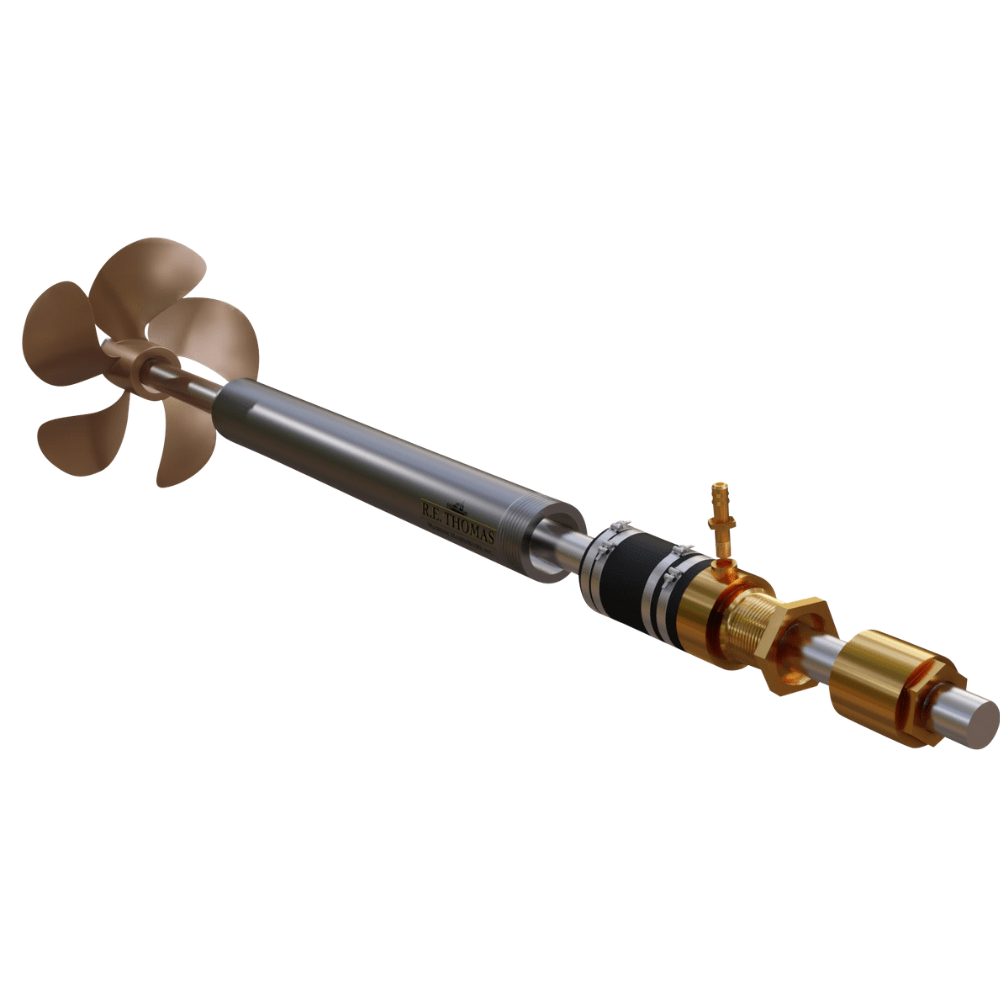
What Is a Marine Propeller Shaft and How Does It Work?
Remove all the other things: the hull, the engine, the electronic equipment, and so forth, and at its core, boat propulsion is simple. The rotational power passes from the engine along the shaft to the propeller. That’s about it. However, creating a durable system capable of withstanding the harsh environment of salt water under heavy loads is quite another matter.
A marine propeller shaft, also referred to as a drive shaft or a tail shaft, is an integral part of the mechanism designed to transmit torque from the engine to the propeller shaft without bending, corrosion, and vibrations.
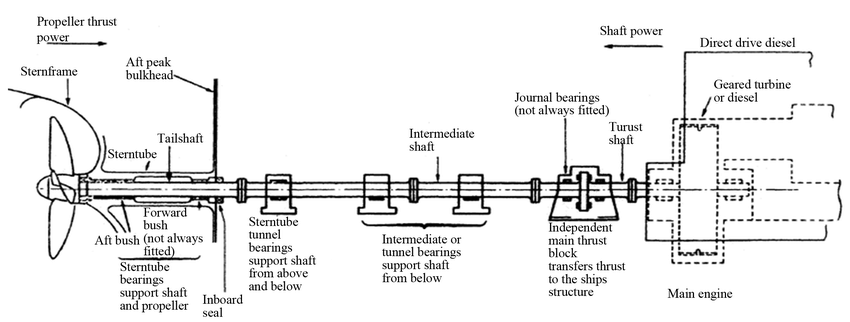
The Power Path, Step by Step
Power doesn’t jump straight from the engine to the propeller. It follows a set route:
-
Engine output enters the gearbox, which brings RPM down to a range the propeller can use well
-
The thrust shaft picks up that rotational force and absorbs the axial load — the forward and backward push the propeller generates
-
Intermediate shafts cover the distance between the engine and the stern
-
The tail shaft passes through the stern tube and connects to the propeller hub
Each step in that chain can introduce vibration, misalignment, or fatigue. The shaft has to deal with all three at once — torque, bending stress, and axial thrust — while sitting in seawater.
What the Shaft Is Up Against
Here are the real physical loads a propeller shaft faces:
-
Torque from full engine power creates rotational stress that builds at higher RPM
-
Bending loads come from propeller weight, hull flex, and any misalignment with the bearing line
-
Corrosion attacks the shaft from the outside in — seawater is brutal against the wrong alloy
Shaft diameter, grade, and machining tolerances need to be considered prior to the ship hitting the water. The standard diameter of the shafts used on ships usually ranges from ¾ inch to 4 inches and is machined to tolerances as close as 0.0005 inches. This isn’t too much, but this is just the amount required to avoid fatigue failure at propulsion forces.
It is the role of the stern tube, cutlass bearings, and shaft seals to support the system. They make sure the shaft does not fail before its time.
Marine Propeller Shaft Materials: Aqualoy vs Stainless Steel vs Bronze
Your stern tube shaft is made of something specific. That choice determines how many years you get before corrosion, fatigue, or both force a haul-out you never planned.
Not all marine shafting is equal. The gap between standard 316 stainless and a purpose-built alloy like Aqualoy 22 isn’t marketing language. It’s measurable, documented, and expensive to ignore.
The Core Materials, Side by Side
Here’s how the main shaft materials compare:
|
Material |
Tensile Strength |
Corrosion Resistance |
Weight vs Bronze |
Best For |
|---|---|---|---|---|
|
Aqualoy 17 |
Highest among SS shafting |
Moderate — not for severe exposure |
~10% heavier |
High-torque workboats, heavy loads |
|
Aqualoy 22 |
High — exceeds standard 316 |
Excellent — resists pitting and crevice attack |
~10% heavier |
Yachts, prolonged saltwater use |
|
316 Stainless |
Lower than Aqualoy grades |
Good — but vulnerable to pitting in stagnant saltwater |
~10% heavier |
Commercial vessels, frequent use cycles |
|
Bronze |
Lower tensile than SS |
Superior non-rusting in aggressive marine environments |
8% lighter than SS |
Sailboats, infrequent-use engines |
How to Size a Marine Propeller Shaft: Diameter & Length Calculation
Shaft sizing is math — but it’s also margin. Get the diameter right, and the system runs clean for years. Get it wrong by a fraction, and you’re chasing vibration problems until you pull the boat and start over.
The standard formula for minimum shaft diameter comes from Bureau Veritas scantling rules:
Dp = F × kp × ∛[ Pw / (n × Rm) ]
Break that down:
-
Pw = shaft power in kilowatts
-
n = maximum continuous operating RPM
-
Rm = tensile strength of your shaft material (N/mm²) — capped at 930 N/mm² regardless of alloy grade
-
F = 100 for standard installations
-
kp = 1.4 for solid shafts
Here’s what that looks like in the real world. A 525 kW vessel running a solid steel shaft at rated RPM needs a 123.5 mm minimum diameter. The torque load hits 10,695 N·m. That’s not a conservative estimate — that’s the floor. Design below it, and your safety factor drops below the acceptable threshold before the boat leaves the dock.
What You Need Before You Calculate
Six inputs. No shortcuts:
-
Boat displacement (tons or lbs)
-
Waterline length (LWL)
-
Engine horsepower (hp or kW)
-
Max crankshaft RPM at wide-open throttle
-
Gearbox reduction ratio
-
Shaft rotation direction (left-hand or right-hand)
If you miss out on even one of these steps, then you will end up with a figure that seems accurate but actually isn’t. It will give you an idea about the relationship between engine revolutions per minute and shaft revolutions per minute. If the reduction ratio in your case is 3:1 on a 3,000 RPM engine, then the RPM of your shaft will be 1,000 RPM. Using 3,000 RPM rather than 1,000 RPM could be disastrous.
Measuring an Existing Shaft for Replacement
Use calipers — not a tape measure. Measure the full diameter on the non-tapered section first. Then measure the taper diameter near the small end, staying clear of the threaded area. Take the propeller bore measurement at the small hole end. Account for any deburring or chamfering there.
SAE standard taper runs 1:16. A 2-inch shaft carries a taper diameter of 1.641 inches and a propeller bore of 5¾ inches. These figures don’t transfer across shaft sizes. The bore table is fixed, and propellers are machined to match it exactly.
Common Marine Propeller Shaft Problems and How to Fix Them
Shaft failures follow a pattern. The same five problems show up on fishing boats, yachts, and workboats across every saltwater environment. The details change. The root causes don’t.
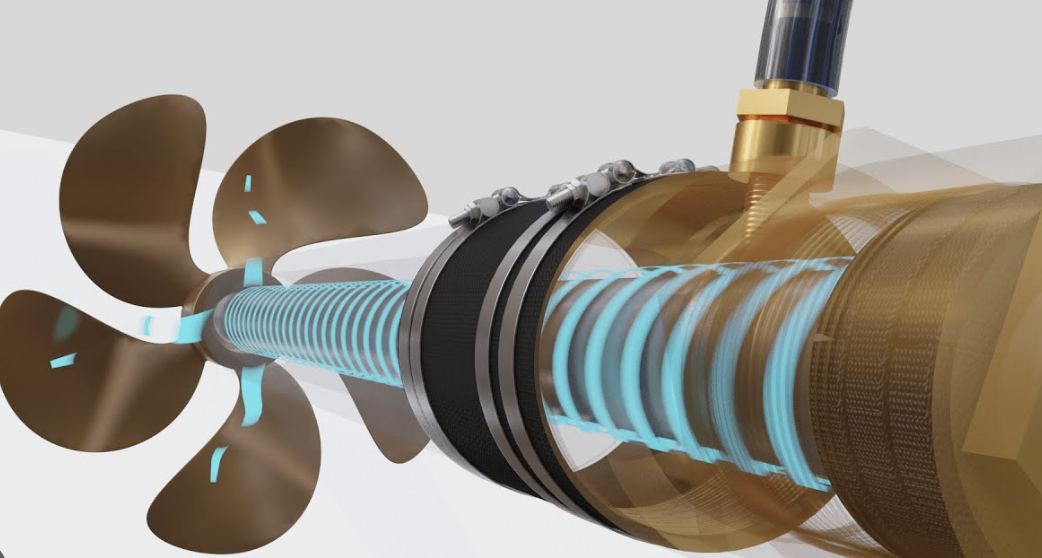
Here’s what goes wrong — and how to fix each one before it pulls you off the water.
1. Excessive Vibration
Root cause: Shaft imbalance or misalignment.
A misaligned shaft has a clear harmonic signature. It pulses at a frequency tied to shaft RPM — not engine idle, not wave slap. RPM. Run your vibration analysis tool against the drivetrain. The reading spikes with throttle increase? The shaft is the problem.
Fix: Realign using precision tools until the shaft matches the engine output angle. Use a dial indicator — get the angle right, not close. Vibration still there after confirmed alignment? The shaft itself may be out of balance. A professional weight correction is needed — material gets added or removed at specific points along the shaft body.
2. Electrochemical Corrosion
Root cause: Saltwater exposure plus weak material protection or anode failure.
One shaft pulled from service had 15mm of shaft material lost to corrosion. A full rust layer covered the surface. That’s not gradual wear. That’s a complete failure in protection.
The fix has three stages:
1. Inspect the shaft surface for pitting, rust penetration, and surface loss
2. Restore eroded areas with composite coatings to bring clearances back to spec
3. Apply anti-corrosion coatings before the shaft goes back in the water
Then fix the source. Zinc anodes are not optional. For vessels under 50 meters, fit one to three anodes per shaft — place them at the stern tube, propeller hub, or rudder. Size them right: a 1kg zinc anode protects a 25–50mm shaft for 12 to 18 months under normal saltwater conditions. Inspect every six to twelve months. Replace at 50% consumption. The US Navy MIL-spec A-18001K benchmark puts expected consumption at 200–400 grams per anode per year. Weigh the anodes before and after each inspection cycle. The numbers show you where you stand.
3. Excessive Bearing Wear
Root cause: Overload, poor lubrication, or debris ingestion.
Scoring and pitting on the shaft surface are the visible signs. But the real test is a clearance measurement. Industry standard for marine shaft-to-bushing clearance is 0.05–0.10mm. Go past that threshold and lubrication fixes won’t help anymore.
Full bearing replacement process:
1. Check for wear indicators and measurable play
2. Disconnect the shaft — U-joints first, then slide the shaft clear
3. Pull the old bearings from the housing
4. Clean the housing and confirm its dimensions match the new bearing spec
5. Press-fit OEM-grade, water-resistant bearings with tight alignment
6. Pack with marine-grade high-load EP grease
7. Reinstall the shaft, confirm alignment, and run a low-RPM test before returning to service
Well-maintained bearings in saltwater service last two to five years. Skip consistent lubrication and that number drops fast.
4. Seal Leakage
Root cause: Aged packing gland or fishing line wrapped around the shaft.
Fishing line is the sneaky one. It wraps without warning, binds the seal, and kills free rotation before you see any symptom. Seal starts leaking? Pull the shaft and check the full length for line debris first — don’t assume the seal itself has failed.
Fix: Clear all debris. Replace aged packing or mechanical seals. Confirm free rotation by hand before putting everything back together.
5. Shaft Bending and Deformation
Root cause: Impact damage, overloaded conditions, or a propeller too large for the shaft.
An oversized propeller pushes both torque and bending load onto the shaft at once. The shaft doesn’t bend in stages. It builds up fatigue cracks — often invisible until they spread under load.
Fix: Inspect for visible bends and surface cracking. Minor deformation can sometimes be corrected in-place. Severe cases need a full shaft replacement. Also, match the propeller spec to the shaft’s rated capacity before installation — this step matters. The sizing math from the diameter calculation section applies here. A shaft running at the edge of its safety factor has no room left for an oversized propeller.
Conclusion
Your propeller shaft isn’t just a piece of rotating metal. It’s the one mechanical link between your engine’s power and the resistance of the water. Get it wrong, and you’re dealing with vibration, faster corrosion, or a full shaft failure miles from shore. Get it right, and it fades into the background — doing its job every hour you’re out on the water.
Material choice matters more than most boat owners think. Aqualoy 17 works well for coastal cruisers. Aqualoy 22 stainless shaft is the better fit for hard-working vessels running in aggressive saltwater. Alignment matters too. So does seal selection. None of it is complicated once you see the system as a whole.
Now you do.
Ready to spec a shaft or replace a worn component? Maybe you just want a second set of expert eyes on your current setup. Either way, reach out to the VIF Propellers team. We’ve been solving shaft problems longer than most people have owned boats.