
The wrong Mercury outboard Propeller costs you more than speed. It drains your fuel tank, stresses your engine, and leaves you frustrated every time you hit the water. Your boat just never feels right — and you can’t figure out why.
pitch is usually the culprit. That one spec separates a dialed-in ride from a disappointing day on the water. Get it right, and everything clicks. Get it wrong, and no amount of trimming or throttle work will fix it.
This guide covers what you need to know — materials, diameter, blade count, and real-world recommendations for every major use case. So whether you’re swapping out a damaged Prop, squeezing out a few extra miles per hour, or matching a new Mercury FourStroke to the right blade geometry, you’ll find clear answers here.

Mercury Outboard Propellers – Buying Guide 2026
Here’s what this guide covers — and why each part matters.
Most buyers start with one number: horsepower. That’s a start, but it’s not enough. A 115hp Mercury with a 7-pitch stainless Prop (Mercury part 48-828152A12, 9.25″ diameter) runs far different from the same engine with a 12–14 pitch blade built for top speed and fuel efficiency. Same motor. A whole different boat.
To pick the right prop, work through five decisions in order:
-
Lock down your specs — Engine HP, gear ratio, WOT RPM target band, hull type, typical load, and your current GPS speed at full throttle
-
Name your goal — Towing, fishing, offshore runs, economy cruising, or flat-out speed. Each one points to a different blade family
-
Match hull to model — Bass and pad hulls suit Tempest Plus or Enertia. Tow boats do better with a 4-blade like Mirage Plus or Fury 4. Bay and flats boats pair well with Revolution 4 or SpitFire X7
-
Choose your starting pitch — Higher pitch gives up acceleration for top speed, like shifting into a higher gear. Lower pitch does the opposite
-
Test, then fine-tune — Run the same conditions every time, and change one variable per run. Cup, rake, engine height, and PVS plugs all shift performance once you’ve locked in the right baseline prop
This guide covers each step in full. You’ll get specific Mercury model picks, material comparisons, and real-world use cases for every major application.
Mercury Outboard Propeller Basics: Pitch, Diameter, Rake & Cup Explained
Four numbers. That’s what separates a prop that transforms your boat from one that silently ruins it. Pitch, diameter, rake, and cup — each one shapes how your Mercury outboard converts engine power into forward motion. Know what they do, and prop selection stops feeling like guesswork.
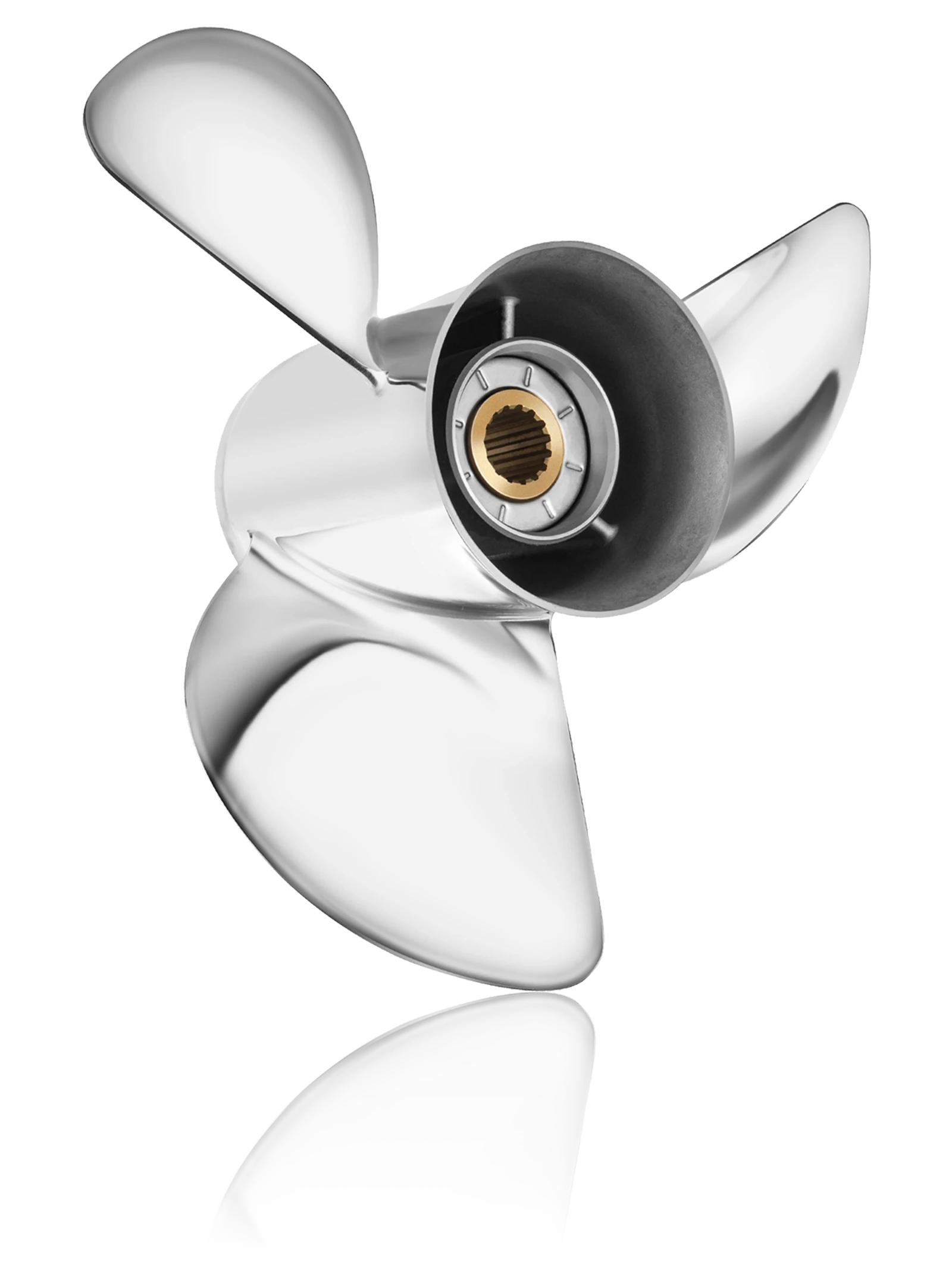
Pitch: The Gear Ratio of Your Prop
Think of pitch as your boat’s transmission. A 26-pitch prop advances 26 inches through solid material with every full revolution — in theory. In practice, water slips. But the principle holds.
-
Lower pitch (10–14) — shorter advance per revolution, faster RPM climb, stronger hole shot. Your engine breathes easier under load.
-
Higher pitch (19–26+) — greater advance per revolution, higher potential top speed, lower cruising RPM.
Mercury propellers use two distinct pitch designs. Constant pitch keeps the same blade angle across all radii — clean, predictable, easy to tune. Progressive pitch increases from hub to tip. It loads the blade in stages and smooths out power delivery across your RPM range.
One more thing about pitch: cup adds to it. A cupped trailing edge raises your pitch by 1 to 2 inches. That matters when you’re dialing in WOT RPM.
Diameter: Surface Area and Spin-Up Speed
Diameter is the measurement from hub center to blade tip, doubled. A blade reaching 7 inches from center gives you a 14-inch diameter prop.
Larger diameter puts more blade surface in the water. You get better power transmission and stronger thrust — but also higher rotational inertia. The engine works harder to spin it up, which slows your hole shot.
The pattern is consistent: lower pitch props run larger diameters, higher pitch props run smaller. Gear reduction plays into this too. A higher gear reduction ratio supports a larger-diameter blade. A lower reduction needs a smaller one. Mercury’s deepwater setups run smaller diameters to avoid blade interference. Surfacing applications run larger.
Rake: How the Blade Stands
Rake measures the blade angle relative to the hub. Picture how much the blades lean back away from the boat.
-
Standard range: −5° to +20°, with most outboard props sitting around 15 degrees
-
High-performance range: Up to +30°, using progressive rake that increases from hub to tip
Higher rake does two things well. It improves grip in aerated or turbulent water. It also generates bow lift — useful for getting a heavy hull up on plane faster. Cup at the blade tip raises effective rake too, amplifying both effects.
Cup: The Fine-Tuning Variable
Cup is a curved lip rolled onto the trailing edge of each blade — ½ to ¾ inch deep. Small feature, big impact.
What cup changes:
– Raises effective pitch by 1–2 inches
– Loads the engine, dropping WOT RPM by 150 to 400 RPM under normal conditions — and up to 1,000 RPM to fix severe blowout
– Reduces cavitation by changing how water separates from the blade surface
– Improves grip mid-turn and during hard acceleration
Cup location controls what it affects. Trailing edge cup raises pitch. Tip cup raises rake. Full trailing-edge-to-tip cup raises both at once. Mercury builds specific cup profiles into every Propeller line. Their Enertia and Mirage Plus series use calibrated cup geometries that you can’t replicate by re-pitching a generic aftermarket blade.
These four specs never work in isolation. Mercury engineers tune pitch, diameter, rake, and cup together as one system. That’s why a prop that looks right on paper can still feel wrong on the water — one variable off, and the whole setup suffers.
Best Mercury Propellers by Use Case: Bass Boats, Pontoons, Offshore & Tow Sports
Every boat category suffers with the wrong prop. A bass boat with mismatched pitch loses precious seconds off your hole shot during a tournament. A pontoon with the wrong blade count wallows and drags. A tow boat without enough lift leaves your skier sinking, waiting. The fix is the same for all of them: match the prop to what the boat does.
Here’s how to make that match by use case.
Bass Boats: Tournament Stakes, Real Consequences
Tournament bass fishing is not recreational. You’re running a 200hp-plus rig loaded with rods, electronics, two anglers, and enough gear to stock a small outfitter. You need a hole shot with no hesitation, sustained top speed to cover water between spots, and a prop that handles repeated WOT runs without washing out.
Mercury built two props for this exact job.
Mercury Fury (3-blade)
The Fury is Mercury’s baseline tournament bass prop — and it delivers without holding back. It’s built from X7 alloy, Mercury’s own high-strength material. That means it takes repeated hard launches and sustained high-speed running without the flex or fatigue you’d see from standard aluminum.
Key specs:
– Pitch range: 24–27P
– Rotation: Right-hand
– Blade count: 3
– System: Performance Vent System (PVS)
The PVS is worth understanding. It lets you tune ventilation at the hub. That controls how hard the prop loads up on launch. Get it dialed in, and you get clean, controlled acceleration without blowout. The 3-blade design keeps top speed high. The trade-off: acceleration and lift sit a step below what the 4-blade version delivers.
Mercury Fury 4 (4-blade)
Your tournament rig is running heavy — full livewell, extra batteries, loaded gunwales. The Fury 4 is built for that. It’s Mercury’s top-rated prop for high-weight bass applications right now.
It runs two PVS holes per blade instead of one. That extra ventilation control gives you better load response under full tournament weight. The 4-blade setup gives up a small amount of peak top speed. In return, you get better acceleration, better efficiency, and more bow lift. For a loaded boat that needs to get on plane fast and stay there, that’s a trade worth making.
Mercury Tempest Plus
Want all-around durability without giving up competitive performance? The Tempest Plus sits in the top three bass boat props in Mercury’s lineup. The standard setup for Mercury’s 250hp V8 4-stroke is 23–24P Tempest Plus. That combination balances acceleration and cruising efficiency across a wide range of hull weights and load conditions.
3-blade vs. 4-blade: The straight answer
On 90hp and above outboards, the performance gap between blade counts is real and measurable. Four blades give you better acceleration, better efficiency under load, and more bow lift. Three blades give you higher peak top speed. Run light and chase GPS numbers? Go three. Run heavy and need to move a loaded boat hard off the line? Go four.
Pontoons, Offshore & Tow Sports: Matching Blade Profile to What Your Boat Demands
Mercury’s prop catalog covers pontoon, offshore, and tow sports through dedicated blade families. Each one is tuned to the specific demands those hulls put on the drivetrain.
Pontoons respond best to 4-blade high-rake designs. These generate lift without needing excessive RPM to do it. The extra blade surface area makes up for heavier, flatter hull platforms.
Offshore running in rough water needs props with cupped trailing edges and progressive pitch profiles. These designs hold grip through wave chop and aerated water. The Revolution 4 and Enertia series both perform well offshore. Blade slip and ventilation in following seas are the main problems out there — these props address both.
Tow sports — wakeboarding, waterskiing, tubing — need maximum low-end pull and a flat, predictable throttle response. A 4-blade with moderate pitch (13–17P, depending on engine displacement) gets the load up fast and holds it. Mirage Plus and Fury 4 setups show up in serious tow sport rigs for exactly that reason.
The pattern holds across all three categories: the more load you’re moving, the more you gain from an extra blade, higher rake, and a cupped trailing edge that keeps water attached through the power stroke.
Mercury Propeller Replacement Signs & Maintenance: When to Replace & How to Extend Lifespan
A damaged prop doesn’t announce itself. It just costs you — fuel, speed, and engine hours you can’t get back.
Spotting the difference between a prop that needs repair and one that needs replacing is one of the most useful skills a boat owner can build. The signs are there. Most people just don’t know what to look for.
Signs Your Mercury Prop Needs Attention
Performance changes you can feel:
-
Fuel consumption creeping up — You’re stopping to refuel more often. Nothing else changed. That’s the prop. Damaged blades create drag and waste energy with every revolution.
-
Loss of top speed or sluggish acceleration — The boat feels heavy off the line. It struggles to plane. The engine sounds like it’s working harder than it should.
-
Vibration when in gear — Shift into forward or reverse and you feel a shake that wasn’t there before. In neutral, it’s smooth. That gap tells you something. A shake in gear means blade imbalance from physical damage.
-
RPM behavior is off — Engine over-revving to chase speed points to insufficient pitch. Labored acceleration at low throttle points to too much. Both stress the drivetrain over time.
Damage you can see:
-
Dents, chips, bent or warped blades, missing chunks — any of these throw the blade into imbalance
-
Blades that have thinned down, or aluminum props showing long cracks
-
Corrosion on the blade surface — repair costs climb fast if you ignore it
-
Spun rubber hub — RPMs climb but the boat doesn’t move. That’s hub slippage. Common on Mercury and Yamaha setups. The hub absorbs the torque instead of passing it to the blade. You can diagnose it yourself, and on most Mercury props, the hub is DIY-replaceable.
Repair or Replace?
The line between repair and replace is clear. Small nicks and dings — fix them, then check for any engine wear that followed. Bent blades, large chunks missing, heavy thinning, long cracks, or serious corrosion — replace the prop. Repair can’t bring back full structural strength at that level of damage.
A useful number to keep in mind: switching from a damaged or underperforming prop to a well-matched Mercury prop adds around 3 knots of top speed. That’s a real gain.
Maintenance Habits That Add Years to Your Prop
-
Inspect after every impact. Hit a sandbar, clip a rock, kiss a dock — check the blades before the next run. Small nicks are fixable. Left alone, they grow into bigger problems and the engine pays the price.
-
Pre-launch checks. Before each outing, run your hand across the blade edges. Look for thinning, cracks, corrosion, and anything that feels uneven. Takes two minutes.
-
Don’t run through pitch or vibration issues. The temptation is to keep going and fix it later. Don’t. Every hour on a damaged or mismatched prop stacks up engine strain and wasted fuel.
-
Check the hub. Forward thrust feels cut off from RPM? Test for hub slippage first before assuming the problem sits deeper in the drivetrain.
The prop takes the first hit every time. Treat it as a maintenance item — not just a part you swap out when things break — and your Mercury outboard stays sharp the way it was built to.
FAQ: Mercury Outboard Propeller Common Questions Answered
Prop questions pile up fast once you start digging. Here are the ones that come up most — answered straight, without the runaround.
What pitch should I run on my Mercury 115hp?
It depends on your goal. The 7-pitch stainless 3-blade (part 48-828152A12, 9.25″ diameter) tightens handling and boosts top-end speed. The 12–14 pitch blade like the 48-816702A40 splits the difference between acceleration and top-end cruise. Know what you’re optimizing for before you pick a number.
What prop works best on a Mercury 70hp?
Go with the 4-blade 48-8M8026620 — 10.6″ diameter, 11-pitch, right-hand rotation. Running with passengers and gear on board? This is the setup. Four blades carry the extra load better than three. You give up a small slice of peak speed. What you get back is smoother, more controlled handling. On a loaded hull, that’s the right trade.
How do I know whether to run 3 blades or 4?
Three blades move faster. Four blades grip harder. GPS top speed is your priority? Go three. Hauling weight, fighting chop, or need stronger acceleration off the line? Go four. The answer comes from how you use the boat — not from what looks good on a spec sheet.
How do I replace a Mercury propeller myself?
You need three things:
– A propeller wrench
– A replacement prop
– Marine grease
Start by loosening the retaining nut. Pull the old prop off the shaft. Align the splines on the new prop. Tighten the nut down. Then run at low speed to check for vibration. The whole job takes about fifteen minutes. Feel anything unusual during that test run? Stop and inspect before you push the throttle.
How often should I inspect my prop?
Run a hand across the blade edges before every outing. Look for cracks, dings, and surface corrosion. Do a full freshwater rinse once a month during the season. Do it again before you lay the boat up for winter. Damage you catch early costs almost nothing to fix. That same damage left alone for a full season starts dragging the engine into the problem with it.
Is there a tool that tells me which Mercury prop to buy?
Yes. Mercury Marine’s Prop Selector Tool lets you enter your boat type, hull setup, and engine horsepower. It gives you a direct recommendation — 3-blade vs. 4-blade, pitch range, and the prop line that fits your setup. Still not sure after reading a guide? That tool fills in the gaps. Use it before you spend money on a prop you’re not confident about.
Do Mercury hub kits work on non-Mercury outboards?
They do. Mercury hub kits fit a wide range of non-Mercury outboards. That gives aftermarket buyers more options when sourcing replacements. Check your engine’s shaft spline spec for fitment before you order.
Conclusion
Picking the right Mercury outboard propeller is simpler than it sounds — but it matters more than most boaters think. Get the pitch wrong by two inches and you lose RPMs or horsepower. Get the material wrong and you’re paying for performance your setup can’t deliver.
The key is matching three things:
-
Match your prop to your engine’s WOT range
-
Match your material to your budget and how hard you run the boat
-
Match your blade count to how you use the water — not how you plan to
Your current prop is bent, cavitating, or not giving you the speed and efficiency your rig can handle? Don’t wait until next season to fix it.
Browse our full selection of Mercury-compatible propellers at VIF Propellers. Filter by engine size, shaft, and use case. Get back on the water running the way your boat was built to run.