
You found the right prop setup for your fishing boat — or so you thought. Then you hit the water with a full load. Your engine screams past its RPM limit. Your trolling speed drifts nowhere near where you need it.
Sound familiar?
Most anglers treat propeller selection as an afterthought. That choice costs them fuel, fish, and engine life. The right fishing boat propeller is more than a hardware decision. It’s the one mechanical variable that shapes how your boat handles heavy loads, holds a steady trolling speed, and keeps your outboard running with you — not against you.
This guide covers it all — propeller pitch, blade count, material choice, and real-world prop slip. You’ll walk away with a clear, confident selection. No guesswork. No wasted money.

Content Framework: Fishing Boat Propeller Guide: Best Prop For Heavy Loads & Trolling Speed
Here’s what this guide covers — and why each piece matters to your wallet, your engine, and your catch rate.
Heavy loads and low-speed trolling are the two scenarios where prop selection makes or breaks your day on the water. Most guides skip the specifics. This one doesn’t.
What You’ll Find Inside
-
Propeller basics — pitch, diameter, blade count, and material, all explained in plain language
-
Heavy-load selection — how to match your prop to a loaded fishing boat (full crew, gear, livewells, ice)
-
Trolling speed control — dialing in stable 1.5–3 mph passes without surging or stalling
-
Real-world examples — two concrete boat setups with actual RPM numbers and pitch changes
-
A step-by-step testing workflow — so you validate performance with data, not guesswork
-
4-blade vs 3-blade breakdown — the honest trade-offs for fishing applications
-
Stainless vs aluminum — where the upgrade pays off and where it doesn’t
-
PVS fine-tuning — the overlooked tool that stops bogging under heavy load starts
Each section targets one outcome. Your engine hits the upper half of its WOT RPM range under a full fishing load. You also get precise, repeatable control at slow trolling speeds.
That’s the benchmark. Everything in this guide is built around reaching it.
What Makes a Fishing Boat Prop Different From a Regular Boat Prop
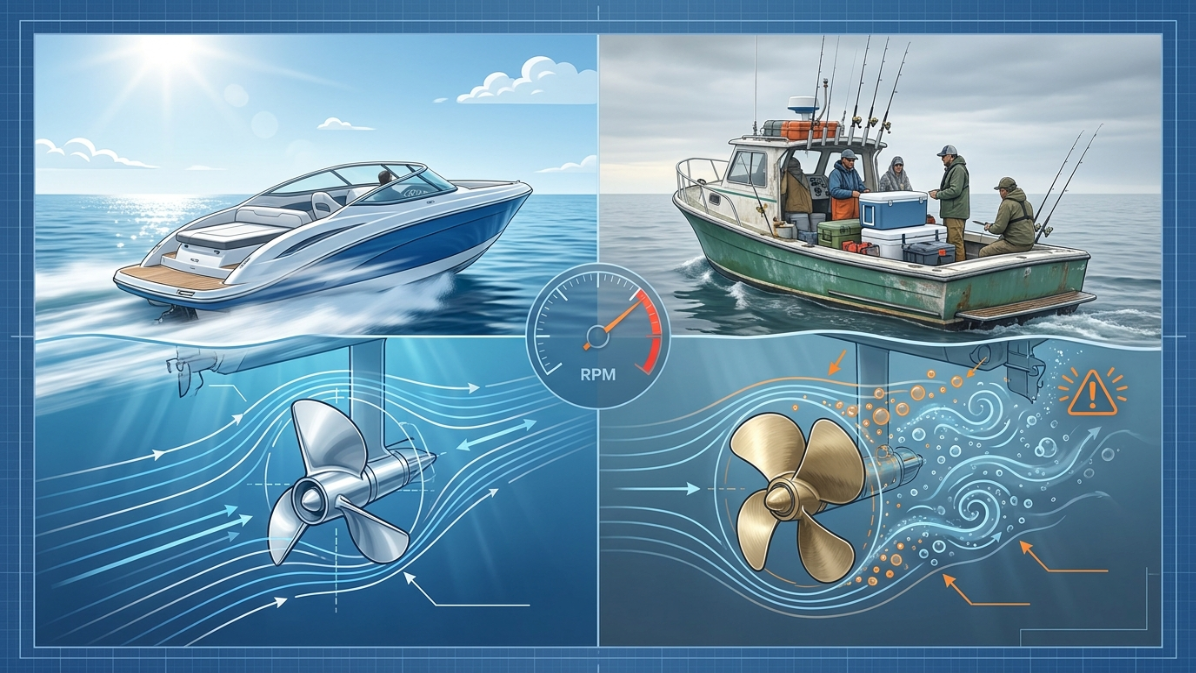
A fishing boat carries a different burden than a recreational cruiser — and your propeller feels every pound of it.
Picture a typical day on the water. Three to five anglers, a 100-quart cooler packed with ice, a full livewell, fish finders, anchors, and tackle. On an 18–22 ft fiberglass fishing boat, that adds 415–860 kg of real-world load on top of the boat’s dry weight. That’s a 35–95% increase over what the hull weighs sitting in your driveway.
Recreational boats are built for speed. They run small diameter, high pitch, 3-blade props that hit peak efficiency at 25–45 knots. Fishing boats never operate there. Trolling runs at 1.5–3.5 knots. Cruising with a full load runs at 8–18 knots. The physics are not even close to the same.
Putting a “fast prop” on a loaded fishing boat creates three immediate problems:
-
Your engine under-revs — high pitch under heavy load pulls WOT RPM 300–800 below the manufacturer’s recommended range
-
Fuel consumption rises 15–25% during typical fishing cruises
-
Blade cavitation accelerates at slow trolling speeds, cutting prop lifespan by 30–50%
The right fishing boat propeller is built around opposite priorities. You get a larger diameter for more blade area. Lower pitch keeps your engine in its healthy RPM band. Extra blade count gives you stable, low-speed thrust control.
That’s not a preference. It’s the mechanical reality of heavy-load fishing.
Propeller Specs Explained: The 5 Parameters That Impact Heavy Load & Trolling Performance
Five numbers printed on every propeller decide whether your fishing trip succeeds or fails — before you drop a line.
Ignore them, and you’re gambling with your engine, your fuel bill, and your catch rate. Know them, and you gain precise control over what your boat does with 800 pounds of gear, crew, and ice aboard.
Here’s what each parameter does — and how to use it.
1. Diameter: Bigger Is Better for Heavy Loads
Blade sweep area scales with the square of diameter. Go from 13″ to 14″, and your effective blade area grows by 16%. More area means more water pushed per revolution. That pushes more thrust at low speed.
General guideline by engine size:
– 40–60 hp (16–18 ft boats): 12–13″ aluminum prop
– 75–115 hp (17–19 ft, multi-passenger + gear): 13–14″; pick the upper end for heavy loads
– 150–250 hp (20–23 ft, heavy-load + towing): 14–15.25″
One rule you can’t skip: keep a tip clearance of at least 15% of diameter between blade tips and hull. On a 30″ prop, that’s 4.5″. Minimum safe clearance is 0.75″. Below 0.625″ — don’t do it.
2. Pitch: The RPM Control Dial
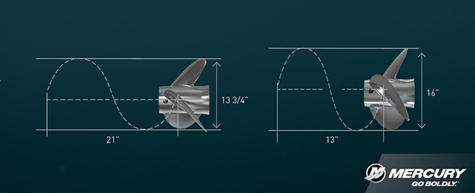
Every 1″ change in pitch shifts your WOT RPM by 150–200 RPM in the opposite direction. Lower pitch = higher RPM. Higher pitch = lower RPM.
This makes a big difference under heavy load. Say your engine is rated for 5,000–5,800 WOT but tops out at 4,600 RPM with a full load. Your prop pitch is choking your engine. Drop pitch by 2–3 inches, and you recover 300–600 RPM.
Practical example:
– Current setup: 19″ pitch, WOT 5,200 RPM
– Switch to 17″ pitch: gain ~300–400 RPM → new WOT ≈ 5,500–5,600 RPM
– Result: healthier engine, more stable trolling torque under continuous load
For trolling and towing, the proven formula is lower pitch + larger diameter + more blades.
3. Blade Count: Why 4-Blade Wins for Fishing
A 4-blade prop raises blade solidity — the ratio of blade area to disc area. More blade contact with water gives you better grip, less cavitation, and smoother low-speed control.
The trade-off in real numbers:
– Same 14″ × 19″ prop: 3-blade hits WOT at 5,600 RPM
– Switch to 4-blade: WOT drops to 5,500–5,550 RPM
– Prop slip drops by 2–4%, trolling speed stabilizes, and steering gets more predictable
You give up ~50–100 RPM at WOT. In return, you get steady thrust under load and tight speed control at 1.5–3.5 knots. For fishing, that’s a clear win.
4. Material: Where Stainless Steel Earns Its Price
Stainless steel doesn’t flex. Aluminum does.
Under heavy continuous load, an aluminum blade bends a little. This changes the actual pitch and cup shape over time. Slip increases. Thrust drops. Your trolling speed drifts and fuel use creeps up — often before you notice.
Stainless steel holds its design shape under high torque. For serious anglers and commercial operators, that means steady efficiency and a service life far beyond what aluminum delivers. The go-to heavy-load setup is: stainless steel 4-blade prop + cup design + reduced pitch.
5. Cup: The Hidden RPM Adjustment
Cup is the small curved edge along each blade’s trailing edge. It raises the blade’s bite angle without touching the stamped pitch number.
What cup does:
– Cuts prop slip from a typical 12–14% down to 8–11%
– Drops WOT RPM by 150–250 RPM — about the same as adding 1″ of pitch
Cup is a fine-tuning tool. You’ve already set the right diameter and pitch, but you’re still getting slip at slow trolling speeds under load. A cupped blade fixes that without a full prop swap.
For heavy-load trolling, cup + 4-blade + stainless steel is the combo that holds slip low and keeps speed steady across a full day on the water.
Heavy Load Fishing: How to Choose the Right Prop for a Loaded Boat
Here’s a number most anglers never calculate: a loaded 22–26 ft center console can carry 1,050–1,400 kg of extra weight on top of the bare hull. Six anglers, 150 liters of fuel, 200 kg of gear, and 400 kg of fish and ice. That’s a 50–70% jump in total displacement — and your propeller takes every pound of it.
That’s not a minor variable. That’s a different boat.
What “Heavy Load” Means (In Real Numbers)
To choose the right prop, start by defining the problem with hard numbers.
A 22–26 ft deep-V fiberglass center console with a loaded displacement of 2.5–3.5 metric tons — here’s what a typical offshore fishing day looks like:
|
Load Category |
Typical Weight |
|---|---|
|
Crew (6 anglers) |
480–540 kg |
|
Fuel (150–200 L tank) |
120–160 kg |
|
Gear, tackle, electronics |
150–250 kg |
|
Fish + ice (full day) |
300–500 kg |
|
Total added load |
1,050–1,400 kg |
The key threshold: your total loaded displacement hits 90–100% of your hull’s rated displacement. That’s heavy-load territory. Or try this simpler field test — your payload (people + fuel + gear + catch) equals 50% or more of your bare hull weight. Your prop selection needs to change.
The Right Prop Parameter Combination for Heavy Loads
Four parameters work together under heavy load. Get one wrong, and the others can’t compensate.
Diameter — go as large as your hull allows. Larger blade area generates more thrust at low speed under heavy load. Keep tip clearance at a minimum of 5–10 mm between blade tip and hull. Push toward the maximum diameter your transom allows within that limit. Thrust gains at displacement speeds are real and show up fast.
Pitch — lower than you think. Heavy commercial fishing vessels run a pitch-to-diameter ratio (P/D) of 0.7–1.0 for this reason. On a 22–24 ft center console with a single 150–200 hp outboard, drop from a typical leisure pitch of 19–21 inches down to 15–17 inches under full load. Lower pitch keeps your engine in its power band. That’s not losing performance — it’s finding it.
Blade count — four, not three. A 4-blade prop raises the blade area ratio (AE/AO). This improves thrust and cavitation resistance under high load. The numbers are clear: a 4-blade delivers 5–15% more thrust at similar diameter and P/D compared to a 3-blade. You give up a small amount of top-end speed. In return, you get smoother torque, better control, and lower slip at displacement speeds. That trade-off works in your favor on a loaded fishing boat.
Material — stainless steel holds its shape. Aluminum blades flex under sustained high-torque load. That flex shifts the working pitch and cup geometry mid-trip. Stainless steel keeps its design shape under full load, all day long. For heavy commercial use or regular full-load offshore runs, the cost of upgrading pays off in steady performance and fewer prop replacements over time.
The Full-Load WOT Test: How to Know If Your Prop Fits
Guessing doesn’t work here. Testing does.
Load your boat the same way you’d fish it — full crew, 75–100% fuel, all gear aboard. Head to calm water and bring the engine to full throttle. Hold it stable for 30–60 seconds. Record your WOT RPM with a tachometer and your speed via GPS. Run the test 2–3 times and average the results.
Compare those numbers against your engine manufacturer’s recommended WOT range:
-
WOT falls below the lower limit (e.g., 4,800 RPM on a 5,000–6,000 RPM engine): your pitch is too high for the load. Drop 2 inches of pitch and retest. The engine can’t hit its power peak — you’re losing torque and burning extra fuel.
-
WOT exceeds the upper limit (e.g., 6,200 RPM on a 5,000–6,000 RPM engine): pitch is too low, the prop is under-loaded, and over-rev damage becomes a real risk. Add 2 inches of pitch or move to a higher blade area ratio.
-
Target zone for heavy fishing loads: aim for the upper 60–90% of the recommended RPM band — about 5,600–5,800 RPM on a 5,000–6,000 RPM engine. That position gives you maximum thrust while leaving a load buffer for a full livewell.
This one test clears up most heavy-load prop problems. Run it before your season starts — not after months of your engine struggling to keep up.
Trolling Speed Optimization: The Prop Setup That Holds 1.5–4 MPH Without Lugging or Racing
Trolling speed is where most fishing boats fall apart — and the prop is almost always the reason.
Here’s the core problem. Your standard 17–19 pitch, 3-blade aluminum prop is built for one thing: top-end speed. At 40 mph, it does exactly what it’s supposed to. At 1.5 mph? It works against you.
Throttle down to trolling speeds with a high-pitch prop. Two things happen — and neither is good.
Lugging hits first. A high-pitch blade has a steep entry angle at low RPM. The engine strains to push through the water with almost no throttle input. Combustion stays incomplete. Torque output turns choppy. You feel it in the steering wheel and hear it in the motor.
Racing comes next. You push the throttle up to escape that rough, low-RPM zone. The engine spins faster — but with low load resistance on a high-pitch blade, boat speed barely moves. You’re burning fuel and making noise while your GPS still reads 2.5 mph, same as five minutes ago.
The fix is simple. Three changes, working together.
The Trolling Prop Formula: Lower Pitch + Larger Diameter + 4 Blades
This combination solves the lugging-racing problem at every speed between 1.5 and 4 mph.
Drop your pitch by 4–6 inches. This is the single biggest lever you have. A standard 17–19P prop limits your slowest controllable trolling speed to around 2.5 mph. Switch to an 11–13P low-pitch prop and that floor drops to 0.75–1.0 mph. Your useful trolling range now runs from under 1 mph all the way to 4 mph — with the engine running in a healthy RPM band the whole time.
The tradeoff is real but acceptable. Top speed drops from ~40 mph to ~30 mph. For a dedicated fishing setup, that’s not a loss. That’s a trade you make on purpose.
Increase diameter by 5–10%. Moving from a 13″ prop to a 14–14.5″ prop moves more water per revolution. At slow displacement speeds, that extra blade area builds higher static thrust and keeps your steering responsive even at 1–2 mph. The engine also holds a steady RPM at low boat speeds — and that’s what stops lugging from happening.
Switch to 4 blades. A 4-blade high-thrust prop gives you smoother flow and more linear throttle response across the 1.5–4 mph range. Small steering corrections feel predictable. Speed-up and slow-down feel smooth, not jerky. You lose 2–5% of top-end speed. In return, you get precise, repeatable control at the exact speeds that catch fish.
Species-Specific Speed Targets to Hit
Know your target speed before you test any prop setup:
|
Species |
Optimal Trolling Speed |
|---|---|
|
Tiger trout |
~1.2 mph |
|
Kokanee / sockeye |
1.7–1.8 mph (range: 0.8–2.0 mph) |
|
Crappie |
≤1.0 mph |
|
Bass / general lake trolling |
1.5 mph starting point |
|
Multi-species offshore |
2.5–4.0 mph |
Your prop setup needs to hold consistent, stable speed at each of these targets — no constant throttle corrections required.
How to Validate Your Trolling Prop Setup
Swapping to a lower-pitch 4-blade prop is step one. Confirming it works is step two.
Step 1 — WOT calibration test. On flat water, run your engine to full throttle. Record GPS speed and tachometer RPM. WOT inside the manufacturer’s rated range (say, 5,200–5,600 RPM) means your prop load is correct. Reads high? Add 2 inches of pitch. Reads low? Drop 2 inches. Each 2-inch pitch change moves WOT RPM by 200–400 RPM in the opposite direction.
Step 2 — Trolling speed ladder test. Step through target speeds at 0.5 mph increments from 1.0 to 4.0 mph. At each point, record your engine RPM, throttle position (percentage of full travel), and any vibration through the helm or hull. A well-matched trolling prop runs these speeds with the engine sitting between 40–70% of WOT RPM — for example, 2,200–3,800 RPM on a 5,500 RPM-rated outboard.
Feel periodic shuddering through the steering wheel below 2 mph? That’s lugging. Your pitch is still too high, or your diameter is too small to keep enough engine load at that RPM.
Nail both tests, and you’ve got a prop that holds 1.5 mph just as steady as it holds 4 mph — all day, on any species, in any load condition.
3-Blade vs 4-Blade Fishing Prop: Which One Wins for Heavy Loads and Trolling?

Four blades beat three blades on a loaded fishing boat. That’s the short answer — but knowing why will save you from a $300 mistake.
Here’s the core trade-off in plain numbers:
-
3-blade props push top speed up by 5–10% and add 1–3 mph on light loads under 2,500 lbs. That’s their lane.
-
4-blade props deliver 20–30% more blade area, 5–15% more thrust at low speed, and stronger cavitation resistance under load. That’s your lane on a fishing boat.
Where Each Blade Count Wins
3-blade props belong on:
– Light boats under 2,500 lbs total
– High-speed bass boats and tournament rigs built for top-end speed
– Setups where top speed matters more than load stability
4-blade props belong on:
– Loaded fishing boats over 4,500 lbs
– Any setup running steady trolling speeds between 1.5–4 mph
– Rough water, heavy gear, multiple anglers, full livewells
At 2,500–4,500 lbs, test both. Put multiple crew members on board, add choppy water and active trolling — four blades win that fight most of the time.
The 3 Performance Gains That Matter for Fishing
1. Cleaner water grip under load. A 3-blade prop loses its grip in rough water or under heavy weight. Anglers report boat shuddering, speed drops, and RPM spikes. Go to four blades and those problems go away. The larger blade area keeps a steady bite through chop and surge.
2. Lower RPM at trolling speed. A 4-blade prop holds your target trolling speed at 200–400 fewer RPM than a comparable 3-blade. Less engine noise. Less fuel burned. More precise speed control in the 1.5–4 mph range where fish get caught.
3. Faster, cleaner hole shot with full load. Heavy boats plane out sluggishly on 3-blade props. A 4-blade gets the bow down and hull up faster. Real-world tests back this up — quicker planing under heavy loads matters every time you move between spots.
One Critical Adjustment: Drop Pitch by 1 Inch When You Switch
The most common mistake anglers make is swapping blades without touching the pitch.
A 4-blade prop puts more load on the engine. Skip the pitch correction and your WOT RPM falls below the manufacturer’s recommended range. You lose the performance gains you just paid for.
The standard fix:
– Going from a 19P 3-blade to a 4-blade? Start at 18P.
– That pitch drop recovers around 150–200 RPM at WOT.
– Retest under full load. WOT reads low? Drop another inch. Reads high? Go back up.
Target: upper 60–90% of your engine’s recommended WOT range under full fishing load.
What About 5-Blade Props?
Skip them for fishing boats. Past four blades, performance gains level off fast while top-speed losses pile up. Five-blade props are built for commercial work vessels, tugboats, and vibration-sensitive yachts — not a 22-foot center console. Your four-blade setup still underperforming? Adjust the basics first: diameter, pitch, and cup. More blades won’t fix a poorly matched prop.
The bottom line: A loaded fishing boat hauling heavy gear, a full crew, and slow trolling passes needs a 4-blade prop running 1 inch lower in pitch. It outperforms a 3-blade in every way that counts on the water.
Aluminum vs Stainless Steel Fishing Propeller: The Real Performance Gap Under Load
Stainless steel is 1.8× stronger than aluminum. Under a full fishing load, that difference shows up in your GPS speed, your fuel bill, and your engine RPM.
Here’s why it matters. Aluminum blades flex under sustained high-torque load. That flex changes your working pitch mid-trip — without you touching the throttle. The result? Prop slip climbs from a typical 8–12% on stainless to 12–18% on aluminum under the same heavy-load conditions. That’s a 4–6 percentage point gap that bleeds your speed and efficiency all day long.
Stainless holds its designed pitch and rake under load. One documented test on a 150 hp Mercury center console recorded 42 mph on aluminum vs. 45 mph on stainless — same pitch, same engine, same boat. That’s a 7% speed increase from material alone. Across 90–150 hp outboards, the consistent benchmark is +1–3 mph at WOT and 5–10% better fuel efficiency at cruise RPM.
Aluminum Still Has a Place
Aluminum isn’t a bad prop. It’s the wrong prop for the wrong job.
Casual anglers running under 150 hp on light inland trips, logging fewer than 50–80 hours per season — aluminum’s advantages are real:
-
Cost: Aluminum costs 1/3 to 1/5 the price of a comparable stainless prop
-
Weight: About two-thirds lighter — smaller engines spool up faster, and you get a noticeably better hole shot on low-HP setups
-
Impact behavior: Aluminum bends on strikes. It sacrifices itself to protect your gearcase — a solid advantage in rock-heavy shallows
At moderate RPM with light loads, the performance gap between materials shrinks. Most weekend anglers won’t feel it. Aluminum gets the job done. And that saves you hundreds of dollars upfront.
Stainless Pays for Itself
Push the load up — full crew, downriggers, planers, heavy gear — and the math flips fast.
Run a 150 hp outboard at 300 hours per season. Stainless’s 7% fuel efficiency gain cuts your consumption by 630 liters per year. At $1.20/liter, that puts $756 back in your pocket every year. Most stainless props cost $600–900 more than aluminum. Payback hits within one season. After that, you’re running ahead.
Stainless also delivers 10–25% faster time-to-plane on loaded hulls. Thinner, stiffer blades grip water better at the moment of acceleration — you feel it immediately off the throttle. Plus, aluminum’s practical life tops out at 2–3 seasons. A stainless prop runs 5+ seasons in the same saltwater conditions. That’s a better long-term deal by a wide margin.
The bottom line is simple. Go aluminum for light, low-frequency recreational fishing under 150 hp. Go stainless for anything running 150 hp or above — offshore trips, heavy loads, long trolling runs, or more than 200 hours per season. The upgrade pays for itself. Most anglers break even before their second season ends.
Step-by-Step Prop Selection Workflow for Fishing Boats With Heavy Loads
Most anglers swap props based on gut feel. That’s why most anglers run the wrong prop all season.
Here’s the process that works — built around real data, not guesswork.
Step 1: Pull Your Engine Specs and Measure Your Current Prop
Open your engine manual and write down two numbers:
-
Recommended WOT RPM range (example: 5,000–6,000 RPM)
-
Maximum rated horsepower and the RPM it’s achieved at
These numbers are your performance benchmark. Everything from here gets measured against them.
Next, look at your current prop hub. Most props are stamped with a code like “14 × 17P 3B” — that’s 14″ diameter, 17″ pitch, 3 blades. No stamp? Measure blade tip to blade tip for diameter. Then look up your engine brand’s prop selector tool online and cross-reference it there.
Write it all down in one place:
|
Parameter |
Your Measurement |
|---|---|
|
Engine WOT RPM range |
e.g., 5,000–6,000 RPM |
|
Current prop diameter |
e.g., 14.0″ |
|
Current prop pitch |
e.g., 17″ |
|
Blade count |
e.g., 3 |
|
Material |
Aluminum / Stainless |
|
Cup strength |
None / Moderate / Heavy |
You also need a working tachometer before you touch the throttle. A GPS app on your phone handles speed. No tachometer, no valid test — full stop.
Step 2: Run a Standardized Full-Load WOT Test
This is the test most anglers never run — and the one that exposes every prop problem on the spot.
Load your boat the same way you would on a real fishing day:
-
Full crew (3–4 anglers, around 225–360 kg total)
-
Tackle, electronics, coolers, safety gear — 50–150 kg
-
Fuel tank at 50–80% capacity
-
Livewell filled to at least 70%
-
Testing for offshore work? Add water jugs or dead weight to the fish box. Target 80–100% of your usual peak load to simulate fish weight.
Now run the test:
-
Find calm water. Moderate chop is fine. No big swells.
-
Set your trim to neutral or the manufacturer’s recommended position.
-
Push the throttle to full WOT. Keep it steady for 20–30 seconds so the boat stabilizes.
-
Add trim in small steps until speed stops climbing or RPM nears the top of the recommended range.
-
Record: WOT RPM, GPS speed, and fuel flow if your boat has a flow meter.
Run at least 3 passes in the same direction and average the results. Wind and current skew individual readings. Averages don’t lie.
Step 3: Read the Results and Make Your Pitch Decision
Here’s where you make the call. Three outcomes, three responses:
WOT RPM falls below the lower limit (e.g., 4,600 RPM on a 5,000–6,000 RPM engine):
Your pitch is too high for the load. The engine is bogging. Drop pitch by 2–4 inches — from a 19P down to a 15P–17P. Each inch of pitch change shifts WOT RPM by 100–150 RPM in the opposite direction. Heavy-load fishing boats land at the high end of that range because of elevated prop slip. Target the middle of the RPM band as your new goal.
WOT RPM sits 200–400 RPM below the upper limit (e.g., 5,600–5,800 RPM on a 5,000–6,000 RPM engine):
This is your target zone. You’re hitting the upper 60–90% of the recommended band under full load. That leaves enough headroom for a full livewell or extra weight. Don’t touch the pitch. Hole shot still feels sluggish? Move to 4 blades at the same pitch before changing anything else.
WOT RPM exceeds the upper limit (e.g., 6,300 RPM on a 5,000–6,000 RPM engine):
The prop is under-loaded. Over-rev damage becomes a real risk. Add 1–3 inches of pitch to bring WOT back down. To estimate your correction: divide the RPM overage by 120. That gives you the inches of pitch you need to add.
Step 4: Apply the Heavy-Load Bias — Blade Count and Material
Once pitch is in the right range, two more adjustments complete the setup:
Switch from 3 blades to 4 blades if you run full crews and heavy gear on a regular basis. A 4-blade builds more thrust at low speeds, gets the boat on plane faster under load, and gives you tighter trolling speed control. One key step: drop pitch by 1 inch with this switch. A 4-blade puts more load on the engine. Skip the correction and your WOT RPM drops right back out of range.
Upgrade to stainless if your season runs 200+ hours or your load stays heavy trip after trip. Aluminum blades flex under hard, sustained torque. That flex shifts your working pitch mid-trip and pushes prop slip from ~10% up to ~16%. Stainless holds its shape all day. At 300 hours per season, the fuel savings alone tend to cover the cost of the upgrade before the season ends.
Step 5: Validate with a Second Full-Load Test
Swap the prop. Repeat the same WOT test with the same load.
Check four things:
-
WOT RPM lands within 200–400 RPM of your engine’s upper limit ✓
-
GPS speed at WOT is equal to or better than before ✓
-
Trolling speed stability — step through 1.5, 2.0, 2.5, and 3.0 mph. At each speed, the engine should hold steady RPM without constant throttle corrections ✓
-
Vibration — no shuddering through the helm at low speed. Shuddering below 2 mph points to a pitch mismatch or not enough blade area ✓
All four check out? You’re done. If not, one more 1–2 inch pitch adjustment and a retest will close the gap.
The whole process takes one afternoon on the water. The payoff — better fuel economy, a healthier engine, and steady trolling speed on every trip — lasts the entire season.
Best Prop Recommendations by Fishing Boat Type: Match Your Setup to the Right Configuration
Every fishing boat is different. A 15-foot aluminum tinnie with two anglers on a freshwater lake shares nothing with a 26-foot center console packed with six people, downriggers, and 400 pounds of ice heading offshore. Run the same prop on both boats and you’ll have a problem on at least one of them.
Here’s the breakdown by boat type — specific parameters, real numbers, no guessing.
Small Aluminum Fishing Boats (14–17 ft, Light Load)
The setup: 2–3 anglers, basic gear, 25–60 hp outboard, total loaded weight around 650–750 kg.
At this size and weight, a 3-blade aluminum prop is the right call. Not because stainless is bad — the performance gap at this power level just doesn’t justify the price difference. Aluminum costs one-third to one-half the price. It absorbs rock strikes without wrecking your gearcase. It delivers everything a light tinnie needs.
Target parameters for a 17 ft aluminum boat + Mercury 60 hp:
|
Parameter |
Recommended Range |
|---|---|
|
Diameter |
12.5–13.0 in |
|
Pitch |
13–15 in |
|
Blade count |
3 blades |
|
Material |
Aluminum |
Expected performance: WOT around 27–32 knots light, cruise at 18–24 knots.
Keep it simple. Match pitch so your WOT RPM lands inside the manufacturer’s recommended band — 5,000–6,000 RPM is the usual target. That RPM number is what you’re dialing in for.
Heavy Center Console Fishing Boats (21–28 ft, Full Offshore Load)
This is where most anglers leave performance on the table.
A 21–28 ft deep-V center console with four to six anglers, a full livewell, fish box, and electronics hits 3,000–3,500 kg loaded. A standard 3-blade aluminum prop struggles at that weight. It flexes under sustained torque. It pushes WOT RPM below the safe range. Every cold-start turns into a slow-motion planing exercise.
The right setup: 4-blade stainless steel prop, dropped 2 inches in pitch.
Target parameters for a 26 ft deep-V CC + 250 hp outboard:
|
Parameter |
Recommended Range |
|---|---|
|
Diameter |
14–16 in (15.25 in typical) |
|
Pitch |
15–19 in (2 in lower than leisure spec) |
|
Blade count |
4 blades |
|
Material |
Stainless steel (AISI 316) |
VIF’s 4-blade stainless props are built for this exact configuration — 15.25 in diameter, available in 17P and 19P to match your loaded WOT test results. Design targets: time-to-plane under 6 seconds at full load, cruise fuel consumption at 0.35–0.45 L/HP·h between 2,200–3,800 RPM.
Quick selection checklist for heavy center console setups:
1. Pull your engine’s recommended WOT RPM range from the manual
2. Record your current prop’s diameter and pitch, then run a full-load WOT test
3. WOT falls below the lower limit? Drop pitch 2 inches and switch to 4-blade stainless
4. Still getting slow planing or sluggish mid-speed trolling? Move up 0.25–0.5 in diameter alongside the pitch reduction
Charter Boats and Commercial Fishing Vessels (30–60 ft, Heavy Inboard)
Commercial work changes the equation completely. A 40-foot trawler running full days at towing speeds — loaded to 12–16 metric tons — needs a prop built for sustained torque, not sprint performance.
The standard configuration: large-diameter 4–5 blade Nibral prop.
Nibral (nickel-bronze-aluminum alloy) is the industry standard for commercial vessels. It combines corrosion resistance, fatigue strength, and weld-repair capability that stainless steel and aluminum simply can’t match. It holds up through years of saltwater abuse without cracking.
Parameter ranges by engine power:
|
Engine Power |
Diameter |
Pitch |
Blades |
Material |
|---|---|---|---|---|
|
150–250 hp |
18–22 in |
14–18 in |
4–5 |
Nibral |
|
250–400 hp |
22–26 in |
16–20 in |
4–5 |
Nibral |
|
400–600 hp |
26–32 in |
18–22 in |
5 |
Nibral |
Real-world example: A 40 ft trawler with a 300 hp inboard diesel runs best on a 24 in diameter, 18 in pitch, 4–5 blade Nibral prop. At working tow speeds of 2–4 knots, the engine sits at 60–70% load — the sweet spot for fuel efficiency and long-term mechanical health.
Five blades beat four blades here. The extra blade area smooths out vibration on all-day towing runs. It also holds thrust steady at the low RPM ranges commercial work demands. This setup isn’t for recreational anglers — it’s built for boats that work hard every single day.
FAQ: Top Questions About Fishing Boat Propellers for Heavy Loads & Trolling Speed
These are the questions that matter most — the ones that save you from buying the wrong prop twice.
Is a 4-blade prop better for trolling?
For most fishing setups, yes. Four blades give you more consistent water grip at low speed, lower prop slip, and better load stability. Trolling speeds run 1.5–9 knots — with many offshore scenarios sitting right in the 6–9 knot range. At those speeds, a 4-blade holds its bite where a 3-blade starts to lose control. Trade-off: you give up a few mph at WOT. For fishing, that’s a trade worth making every time.
Should I go higher or lower pitch under heavy load?
Lower. Go lower under heavy load — every time.
High pitch under heavy weight pulls your WOT RPM below the manufacturer’s recommended range. Your engine bogs. Fuel consumption climbs. The simple rule: your WOT RPM at full load must land inside the rated band. Drop pitch until it does. Start with a 2-inch reduction and retest.
How do I know if my prop is cavitating?
Four signals to watch for:
-
Engine RPM climbs but boat speed doesn’t follow
-
Noise and vibration increase around the prop
-
A visible bubble cloud appears in your wake
-
Steering feels loose or unpredictable at low speed
Cavitation? The fix is a larger blade area ratio. More blade surface moves water without creating the vacuum that causes bubbles.
When does a stainless steel prop pay off?
Heavy loads, high hours, and blade flex costing you performance — that’s the scenario where stainless makes sense.
Aluminum bends under sustained torque. That shifts your working pitch mid-trip without you touching the throttle. Stainless holds its shape all day. Running 200+ hours per season with full loads? The fuel savings and longer service life tend to cover the price difference within one season. Fishing light loads a few times a year? Go aluminum first. Upgrade later once you’ve confirmed the right size.
Can one prop handle both heavy loads and high speed?
Yes, but it’s a compromise. Always.
Heavy loads demand lower pitch. High speed demands higher pitch. Those two requirements pull in opposite directions. The smarter play: keep two props — one tuned for loaded fishing trips, one for running light. Not practical? Find the middle pitch that keeps your engine inside the recommended RPM band at full load without over-revving on an empty run.
Do I need to adjust engine settings after swapping props?
Yes — every time you make a significant prop change.
Check your engine height, trim angle, WOT RPM, and prop slip after any swap. Run a full-load test on calm water. Confirm your WOT RPM lands inside the manufacturer’s range before heading out on a real trip. Skip this step and a pitch mismatch can overload your engine all season without any obvious warning signs.
What’s the catch with cupped propellers?
Cup improves water grip, reduces slip, and helps maintain speed through rough water and heavy loads. That’s the upside.
The downside: cup adds effective pitch load to your engine. Your WOT RPM is already borderline low? Adding a deep-cupped blade can push it further out of range. Cup works best once your base pitch and diameter are already dialed in. Use it as a fine-tuning tool — not a fix for a mismatched prop.
How do I use prop slip to diagnose a bad match?
Engine RPM reads normal but GPS speed runs low? Prop slip is the problem.
High slip — above 15–18% under load — points to pitch that’s too low, insufficient blade area, or blade flex from an aluminum prop under heavy torque. For loaded fishing and trolling setups, target slip in the 8–12% range. Anything above that and you’re burning speed and fuel for no useful output.
What numbers should I check first on a heavy-load fishing boat?
Five numbers. In this order:
-
WOT RPM at full load — must sit inside the manufacturer’s rated range
-
GPS speed at WOT — your real-world performance baseline
-
Fuel consumption at cruise RPM — spots efficiency problems before they get worse
-
Prop slip percentage — flags blade area and pitch mismatches
-
Cavitation signs at trolling speed — catches problems before they damage your engine
For trolling and heavy-load fishing, consistent low-speed control and clean efficiency matter more than peak speed. Get those five numbers right, and your prop is doing its job.
Conclusion
The right propeller isn’t a minor upgrade — it’s the difference between a frustrating day on the water and a productive one.
Here’s what you know that most anglers don’t. Heavy loads need lower pitch and a higher blade count. That keeps your torque strong without dropping your RPMs. Trolling precision lives and dies by your prop geometry, not just your throttle hand. And your material choice — aluminum or stainless steel — has real consequences for your wallet, your engine, and your catch rate.
Stop guessing and start matching. Use the selection workflow in this guide. Cross-reference your engine’s WOT RPM range. Then dial in the exact propeller pitch that keeps your outboard in its sweet spot — under full load or dragging bait at 2 MPH.
Your next fishing trip is one prop choice away from being your best one.
Ready to find your perfect match? Browse VIF’s fishing boat propeller lineup — built for heavy loads and low-speed trolling precision.