
More blades should mean better performance — that’s what most boaters assume. It makes sense on the surface. But a 5-blade Prop can work against you in ways you won’t notice until you’re on the water asking why your top speed dropped and your fuel bill went up.
The truth is, blade count, marine Propeller efficiency, and real-world boat performance optimization don’t have a simple relationship. The marketing glosses over that.
So before you buy an upgrade — or start troubleshooting a sluggish setup — get clear on what a 5-blade Prop actually costs you. And figure out whether those tradeoffs fit your situation.
Key Disadvantages of 5-Blade Props

Five blades look impressive bolted to the transom. They signal seriousness. But engineering doesn’t care about appearances. The hydrodynamics of a 5-blade prop carry real, measurable penalties — and most boaters don’t find out until after the purchase.
Here’s what the spec sheets tend to leave out.
You Will Lose Top Speed
This one is non-negotiable. More blades mean more blade surface area in the water. More surface area creates more propeller drag coefficient. That drag is the direct enemy of boat top speed — physics doesn’t negotiate.
A 5-blade setup posts lower top-end numbers than a 3-blade prop of the same propeller pitch and diameter. Some boaters report losses of 2–4 mph at wide-open throttle. That’s not a rounding error. That’s the difference between getting on plane clean and chasing a number that stays just out of reach.
The tradeoff is straightforward:
-
5-blade props give up raw speed in exchange for acceleration and grip
-
For watersports or boats running heavy loads, that’s a fair deal
-
For fishing runs or open-water cruising, a 5-blade prop works against you
Bottom line: Your boat top speed dropped after switching to a 5-blade? The prop isn’t broken. That’s 5-blade geometry doing its job.
Fuel Consumption Goes Up
More drag doesn’t just slow you down. Your engine works harder to hold the same speed. That extra load feeds straight into fuel consumption propeller inefficiency — more fuel burned, less performance delivered.
German hydrodynamic studies back this up. The data is clear: 3-blade props beat 5-blade configurations in pure marine propeller efficiency. Fewer blades mean less resistance and cleaner water flow through each blade passage.
A 5-blade setup shifts your engine RPM and propeller load relationship. The engine strains harder at cruise speeds. That means more fuel burned per nautical mile. Across a full season, that adds up to a real difference in operating costs — and fuel prices aren’t getting cheaper.
Running long distances or extended charters? That efficiency gap matters. A lot.
WOT Handling Can Get Unpredictable
Few reviews mention this: a 5-blade prop can lift the stern much higher at wide-open throttle than a 4-blade equivalent. On some hull designs, that trim shift creates serious handling issues. The boat feels unstable. The bow pitches in strange ways. The steering goes light — and at speed, that’s unsettling.
This isn’t a universal problem, but it’s not rare either. Hull geometry matters. A boat not built around the extra lift a 5-blade prop produces can develop a handling problem that trim tab adjustments won’t fix. You’re adding a variable the hull wasn’t designed to handle.
Blade Damage Tolerance Is Lower
Five blades means each blade is smaller and narrower than on a 3- or 4-blade prop of similar diameter. Narrower blades take damage more easily. Hit debris, graze a sandbar, or run into propeller cavitation damage — and each blade is more prone to bending or cracking than on a heavier 3-blade design.
One damaged blade, and you feel it right away. That blade creates vibration and prop slip percentage imbalance that runs straight through the hull. There’s no limping home in silence — the boat tells you something is wrong, loud and clear.
The “Choking” Problem Between Blade Roots
More blades means less space between blade roots at the hub. On a 5-blade prop, that tight gap restricts water flow through the blade root area. This is called choking.
Restricted flow at the roots feeds ventilation in marine propeller behavior. Air gets pulled down into the blade faces. Clean thrust breaks apart.
The results:
-
Inconsistent thrust output
-
Reduced efficiency across certain throttle ranges
-
In bad cases, the prop spins without catching water properly
It’s a subtle problem. But it stacks on top of the efficiency losses already built into 5-blade geometry, and that compounds fast.
Higher Costs, More Complex Repairs
Five-blade props carry a significant price premium over 3- or 4-blade options. The extra machining and material requirements push the purchase price up — and that higher cost follows you into maintenance.
Specialized props need specialized repair shops. Not every prop shop can balance and repair a 5-blade design properly. Turnaround times run longer. Repair costs run higher. A blade that needs replacement rather than repair means sourcing matched components, which gets complicated fast.
For any boat owner running their prop hard through a full season, that maintenance burden is a real operating cost — not a minor detail.
The 5-blade prop is a legitimate tool. It does specific things well. But it’s not a universal upgrade. Treating it like one is how boaters end up confused about why their boat performance optimization went wrong after spending more money. Know the penalties before you buy the prop.
5-Blade vs. 4-Blade vs. 3-Blade Comparison
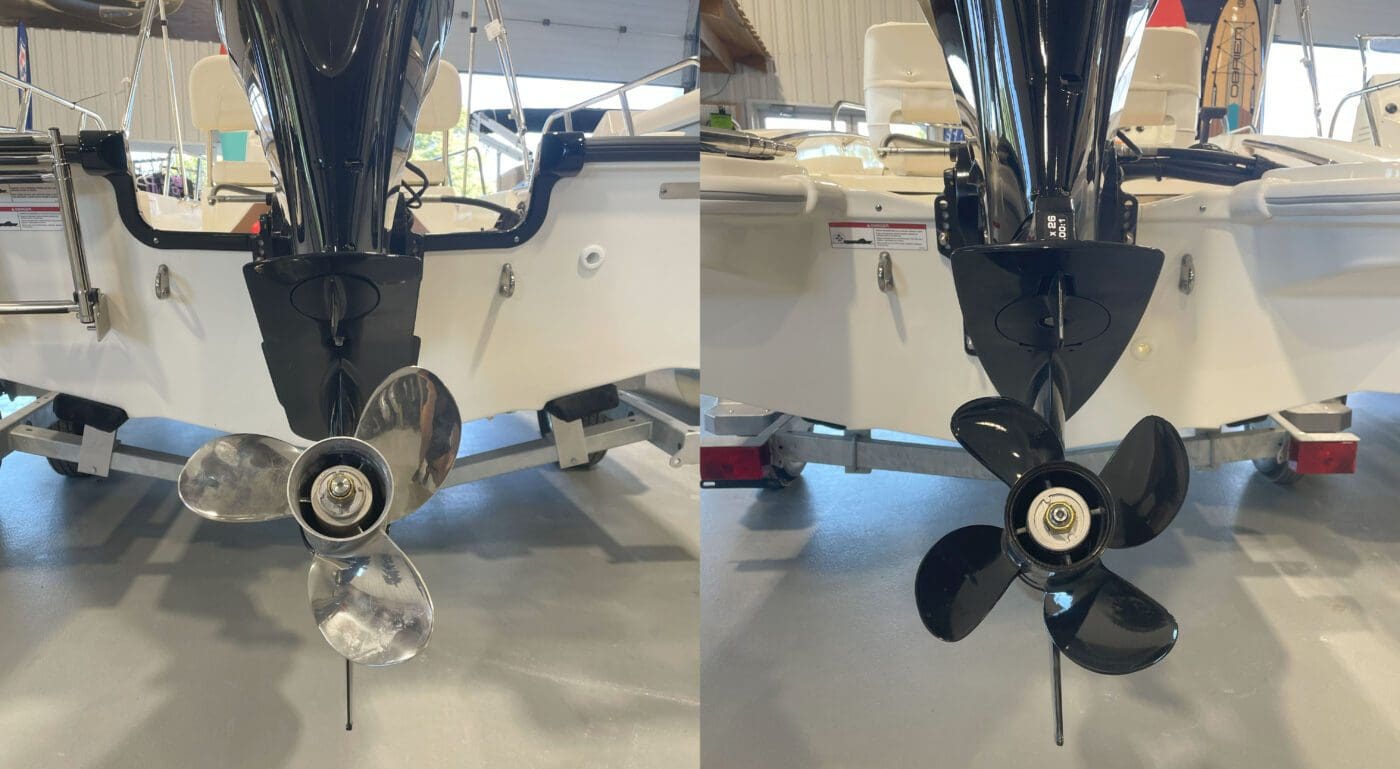
Blade count is a spectrum, not a ladder. Going from three blades to five doesn’t mean going from worse to better. It means trading one set of tradeoffs for another set. Knowing where each configuration wins and loses is the real work of picking the right Boat Prop.
Here’s how they compare across the dimensions that matter.
The Speed Picture
Three blades are the speed specialists. Less surface area in the water, less drag, cleaner water flow between blades — a 3-blade prop delivers the highest top-end numbers of the three. Raw boat top speed is the priority? Three blades is where you start, and where you’ll stay.
Four blades give up a small slice of top-end speed in exchange for better grip off the line. The difference is noticeable but not dramatic.
Five blades lose the most ground at wide-open throttle. Real-world data puts the penalty at 3 mph less top-end speed compared to a 4-blade prop at the same propeller pitch and diameter. Stack it against a 3-blade? The gap gets bigger. That’s not noise in the data. That’s the propeller drag coefficient doing its math, every single time.
Acceleration and Hole Shot
Flip the script and the rankings reverse.
Five blades grip the water harder. More blade area bites into each rotation with greater force. That translates into faster acceleration off the line and a more confident climb onto plane — especially under load. Boats carrying gear, passengers, or towing weight? That hole shot advantage is real and noticeable.
Four blades split the difference well. The hole shot is stronger than three blades, but you don’t pay the top-speed penalty that five blades brings.
Three blades produce the weakest acceleration of the group — speed credentials and all. On a solo bass boat with a light load, that’s fine. Put six people on a family runabout, and it shows.
Blade Count Comparison at a Glance
|
3-Blade |
4-Blade |
5-Blade |
|
|---|---|---|---|
|
Top Speed |
Highest |
Moderate |
Lowest (−3 mph vs. 4-blade at WOT) |
|
Hole Shot / Acceleration |
Weakest |
Strong |
Strongest |
|
Heavy Load Planing |
Poor |
Excellent |
Excellent |
|
Cruise Efficiency |
Best at cruise |
Slightly lower |
Higher MPG possible at mid-RPM |
|
Vibration |
Most |
Reduced |
Minimal |
|
Best Use Case |
Bass boats, racing, light loads |
Family boats, towing, rough water |
Stepped hulls, trolling, cruise-focused builds |
|
Fuel at WOT |
Best |
Moderate |
Highest consumption |
The Cruise Efficiency Surprise
Here’s where the 5-blade story gets more complicated — and most comparison guides skip right past this.
At cruise RPM, a 5-blade prop can outperform a 4-blade in both speed and fuel economy. Independent testing shows gains of around +4 mph at 3,500 RPM, with better miles-per-gallon figures on top of that. The same physics that hurt a 5-blade at wide-open throttle work in its favor at mid-range speeds. Blade grip increases and prop slip percentage drops — both working together to your advantage.
That’s exactly why 5-blade props fit cruise-focused boaters better than speed-focused ones. The Mercury Maximus versus Revolution 4 real-world comparison backs this up. Boaters who cared most about engine RPM and propeller efficiency at cruising speeds found the 5-blade delivered. Those chasing peak WOT numbers switched back to the 4-blade.
Which Boat Gets Which Prop
Each blade count has a natural home. None of these matches are random:
-
3-Blade — Bass boats, racing setups, solo running with light loads where top-end marine propeller efficiency is the whole point
-
4-Blade — Family boats, pontoons, towing rigs, rough-water applications where planing with passengers and stability matter more than outright speed
-
5-Blade — Stepped hulls, luxury cruise builds, heavy low-torque applications, trolling setups where smooth thrust and mid-range boat performance optimization outrank wide-open-throttle numbers
The decision isn’t about which blade count is best. It’s about which tradeoffs fit your water, your load, and your real expectations for how that boat should perform.
Common Applications and Limitations
Not every boat benefits from a 5-blade prop. Most reviews bury that fact in a footnote — or skip it entirely.
Knowing where a 5-blade setup earns its place — and where it creates new problems — saves you money and frustration. The blade count conversation gets abstract fast. Keep it grounded in boat type, load, and how you use the water.
Where 5-Blade Props Belong
Five-blade props have a real job to do. They just need the right boat.
Stepped-hull builds are the natural home. Stepped hulls run with ventilated air pockets under the hull — they already manage airflow in unconventional ways. A 5-blade prop’s smooth, distributed thrust pairs well with that hull shape. It delivers controlled performance where a 3-blade would feel loose.
Heavy-displacement vessels running at cruise speeds — not WOT — also benefit. Think long-range trawlers, luxury cruisers, and charter boats. The priority is smooth, consistent power delivery over hours, not a sprint to top speed. The mid-range prop slip percentage advantage a 5-blade produces is real and meaningful in these cases.
Pontoon and deck boats carrying variable passenger loads respond well to the stronger bite a 5-blade provides. Getting a heavy boat onto plane is easier. The engine RPM and propeller relationship stays more manageable too, because blade grip compensates for the extra weight.
Trolling and slow-speed precision work — fishing deployments above all — favor the smoother thrust profile. A 5-blade delivers power with less vibration at low throttle. That matters when you’re holding position in current or managing a drift.
Where 5-Blade Props Create Real Problems
These limitations are not hypothetical. They show up in specific situations, and they show up consistently.
High-speed runabouts and bass boats are a poor match for 5-blade geometry. These hulls are built around maximum boat top speed — every design decision targets minimal drag. A 5-blade prop works against that goal. The propeller drag coefficient penalty at WOT can’t be fixed through tuning or trim adjustment.
Lightweight single-passenger setups don’t need the extra grip. The acceleration advantage a 5-blade offers disappears when the boat is already light enough to plane on a 3-blade. You end up paying the top-speed and fuel consumption propeller penalty without getting the hole-shot benefit back.
High-RPM outboard engines can be especially unforgiving. A 5-blade prop shifts the load on the engine across the full RPM band. Your engine may not be built to handle that change in resistance. Run it outside its efficiency window long enough, and marine propeller efficiency drops. Engine wear increases over time.
The Limitation That Catches Most Boaters Off Guard
Propeller cavitation and ventilation in marine propeller behavior don’t disappear with more blades — they shift. The tight blade spacing at the hub on a 5-blade design creates flow restriction. That’s something 3- and 4-blade props don’t face at the same level. Under certain throttle conditions, that restricted root flow pulls air into the blade faces. Clean thrust breaks up at the worst possible moment.
This limitation matters most in:
-
Shallow-water operation, where surface air sits closer to the prop
-
Aggressive acceleration from standstill, where the prop over-demands from the water column
-
High-trim angles, where the prop is angled toward the surface
The fix isn’t always clear. Adjusting trim helps. Lowering the engine on the transom bracket helps more. But those adjustments treat the symptom, not the source — the Boat Prop selection was wrong for the hull from the start.
Match the prop to the mission. A 5-blade is a precision tool, not a universal one.
Conclusion
A 5-blade prop isn’t a bad choice — it’s just not a universal one.
Want lower prop slip percentage and a smoother ride? The extra blade delivers that. But chasing top-speed numbers or keeping fuel consumption propeller costs down? Those added blades can work against you. More surface area creates more drag. More drag makes your engine RPM and propeller relationship harder to manage.
The honest takeaway: the best prop matches your boat, your load, and your water. Nothing else.
Don’t spend money on an upgrade — or burn time troubleshooting a setup that was never right for your hull — without getting specific first. Know your use case. Run the numbers.
Head to VIF Propellers to compare blade configurations side by side. Or reach out directly for a fit recommendation based on your exact setup.
The right prop doesn’t just move your boat. It transforms it.