
You’re shopping for a prop and wondering: who actually makes this thing? That’s a fair question.
Every Solas prop tells a story — from the compact aluminum boat propeller on a weekend fishing skiff to the stainless steel blade pushing a performance rig. That story starts with Solas Science & Engineering, a Taiwan-based propeller maker that has shaped how boats move through water for decades.
Knowing who’s behind the brand matters. It helps you buy with confidence, compare options clearly, and pick the right prop for your engine and hull. Here’s everything you need to know.
Who Makes Solas Props?
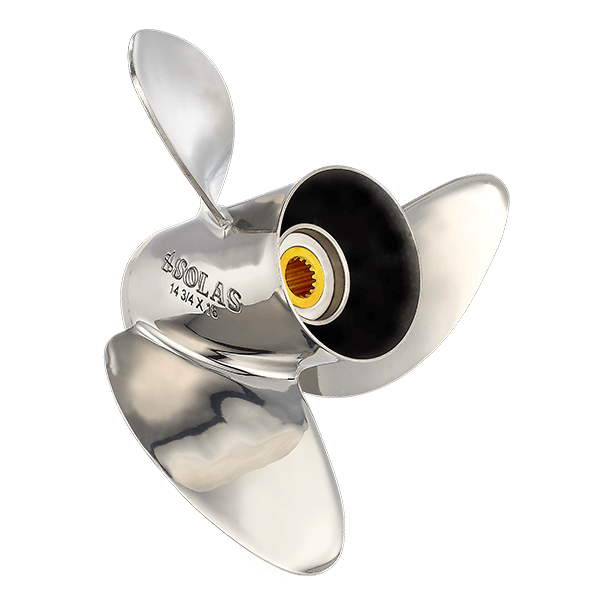
Solas Science & Engineering Co., Ltd. was founded in 1986 by Dr. Solas Y.J. Lin in Taichung, Taiwan. They’re the company behind every Solas propeller you’ll find on the water today.
That’s worth knowing. Solas has grown into a world leader in propeller and impeller manufacturing. They serve both OEM partners and the aftermarket with a wide product range:
-
Stainless steel props
-
Aluminum boat propellers
-
Plastic propellers
-
Impellers for personal watercraft
-
Ski props
So what keeps them at the top? Strict manufacturing standards. Every prop goes through a full set of checks before it ships:
-
Material composition checks
-
Hardness testing
-
Salt spray testing
-
Rubber torque testing
-
Balance verification
Their BSI ISO 9001 certification and Taiwan’s Product Symbol of Excellence back this up. These aren’t just badges. They show a quality system built into the process from the start — not added at the end.
Solas also runs a dedicated R&D division. Their team works with industry specialists and academic researchers to develop new alloys, better blade shapes, and improved surface finishes. They treat propeller design as a serious discipline. It’s not just about production volume — it’s about building a better prop every time.
The History Behind Solas Propellers: From Taiwan to Global Waters
Taichung, Taiwan, 1985. A propeller engineer named Dr. Solas Y.J. Lin decided the marine industry deserved something better — and built a company to prove it.
That company became Solas Science & Engineering Co., Ltd., named after its founder. It wasn’t a bold rebrand or a clever marketing move. The name was a declaration: this is personal, and the work behind it will reflect that.
From the start, Solas focused on outboard motor propellers, stern drive applications, and impellers for personal watercraft. The goal wasn’t to ship volume. It was to build a manufacturing system worthy of the engineering behind it. Dr. Lin put together a strong combination:
-
World-class research and design capabilities
-
A skilled, experienced workforce rooted in Taichung’s industrial base
-
Cost-effective, high-quality material sourcing
-
A cutting-edge production facility — all under one roof in Taiwan
That foundation held. Today, Solas props reach boat owners across the US, Australia, and markets worldwide — from weekend anglers to performance boaters running serious offshore rigs.
The brand name on the box carries real weight. The infrastructure behind it was built with intention, not convenience.
Taiwan has earned its reputation in precision engineering. For Solas, that reputation became the backbone of a marine propeller brand trusted around the world — still headquartered at the same Taichung industrial park where it all began.
What Does Solas Make? Product Line Breakdown
Over 200 SKUs. A pitch range from 9 to 32 inches. Engine compatibility runs from 40 HP weekend runabouts up to 350 HP offshore machines. The Solas catalog covers nearly every propulsion need on the water.
Here’s how it breaks down.
Outboard Motor Propellers
This is Solas’s core territory. Their outboard motor propeller lineup spans the full horsepower range — 40 HP to 350 HP — in both aluminum boat propeller and stainless steel boat prop builds.
-
Aluminum props: Three-blade standard design, pitch range from 9 to 30 inches. These are affordable and solid for everyday boating, fishing rigs, and moderate-performance use.
-
Stainless steel props: Three- and four-blade options built for tough conditions. The Rubex series is the top pick here — it holds up where aluminum would flex and wear out.
Solas props fit a wide range of engines. You’ll find compatibility across:
-
Yamaha outboards from 40 to 300 HP (including F150–F300 models)
-
Mercury and MerCruiser from 20 to 350 HP (Vengeance and Bandit series)
-
Honda outboards from BF40 to BF250
-
Suzuki, Tohatsu, and Evinrude — all covered in the 2026 OBP Catalog, which maps over 100 compatible models
Stern Drive Propellers
Solas also makes stern drive propellers for twin-screw inboard/outboard setups. You get both aluminum and stainless steel options. These props are built for MerCruiser and Volvo Penta drives. Prop geometry and hub fitment tolerances are tight in these applications — there’s little room for error.
PWC and Jet Boat Impellers
Solas goes beyond traditional boat propellers. Their Dynafly impeller series covers the personal watercraft market:
-
Kawasaki: Ultra 150 and JE series pumps
-
Sea-Doo: 951 pump, GTX and GTI models
-
Yamaha WaveRunner: Select VX and WaveRunner fits
Reading a Solas Model Number
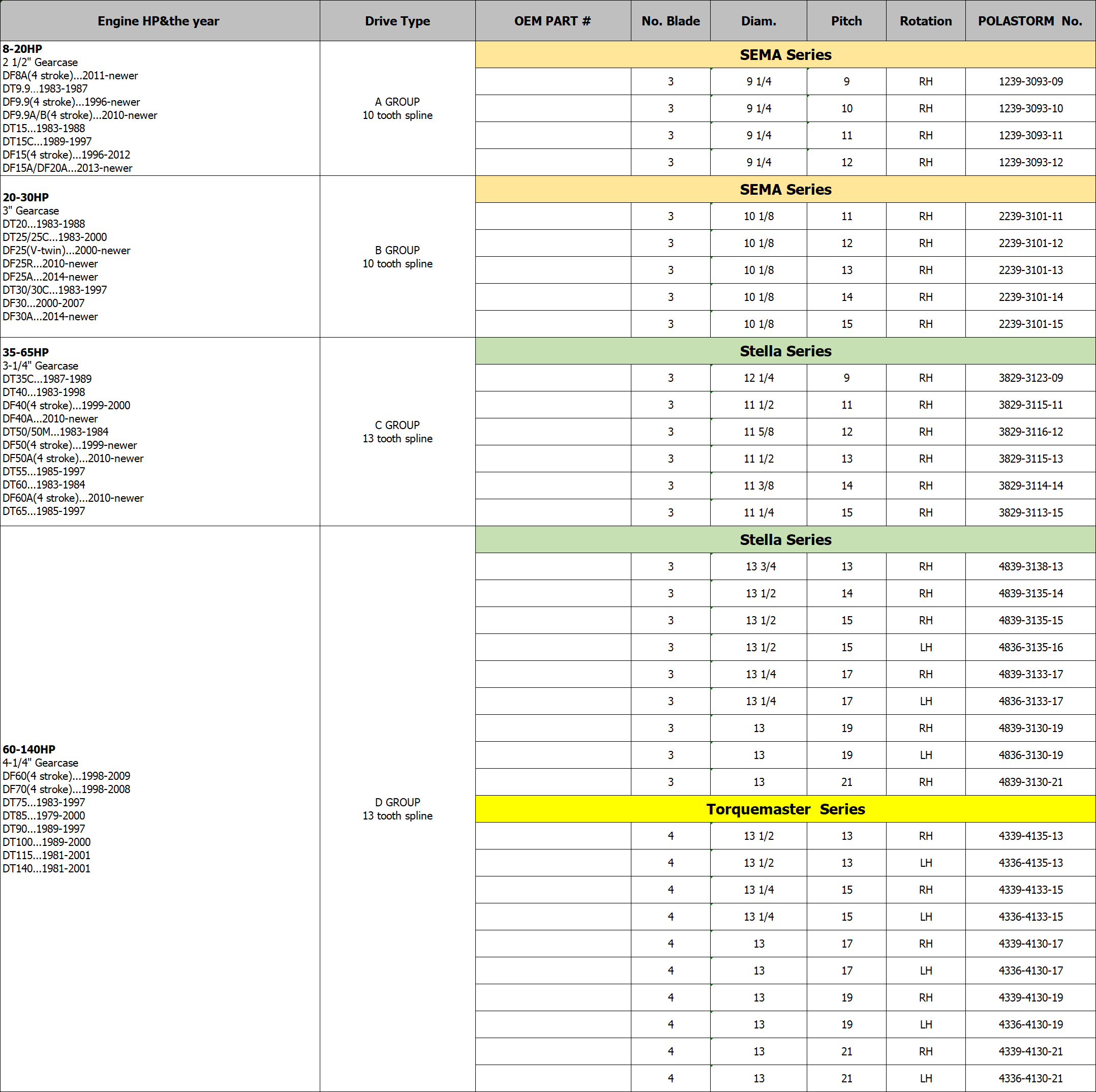
The part numbers follow a clear system. A code like 3211-111-14 tells you the material, blade count, pitch, diameter, and gear ratio — in that order. Four-blade stainless options like the S401 point to high-speed use. The HR designation marks a high-rake blade profile built for bow lift.
Pitch steps run in 0.5 to 1-inch increments. Your engine’s horsepower, gear ratio, and hull weight drive the selection. Solas provides compatibility charts to make the matching process straightforward — no guessing needed.
How Solas Props Are Made: Manufacturing Standards & Quality Control
Precision isn’t a feature Solas adds to their props. It’s the process itself.
Every propeller leaving their Taichung facility — aluminum or stainless steel — goes through a manufacturing sequence built on one principle: kill the weak spots before the prop ever hits the water.
Stainless Steel: Investment Casting Done Right
Solas stainless props start as a CNC-engineered design cut into tooling. That tooling creates a wax mold. Solas dips that mold in ceramic slurry, again and again, until a thick, hardened shell builds up around it. The shell goes into an oven. Then liquid 15-5 stainless steel alloy — 15% chromium, 5% nickel, heated to 3,000°F — gets poured in.
Once cooled, Solas removes the ceramic casing. What’s left goes through a five-stage polishing sequence: stone, ceramic, synthetic plastic, corn cob, and porcelain pin. That’s not overkill. A mirror finish demands exactly that. Inspectors catch any blade inconsistency and send it back for re-polishing before the hub goes in.
Aluminum: Squeeze-Cast for Strength
Solas doesn’t just pour aluminum into a mold and walk away. Their squeeze-casting process applies pressure right after the metal is poured. That compression pushes out weak spots and produces thinner blades with less drag. You get a stronger, tougher aluminum boat propeller than traditional die-casting can deliver.
Four layers of paint go on after that. That coating isn’t there for looks. It’s saltwater armor.
Quality Control That Goes Beyond the Checklist
Before any boat prop ships, it clears a full battery of tests:
-
Dynamic balance testing
-
Salt fog exposure testing
-
Rubber torque testing
-
Full material composition and hardness checks
Their TQC (Total Quality Control) system — backed by BSI ISO 9001 certification — means every step is audited, repeatable, and documented. No shortcuts. No skipped stages.
Each blade’s trail edge gets a final grind for water efficiency. Then one last round of QC checks. A Solas prop earns its box only after clearing all of it.
Solas vs Other Propeller Brands: How Does It Stack Up?
Price is where the conversation starts — and with Solas, the numbers are hard to ignore.
A comparable Mercury prop runs $500 or more. A Solas equivalent lands around $300. On a 25hp Mercury 2-stroke, that gap gets even sharper. The Mercury Vengeance retails around $275. The Solas New Saturn (48-19640A40) comes in at $165. That’s not a rounding difference. That’s 40–50% back in your pocket for a prop built to the same performance standard.
But price alone doesn’t win an argument. Here’s what else matters.
Material and Design Flexibility
Mercury and Quicksilver lead with their OEM positioning. Solas competes on range. You get aluminum and stainless steel options, multiple blade counts, cupped blade profiles, and rake variations — all in one catalog. The Rubex interchangeable hub system keeps you from being locked into a single setup. Swap the hub, change the application, keep the prop.
Quicksilver’s Silverado QS5180R sits at $255 — closer to Solas pricing, but with a narrower fit range. Michigan Wheel is a solid alternative too. Solas still covers more OEM cross-reference applications across outboard and stern drive setups.
Performance Where It Counts
Real-world testing shows Solas props hold their own against premium-priced competitors. They deliver on the metrics boaters care about:
-
Top speed
-
Acceleration
-
Fuel efficiency
-
Cavitation reduction
The blade geometry is built for 4-stroke WOT RPM windows (5,000–6,000 RPM). That’s the range most modern outboards run at.
So what’s the honest answer? Solas isn’t the budget option that happens to work. It’s a precision-engineered prop that also costs less. Taiwan-based manufacturing keeps overhead low. That means no premium markup just to stay profitable.
For most boat owners comparing marine propeller brands, that combination tells the whole story.
Is Solas a Good Propeller Brand? What Real Boaters Say
The numbers on paper look solid. But what happens when a Solas prop hits saltwater for real?
The real-world story holds up just as well as the spec sheet.
Solas earns some of the highest ratings in quality and customer satisfaction in the marine propeller industry. That’s backed by ISO 9001 certification — and by the people running these props on actual boats.
One owner on iboats shared his take after running a Solas on a 17-foot Sportcraft with a 90hp Mercury outboard:
“I can’t be more pleased with the overall quality — especially for the money. Ran smooth, well finished, hub system had no issues.”
That last detail matters. The hub system is where cheap props often fall apart. Not here.
Forum conversations tell a more nuanced story. Some boaters note that Mercury edges out Solas on finish quality and leading edge precision. Fair point. But those same conversations report that Solas performed well in real testing — smooth handling, reliable acceleration, no drama on the water.
What Boaters Are Getting
-
Durability: The stainless steel props use a high-chromium, molybdenum, and nickel blend. This mix resists corrosion through six-plus months of saltwater exposure. Aluminum versions carry a four-layer performance coating built for the same harsh conditions.
-
Fuel efficiency: Thinner stainless blades create less drag. You get better mileage and need less throttle to reach cruising speed.
-
Fit across boat types: Recreational boaters, anglers, and pontoon owners all report the same experience — smooth, dependable, worth the price.
The honest verdict from real boaters? Solas isn’t the prop you settle for. It’s the one you choose — precision engineering without paying a premium just for the brand name on the box.
How to Choose the Right Solas Prop for Your Boat
The right prop doesn’t just fit your engine — it fits your boat, your water, and how you use both. Get it wrong, and you’ll feel it in every hole shot, every fuel stop, every time your RPMs climb past where they should.
Here’s how to get it right.
Start With Four Numbers
Every Solas prop selection comes down to four core parameters: diameter, pitch, blade count, and material. These aren’t independent decisions. They work together.
-
Diameter: Measure from the center of the shaft hole straight across. A larger diameter gives you more low-speed grip — better reverse control, cleaner planing, and less porpoising.
-
Pitch: This is the distance your boat travels per prop revolution. A 21″ pitch means 21 inches of forward movement with zero slippage. Drop pitch by 1–2 inches to improve hole shot and raise RPM. The rule of thumb: every 1 inch of pitch change moves your RPM by about 200.
-
Blade count: Three blades for top speed. Four blades give you more thrust, smoother cruising, faster planing, and better fuel efficiency. Four-blade props are a strong choice for fishing boats and pontoons. They cost more, but they deliver under load.
-
Material: Aluminum handles everyday use well. It also comes with a corrosion-resistant coating for saltwater. Stainless steel — the Rubex series in particular — is built for performance and durability in tough conditions.
Match Your Engine, Then Your Mission
Once you have your parameters, run your engine specs through the Solas Prop Finder:
-
Select your outboard or stern drive brand (Yamaha, Mercury, Suzuki, Honda)
-
Enter horsepower, model, and year
-
Pick blade count, material, and rotation — right-hand for single engines, left-hand for twin setups
-
Filter by hull type: cruiser, ski boat, bass boat, pontoon
-
Submit — Solas returns the closest matched models
Dial In With WOT RPM
Aim for the manufacturer’s recommended WOT (wide-open throttle) RPM range — target the middle-to-upper end of that spec window. Here’s how to adjust:
|
Situation |
Fix |
|---|---|
|
RPM too low at WOT |
Decrease pitch or increase diameter |
|
RPM too high at WOT |
Increase pitch |
|
Boating at high altitude |
Drop pitch (lose ~3% power per 1,000 ft) |
|
800 RPM below target |
Drop 4 inches of pitch |
Know When It’s Time to Replace
A prop swap isn’t always an upgrade decision. Sometimes it’s a maintenance call. Replace your current prop if you’re seeing:
-
Ventilation or porpoising (engine mounted too high)
-
Poor planing despite correct engine height
-
WOT RPM out of the manufacturer’s range
-
Slippage exceeding 20–30%
-
Visible blade damage
Before ordering a replacement, lock down your current specs. Check diameter by measuring from the shaft center. Check pitch by reading the blade markings — 15×17 means 15″ diameter, 17″ pitch. Also note your blade count and rotation direction.
Then use the Solas Prop Finder at vifpropellers.com to match your engine specs to the right model. Test with pitch adjustments of ±1–2 inches until your WOT RPM lands right where it needs to be.
Conclusion
Solas isn’t a mystery brand riding on borrowed credibility. It’s a decades-deep engineering company built in Taiwan, trusted across global waters, and backed by manufacturing standards that hold up under scrutiny.
Bolt a Solas prop onto your outboard and you’re not guessing. You’re choosing a propeller blade design refined through real R&D. It comes in both aluminum boat propeller and stainless steel boat prop configurations. Each one matches specific performance needs.
The right prop changes everything about how a boat feels on the water. Not in small ways. In ways you feel from the first push off the throttle.
So don’t leave that to chance. Browse the Solas lineup at vifpropellers.com. Filter by your engine specs. Find the exact fit your boat needs.
A great day on the water doesn’t start at the dock — it starts with the right prop turning beneath it.