
Wrong Prop choice can cost you hundreds of dollars, a full season of sluggish performance, or worse — a blown engine running outside its RPM range.
Own a Suzuki DF series outboard? You’re probably staring at a wall of diameter numbers, pitch ratings, and blade configurations with no idea where to start. You’re not alone.
Picking the right Suzuki outboard Boat Propeller goes beyond finding something that fits the hub. It’s about getting what your engine was built to deliver.

This guide breaks it all down with model-specific spec charts and a plain aluminum vs. stainless steel comparison. You’ll also find honest side-by-sides of OEM and aftermarket options. Walk away with the right Prop for your boat, your budget, and how you use it.
Content Framework: Suzuki Outboard Boat Propellers – Buying Guide 2026
Here’s what this guide covers — and why each section matters to your decision.
-
Propeller Basics — Diameter, pitch, blade count, and material. All explained in plain terms.
-
DF Series Spec Charts — Model-specific sizing from the DF15 up to the DF300B
-
Aluminum vs. Stainless Steel — A direct comparison across price, durability, and real-world performance
-
3-Blade vs. 4-Blade — Which setup fits your use and why
-
Selection by Use Case — Fishing, recreational cruising, and high-speed running. Each one has different needs.
-
Product Recommendations — Top picks across budget tiers. This includes aftermarket options from VIF, Solas, Michigan Wheel, and Powertech.
-
Installation & Maintenance — What to check before and after every season
-
FAQ — The questions Suzuki owners ask most
Every section serves one goal: matching you to the right prop the first time.
What Makes a Suzuki Outboard Propeller Different (And Why It Matters for Your DF Engine)
Suzuki engineers didn’t build the DF series around generic propeller standards. That choice affects every prop purchase you make.
Each DF model runs a specific gear ratio and spline configuration. These two factors decide which props work and which ones cause problems. The DF300B, for instance, runs a 2.29:1 two-stage gear reduction. It draives contra-rotating dual props — a system that won’t work with standard single-prop setups. The DF15 is different. It uses a 10-tooth spline. Mount the wrong prop and you get vibration, efficiency loss, and a voided warranty.
Props are not interchangeable across DF models. A pitch or spline mismatch pushes your engine outside its target RPM band. On performance DF models, that band sits at 5,500–6,100 RPM. Miss it, and you lose an estimated 10–20% of real-world efficiency — before you’ve even left the dock.
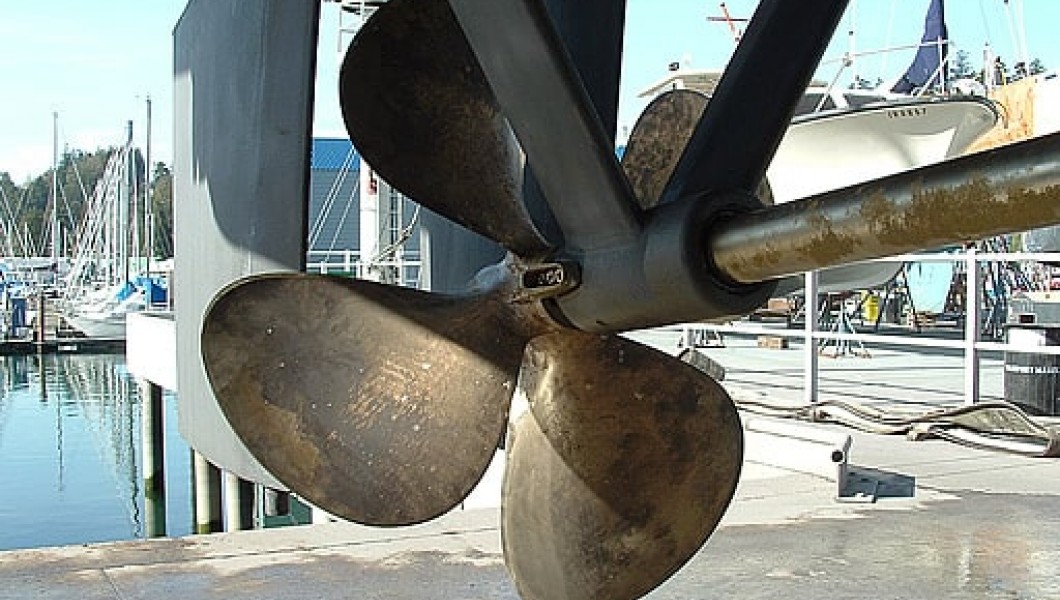
“Fits the shaft” is never enough. Suzuki prop selection follows a clear order:
-
Start with your gear ratio
-
Confirm your spline count
-
Then move to diameter and pitch
Skip the first two steps and the third one won’t save you.
Propeller Specs Decoded: Diameter, Pitch, Blade Count & Material Explained for Suzuki Owners
Every number stamped on a Suzuki prop means something specific. Misread one of them and you lose real performance on the water.
Suzuki uses a simple two-number system. A prop marked 14 x 19 means 14 inches of diameter and 19 inches of pitch. Pitch is the distance the prop moves through water in one full rotation. That’s your starting point.
Diameter
Diameter is set by your engine series. You don’t have much room to change it. A larger diameter pushes more water and builds stronger thrust. That works well for heavy hulls and rough conditions. A smaller diameter spins faster and suits lighter, quicker boats.
Pitch
Pitch is how you tune your performance:
– Higher pitch = more top-end speed, slower hole shot
– Lower pitch = stronger acceleration, better load handling
Your target is WOT between 5,000–6,000 RPM. Running a heavier boat? Drop the pitch to keep your RPM in that range. Got a light hull covering long distances? Step the pitch up.
Blade Count
-
3-blade: Top speed, fuel efficiency, everyday cruising
-
4-blade: Stronger acceleration and better grip in rough water or under heavy loads. You give up a small amount of top speed, but you gain more control.
Material
|
Use Case |
Aluminum |
Stainless Steel |
|---|---|---|
|
Rivers / Inland |
Affordable, repairable |
Overkill for most |
|
Bay / Nearshore |
Solid everyday choice |
Better stress tolerance |
|
Offshore / High-performance |
Not recommended |
Purpose-built for this |
Aluminum takes bumps and groundings without wrecking your budget. Stainless steel keeps its shape under hard, steady use. That matters on a DF150 pushing a heavy hull offshore every weekend.
Two more factors worth knowing:
-
Rake — Positive rake lifts the bow for rough-water speed. Negative rake keeps the bow planted in calm conditions.
-
Cupping — A small curve at the blade edge. It improves grip and cuts down on ventilation.
Read the numbers. Know what each one controls. That’s how you stop guessing and start picking the right prop.
Suzuki DF Series Propeller Spec Chart: Find the Exact Match for Your Engine Model
Spline count and gear ratio determine your starting point. Everything else follows from there.
This table comes straight from Suzuki’s official application charts. Find your engine group. Confirm the spline count. Then work through diameter and pitch from there.
|
Model Group |
Boat Length (ft) |
Speed (MPH) |
Dia. × Pitch (in.) |
Blades |
Material |
Notes |
|---|---|---|---|---|---|---|
|
DF8–15 |
14–19 |
19–24 |
9¼ × 9–10 |
3–4 |
AL |
10-tooth spline; 4-blade high-thrust option available |
|
DF20–30 |
16–20+ |
13–20 |
10–12¼ × 9–13 |
3–4 |
AL |
10-tooth spline; Flo-Torq Reflex hub recommended |
|
DF40–70 |
17–22 |
18–22 |
10–14 × 12–21 |
3 |
AL/SS |
15-tooth spline; DF60A gear ratio 1.20 supports 14″ dia. |
|
DF115–140 |
18–22 |
44–56 WOT |
14¾ × 21 |
3 |
SS |
15-tooth spline; stainless is the clear choice at this power level |
|
DF200–300AP |
20+ |
47–56 |
14¾ × 21+ |
3 |
SS |
Gear ratio 2.42; large-diameter props for heavy-load propulsion |
A Few Notes Worth Keeping
DF8–15: The 10-tooth spline is non-negotiable. A 4-blade high-thrust aluminum (10″ × 10″) works well on heavier hulls that need stronger bite off the line.
DF20–30: Pitch range runs wide here — 9″ up to 13″. Light skiffs with a DF25 can run a shorter 7½” diameter prop (C601–C701 series) at lower speeds. Heavier hulls need more diameter to stay in the 5,000–6,300 RPM target band.
DF115–140: The 14¾ × 21 stainless three-blade is the standard match. Running a lighter hull? Step up one pitch increment and verify WOT RPM before committing.
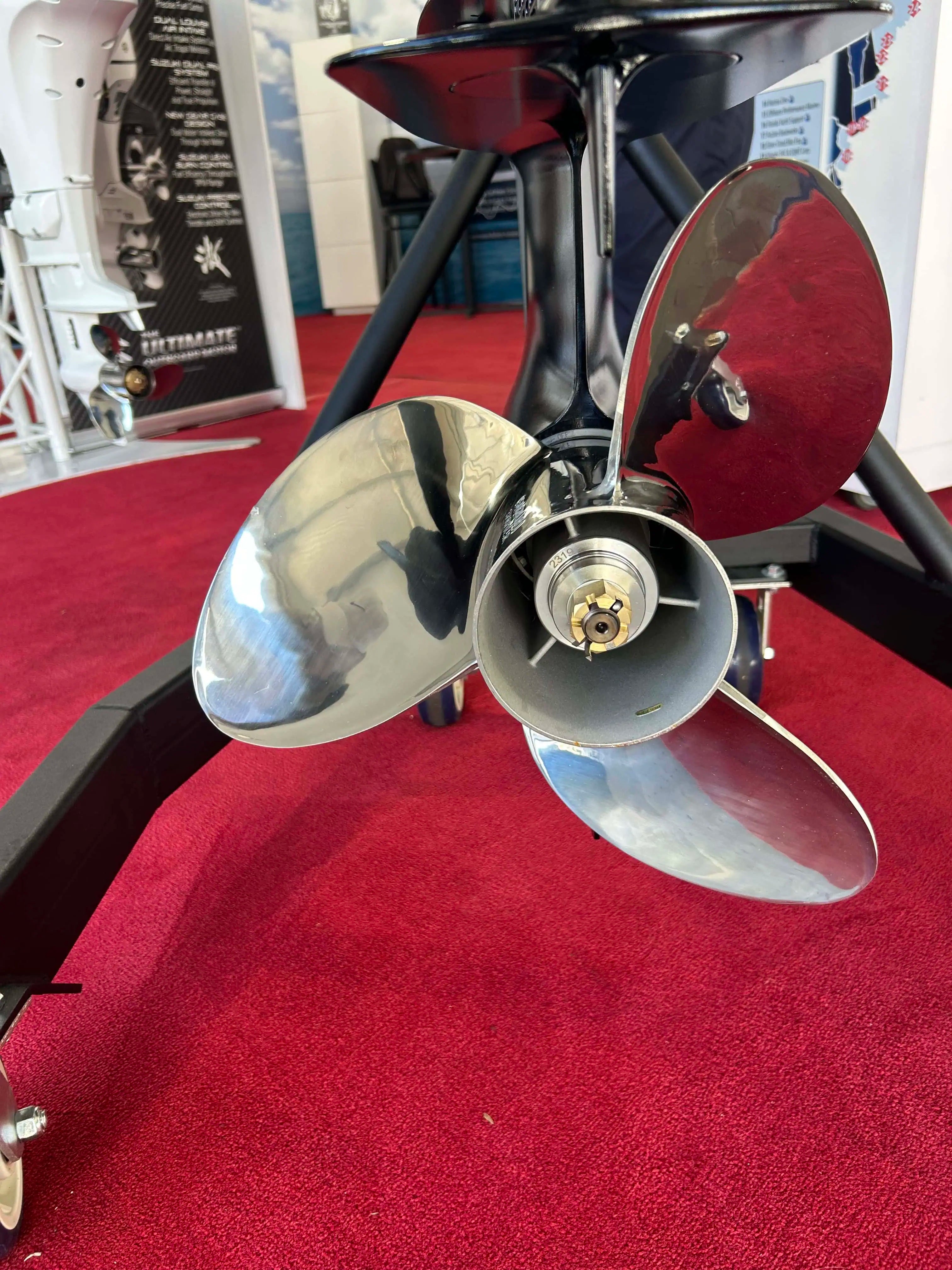
DF200–300AP: At this power level, gear ratio drives the decision. The 2.42:1 reduction is built for 14-inch-diameter props running under sustained high load. Don’t undersize here — the engine will make the problem obvious, fast.
Aluminum vs. Stainless Steel Suzuki Propellers: Which One Fits Your Budget and Needs
The material debate isn’t philosophical. It’s math, use case, and what you can afford to lose on a bad day.
Here’s the split in plain terms:
-
Aluminum (2026 pricing: $100–$300) — DF40–60 runs $120–220. DF90–115 lands at $180–280. DF150 tops out around $300.
-
Stainless steel (2026 pricing: $400–$800) — 2–3x the aluminum price. VIF-series stainless runs another 10–20% above standard stainless.
That price gap exists for real reasons.
What Each Material Does
Stainless doesn’t flex under load. That rigidity cuts slip and pushes speed up — expect 5–10% more top end on DF40–DF150 setups. A boat doing 42 mph on aluminum can hit 45 mph on stainless at the same pitch. Watch your WOT RPM though. Stainless requires dropping 1–2 inches of pitch to stay in the 5,500 RPM target band.
Fuel savings follow the same logic. Less flex means less wasted energy. High-use operators report 11% efficiency gains — that’s real money if you’re burning 30 gallons a day across a 200-day season.
Aluminum plays a different role. It’s lighter — about one-third the weight of stainless — and that helps hole shot on boats under 75 HP. It also acts as a sacrificial layer. Hit a submerged rock in shallow water, and the aluminum prop takes the hit. It bends. It sheds a blade. That’s damage you can see, repair for low cost, and move on from. Stainless handles the same impact a different way — it gouges rather than flexes. Its 5x stress tolerance means it often survives hits that would destroy aluminum outright.
|
Aspect |
Aluminum |
Stainless Steel |
|---|---|---|
|
Price (2026) |
$100–$300 |
$400–$800 (VIF +10–20%) |
|
Speed |
Baseline |
+5–10% MPH |
|
Fuel Efficiency |
Baseline |
+11%, ~10% savings |
|
Impact Behavior |
Flexes, protects lower unit |
Gouges, 5x stronger, repairable |
|
Best For |
Shallow water, casual use, spare |
Performance, saltwater, heavy loads |
The Simple Rule
Under 75 HP, light hull, occasional use — aluminum is the honest answer. Above 75 HP, offshore saltwater, heavy loads, or anything pushing past 50 mph — stainless pays for itself in durability and recovered speed.
One practical move no matter which you pick: carry an aluminum prop as your spare. Stainless may be your primary, but aluminum is cheap, easy to find, and gets you home when things go sideways.
3-Blade vs. 4-Blade Propellers for Suzuki Outboards: Performance Trade-offs by Use Case
Blade count is one of the most misunderstood choices in prop selection — and one of the easiest to get wrong.

Here’s the honest truth: correct pitch matters more than blade count. A real-world example proves it. Twin DF300AP engines on a 40-ft, 4-ton dive boat. OEM prop was a 3x16x20. WOT topped out at 5,000 RPM — 700 to 1,300 RPM short of the 5,700–6,300 RPM target. That’s an over-propping problem. Adding a fourth blade won’t fix it. Dropping to a 16×17 or 16×15 pitch will.
Get the pitch right first. Then choose your blade count.
Where 3-Blade Props Shine
Three blades mean less drag. On a DF150 running a 15×21 stainless prop, you get 42.6 MPH at 5,750 RPM and a best cruise efficiency of 3.99 MPG at 4,000 RPM. Light-to-medium hulls on DF90–DF200 setups benefit most. Three blades give you cleaner top-end speed and better fuel economy on long runs.
Where 4-Blade Props Shine
Heavy displacement boats, tow sports, rough water — four blades earn their keep here. Take the Powertech LFS4 (16×21, built for Suzuki engines). It matches the same 16-inch diameter as the OEM 3-blade. That’s a big deal. You keep hull clearance intact on RIBs and tight cavitation plate setups. No diameter change needed. The extra blade surface holds grip where a three-blade loses traction under load.
|
3-Blade |
4-Blade |
|
|---|---|---|
|
Top Speed |
Higher |
A bit lower |
|
Hole Shot |
Moderate |
Stronger |
|
Fuel Efficiency |
Better at cruise |
Lower RPM at same speed |
|
Best For |
Light hulls, cruising, speed |
Heavy loads, tow sports, chop |
One calibration rule applies to both: every 1 inch of pitch change moves RPM by around 200. Use that to dial in your WOT before you decide blade count is the problem.
How to Choose the Right Suzuki Propeller for Fishing, Watersports, and Cruising
Three activities. Three different demands. The prop that works great on your fishing boat will frustrate you on a wakeboard run — and neither one suits a cruiser covering 200 miles offshore.
Here’s how each use case breaks down.
Fishing
Heavy coolers, live wells, and a trolling motor running all day — fishing boats carry weight. That load needs grip, not raw speed.
A 4-blade aluminum prop handles this well. The extra blade surface holds thrust when the hull is heavy or the water gets rough. Aluminum keeps costs down. Clip a submerged log, and it bends rather than gouging your lower unit. Go large on diameter to maximize pulling power through the water column.
Watersports
Tow sports punish weak hole shots. A rider on a wakeboard or ski rope needs the boat moving now — not after a slow three-second climb through RPM.
Drop your pitch. Each inch you lose adds 150–200 RPM at WOT. That translates into faster response off the line. Pair that lower pitch with a 4-blade stainless prop. Stainless handles repeated hard-load stress without flexing. Four blades keep you planted through choppy wakes.
Cruising
Cruising rewards efficiency. A 3-blade prop produces less drag than a four-blade at the same pitch. You get cleaner speed and better fuel economy on long runs.
Keep your cruise RPM at 70–75% of your rated maximum. For most Suzuki DF engines, that falls between 3,500–4,500 RPM depending on model. Running there — rather than pushing WOT — reduces wear and extends engine life. Your fuel range stretches further too. Stainless is worth the investment for serious offshore miles in saltwater.
|
Activity |
Blades |
Material |
Priority |
|---|---|---|---|
|
Fishing |
4 |
Aluminum |
Thrust & load handling |
|
Watersports |
4 |
Stainless Steel |
Hole shot & durability |
|
Cruising |
3 |
Stainless Steel |
Efficiency & longevity |
OEM Suzuki Propellers vs. Aftermarket Brands (Solas, Michigan Wheel, VIF): Honest Comparison
Suzuki OEM props do one thing really well: they put your engine in its 5,000–6,000 RPM WOT sweet spot right out of the box. No guesswork. No test runs to dial in pitch. That precision costs money — and for a lot of Suzuki owners, it costs more than it needs to.
Here’s the honest breakdown.
OEM props are built around each DF model’s gear ratio and spline count. The fit is exact. The RPM calibration is guaranteed. Your time matters more than your budget? That’s a fair reason to pay the premium.
Solas covers the full DF4–DF300AP range with OEM-matched specs. Their 70–140 HP stainless options run 14″ diameter across a 10–13″ pitch range. Solid engineering at a lower price point.
Michigan Wheel uses the Reflex hub system. It covers DF8 through DF300 in both aluminum and stainless. You get 3- and 4-blade options. The fit is reliable and you can find them just about anywhere.
VIF goes after performance-focused buyers ready to spend a bit more than standard aftermarket pricing. Expect a 10–20% premium over comparable stainless options. The blade geometry backs up the price.
The rule is simple: OEM buys certainty. Aftermarket buys value — sometimes better value. Match the specs first. The brand choice falls into place from there.
Top Suzuki Propeller Picks for 2026 by Budget and HP Range
Budget matters more than most people admit. So does horsepower. Here are the props worth buying this year, sorted by what you’re spending and what you’re running.
Under $200 — DF40 to DF115: Aluminum Gets the Job Done
Aluminum at this price point isn’t a compromise. It’s the right tool for light-to-medium hulls that don’t get pushed hard offshore every weekend.
The Suzuki OEM 3-blade aluminum (part 58100-96372-019) fits DF40 through DF115 engines. Diameter runs 10.25 inches. Pitch sits at 9–10 inches depending on hull weight. It’s factory-calibrated, and it works.
Solas aluminum 3-blade covers the same range at a lower price. Available in 0° and 20° rake configurations for DF40–115. Diameter matches OEM to spec. You need a solid replacement without overthinking it? Solas covers that. Pick one and move on.
$200–$500 — DF90 to DF200: Where 4-Blade Starts Making Sense
Heavier hulls, towing rigs, and serious fishing setups need more blade surface. A 4-blade aluminum from Solas or the Rubex line handles that load well. Specs: 10.25-inch diameter, 9–12-inch pitch, 10-spline. You stay within budget and out of stainless territory.
Step up to entry-level stainless and the difference shows fast. Solas offers 3- and 4-blade options with 20° rake. You get better grip and less flex under a sustained load. That matters on bigger hulls pushing harder.
Over $500 — DF150 to DF300: Stainless and Dual-Prop Territory
The DF300B comes with contra-rotating stainless props built into the package. The 2-stage gear reduction system drives that choice. Single props don’t work here. The dual setup spreads torque across both blade sets. Industry data puts the gain at 10–20% over comparable single-prop builds.
The DF350A runs the same setup on a 350 HP V6. Lean Burn and O2 sensors manage fuel efficiency. The dual contra-rotating stainless props take care of the rest. You can expect speed gains of 5–15% and fuel savings of 10–20% compared to a single-prop aluminum setup.
2026 pricing snapshot:
|
Tier |
Engine Range |
Price Range |
Best Option |
|---|---|---|---|
|
Budget |
DF40–DF115 |
$100–$300 |
OEM or Solas aluminum |
|
Mid-Range |
DF90–DF200 |
$200–$500 |
4-blade aluminum or entry SS |
|
High-Performance |
DF150–DF300 |
$500+ |
Stainless, VIF upgrade, or OEM dual-prop kit |
VIF stainless props run 10–20% above standard aftermarket stainless pricing. The blade geometry earns that premium for high-load, high-use setups. Think DF150 and above running saltwater on a regular schedule. That’s where the extra cost pays off.
Suzuki Propeller Installation, RPM Tuning & Maintenance: Avoid These Costly Mistakes
Most prop failures aren’t mechanical. They’re procedural. Someone skipped a step, used the wrong grease, or never ran a WOT test after installation. The engine pays for it.
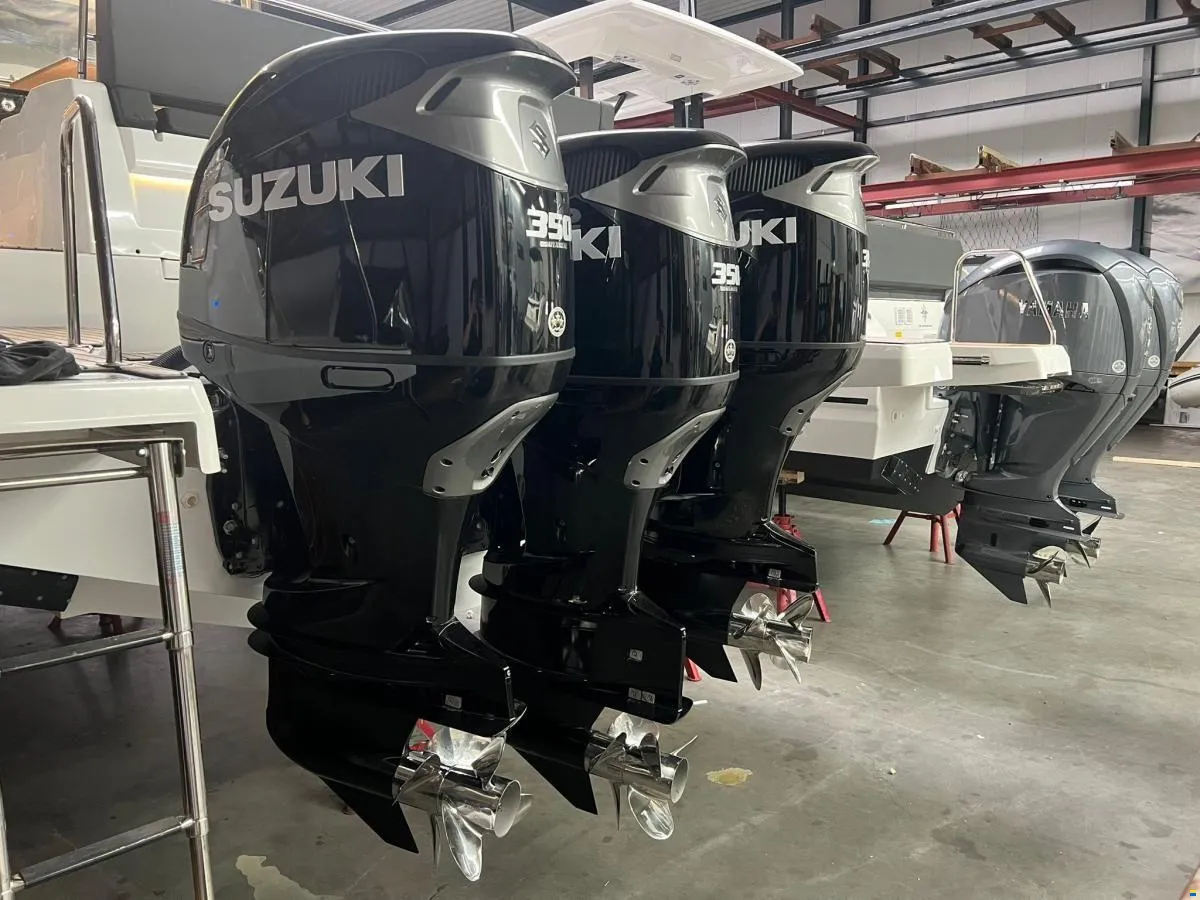
Install It Right the First Time
Start with marine-grade grease — Suzuki’s own water-resistant grease (99000-25520) works best. Coat the shaft splines and hub bushing surfaces before anything goes on. Dry splines corrode. Corroded splines seize. That’s an expensive lesson.
Slide the hub bushing in from the front. Tap it down with a mallet until it sits flat. Then install the thrust washer (41570900) — tapered end first. Skip it and you risk serious damage to both the prop and lower unit. It’s not optional.
Get the prop onto the shaft. Add the nut spacer and flat washer. Torque the prop nut to 55 ft-lb. Not close to 55. 55, dead on. Too loose and the prop spins free. Too tight and you strip the threads. Fit the cotter pin, bend both ends, then spin the prop by hand in neutral. It should turn without resistance.
Dual-prop DF models follow a different sequence. The front nut uses left-hand thread — turn it counterclockwise to tighten. Lock at least two spacer tabs before moving to the rear nut.
Tune Your RPM After Every Prop Change
Installation is half the job. Take the boat to WOT under full load in normal conditions and check your RPM. Target range for most DF engines is 5,000–6,000 RPM. Fall outside that range and you’re either over-propping or under-propping the engine.
The fix is simple: every 1-inch pitch change shifts RPM by about 200. Running low? Drop pitch. Running high? Add pitch. Retest. Repeat until you’re inside the band.
Maintain It or Pay for It
|
Task |
Frequency |
Threshold |
|---|---|---|
|
Inspect blades for damage |
Quarterly |
Repair if >0.5mm deep or >10% blade area |
|
Regrease splines |
Quarterly |
Suzuki water-resistant grease only |
|
Re-torque prop nut |
Quarterly |
55 ft-lb |
|
Dynamic balancing |
Annual / after impact |
Cost ~$100–200 |
|
Freshwater rinse + anti-corrosion spray |
Weekly (saltwater) |
Zinc anodes: replace if <50% remaining |
One number to keep in mind: an unbalanced prop cuts engine life by 20–30% through constant bearing vibration. Dynamic balancing after any hard impact isn’t a routine task — it’s damage control. Don’t skip it.
FAQ: Suzuki Propeller Questions Answered
Suzuki owners ask the same questions. Over and over, on every forum, in every dealer inbox. Here are the real answers.
How do I read prop size notation?
Three numbers. 3 x 13 x 18 means 3 blades, 13″ diameter, 18″ pitch. Start there.
How do I match a prop to my DF engine?
Pull Suzuki’s application chart. A DF8–15 on an 18–20″ pontoon runs a 13¾ x 15 RH aluminum. DF40/50/60 fall into Class C — a 14×13 RH extra-cup aluminum covers most setups. Start with the spline count. Then match diameter and pitch.
Will a prop swap make me faster?
Yes — if you’re running the wrong prop right now. A DF115/150 moving from a 13.75×17 to a 13×19 picks up 400 RPM and 2–4 MPH. A DF200 stepping from 14×15 to 14.5×17 climbs from 5,200 to 5,800 RPM and gains 3–5 MPH. The right prop size makes a real difference.
Does running an aftermarket prop void my Suzuki warranty?
No. Suzuki’s official stance is clear: prop choice does not void the motor warranty. The only exception is if the prop fails and that failure causes engine damage. OEM Watergrip props carry a 1–3 year prop warranty. Aftermarket props are fine — just make sure you install them the right way.
What counts as damage worth replacing?
– Bent blades past ⅛” deviation
– Cracks longer than 1 inch
– Erosion covering more than 20% of blade area
Anything beyond those limits, replace the prop.
Conclusion
Your Suzuki outboard deserves better than a guessing game at the Prop shop.
The right Suzuki outboard Boat Propeller isn’t just a replacement part. It’s the difference between an engine that struggles and one that runs at peak RPM. Get the pitch wrong by two inches and you’ve left performance and fuel economy on the table. Get the material wrong and you’re replacing it again in two seasons.
You now have the spec charts, the material comparisons, the blade-count trade-offs, and honest takes on OEM versus aftermarket. That’s everything you need to stop second-guessing and start shopping smart.
So here’s your next move:
-
Grab your engine model number — Suzuki DF115, DF150, or DF200
-
Cross-reference it against the charts in this guide
-
Browse the VIF aftermarket lineup for the best value at your horsepower range
The right prop is out there. Now you know how to find it.