
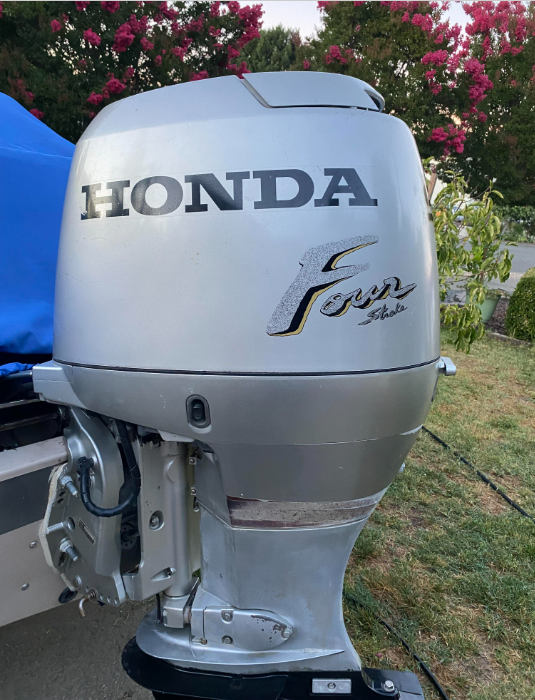
Twenty-plus years on the water, and the 2001 Honda BF90A still shows up to work. That’s not marketing copy — that’s what actual owners keep reporting. Call it a testament to Honda’s four-stroke engineering. Or call it proof that some engines just refuse to quit.
Staring down a used listing right now? That’s the right question to ask. This engine is either a smart buy or an expensive gamble — and you deserve a clear answer before you decide. Already own one? You want to know how much life it has left. That’s fair too.
Either way, the Honda Four Stroke 90Hp gets a straight answer here. On performance. On what breaks. On what it costs to keep running. And yes, on whether the right Propeller can pull even more out of it.

2001 Honda BF90A Overview: Performance, Reliability & What to Watch For
If you’re looking at the 2001 Honda BF90A, you’re dealing with a 1.5-liter, inline-four workhorse. Honestly, this is the engine that helped phase out those smoky two-strokes by offering incredible fuel efficiency—frequently burning 25% to 35% less fuel right around its 4,000-rpm cruising sweet spot. Sure, it relies on an old-school four-carburetor setup rather than modern electronic fuel injection (EFI), but that exact mechanical simplicity is why some of these motors are still pushing strong past the 5,000-hour mark today.
While you shouldn’t expect an explosive, modern hole-shot, a properly propped BF90A provides smooth, linear power and can easily push a lightweight 17-foot hull past 40 mph. The real catch? It’s a two-decade-old machine. Its famous reliability hinges entirely on meticulous maintenance rather than just clever engineering. To keep it running right, you absolutely need to monitor a few key areas:
-
Fuel System: Stay on top of syncing and clearing out those carburetors to prevent varnish clogs from old gas.
-
Cooling System: Swap out aging water pump impellers before the rubber crumbles and kills your water pressure.
-
Hardware & Electronics: Keep a close eye on the mid-section for saltwater corrosion, and don’t forget to test the electrical regulator.
Ultimately, if you stumble upon a unit with solid, even compression and a genuine paper trail of routine care, this vintage Honda remains a remarkably capable engine to have on your transom.
Used 2001 Honda 90hp Buying Guide: Deal-Breaker Checks
When you walk up to a used BF90A, you need a plan. Private sellers often price their motors on hope, but you should only buy based on evidence. Honestly, a 20-year-old engine is either a hidden gem or a money pit, and the line between the two comes down to a few specific tests. Here is the breakdown of what to check before you even talk numbers.
|
Inspection Area |
The “Green Light” Target |
Red Flags & Cost Warnings |
|---|---|---|
|
1. Compression Test |
160–200 psi on all 4 cylinders (variance under 10%). |
If one cylinder lags 15-20% behind, walk away. It means major powerhead wear. |
|
2. Engine Oil |
Gold to light brown color. |
Milky or foamy oil means water intrusion (likely a blown head gasket). |
|
3. Gear Lube |
Dark, uniform fluid. |
White or cream fluid means a failed lower unit seal. Budget $100–$300 to fix. |
|
4. Thermostat & Impeller |
Invoices showing replacement within the last 2–3 years. |
No records? The impeller is a ticking bomb. Add $150–$300 to your immediate budget. |
|
5. Service Records |
Consistent 100-hour or annual service intervals. |
Without paper trail for oil, lube, and anodes, you are guessing at its internal health. |
|
6. Water Test |
Starts in 3-5 seconds cold. Wot hits 5,300–6,300 rpm. |
Idle surging or failing to reach 5,300 rpm indicates fuel issues or Prop mismatch. |
The Pricing Formula: Add your agreed purchase price to the estimated first-year repair costs. If that total is under 45% of a brand-new BF90 (which runs about $13,000–$15,000), it makes financial sense. Generally, expect to pay $2,800–$3,500 for a clean freshwater unit with records, and drop to $2,000–$2,800 for saltwater or undocumented motors—assuming they pass the compression test.
2001 Honda 90hp Maintenance Schedule: Keeping It Alive
There’s a saying among marine mechanics: neglect kills more vintage Hondas than age ever will. The BF90A rewards consistency. If you stick to a simple, rigid maintenance routine, this engine will essentially run forever.
|
Interval |
Essential Maintenance Tasks |
|---|---|
|
Every Trip |
Check engine oil, confirm steady tell-tale water stream, inspect fuel lines for soft spots, and clear any fishing line from the propeller. |
|
100 Hours (or 6 Months) |
Change engine oil and gear lube. Pull and gap spark plugs (~0.8–0.9 mm). Grease all steering and linkage points. Replace anodes if worn over 50%. |
|
200 Hours (or 2 Years) |
Replace oil and fuel filters. Test charging system (target: 13.8–14.4V at idle). Check valve clearance (budget $300–$600 for a shop to do this right). |
|
400 Hours (or 2 Years) |
Replace all 4 spark plugs. Swap out the water pump impeller (if running in saltwater, do this every 1-2 years instead). |
Extra Care for 20-Year-Old Motors
You can’t treat a 2001 engine quite like a modern EFI motor. It needs a little old-school preventative care to stay dependable:
-
Chemical Descaling (Every 2-3 Years): Over two decades, salt bakes into the cooling passages. A simple freshwater flush isn’t enough anymore. Run a marine descaler through the system for 30 minutes to dissolve the buildup and restore water pressure.
-
Annual Rubber Inspection: Check every fuel hose, primer bulb, and O-ring. Old rubber doesn’t warn you before it cracks. Replacing a fuel hose costs maybe $50, but it saves your trip.
-
Fuel Stabilizer (Always): The BF90 runs four carburetors. Untreated ethanol fuel will gum up the pilot jets in just a few weeks of storage. Add stabilizer every time you store it, run the motor for 15 minutes to pull it through the system, and you’ll completely avoid the most common headache with these engines.
Choosing the Right Propeller for Your 2001 Honda 90hp (Optimize Every RPM)
You’ve done the maintenance. Compression is solid. Carbs are synced. Impeller is fresh. Now there’s one last link between your engine and the water — and on a 20-year-old BF90A, it’s often the most neglected one. The Prop.
Honda specifies 5,300–6,300 rpm as the WOT operating range for the BF90. That number isn’t a suggestion. A healthy engine running at 4,800 rpm due to wrong pitch feels broken — even with perfect compression and carburetion. Re-propping fixes that. No powerhead work needed.
Start here: measure your actual WOT rpm under normal load — with your typical crew, gear, and fuel. An empty Boat gives you a falsely high reading and leads you to the wrong pitch. Then compare:
Below 5,300 rpm → pitch is too high. Drop 1–2 inches.
Above 6,300 rpm → pitch is too low. Increase 1–2 inches.
Target zone: 5,700–6,100 rpm — that’s your sweet spot.
Each inch of pitch change shifts WOT by 150–300 rpm on a 90hp-class engine. This is why propping matters just as much as carb tuning — a perfectly maintained engine spinning the wrong prop will still feel sluggish and burn extra fuel.

Pitch by Boat Type
|
Hull Type |
Start Here |
Adjust If… |
|---|---|---|
|
Light 17–18 ft center console |
13-1/4″ × 19″ aluminum |
WOT < 5,300 → drop to 17″ |
|
Heavier 19–20 ft dual console |
13–13.25″ × 17″ |
WOT < 5,300 → drop to 15″ |
|
Pontoon / high-drag hull |
13–13.5″ × 15″ |
WOT < 5,300 → drop to 13″ |
Here’s a real example. A BF90D owner dropped from 19″ to 17″ pitch on a similar hull. The result? A “way better” hole shot and a steady 32–32.5 mph at WOT. No engine work — just the right prop.
Aluminum or Stainless?
Aluminum works fine for general use, especially if you run shallow or rocky water. If you strike something, the softer metal takes the hit — a bent prop is a lot cheaper than a damaged gearcase. VIF’s aluminum props for Honda outboards are built from a flexible, high-reliability alloy with a patented anti-corrosion coating, designed to hold up season after season without sacrificing top speed or acceleration. The 13-3/4″ × 13″ model (OEM replacement for No. 58130-ZW1-013AH) fits Honda 60–130 HP engines with a 15-tooth spline, so if your BF90A is propped for heavy loads or high-drag hulls, this is a direct bolt-on at a fraction of OEM pricing.
Stainless gives you 1–3 mph more top speed at the same pitch. That comes from reduced slip and thinner blade profiles that aluminum simply can’t hold at high RPM. You also get sharper mid-range response in choppy water. If your BF90A is on a performance fiberglass hull, a stainless 3-blade in 17–19″ pitch is worth the upgrade. VIF manufactures stainless props from 15-5PH and 17-4PH grades — the same alloys used in high-end OEM props — with aggressive cup and rake geometries that hold their shape under full throttle.
Not sure where to start? Honda’s official Propeller Calculator points to 13–13.25″ diameter, 17–19″ pitch as the go-to range for a typical 18-ft fiberglass center console. That’s your baseline. From there, fine-tune based on your actual WOT numbers. The right prop restores the performance this engine was designed to deliver — and if you’re replacing a two-decade-old original, the difference will be immediate.
Verdict: Is the 2001 Honda BF90 Still Worth Running in 2025?
Here’s the short answer: yes — with conditions.
The BF90A scores 9/10 on reliability — provided compression is healthy and maintenance records are on hand. That number isn’t sentiment. It comes from 20-plus years of real owner data.
The buy-or-keep decision comes down to three hard checks:
-
Four cylinders reading 180–210 psi, variance within 10%
-
Cold start firing clean within 3 seconds
-
Sustained WOT run at 4,000–5,000 rpm for 10–15 minutes without overheating
Pass all three? A clean unit runs $2,000–$3,000. A comparable new 90hp four-stroke costs $11,000–$14,000. That gap makes the case on its own.
This engine makes sense for you if:
-
You run 50–150 hours a year on lakes, coastal flats, or weekend fishing grounds
-
You’re comfortable budgeting $300–$400 per year for routine maintenance
-
You want solid performance without paying new-engine prices
Walk away if the engine is headed into commercial charter work or offshore passages. Also step back if the compression test comes back uneven. A major powerhead rebuild on a 24-year-old engine can cost more than the engine itself is worth. That math doesn’t work in your favor.
Conclusion
After 20-plus years, the 2001 Honda BF90A hasn’t earned its reputation by accident. This engine was built to outlast trends. It can handle neglect. And with the right maintenance, it outlasts most motors on the water. The compression numbers check out. The service history is clear. You’re not buying an old motor — you’re buying a Honda.
The real question was never can it still run. It’s whether you’re set up to run it well. That starts with the propeller. A worn or mismatched prop drains performance from even the healthiest Honda Four Stroke 90hp. Fuel consumption climbs. RPMs drift out of the optimal band. You lose power without realizing where it went.
Check your prop spec before your next outing. Match it to what this engine needs. vifpropellers.com carries compatible options built to bring the BF90 back to its numbers. The right prop restores the performance this engine was designed to deliver.
Don’t just keep it running. Keep it running right.