
The “4-stroke vs 4-cycle” question has a quick answer: same engine, different label. Two terms, one thing. At VIF, we ship propellers to over 700 engine applications every year — and we see the same confusion pop up in customer emails, dealer calls, and forum threads. Clearing this up lets Boat owners focus on what actually matters: choosing the right engine, the right oil, and the right Propeller.
This guide covers five areas real boat owners care about:
-
Terminology — Why two names exist for one engine cycle, and why it creates so much confusion in search results and forums
-
Oil and lubrication — Your 4-stroke outboard needs NMMA FC-W certified oil. The automotive API SN sitting in your garage won’t cut it
-
Maintenance schedule — What to do at 20 hours, 100 hours, and 300 hours. Plus a full off-season storage checklist
-
Performance and cost — Fuel efficiency benchmarks, power-to-weight tradeoffs, and 5-year ownership cost comparisons between 4-stroke and 2-stroke boat engines
-
Buying checkpoints — Specs to check before you sign: Wot RPM range, transom weight rating, and expected MPG at cruise
The real decisions aren’t 4-stroke vs 4-cycle. You’re choosing between 4-stroke vs 2-stroke. You’re picking the right FC-W oil viscosity for your climate. You’re checking whether the engine’s dry weight works with your hull.
That’s the roadmap. Let’s get into it.
What Is a 4-Stroke Engine (And Why “4-Cycle” Is the Same Thing)
Four strokes. Four cycles. One engine. Let’s just put the naming confusion to rest. A 4-stroke engine simply completes one full power cycle through four separate piston movements.
How It Works: The 4-Step Process
Each movement covers one “stroke” (traveling from top-to-bottom or bottom-to-top). It takes exactly four steps to complete a single combustion cycle:
-
1. Intake: The piston drops, the intake valve opens, and the air-fuel mixture gets pulled into the cylinder.
-
2. Compression: The piston rises with all valves closed, squeezing the mixture tightly (usually to a ratio of 8:1 to 12:1).
-
3. Power: The spark plug fires near the top. The resulting explosion forces the piston down hard. (Honestly, this is the only stroke that actually does the heavy lifting to generate power.)
-
4. Exhaust: The piston rises one last time, opening the exhaust valve to push out the burned gases.

The Core Math: 4 Strokes = 1 Complete Combustion Cycle = 2 Full Crankshaft Rotations (720°).
It really just boils down to different industries stubbornly clinging to their own habits. Mechanical Engineering uses “4-stroke” because they focus on counting the physical hardware movements. Thermodynamics leans toward “4-cycle” to describe the chemical combustion process as a whole. This explains a lot of the confusion at the dealership. For instance, Yamaha might enthusiastically sell you a “Four-Stroke Outboard,” but when you open the owner’s manual, it tells you to buy “4-cycle engine oil.” Same exact machine, just different labels printed on the documents.
The 720° Rule: The One Number That Actually Matters
If you’re going to remember anything from this guide, make it the firing frequency. This single mechanical difference dictates everything on the water. In a 4-stroke engine, the spark plug fires every 720° (two full revolutions). In a 2-stroke engine, it fires every 360° (every single revolution). Because a 2-stroke fires twice as often, it naturally feels snappier and accelerates faster off the line. But because a 4-stroke takes its time (720° per power stroke), it runs dramatically quieter, burns far less fuel, and usually boasts a longer lifespan. Keep that 720° rule in mind, and the real-world performance differences will make perfect sense.
4-Stroke vs 2-Stroke Marine Outboard: The Real Comparison That Matters
Two engine types. One decision that follows you every time you back the trailer down the ramp.
This is where the practical work begins. Forget the terminology debate. Here’s what separates a 4-stroke from a 2-stroke Boat Engine — broken into the four dimensions that shape real ownership: weight, fuel economy, noise, and emissions law.
Weight and Power-to-Weight: Lighter Isn’t Always Better
A 2-stroke outboard is lighter. That’s a fact, not marketing copy.
Take the Yamaha 115 HP comparison. The F115 four-stroke (long shaft) comes in at 377 lb / 171 kg dry. The older Yamaha 115A two-stroke carbureted version sat around 301–315 lb / 136–143 kg. That’s a gap of 60–75 lb — the four-stroke is about 20–25% heavier at identical horsepower.
The power-to-weight math shows this gap clearly:
-
2-stroke 115 HP: ~0.38–0.40 HP/lb
-
4-stroke 115 HP: ~0.30–0.32 HP/lb
At 150 HP, the gap narrows. The Yamaha F150 four-stroke runs about 478 lb. The 150 HPDI two-stroke? Around 427 lb. That’s a 50 lb difference — closer to 12%. Independent testing from video reviewers backs this up. Modern four-strokes run about 10–15% heavier than their two-stroke equivalents at the same rated power.
What this means on the water:
-
On a small 4–5 m boat (hull weight under 350 kg), that extra 25–35 kg at the transom raises your plane-off RPM by 200–400 RPM. You’ll need a bit more throttle to get up on step.
-
On a mid-size 6–7 m fishing boat (hull weight 800–1,200 kg), the weight difference costs you about 1–2 knots at top speed. Your hole shot slows by 1–3 seconds under identical load and Prop conditions.
Run a small aluminum skiff where every pound at the stern counts? The two-stroke’s weight advantage is real. On anything bigger, the difference is manageable.
Fuel Economy: Where 4-Stroke Wins, Every Time
At idle, the numbers aren’t even close.
At 600–800 RPM, a modern EFI four-stroke burns around 0.2–0.4 GPH. A carbureted two-stroke at the same RPM burns 0.5–0.8 GPH — up to 60% more fuel just sitting there. Anglers who spend 20–30% of their time at low speed or trolling feel that idle consumption add up fast.
At cruising speed (3,500–4,000 RPM, around 18–23 knots):
|
Engine Type |
Fuel Consumption |
Nautical Miles/Gallon |
|---|---|---|
|
4-stroke EFI |
4.0–5.0 GPH |
~3.8–4.5 nm/gal |
|
Carbureted 2-stroke |
6.5–8.0 GPH |
~2.5–3.0 nm/gal |
That’s a 25–40% fuel advantage at the RPM range most people run their boats day to day.
At wide-open throttle, the gap shrinks. Both engine types converge toward 9–12 GPH at 5,500–6,000 RPM. The four-stroke still edges out 10–20% better efficiency at that range.
Direct-injection two-strokes (Evinrude E-TEC, Mercury Optimax) close the gap by a solid margin. At cruising RPM, DI two-strokes land within ±5–10% of four-stroke fuel consumption. Keep in mind, though — TC-W3 two-stroke oil costs more, and that offsets some of the savings.
Here’s a real-world cost breakdown. Use a 115 HP four-stroke boat engine with a realistic profile — 20–30% idle/trolling, 40–60% cruising, 10–20% WOT — at $1/liter gas:
-
Four-stroke: $17–19/hour in fuel
-
Carbureted two-stroke: $23–26/hour
Over a 100-hour season, that’s $600–800 in your pocket, not the fuel dock’s.
Choosing the Right Oil: Why “4-Cycle” Car Oil Kills Outboards
We’ve all been tempted. You’re walking down the aisle at an auto parts store, see a jug of 10W-30 that says “4-cycle,” and figure it’ll work just fine in your boat. Honestly? That split-second assumption has cost countless boat owners thousands of dollars in voided warranties and ruined engines.
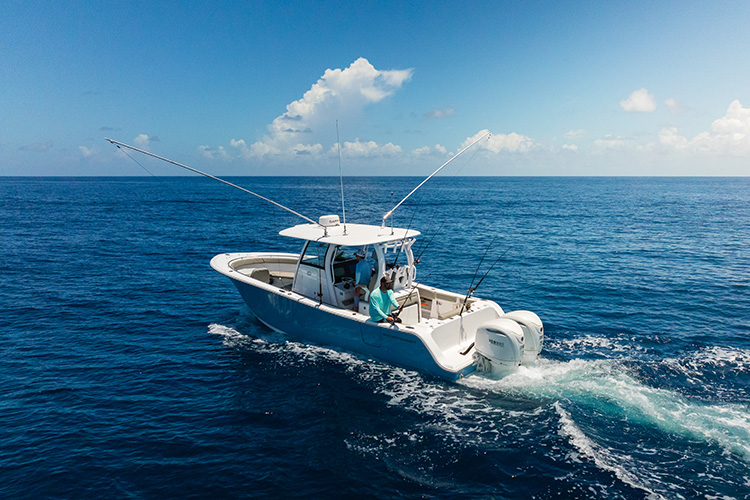
Your automobile cruises down the highway at a relaxed 2,500 RPM. Your outboard, on the other hand, frequently screams at 5,000 RPM for hours on end, all while sucking in extremely humid, salty air. To survive this brutal environment, marine engines require a completely different cocktail — specifically, oil certified to the NMMA FC-W standard.
Yamaha, Mercury, and Honda are entirely clear on this: API SN car oil is not a substitute. If an engine fails and non-FC-W oil is found, expect your warranty claim to be denied. It’s a $15 shortcut that can easily lead to an $8,000 repair bill.
Car Oil vs. Marine FC-W Oil: The Crucial Differences
|
Feature |
Standard Car Oil (API) |
Marine Outboard Oil (FC-W) |
|---|---|---|
|
Additive Package |
~10–20% by volume |
~20–35% by volume (Extra protection) |
|
Corrosion Resistance |
Not tested for harsh salt environments |
Passes extreme 96–200 hour salt-fog tests |
|
Anti-Emulsification |
Pushes water away poorly |
Maintains lubrication even with water in the crankcase |
|
High-RPM Stability |
Thins out under sustained high-speed loads |
High HTHS viscosity rating prevents pressure drop |
* Always match viscosity to your season. Below 0°C calls for 5W-30, typical weather (0–40°C) uses 10W-30, and extreme heat requires 20W-40 or 25W-40.
The Big Decision: 4-Stroke vs. 2-Stroke Outboards
If you’re repowering an older hull or buying a new rig, the engine debate is practically inevitable. Forget the endless forum arguments—your choice should simply come down to how you physically use the boat.
If you’re hauling a portable 15 HP motor in and out of your truck bed every weekend, your back will absolutely thank you for choosing a lighter 2-stroke. But for almost everyone else on the water—especially those running 90 HP or more—the 4-stroke is a no-brainer today. They sip fuel, idle quietly without that bone-rattling vibration, and most importantly, they pass strict emissions laws.
Keep in mind that locations like Lake Tahoe and multiple European reservoirs have completely banned older carbureted 2-strokes. A cheap used 2-stroke isn’t much of a bargain if you legally can’t launch it at your local ramp.
5-Year Ownership: The Real Cost Math (90 HP Model)
Sure, a 4-stroke demands a heftier price tag at the dealership. But let’s stretch the timeline out over five years (assuming about 100 hours of run-time per year). The savings might surprise you.
|
Expense Category (5 Years) |
Carbureted 2-Stroke |
EFI 4-Stroke |
|---|---|---|
|
Upfront Purchase Price |
~US$8,000 |
~US$9,600 – $10,400 |
|
Fuel Cost (100 hrs/yr) |
~US$17,820 |
~US$12,960 (Massive savings) |
|
Maintenance & Oil |
~US$3,200+ |
~US$750 – $1,250 |
|
Estimated Total Cost |
~US$29,000+ |
~US$23,700 – $24,600 |
The numbers don’t lie. The 4-stroke easily earns back its initial premium through drastic fuel savings, leaving thousands back in your pocket. When it’s time to sell, well-maintained 4-strokes retain 40–60% of their value, whereas older 2-strokes are shedding value fast as parts become scarce and environmental rules tighten.
You picked the right outboard. Now make sure it delivers what it promised. A mismatched propeller can cost you 10–15% in fuel economy, add seconds to your hole shot, and leave RPM on the table. At VIF Propellers, we’ve spent 25 years engineering props that match your engine’s power curve — whether you’re running a new 4-stroke or a classic 2-stroke. Over 700 engine applications covered. Interchangeable hub systems that you can swap at the dock in 15 minutes, no press needed. Factory-direct pricing that’s typically 30–50% less than OEM.
Conclusion
Here’s what you need to know: “4-stroke” and “4-cycle” are the same boat engine — full stop. The confusion comes from marketing, not from any real mechanical difference.
The choice that matters is 2-stroke versus 4-stroke. Older boat, tight budget, lighter load? A 2-stroke gets the job done. Fish often, haul gear, or watch long-term fuel costs? A 4-stroke outboard is the clear winner.
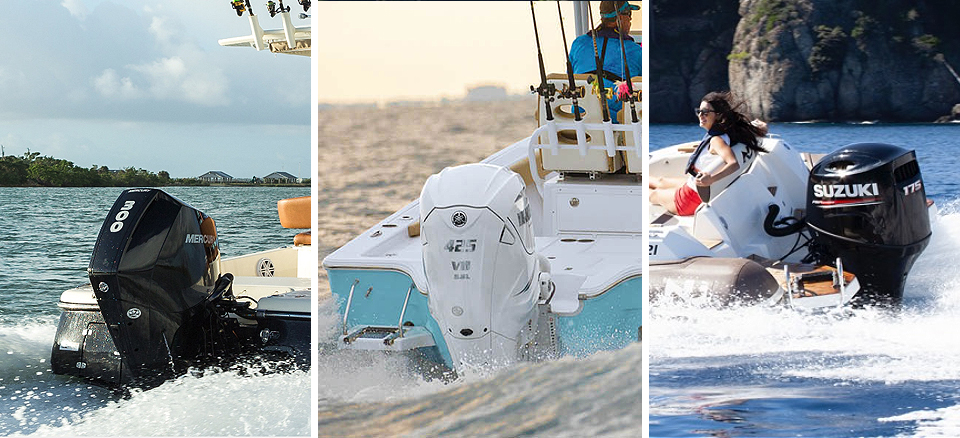
Whatever you’re running — use the right marine-grade oil to protect it. A $12 shortcut can kill a $3,000 engine. That’s not a trade worth making.
A note from VIF Propellers:We didn’t write this guide because we sell engines. We sell propellers. But after 25 years of matching props to engines — from classic 2-strokes to modern 4-strokes — we’ve learned that an engine’s health directly affects how a propeller performs. If your engine runs right, your Prop delivers what it’s designed for. If you ever need help selecting a propeller for your 4-stroke (or 2-stroke) outboard, our support team is here.
That’s it. Everything else is noise.