
Most boat owners upgrading to a Sharrow Prop expect the obvious wins — better fuel economy, less cavitation, smoother cruising RPM. What surprises them is something quieter: the boat handles differently.
Not in a dramatic way. Not something you notice on the first throttle push. But after a full season on the water, switching back to a conventional Prop feels like driving a car with a flat tire you never knew was there.
That shift shows up in steering response, docking confidence, and mid-throttle predictability. This guide breaks all of that down.
You’re weighing whether a Sharrow prop is worth the cost. Fuel efficiency numbers matter — but the real question is how it changes the way your boat handles. That’s what’s worth understanding first.
Content Framework: “Does A Sharrow Prop Affect Boat Handling?”

The short answer is yes — but the how is what matters most.
The Sharrow prop uses a continuous helical blade design. This doesn’t just change how thrust is generated. It changes where that thrust goes and how steady it stays across the full power curve. That shift in thrust distribution is what you feel at the helm.
Real-world testing confirms this. Owners of the 325 DC Bowrider described hard, high-speed turns as feeling “glued to the water” — no sliding, no overturning, traction on par with a six-blade prop. The 57′ catamaran tests showed better grip in turns and stronger reverse thrust. Both of those gains lead to tighter, more confident low-speed handling.
Less vibration is part of the story too. Most Sharrow owners notice the drop in vibration fast — often right away across the full power curve. Your steering inputs stop fighting those small, hidden disturbances that were always there but hard to pin down.
Handling gets better not because the Sharrow prop does something exotic. It gets better because it does the basics more thoroughly.
What Makes the Sharrow Prop Different from Traditional Propellers
Traditional propellers have a built-in flaw. Every blade has an endpoint. At that endpoint, water stops cooperating. It spirals off into chaotic tip vortices that steal thrust, create cavitation, and drain power from your engine.
The Sharrow prop fixes this by removing the endpoint completely.
Traditional blades cut through water at sharp angles with hard tips and abrupt edges. The Sharrow takes a different approach. It uses a continuous helical loop structure — blades that curve back into themselves. No sharp tips. No hard edges. No break points where vortices can form. This isn’t a twist on traditional design. It’s a completely different way of thinking about propulsion.
The numbers show exactly what that means:
-
At 3,000 RPM, a Sharrow prop pushes a boat to 27.1 mph with an effective advance rate of 15.4 inches per rotation
-
A traditional prop at the same RPM? 14.3 mph — just 8.62 inches of effective advance
-
The Sharrow holds plane at 2,700 RPM; traditional designs are still working to reach that point
The loop structure also cuts out the tip vortex cavitation that standard 3- and 4-blade props produce at every blade tip. That adds up fast. Thrust efficiency runs 9–15% higher than the Wageningen B-series benchmark — the standard most modern prop designs are tested against.
Less cavitation means cleaner water contact. Cleaner water contact means the thrust your engine produces goes to work moving the boat — across the full power curve — rather than bleeding off into hull vibration you can feel but can’t pin down.
How the Sharrow Prop Changes Turning Performance at Speed

At speed, a boat’s turning behavior exposes every weakness in its Propeller. That’s where the Sharrow prop’s helical design stops being theory and starts being something you feel in your hands.
It all comes down to blade geometry in motion. Push through a hard turn with a conventional prop, and it loses its grip. The blade tips cavitate. Thrust vectors wander. The stern starts drifting — and that’s not where you want to be. The Sharrow’s looped structure eliminates that breakaway point. All six active blade faces stay engaged through both port and starboard turns. Water pressure spreads across the full sweep, giving you controlled, directional thrust — not just forward push — so the hull tracks where you point it.
The numbers speak for themselves:
-
On a Robalo R302 center console, the Sharrow hit 25.7 mph at 3,000 RPM versus a standard prop’s 15.3 mph — a 68% speed advantage at the same engine load
-
At 3,500 RPM, that gap stays at 61% faster response. The standard prop still struggles to hold plane. The Sharrow is already pulling clean through the turn
-
On a pontoon at 2,500 RPM, the Sharrow moves 34% farther per revolution — 12.68 inches versus 9.46 — giving you steadier tracking under load
That advance rate difference is what “glued to the water” means in mechanical terms. Less slip per revolution keeps the thrust vector consistent through the arc of a turn. The bow stays planted. The stern doesn’t hunt.
So which boat types benefit most? Center consoles and multi-hulls. The Voodoo catamaran planed at 700 RPM lower with the Sharrow installed and burned 21% less fuel through turns. That gain comes from the Propeller holding a cleaner, more efficient thrust line — instead of fighting its own cavitation mid-maneuver.
Low-Speed Docking and Reverse Thrust: Where Sharrow Prop Excels Most
Docking is where confidence — or the lack of it — shows up fast.
The Sharrow prop’s helical blade geometry earns its price tag here. Not through big speed numbers. Through something far more useful on a busy Saturday at the marina: control you can trust.
The looped blade structure pulls water from a wider radius. It then pushes that flow through the full blade arc. No tip vortices break away at slow speeds. No ventilation steals thrust at the moment you need it most. That consistency runs from idle all the way to 4,800 RPM. So the propeller isn’t “searching” for grip as you crawl into a tight slip.
The reverse thrust data backs this up:
-
Up to 50% more reverse thrust compared to conventional props — enough to cut stopping distances in close-quarters situations
-
Boats plane at 500–1,000 RPM lower than with standard propellers, giving you a wider, more manageable throttle range at low speeds
-
On a Ranger Tug, idle efficiency improved by 18% in MPG — with stronger thrust response to match
That 50% reverse thrust gain is a big deal. In a tight marina with a cross-wind, stronger stopping power opens up your options. You correct less, react less, and steer more.
One practical note on trim: run a more positive trim angle than you would with a stock prop. Start full down, then trim up as the boat planes. This lifts the stern and gives you cleaner directional control while backing into position.
For close-quarters work — U-turns, narrow approaches, backing against current — the Sharrow’s edge isn’t a number on a spec sheet. It’s the feeling that the boat does exactly what you ask, the first time you ask it.
Acceleration, Planing Response, and Mid-Range RPM Handling (2,000–4,000 RPM)
The 2,000–4,000 RPM band is where most boats spend their time. Not wide-open throttle. Not idle. It’s the middle ground — getting onto plane, holding a cruising speed, pushing through when the channel opens up. This range defines how a boat feels to drive. And the Sharrow prop’s helical blade geometry makes its strongest case right here.
Start with the planing transition. On a 251 CE test, the Sharrow hit 20 mph at 2,750 RPM. A conventional prop at the same RPM? 12–13 mph. That’s a 79% speed gap at the worst possible moment — nose high, stern dug in, hull fighting its own weight. The Sharrow gets through that phase faster. Less time wallowing. More time tracking clean.
That gap matters beyond the raw number. A quicker plane-out shrinks the instability window. Your hull stops hunting for its ride angle. Steering inputs in that phase carry real weight.
Through the mid-range, the efficiency gains stack up:
-
Hitting 20 mph at 2,750 RPM instead of pushing to 3,500+ drops engine load by an estimated 20–30%
-
That lighter load cuts 10–15% off fuel use — not by going slower, but by reaching the same speed with less strain
-
The prop stays in its clean thrust zone, where slip is lowest and forward movement per revolution is highest
The result is throttle response that feels linear and predictable. You push for acceleration between 2,000 and 4,000 RPM, and the boat answers cleanly. No hesitation. No surge. No prop scrambling to hold water contact. Clean blade geometry means clean power — through every throttle position in the range you use most.
Vibration Reduction and Its Overlooked Impact on Boat Handling Feel

Here’s something nobody mentions when comparing propeller specs: vibration doesn’t just rattle your fillings — it lies to you.
Every buzz traveling up the shaft, through the hull, and into your hands at the helm is interference. It distorts your steering feedback. It masks what the water is telling you. Most boat owners have been compensating for this their whole lives. They just don’t know it.
The Sharrow prop’s continuous helical blade geometry changes this. It eliminates tip vortices and spreads load across the full blade arc. That removes the main source of propeller-induced vibration — uneven blade loading. The result isn’t just a quieter ride. You get a cleaner information channel between the water and your hands.
The difference shows up in two places:
-
Steering precision: Conventional props running outside ISO Class I tolerances (pitch deviation beyond 0.011 inches) push constant low-level noise into every steering input. Even blade loading cuts that distortion out.
-
Driver endurance: Whole-body vibration fatigue builds fast — numbness, joint strain, and headaches within hours at speed. Less vibration gives you longer, sharper sessions on the water.
Reduced drivetrain wear is the bonus you won’t notice right away, but you’ll feel it in your maintenance bill. Even blade loading means fewer loose fasteners, less bearing wear, and a gearbox that lasts longer than one running behind a prop that’s always fighting itself.
The handling improvement from vibration reduction isn’t dramatic. It’s cumulative. Every small correction you stop making, every micro-adjustment that disappears — those stack up. Over a full day on the water, the boat feels like it’s working with you instead of around you.
Sharrow Prop vs Standard Propeller: Handling Performance Comparison by Scenario
Numbers don’t lie — but they need context. A raw speed figure or fuel economy stat tells you what happened. It doesn’t tell you how that difference feels across different conditions on the water. That’s what this comparison is about.
High-Speed Turns
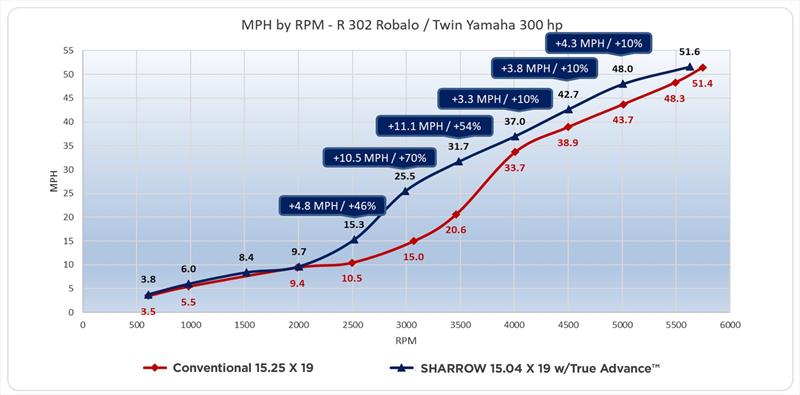
A standard prop under hard cornering is fighting itself. Blade tips ventilate, thrust wanders, and the stern drifts wide. The Sharrow holds. At 3,500 RPM, it runs 58% faster than a standard prop — 32.5 mph versus 20.6 mph. It also keeps cleaner directional tracking through aggressive turns. Less prop slip means more thrust goes straight to where steering demands it.
Docking and Low-Speed Control
This is where the Sharrow’s edge becomes clear. You get up to 50% more reverse thrust than a conventional prop. That gives you real stopping authority in tight quarters. Add stronger low-speed water grip and lower ventilation risk on top of that. Docking stops feeling like a guessing game.
Acceleration and Hole Shot
The Sharrow reaches 30 mph in 10.76 seconds. A comparable standard prop? 16.53 seconds. That’s close to six seconds of difference — a big gap when you’re pulling a skier or threading a channel. The Sharrow also climbs onto plane close to a full second faster. That shrinks the unstable transition phase. Most handling errors happen right there, so cutting that window matters.
Cruising Efficiency and Planing Range
Standard props on the Robalo R302 couldn’t climb over the bow wave at lower RPMs. The Sharrow planes that same hull at 2,800 RPM. Holding plane 500–1,000 RPM lower isn’t just a fuel story — it’s a handling story. You get a wider, more forgiving throttle range across your entire time on the water.
Is the Sharrow Prop Worth It for Handling? Honest Assessment for Boat Owners
The data is clear. The mechanics make sense. Now for the honest part.

Most boat owners running center consoles, pontoons, or catamarans in the 23–25-foot range will see real, measurable handling gains. This isn’t marketing talk. Juan V. on his Hydra Sports 230WA reported “dramatically improved handling” with noticeable stern lift through the mid-range. John G.’s 25-foot pontoon planed at 2,800 RPM instead of 3,100 — and hit 5 mph faster at wide-open throttle. Captain Steve called hard turns a “vast improvement,” with zero overturn concern.
These aren’t isolated opinions. They form a clear pattern.
Where the value is clearest:
– Frequent close-quarters docking in crosswinds or current
– Aggressive high-speed turning where stern drift is a real safety concern
– Boats already near their performance ceiling with a standard prop
Where it’s harder to justify:
Casual weekend cruisers who don’t push handling limits may struggle to justify the premium price. Some specialized fishing styles don’t need what the Sharrow delivers either.
The honest take? Your current prop falls short on handling — the Sharrow closes that gap. It’s a direct fix for a specific problem, and the results back it up.
FAQ: Common Questions About Sharrow Prop and Boat Handling
These questions show up in every forum thread, every marina conversation, and every inbox after someone sees the performance numbers for the first time.
Does the Sharrow prop improve turning radius?
It does — and the difference is real. The looped helical blade design works like six active blade faces through every turn. It holds water traction where standard props lose grip and slide. Hard port and starboard turns at speed feel planted and controlled. No trimming needed to handle ventilation mid-corner.
Will it make docking a large boat easier?
You get up to 50% more reverse thrust compared to a standard prop. That number matters the next time a crosswind pushes you sideways toward a dock piling. Less vibration also sharpens your control precision at the slowest, tightest moments — right where it counts most.
Is it compatible with Outboard Motors?Yes. Pontoon and outboard tests confirm it works. You’ll see solid mid-range gains and 20–30% fuel efficiency improvements with the right size. Check your engine specs before ordering.
What about vibration?
Owners report zero noticeable vibration after installation. You get cleaner feedback, quieter operation, and less fatigue across a full day on the water.
Conclusion
The verdict is in — and it’s not a close call.
The Sharrow prop doesn’t just tweak your boat’s handling at the margins. Its continuous helical blade design changes how thrust is built, spread, and felt at every throttle position. Smoother low-speed docking. Crisper mid-range response. Less vibration stealing confidence from your hands at the helm. These aren’t marketing promises — they’re physics working in your favor.
Is it a premium investment? Yes. But the real question was never “is it expensive?” It was always “what is predictable, responsive boat handling worth to me?”
Still weighing the upgrade? Start by matching the right Sharrow prop spec to your hull and engine setup — that’s where the real performance gains are. Explore the full Sharrow prop lineup at vifpropellers.com, and find the fit that turns good days on the water into great ones.
Your next ride should feel like an answer, not a question.