
Buying a 175 hp outboard is a serious investment. The Suzuki DF175 is not a bargain purchase — you already know that. But there’s a big gap between knowing what these motors cost and knowing what you’ll actually pay.
Dealer markups, regional pricing gaps, and installation fees all add up. The Propeller you bolt on can push your total spend thousands of dollars in either direction.
This guide gives you the full picture:
-
Real MSRP figures
-
Honest dealer quote ranges
-
A side-by-side comparison with Yamaha and Mercury’s competing 175s
-
A full five-year cost breakdown showing where your money goes — long after you’ve left the dealership
How Much Does Suzuki 175 Outboard Price Cost?

The numbers are all over the place — and that’s not a bad thing.
Take the 2026 Suzuki DF175A. It’s listed at $13,100 after a $6,299 sale discount (valid through 09/30/2026). On the other end, a DF175APXW runs $21,109. Same displacement. Same 175 horses. The price gap is real.
Here’s what drives that spread:
-
Shaft length (20″ vs. 25″) shifts pricing — the DF175AP sits at $13,990
-
Color choice adds $600 for white or stealth finish
-
Drive-by-wire technology (AP models) adds a notable price bump
-
Dealer location matters — Fort Myers quotes can differ from Lakeland quotes on the exact same unit
Clark Marine’s 2026 sale prices fall between $14,995–$15,650. That’s a solid mid-market baseline for most buyers.
The engine under all these price tags is the same: a 2,867cc inline-4, 175 bhp, rated at 5,500–6,100 RPM. You’re not paying extra for more power. You’re paying for configuration — shaft length, color, tech package, and where you buy it.
What Is the Suzuki DF175 Outboard? (Quick Buyer Context)
The Suzuki DF175 has a strong reputation for a simple reason — it’s built beyond what most buyers need, and that’s the point.
At its core, you get a 2,867cc inline-4 four-stroke — the largest displacement four-cylinder four-stroke outboard in its class. Suzuki calls it the “Big Block” design, and that’s not a marketing term. That extra displacement produces low-end torque that smaller competitors can’t match. To get close, they’d need to step up to a V6.
Here’s what the spec sheet means for real-world use:
-
175 hp at 5,500–6,100 RPM — power that’s usable across a wide rev range, not just at redline
-
10.2:1 compression ratio — strong enough to pull serious torque, yet runs fine on standard marine fuel
-
~500 lbs wet weight — right in line with the class, and balanced well enough to suit transom-sensitive hulls
The Variable Valve Timing (VVT) system on DF175A and AP models is worth knowing before you buy. It shifts valve timing based on throttle demand. That means stronger pull off the hole and better cruising efficiency — from the same motor.
Suzuki’s Lean Burn Control system manages fuel delivery at cruising speeds. It pushes up to 19% better fuel efficiency compared to older V6 designs like the DF200. That difference adds up fast over a full season of hours.
The DF175AP brings drive-by-wire throttle and Suzuki Selective Rotation. So you can set it up as a counter-rotating unit for twin-engine rigs — no need to source a separate model.
This is the engine background behind every price figure in this guide.
Suzuki DF175 Price: Current MSRP & Dealer Quote Range (2024–2026)
The Suzuki DF175 price range is wide enough to confuse anyone who hasn’t done their homework. That’s not a market flaw — it’s useful information. You just need to know how to read it.
Canadian dealers list the 2024 DF175A starting at $23,115 to $23,380, depending on shaft length and rotation. The 20″ shaft (Black, electric remote, power tilt/trim) comes in at $23,115. Go with a 25″ shaft or counter-rotation configuration, and you’re at $23,380. Those differences are real. They matter for your specific transom setup.
But MSRP is not what most buyers pay.
What Dealers Are Quoting Right Now
This is where things get interesting. Active dealer quotes — some running well into 2026 — tell a very different story:
-
$19,999 for a 2024 DF175ATX Black (regular price ~$23,799; that’s $3,800 off, valid through 03/31/2026)
-
$16,450 for a DF175ATXW5
-
$11,995 for a 2024 DF175A Black, 25″ shaft, counter rotation — a figure worth a second look
-
$7,150 for a DF175 APX 2020, 25″ shaft — older stock, used, but still a solid entry point for budget-conscious buyers
Suzuki Canada has also offered a 5% repower discount off MSRP as a limited promotion. Stack that on top of the $3,800 seasonal markdown. The combined savings push the effective price down by a significant margin.
In Europe, a new DF175A with kit and propeller has been listed from €12,900 (down from a €19,500 sticker). That’s a 34% reduction — before you’ve negotiated a single dollar.
What This Means for Your Budget
Forget the sticker price. The real Suzuki DF175 market — for a 2024 model, new — sits in the $12,000 to $20,000 USD equivalent range. The exact number depends on where you buy, the timing, and which configuration you need. Regional promotions and end-of-season clearance can push that floor even lower.
No confirmed 2025–2026 MSRP changes have come out yet. Current 2024 pricing stays active through extended dealer promotions. That makes right now a solid window to lock in a competitive quote.
Suzuki 175 Outboard Price by Region: US vs. Europe vs. Used Market
Price shifts more by geography than most buyers expect. The same Suzuki DF175 priced one way in Florida can run a very different number in Ontario. Europe plays by its own rules on top of that.
US Market: What You’re Working With
The 2026 US lineup runs from $12,400 to $19,419. Both ends of that range are real transactions, not outliers.
Entry configurations start here:
-
DF175ATX — $12,400
-
DF175ATXZ — $12,500
-
DF175AP — $13,990 (drive-by-wire, the tech upgrade tier)
The high end moves up fast. A DF175ATLW can reach $19,639. A DF175A Drive By Wire L sits at $19,200. The full-spec DF175ATXZ lands at $19,419.
That $7,000 gap between the cheapest and most expensive 2026 model comes down to shaft length, color, and tech package. Not engine output. Every one of them puts out 175 horses.
Canada: Strong Dollar Premiums Apply
Canadian buyers pay in CAD, and the numbers show it:
-
DF175ATL: $18,799 CAD (with a $4,895 discount already applied)
-
DF175ATLW: $19,349 CAD
Pull out the promotional savings and the full sticker goes up. Cross-border shopping sounds appealing, but duties and warranty terms can kill the savings fast. Run the full math before assuming you come out ahead.
Europe and Used Market: Expect Wider Swings
European pricing is harder to read than North American pricing. Dealer-to-dealer gaps are wide. Bundle pricing — engine plus rigging kit plus propeller — makes direct comparison tricky. The €12,900 deal referenced earlier (down from €19,500) shows how much price room dealers have once they need to move stock.
The used market runs on its own logic. A 2020 DF175 APX has sold for $7,150 — close to half the price of a new base model. Yes, it’s older. But the core engine design hasn’t changed enough to make that price gap hard to justify.
Suzuki 175 vs. Yamaha F175 vs. Mercury 175: Price & Value Comparison
Three brands. Three different philosophies about what a 175 hp outboard should cost — and what it should give you back.
At the base level, all three start at almost the same price: $16,000 for a comparable 175 hp setup, before dealer pricing and rigging come into play. That closeness is deceptive. The gap opens fast once you look at what’s included, what costs extra, and what each brand charges you over five years of ownership.
Where Suzuki Wins on Price
Suzuki runs 10% cheaper than Yamaha across equal configurations. On a 200 hp repower comparison — a fair stand-in for the 175 class — Suzuki quotes land around $17,500–$18,000. Yamaha comes in at $18,500–$19,000. That price gap holds from 20 hp all the way to 300 hp. The savings are built into the brand’s structure, not tied to a sale or promotion.
So what do you get with that lower price? Lower fuel burn, solid mechanical reliability, and a warranty that doesn’t need a separate negotiation. Rigging does cost extra in most cases. Add that to your budget before you celebrate the sticker price.
What Yamaha and Mercury Charge For
Yamaha’s premium is real — and it’s earned. The brand holds the highest resale value of the three. Transferable warranties push that value even higher. Failure rates sit among the lowest in the class. You’re paying a brand tax, but that tax comes back as real cash at trade-in time.
Mercury plays a different game. Its pricing is modular: mechanical or digital controls, standard or upgraded gear cases, optional joystick piloting. The base number looks fair. The final invoice, after upgrades, often tells a different story.
Brand Comparison at a Glance
|
Factor |
Suzuki DF175 |
Yamaha F175 |
Mercury 175 |
|---|---|---|---|
|
Base Price (est.) |
~$16,000 |
~$16,000+ |
~$16,000+ |
|
Upfront Cost |
Lowest |
Highest |
Mid-range |
|
Fuel Efficiency |
Strong |
Competitive |
Competitive |
|
Resale Value |
Good (with records) |
Best in class |
Strong (with warranty) |
|
Warranty Flexibility |
Solid standard |
Transferable |
Gold/Platinum tiers |
|
Rigging Included |
Often separate |
Turnkey options |
Modular add-ons |
Here’s the straight answer: upfront cost and fuel economy matter most? Suzuki wins. Buying with resale in mind? Yamaha’s premium pays itself back. Want upgrade flexibility built in from day one? Mercury is the smarter pick.
True Cost of Owning a Suzuki 175 Outboard: 5-Year Total Breakdown
Five years from now, that $15,000 engine will have cost you closer to $28,000. That’s not a scare tactic — it’s just math.
Most buyers fixate on the sticker price and stop there. The sticker is the smallest part of the story. What follows is where the real money goes.
Year-by-Year: Where Your Money Goes
Start with the purchase. A 2026 DF175ATL runs $14,995. Your state’s sales tax adds 3–7% on top — capped anywhere from $500 to $20,000, depending on where you register the boat. That puts you at $15,750 out of pocket before the engine hits the water.
Then the costs stack up year by year:
-
Year 1 — 20-hour service, insurance, fluids: ~$750
-
Year 2 — 100-hour full tune-up, storage, insurance: ~$1,650
-
Year 3 — Another 100-hour service, minor repairs: ~$1,350
-
Year 4 — Service cycle repeats, storage back in the budget: ~$1,650
-
Year 5 — Service plus rebuild contingency fund: ~$1,850
Total five-year TCO: $26,500–$28,500 — fuel not included, no catastrophic failure assumed.
What’s Eating the Budget
Maintenance is predictable. Suzuki’s genuine parts schedule runs $200–$400 for the 20-hour break-in service. Each 100-hour tune-up — spark plugs, water pump, full inspection — runs $500–$800. Add $150–$300 per year for winterization.
Insurance gets underestimated. Mechanical breakdown coverage runs $120–$400 per year with a $50 deductible. Still debating that extended warranty? Depending on the provider and coverage tier, add $100–$1,000+ to your budget. Suzuki’s 7-year limited warranty (promotional through 03/31/2026 on DF175+ models) shifts this math in your favor. It absorbs costs that would otherwise hit hard in years 3–5.
The rebuild risk is real but manageable. A major engine rebuild in years 3–5 is what most buyers never budget for. Parts kit alone: $1,500+. Crankshaft: another $1,000+. Labor pushes the total to $5,000–$7,000. Warranty coverage makes that scenario far less painful than the numbers suggest.
Depreciation is the silent expense. Plan for 20–30% value loss over five years. That’s $3,000–$4,500 gone without a single repair bill — as long as you keep your service records clean. Do that, and resale retention stays close to 80%.
The real number lands at $5,000–$6,000 per year in total ownership cost, once everything gets counted. That’s under the $7,000 annual benchmark for comparable boat TCO analysis. For what the DF175 delivers, that number holds up.
How to Get the Best Deal on a Suzuki 175 Outboard Motor
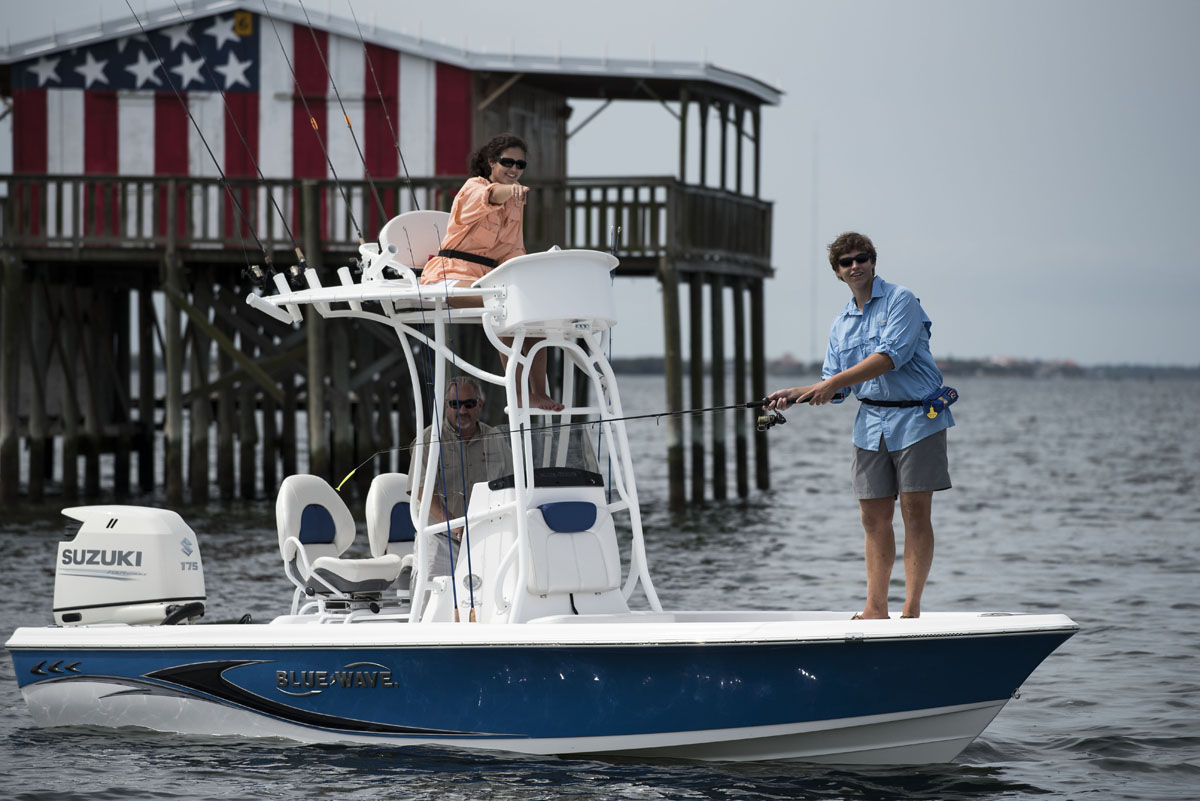
Dealers know something most buyers don’t. There’s real room between the sticker price and what you’ll end up paying.
Florida makes this clear. Portside Marine in Winter Park listed a 2026 DF175A at $13,100 — that’s $6,299 off the original $19,399, valid through 09/30/2026. Other Florida dealers sell the same model somewhere between $13,534 and $14,403. That’s a $900 gap on identical hardware, from dealers within driving distance of each other. That gap is your negotiating room.
Here’s how to use it:
-
Time your purchase around off-season promotions. The Portside deal is no accident. Dealers drop prices to move inventory before the season ends. Shop at the right time, and you capture that discount.
-
Call multiple dealers before you commit. Florida alone shows $300–$900 in price variation on the same unit. A phone call costs nothing and can save you hundreds.
-
Don’t pay the color tax. White and Stealth finishes add $600 as a separate line item. Ask the dealer to fold that cost into the overall deal instead.
-
Read every listing. Some packages include SMG4 digital controls and a stainless steel propeller. Others don’t. The base price tells you very little without knowing what’s included.
-
Ask about warranty flexibility. Standard coverage runs 60 months. Dealers on end-of-season clearance units are often open to negotiating extended service packages — so it’s worth asking.
The DF175 already sits below Yamaha equivalents on price. Add a well-timed seasonal discount on top of that, and this motor is one of the strongest value buys in the 175 hp class.
Choosing the Right Propeller for Suzuki DF175: Specs & Compatible Options
The propeller is where your DF175’s engineering either pays off or gets choked. Get it wrong and you’ll never see the RPM range Suzuki built that motor to run in.
Here’s what the DF175 gearcase tells you first: 4-3/4″ diameter. That’s your starting filter. Any Prop that doesn’t match that spec doesn’t belong on this motor — full stop.
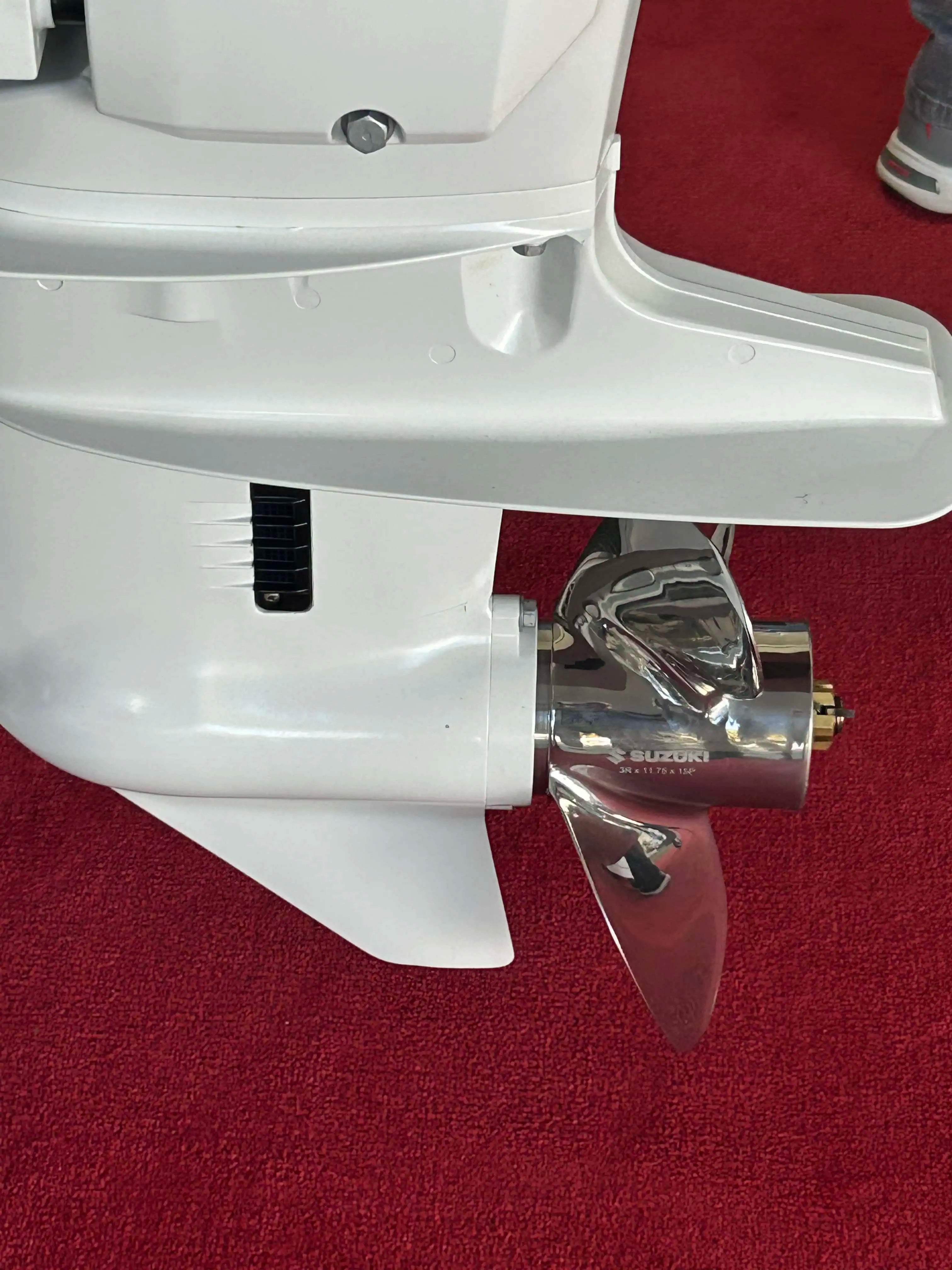
From there, the diameter window narrows to 15-1/4″ to 15-1/2″. Both work. The pitch is where your real decision lives.
A 17″ pitch — as in a 15-1/4 x 17 or 15-1/2 x 17 — is the proven baseline for the DF175. It holds top-end speed and hole shot pull together. Neither one suffers. Push the pitch higher and you gain cruise speed. You lose low-end response. Drop it lower and the reverse happens.
Compatibility at a Glance
|
Spec |
DF175 Range |
|---|---|
|
Gearcase |
4-3/4″ |
|
Diameter |
15-1/4″ – 15-1/2″ |
|
Pitch (baseline) |
17″ |
|
Compatible HP Range |
150–300 hp (4-stroke) |
The DF175 shares its Prop lineup with the DF150, DF200, DF250, and DF300. That’s a real advantage. You get more options, better availability, and easier sourcing across the board. Click here to get the link for the compatible propeller.
Before you order, run this check:
1. Confirm gearcase: 4.25–4.75″
2. Match diameter: 15.25–15.5″
3. Start with 17″ pitch, then adjust based on actual WOT RPM
Custom propellers tailored for Suzuki outboards are available now. Shop now!
FAQ: Suzuki 175 Outboard Price & Buying Questions Answered

Six questions come up over and over again. Here are straight answers.
What’s the actual price range for a new Suzuki DF175 in 2026?
$13,100 to $19,739 — new, from a dealer, for a current model. The $13,100 figure is a real transaction price on a DF175A (20″ or 25″ shaft, black), with $6,299 knocked off through 09/30/2026. The $19,739 end is a white DF175ATXW at full retail. Same 175 horses, very different invoice.
Why is there a $6,000 gap between models?
Shaft length, color, and technology package all play a role. Drive-by-wire models carry a higher price. White or stealth finish adds $600 as a separate line item — on every applicable model. Shaft length (20″ vs. 25″) moves the number a little. None of these upgrades change what comes out of the exhaust.
What does installation cost?
Every listed price excludes rigging, installation labor, and parts. Budget for those on top of the motor price. Dealers keep manufacturer rebates — those don’t pass back to you. Ask your dealer exactly what’s included before you sign anything.
Do any packages include a propeller?
Some do. Certain Drive By Wire L configurations ship with an SMG4 gauge and a stainless steel Prop already in the box. Others don’t. Read the line items carefully. A stainless prop alone runs $300–$600, so a bundled unit changes the math.
Is now a good time to buy?
The 2026 promotional window is open. The $6,299 discount on the DF175A runs through September 2026. Clark Marine’s mid-market sale prices — $14,995 for an ATL, $15,075 for an ATX — are active right now. Holding off won’t get you a better deal on those numbers.
What warranty comes with it?
You get a five-year full factory warranty. That’s standard coverage — not a negotiated add-on. It applies to all current DF175 models right out of the box.
Conclusion
The Suzuki DF175AP hits a sweet spot that’s hard to argue with. You get a competitive MSRP, best-in-class fuel efficiency, and a reliability track record that holds its value longer than most rivals. At this point, you have the full picture: real dealer price ranges, five-year ownership costs, and a direct dollar-for-dollar comparison against Yamaha and Mercury.
Here’s what to do next:
-
Get quotes from at least two authorized Suzuki dealers
-
Time your purchase toward model-year-end for better pricing
-
Lock in the right propeller before leaving the dock
That last point matters more than most buyers realize. An undersized or mismatched prop drains both performance and fuel economy — even from the best Suzuki 175 four stroke outboard on the water. You lose power and pay more at the pump, all because of one overlooked part.
Browse our Suzuki DF175-compatible propeller options at VIF Propellers. Every dollar you put into that engine deserves to reach the water — and the right prop makes sure it does.