
Most boat owners upgrading their outboard motors obsess over horsepower. But the Propeller doing the actual work in the water? It’s almost always an afterthought.
That’s where the Sharrow propeller changes everything. Its looped-blade design isn’t a small upgrade. It’s a complete rethink of how a Prop moves through water. You get real, measurable gains in fuel efficiency, speed, reverse thrust, and noise reduction — results that traditional three- and four-blade designs can’t match.
Don’t write it off as expensive hype. The performance data tells a different story. Below is a straightforward breakdown of every real-world benefit the Sharrow MX-1 delivers — and whether those gains justify the price tag.
What Are The Benefits Of A Sharrow Prop?
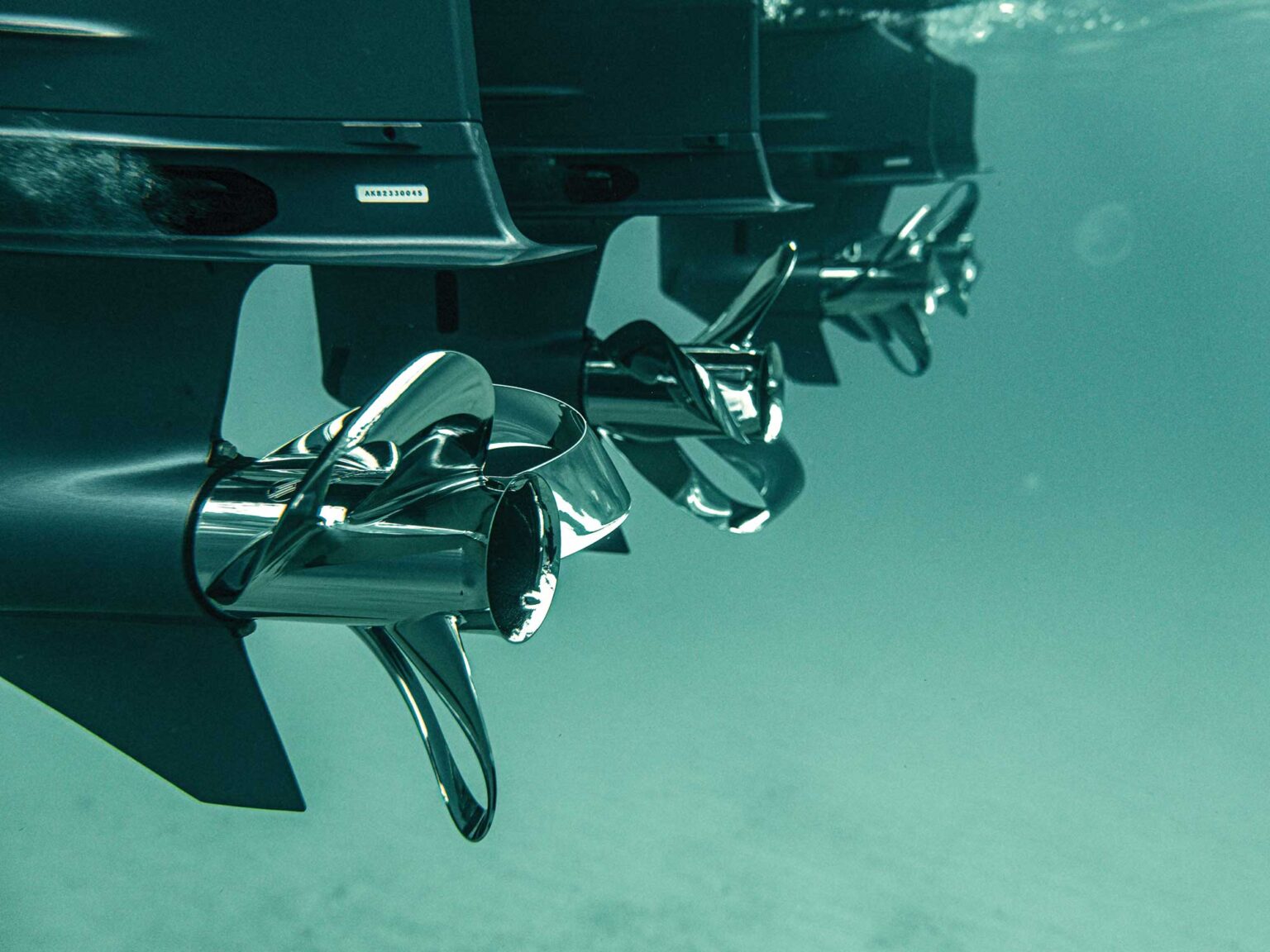
Here’s what the numbers show — and they’re hard to ignore.
At 3,000 RPM on a Grady-White test, the Sharrow MX-1 ran 11 MPH faster than the stock propeller. That’s not a rounding error. That’s 79% more speed at the same engine output. At cruising speeds between 20–25 MPH, fuel economy improved by 36%. On a 300-hp diesel catamaran running 18 knots, efficiency jumped 46%.
The gains stack up across every condition:
-
Idle efficiency: 27% better — boats spend about 40% of operating time at idle, so this matters
-
Reverse thrust: Up to 50% more than conventional props
-
Range: A Robalo R302 gained 109 extra miles at 25 MPH
The looped-blade design moves farther forward with each rotation. You get up to 20–30% more distance per spin than a comparable five-blade conventional Prop. Less slip. Less wasted energy. More forward motion.
These aren’t showroom claims. Real tests produced these numbers. Logged, documented, real-world results.
What Is a Sharrow Propeller and How Does Its Toroidal Design Work?

The blade you’ve been using your whole boating life has a flaw built into its shape. And it’s been costing you fuel, range, and quiet water for decades.
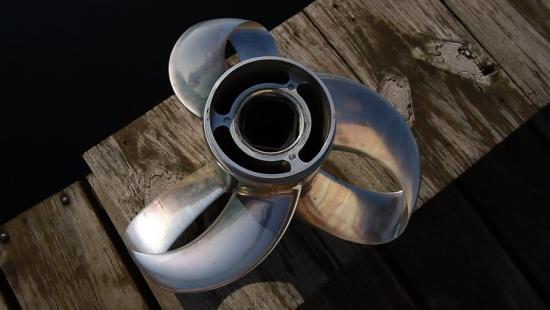
The Sharrow propeller throws out the conventional straight-blade design. Its looped blades extend outward from the hub in a curved path. Each blade forms a closed loop with three working sections: an intake portion, a tip portion, and an exhaust portion. That closed-loop structure is the core of its toroidal propeller design. It’s what makes the fluid dynamics work differently from anything you’ve used before.
Here’s the problem it solves. Traditional blades create tip vortices — spinning energy losses at each blade tip. Those vortices cause drag, propeller cavitation, and underwater noise. The Sharrow’s looped shape eliminates tip vortex cavitation (TVC) at the source. Underwater testing recorded zero cavitation trails behind the Sharrow. Conventional props? They leave clear helical vortex paths — visible and wasteful.
The multiple loops don’t work in isolation. They work in tandem, pulling more water through the intake-to-exhaust channel with each rotation. That flow becomes usable thrust — not wasted turbulence.
The result isn’t a small upgrade. It’s a structural shift in how a propeller works.
This isn’t garage-level engineering. The University of Michigan’s Marine Hydrodynamic Laboratory ran third-party tests and confirmed the performance claims. The design earned TIME Magazine’s Best Inventions award in 2023 and a 2022 Marine Power Innovation Award from Boating magazine. Sharrow also holds dozens of patents worldwide, backed by a development process that combined computer modeling, additive manufacturing, and rigorous third-party testing.
The science behind the Sharrow MX-1 propeller is solid. And it took a long time to get here.
Benefit #1: Dramatic Fuel Efficiency Gains Across All Speed Ranges
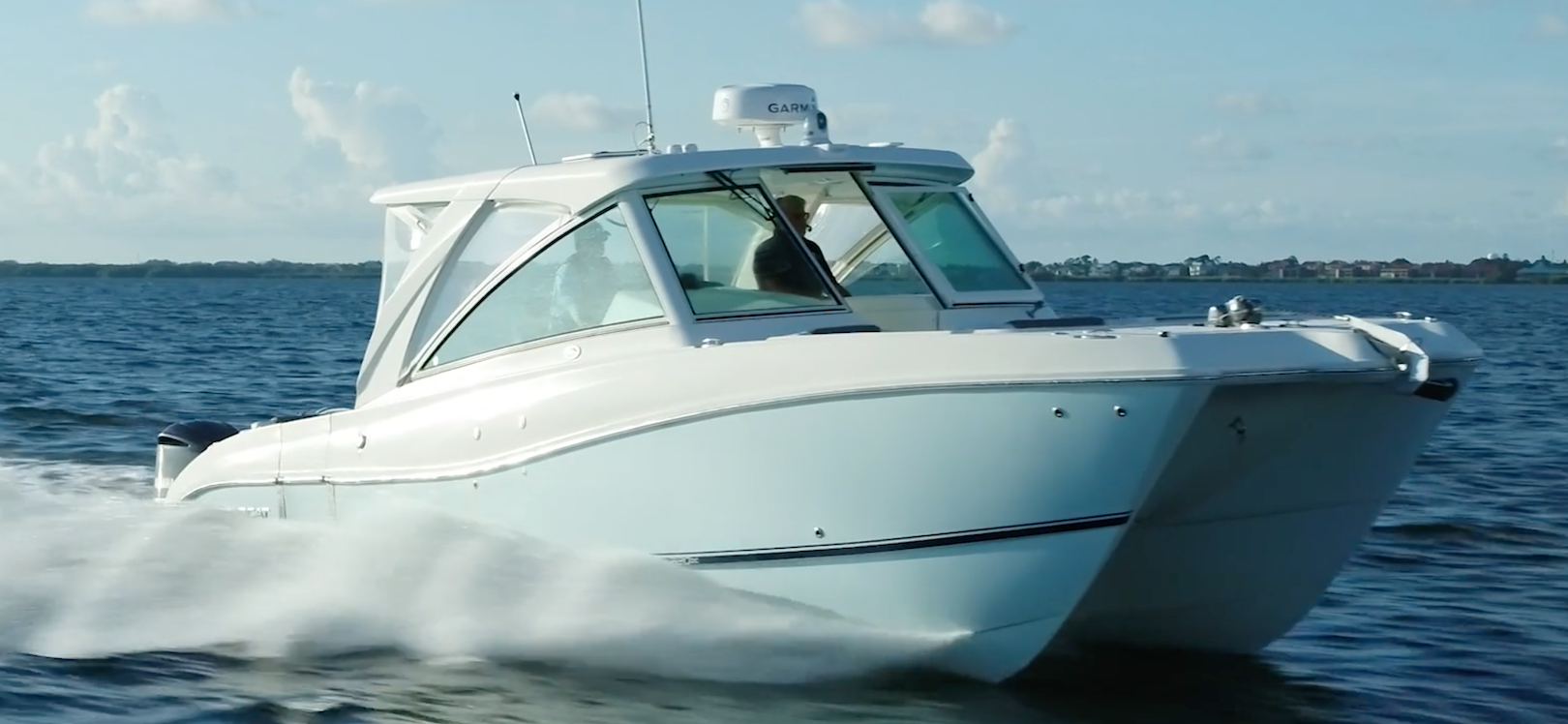
Fuel savings sound boring until you do the math on a full season of running.
The Sharrow propeller doesn’t deliver a modest 5% improvement and stop there. The efficiency gains shift based on your speed range — and at certain throttle settings, the numbers are hard to believe. Built for Speed.
Here’s what the data shows:
-
Low speed (10 mph): 75% better fuel efficiency
-
Economic cruise (20–25 mph): 36% better MPG
-
Idle: 18% improvement — and since most boats spend a big chunk of operating time at idle, that number adds up fast
Notice the pattern. The gains don’t flatten out at one speed and vanish at another. They hold across the entire throttle range. Crawling into a no-wake zone? The looped blade propeller keeps pulling efficiently. Holding steady at cruise? Same story. More engine output goes into forward motion, less into wasted turbulence — at every throttle setting.
That’s what sets this apart from a typical outboard motor propeller upgrade. Most Prop improvements are speed-specific. You optimize for top end, you give something up at cruise. The Sharrow MX-1 propeller’s toroidal design skips that trade-off entirely. You get strong efficiency numbers at low speed, cruise, and idle — all at once.
Take a boat used on weekend trips, fishing runs, and longer coastal passages. The fuel savings stack up across every outing. By the end of a full season, the total becomes a real number worth paying attention to. That’s where the ROI conversation gets worth having.
Benefit #2: Higher Speed at Lower RPM — More Power, Less Engine Stress
The test data is precise: 42 mph at 5,500 RPM with the Sharrow, versus 41.6 mph at 5,900 RPM with a traditional Prop. That’s 400 fewer RPM — a 7.6% drop — to go faster. Not the same speed. Faster.
That gap is bigger than it looks on paper.
Every revolution your engine skips is a combustion event that didn’t happen. Fewer combustion events per mile means less heat, less wear, and less stress on parts that cost serious money to replace. The Sharrow’s looped blade design builds steady torque at lower engine speeds. Your outboard isn’t straining to hold speed — it’s coasting into it.
The practical result for mid-range cruising (4,000–5,500 RPM):
-
5–10% efficiency gain in speed-per-fuel at that throttle band
-
2–4 extra hours of cruising range on the same tank for a 30-ft yacht
-
15% faster 0–30 mph acceleration — the Prop enters the power band from a lower, more stable baseline RPM
Engine lifespan gets a boost too. Lower sustained RPM stretches maintenance intervals by an estimated 20–30%. That means fewer overhauls across the life of the motor. It’s not a marketing claim. It’s basic mechanical physics: less heat and fewer combustion cycles per hour add up to less cumulative damage over time.
The Sharrow MX-1 propeller doesn’t just move your boat faster. It pushes your engine toward a longer life in the process.
Benefit #3: Extended Cruising Range — Up to 30% More Miles Per Tank
86 extra miles. BoatTEST documented this in controlled testing — 368 miles total versus 282 miles on a conventional Prop. Same boat, same tank, same throttle. That’s a 30.5% range increase, logged under full WOT conditions on a Yamaha-powered outboard in the 300–400 HP class.
Put that number next to something familiar. A Ford F-150 with a full 36-gallon tank gets 555 miles. A Volkswagen Passat TDI stretches to 690. Those numbers come from engineering optimized down to the last variable. The Sharrow MX-1 propeller does the same for your hull. It closes the gap between the range your engine should deliver and what a conventional Prop gives you in real use.
The math is straightforward. The looped blade propeller cuts tip vortex energy loss. More rotation turns into forward distance instead of underwater turbulence. Every gallon works harder. Every mile costs less.
For coastal cruisers and anglers running long offshore legs, that 86-mile buffer is not a luxury. It’s a safety margin. It’s a refueling stop you skip. It’s a full season’s worth of fuel savings adding up in the background — trip after trip.
Benefit #4: Smoother Planing at Lower RPM — Better Load Handling
Heavy loads punish conventional props. Add a full cooler, extra passengers, and rough water — a high-pitch blade struggles to pull the hull onto plane. The engine screams past 5,000 RPM just to get there.
The Sharrow’s looped-blade geometry changes that. It holds plane at lower RPM. That matters most in the tough conditions — weighted-down hull, choppy swells, a headwind that won’t quit.
Here’s the mechanic behind it: lower effective pitch cuts engine load. The motor hits its target RPM band faster. You get quicker throttle response, better grip through wave faces, and a hull that stays on plane — not one that drops off every time you ease back on the throttle.
For load-carrying runs, the 3,800–4,000 RPM sweet spot is where efficiency and capacity peak. The Sharrow gets you there — and keeps you there — without pushing the engine to overwork.
Benefit #5: Superior Handling — 50% More Reverse Thrust for Safer Docking
Docking is where confidence either holds or falls apart.
You’re backing into a slip. Wind is pushing the stern sideways. Your conventional Prop delivers whatever reverse thrust it can — which is not much. Traditional blade geometry was never built for reverse. The blade profile that pulls well going forward becomes a weak, inefficient paddle in reverse.
The Sharrow’s looped-blade geometry skips that trade-off. The closed-loop structure works in both directions — forward and reverse. Sharrow reports up to 50% more reverse thrust compared to conventional props. That gap shows up right when you need it most.
Here’s what 50% more reverse thrust means at the dock:
-
Shorter stopping distances backing into tight slips
-
More controlled lateral correction as wind or current pushes you off line
-
Quicker engine response without bumping the throttle hard
-
Less reliance on bow thrusters or dock lines to cover for weak reverse power
That last point is big for single-handed operators. You’re juggling throttle, wheel, and lines on your own. Every extra bit of reverse control cuts down the margin for error.
The Sharrow MX-1 doesn’t just shine on open water. It handles the hardest part of the trip — getting back to the dock clean — with a mechanical edge that a flat-blade prop can’t match.
Benefit #6: Quieter Operation and Reduced Vibration
Underwater noise isn’t a comfort issue. It’s a physics problem — and tip vortex cavitation is the source.
Every conventional blade tip sheds a spinning vortex as it rotates. Those vortices collapse. That collapse sends noise and vibration straight through the hull and into the cabin. You feel it in the floor. You feel it in the seat. After a full day on the water, you feel it in your bones.
The Sharrow’s looped-blade design cuts out tip vortex cavitation at the source. No tip. No vortex. No collapse. You get quieter operation — both above and below the waterline — plus a clear drop in hull vibration at cruise speed.
Less vibration also means less mechanical stress on the drivetrain over time. Smoother rotation does three things:
-
It protects shaft seals from early wear
-
It reduces stress on bearings
-
It keeps the whole system running cleaner across a full season
Quieter water. Quieter cabin. Less wear. One design change.
Benefit #7: Lower Emissions and Longer Engine Life
Burning less fuel saves money — and it cuts what your engine dumps into the atmosphere.
Every gallon of diesel releases 22.38 lbs of CO₂. A 10% fuel reduction saves 2.24 lbs of CO₂ per gallon. Run the numbers across a full season, and that adds up fast. The Sharrow trims your fuel burn. That means a smaller carbon footprint, trip after trip.
Engine longevity is just as strong a case. Lower RPM means fewer combustion events per hour. The physics follow from there:
-
10–20% RPM reduction = 30–50% less piston and cylinder abrasion
-
Time between overhauls extends 20–30% — from 5,000 to around 6,500 hours
-
Oil change intervals stretch 25% — 300 hours becomes 375
-
Running at 70–80% of max RPM can double bearing life
Less wear. Longer intervals. Fewer overhauls. The Sharrow MX-1 propeller moves your boat with less strain on the engine. That means the engine lasts longer — and costs you less to maintain over time.
Sharrow Prop vs. Traditional Propeller: Side-by-Side Performance Data
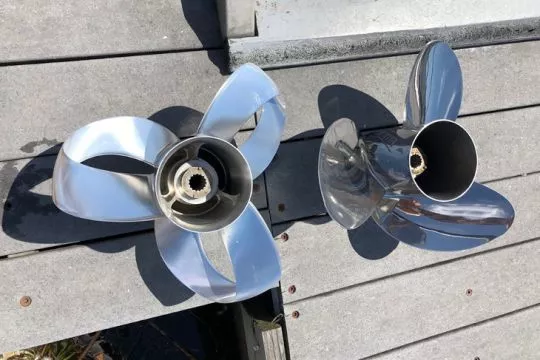
Numbers don’t lie. Real-world testing puts the Sharrow MX-1 head-to-head against conventional props across three different hull types. Here’s what the data shows.
Robalo R302 (Twin Outboards)
The gap shows up fast, even at low RPM. At 3,500 RPM, the Sharrow hit 32.5 mph. The conventional prop managed just 20.6 mph. Same engine, same hull, same throttle position — that’s a 58% speed advantage. Cruising between 20–35 mph, the Sharrow delivered 15–29% better fuel economy. At 25.4 mph, you gain 109 extra miles of range. Noise dropped by up to 80% — not a minor trim, a full structural reduction.
World Cat 325 DC (Twin Yamaha 300 HP)
At 3,000 RPM, the Sharrow ran 21.7 mph at 1.5 mpg, covering 368 total miles. The stock prop needed 4,000 RPM to reach a similar speed, burned more fuel, and still came up 86 miles short. At idle, the Sharrow used 24% less fuel to cover the same ground.
Feature Comparison at a Glance
|
Feature |
Sharrow MX-1 |
Conventional |
|---|---|---|
|
Thrust at Low RPM |
High |
Moderate |
|
Fuel Efficiency |
Excellent |
Variable |
|
Cavitation |
Very Low |
Moderate–High |
|
Noise & Vibration |
Sharply Reduced |
Noisy |
The pattern holds across every test. The Sharrow propeller doesn’t lead in one area and fall short in another. It wins on thrust, efficiency, cavitation, and noise — all at once, across every hull type tested.
Is the Sharrow Propeller Worth the Investment? ROI Analysis for Boat Owners
The Sharrow MX-1 carries a premium price tag. That’s the first thing people notice. The second thing — if they look at the data — is that the math works in their favor.
Here’s how the numbers break down in real use.
Take the World Cat 325 DC with twin Yamaha 300s. At 3,000 RPM, the Sharrow MX-1 hits 1.5 mpg. The stock prop needs 4,000 RPM just to reach 1.1 mpg. That’s a 36% efficiency gain at the same cruising speed. You get 86 extra miles of range on a single tank. For coastal cruisers running long legs, those miles aren’t abstract. They’re a skipped fuel stop, a wider routing option, a genuine safety buffer offshore.
Run the fuel savings across a full season and the return becomes concrete:
-
9–15% efficiency improvement is the baseline across typical cruising conditions
-
At planing speeds, gains can reach up to 179%
-
Boats running 18 knots on a 57-ft diesel catamaran saw 46% better fuel economy against conventional five-blade props
Lower RPM compounds the savings further. The Sharrow lets you cruise 1,000 RPM lower than stock. That means fewer combustion cycles per hour. Maintenance intervals stretch out. Parts that cost real money to replace wear down slower.
The price premium is real. So is the payback — in fuel, in range, and in engine hours preserved.
Who Should (and Shouldn’t) Upgrade to a Sharrow Propeller?
The Sharrow MX-1 isn’t the right prop for every boat. Knowing where you stand saves you money and frustration.
Upgrade if you fit any of these profiles:
-
Long-distance cruisers and charter operators — The 57-ft catamaran Voodoo burned 15.5 gal/hr instead of 19.8 at 18 knots. That’s 4.3 gallons saved every hour. Run it every day, and the cost pays itself back fast.
-
Heavy-load runners — The Sharrow planes 500–1,000 RPM lower under load. At idle — which covers about 40% of powerboat use — it runs 27% cleaner on fuel. That’s real money over a season.
-
Noise-sensitive boaters — Stingray, Sea Ray, and Axopar owners reported quieter, smoother rides at cruise. The difference is noticeable, not just on paper.
-
Offshore anglers — 30% more range rewrites your trip planning. You can push farther out and stop worrying about the fuel gauge.
Skip it if you’re in this camp:
-
Pure top-speed racers — Above 35 mph, the efficiency gap shrinks. At WOT, fuel burn matches conventional props. The Sharrow won’t give you an edge at full throttle.
-
Low-hour owners — ROI ties directly to seat time. A few weekend runs per season won’t stack up enough fuel savings to cover the price difference. The math just doesn’t work at low hours.
Frequently Asked Questions About Sharrow Propeller Benefits
How much fuel does the Sharrow propeller save?
It depends on your speed. At 18 knots, a 57-ft catamaran burned 15.5 gal/hr with the Sharrow versus 19.8 with stock props — a 46% reduction. At cruising speeds between 20–35 mph, you get 15–29% better MPG. At idle, it runs 27% cleaner. The savings hold across the full throttle range, not just at one sweet spot.
Will it make my boat faster?
Yes — at the same RPM. On a Grady-White 251 CE, the Sharrow added 11 mph at 3,000 RPM. That’s 79% more speed from the same engine output.
Does it improve handling?
Reverse thrust goes up by as much as 50%. Docking becomes noticeably easier. On a 26-ft Robalo, owners saw better slow-speed tracking and quicker hole shots. They also ran a wider trim range with less tab correction.
Is it worth it at low hours?
No. The ROI comes down to time on the water. Weekend boaters with low hours won’t save enough fuel to cover the price gap. High-use operators will.
Conclusion
The numbers don’t lie — and neither does the water beneath your hull.
A Sharrow propeller isn’t just a hardware upgrade. It’s a full rethink of how a blade moves through water. The results show up everywhere that matters: at the fuel dock, on the tachometer, in the quiet hum of an engine working with hydrodynamics instead of fighting them.
Burning through a full tank on weekend runs? Wrestling with vibration at cruise speed? White-knuckling every docking approach? The Sharrow MX-1 propeller was built for those problems.
The next move is simple:
-
Check your current prop pitch
-
Match it to your engine specs
-
See what the right Sharrow configuration does for your specific setup
Your boat already knows how to perform. Give it a propeller that keeps up. Click here.a