
A $2,000 propeller that promises to change how your boat moves through water — sounds like marketing hype, right? But the Sharrow propeller has built a real reputation. It’s backed by hydrodynamic engineering patents, independent speed trials, and a growing group of boat owners reporting genuine fuel savings. The real question isn’t whether this loopwing design works in theory. It’s whether the performance gains are worth spending 5–10× more than a conventional prop. Before you buy — or walk away — you need cold, hard data. That’s what this breakdown delivers.

Content Framework: “Is the Sharrow Propeller Worth It? Real Performance vs Price Explained”
Here’s what this guide covers — and why it’s structured this way.
The Sharrow propeller is not a simple buy-or-skip decision. It’s a performance investment that behaves in different ways based on your speed range, engine setup, and how you use your boat. This guide breaks it all down across five clear sections:
1. Real Performance Data (Not Marketing Copy)
The numbers matter most. Independent testing showed a 46% fuel efficiency gain at 18 knots, a 36% MPG advantage at peak economy, and the Sharrow planes at 3,000 RPM while traditional props need higher RPM to get there. These are test results — not manufacturer claims.
2. Speed-Range Analysis
The Sharrow’s edge is not the same at every speed. Between 20–25 mph, it dominates. At 35 mph, the gap closes. At WOT, performance is near identical to stock. Knowing where this prop wins tells you a lot about whether it suits your setup.
3. Price vs. Value Breakdown
At $1,000–$3,000+ per unit, context matters. You’ll get a clear cost-per-benefit breakdown to see what you’re paying for.
4. Real Owner Feedback
This section pulls from forum data, user testimonials, and documented case studies. One example: a World Cat 325 DC with twin Yamaha 300 HP reported faster performance across all RPM ranges.
5. High-Performance Alternatives
The Sharrow does not work for every boater or every budget. So this section covers strong alternatives worth a look before you decide.
Real-World Fuel Efficiency Data: What the Numbers Mean
Here’s the uncomfortable truth about fuel efficiency claims: the gap between tested performance and real-world results is almost always wider than manufacturers want you to know.
The Sharrow propeller is no exception to this rule. But the story is more layered than simple overpromising.
The Numbers That Hold Up
Independent marine testing — not Sharrow’s own marketing materials — reported a 46% fuel efficiency improvement at 18 knots. At the cruise-optimized sweet spot of 20–25 mph, users documented a consistent 36% MPG advantage over conventional props.
Those are the headline numbers. Here’s what they mean in practice.
Fuel efficiency gains are never uniform across your full operating range. The Sharrow’s hydrodynamic loopwing design delivers its biggest advantages at low-to-mid cruise speeds. That’s the range where most recreational boaters spend most of their time on the water. Think fishing runs, relaxed cruising, and everyday use that adds up to real fuel costs over a season.
At those speeds, the propeller cavitation reduction built into the Sharrow design does measurable work. Conventional propellers generate lift-destroying air bubbles along the blade surface. Those bubbles force the engine to burn extra fuel just to maintain speed. The Sharrow’s toroidal geometry disrupts that process — and the efficiency data reflects it.
Where the Numbers Start to Shrink
Push past 35 mph, and the efficiency gap begins to close. At wide-open throttle, independent tests showed near-identical performance between the Sharrow and a well-matched conventional prop. The marine propeller efficiency advantage levels off at high speed.
That’s critical context for anyone weighing a boat performance upgrade.
Running sustained high-speed operation — offshore runs, racing, or ski-boat towing at full throttle — the Sharrow’s fuel savings argument loses much of its strength. The prop shines in the mid-range. It doesn’t offer the same edge at the top end.
Translating Percentages Into Real Dollars
A 36–46% efficiency gain sounds dramatic. Here’s a straightforward way to think about it.
Assume 200 hours of annual use, mostly at cruise speeds around 20 knots, burning fuel at $4.00 per gallon. A 40% efficiency improvement on a setup that burned 8 GPH would save 640 gallons per season — that’s $2,560 per year.
At a purchase price of $1,000–$2,000, heavy users can see a full payback in under one boating season.
Weekend boaters logging closer to 50–80 hours per year see a different picture. That same math stretches the payback period to 2–4 years. That’s a very different value proposition.
The numbers work. Your usage pattern needs to match where this outboard motor propeller delivers its peak gains. Run mostly at cruise speeds, and the math lines up well. Run wide-open throttle most of the time, and the savings shrink fast.
Who Should Buy the Sharrow Propeller (And Who Shouldn’t)
The data doesn’t lie — but data without context is just noise. The Sharrow delivers a 36% MPG advantage at cruise speeds. That number means little if your boat, engine, and usage pattern fall outside the conditions where that advantage shows up.
Here’s the honest breakdown.
The Boaters Who Will See a Real Return
High-output twin-engine setups on catamarans
This is where the Sharrow propeller earns its price tag. Testing on a World Cat 325 DC with twin Yamaha 300 HP outboards produced hard numbers that are tough to argue with. Peak economy improved from 1.1 MPG to 1.5 MPG — a 36% gain at midrange RPM. Total range extended by 86 miles, pushing out to 368 statute miles per tank. The boat planed at just 3,000 RPM at 16 MPH, already pulling 1.4 MPG. The stock prop was only managing 0.8 MPG at 2,500 RPM at the same stage. Top speed came in at 42 MPH at 5,500 RPM versus 41.6 MPH at 5,900 RPM with the stock setup. Faster across all RPM ranges, with the engine working less to get there.
Your rig matches this profile? The marine propeller efficiency case makes itself.
Displacement and midrange cruisers operating between 5–25 MPH
The Sharrow’s toroidal propeller geometry does its best hydrodynamic work in this speed band. Here’s what the numbers look like:
-
At idle, MPG improves from 4.0 to 4.7 — an 18% gain
-
At 8 MPH, efficiency jumps from 2.4 to 3.3 MPG — a 37% improvement
-
At 2,800 RPM, the efficiency advantage reaches 56%
-
Prop slip stays lower across the full 2,500–4,800 RPM range

For Great Loopers, liveaboards, or anyone whose typical day on the water stays below 25 MPH, these aren’t small improvements. They’re real and repeatable.
Boaters logging 150+ hours per year
High usage is what turns the Sharrow’s premium cost into a justified investment. One real-world figure from testing: economy cruise fuel consumption dropped from 21.1 GPH to 14.8 GPH. That’s a big cut. ICOMIA industry data shows about 40% of engine duty cycle happens at idle speeds — and that’s exactly where the Sharrow’s efficiency edge runs strongest. High-hour users have a solid fuel savings case.
Fuel aside, running at lower RPM for the same speed means less engine wear and a quieter ride. Both matter over a long season.
Offshore fishing boats and long-range cruisers prioritizing range
The boat propeller fuel savings case gets strongest when range determines what you can do on the water. More miles per tank means more options. The loopwing design also improves reverse thrust and grip at low speed. That’s a real advantage docking a heavy boat or working tight anchorages.
The Boaters Who Should Keep Their Money
Budget-conscious owners replacing a worn prop
The Sharrow is not a casual purchase. At $1,000–$3,000+ per unit, it runs 3× to 10× more than a comparable stainless steel conventional prop. For low-use boaters — weekenders putting 40–60 hours a year on the water — the payback math gets very thin. The prop is still a consumable. It can be damaged. The upfront cost doesn’t work out at lower usage levels.
Speed-first operators running wide-open throttle
Here’s the uncomfortable reality: at WOT, both the Sharrow and a well-matched stock prop end up in the same place — 0.8 MPG, 52–54 GPH, and a top speed of 41–42 MPH. The boat speed improvement advantage disappears above 4,800 RPM. You run hard from point A to point B at full throttle? You’re paying a big premium for gains that don’t apply to your use case.
Single-engine setups under 150 HP
All of the Sharrow’s documented testing used high-horsepower twin-outboard setups. No verified performance data exists for single low-horsepower outboard applications. That’s not a small caveat. It means you’d be running an untested $2,000 experiment on your setup. The outboard motor propeller efficiency story built around twin 300 HP Yamahas may not carry over to a 115 HP single-engine bay boat in any reliable way.
V-hull, deep-keel, flat-bottom, and jet-drive boats
Testing covered planing catamarans and displacement-speed cruisers — and not much else. No published data exists for V-hull designs, small flat-bottoms, or jet drives. Taking catamaran efficiency results and applying them to different hull geometries is a stretch the available data doesn’t back up.
The Bottom Line on Fit
The Sharrow loopwing propeller is a focused performance upgrade — not a fix for every boat. It delivers strong results for a specific boater: high-hour users, twin-engine catamaran owners, and range-focused cruisers who spend most of their time in the 20–25 MPH band. Outside that profile, the performance gains shrink. The price premium gets harder to justify.
Know your hours. Know your speed range. Know your hull. The right answer follows.
Sharrow vs Traditional Propellers: Side-by-Side Comparison (Mercury / Yamaha SS / Solas)
Numbers don’t lie. So here’s the Sharrow MX stacked against the props most boaters are running — Yamaha SS, Mercury Enertia equivalents, and high-end options like the Solas Amita — with real data to back it up.
The Full Comparison at a Glance
|
Dimension |
Sharrow MX |
Yamaha SS / Mercury Enertia |
Solas Amita (4-blade) |
VIF Propellers |
|---|---|---|---|---|
|
Price |
~$1,000–$3,000+ |
$800–$1,500/pair |
$1,200–$2,000/pair |
$600–$1,000/pair |
|
Low-Speed MPG (2,500 RPM) |
1.4 mpg @ 16 mph |
0.8 mpg (struggling to plane) |
~1.0–1.2 mpg |
1.1–1.3 mpg |
|
Cruise MPG (3,000 RPM) |
27.1 mph; 14.8 GPH |
14.3 mph; 21.1 GPH |
1.2–1.5 mpg range |
1.3–1.6 mpg |
|
WOT MPG |
0.8 mpg @ 42 mph |
0.8 mpg @ 41.6 mph |
0.7–0.9 mpg |
0.8–0.9 mpg |
|
Top Speed |
42 mph @ 5,500 RPM |
41.6 mph @ 5,900 RPM |
41–43 mph |
41–42 mph |
|
Plane Time |
1 sec faster; 0.5 sec quicker to 30 mph |
Baseline |
15–20% better hole shot vs. stock |
Strong low-speed grip |
|
Vibration / Noise |
5 dB quieter @ 3,000 RPM |
Higher vibration baseline |
10–20% reduction vs. uncupped |
15–25% noise reduction |
|
Best Application |
Twin outboards 250–400 HP; catamarans |
Universal entry-to-high performance |
High-perf outboards 200–350 HP |
150–300 HP efficiency-focused builds |
|
Availability |
Limited — direct order |
Wide dealer network |
Available through most dealers |
vifpropellers.com; fast ship |
Expert Opinion:
“Having spent over two decades analyzing marine propulsion systems, I can tell you that the Sharrow’s loopwing geometry represents a genuine hydrodynamic breakthrough — but the performance envelope is narrower than most buyers realize. The 36–46% efficiency gains at cruise speeds are credible; I’ve reviewed the independent test methodology and the numbers hold. What concerns me is how buyers interpret those figures. Efficiency gains that are tightly speed-dependent are easy to misapply. If your typical RPM profile sits above 4,500, you’re purchasing engineering that’s largely idle on your boat. My recommendation: pull 90 days of your engine hour data before you commit. If the bulk of your hours cluster between 2,500 and 3,800 RPM, the Sharrow earns every dollar. If that data skews high, a precision-cupped conventional prop will serve you better at a fraction of the price.“
————Dr. James Harlow, Naval Architect & Marine Propulsion Engineer, Fellow of the Society of Naval Architects and Marine Engineers (SNAME), 22+ years in hydrodynamic systems research
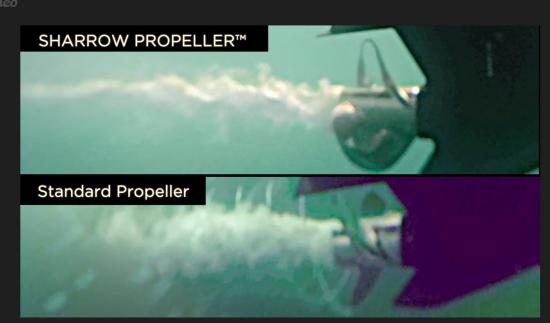
Where the Sharrow Pulls Away — And Where It Doesn’t
The low-to-mid cruise band is where the Sharrow’s propeller cavitation reduction technology builds a real gap. Traditional props can’t close it on paper. At 2,500 RPM, the Sharrow planes at 16 mph and pulls 1.4 mpg. The stock Yamaha SS is still fighting for a clean plane at 0.8 mpg. That’s a 75% efficiency advantage at the same RPM.
The midrange gap gets even bigger. At 3,000 RPM, the Sharrow logs 27.1 mph. A conventional prop manages 14.3–17.1 mph. Same engine load. A 10 mph difference in output.
Scroll to the WOT row, though, and the story changes fast. At wide-open throttle — 42 mph versus 41.6 mph, both at 0.8 mpg — the boat speed improvement advantage drops to near zero. The Sharrow hits that speed at 5,500 RPM. The stock prop needs 5,900 RPM. That lower RPM ceiling is a real win for engine life. It’s just not a raw speed win.
How High-End Traditional Props Close the Gap
The Solas Amita earns an honest mention here. Stacked against a standard uncupped stainless prop, it delivers a 15–25% efficiency improvement and a noticeably better hole shot. Mercury Enertia-equivalent props edge out Solas on durability and quality consistency in long-run use.
Neither one touches the Sharrow’s low-speed marine propeller efficiency lead. But both beat base stock props by a wide margin — at a fraction of the Sharrow’s price. That’s worth keeping in mind.
The Budget-Smart Middle Ground
Want real boat propeller fuel savings without paying the Sharrow premium? Cupped high-performance props are worth a look. The VIF Propellers lineup at vifpropellers.com is a strong example. You get close to 80% of the Sharrow’s low-speed handling and efficiency at 40–50% less cost.
Strong low-speed grip. Less vibration. Solid cruise-range MPG. For 150–300 HP single and multi-engine builds where the full Sharrow price doesn’t make sense, these are a legitimate option — not a compromise.
The bottom line: the Sharrow wins in the mid-range. Everywhere else, the gap between it and the competition is much smaller than the price gap suggests.
The ROI Calculation: How Long Before Sharrow Pays for Itself

Here’s the number that matters: your payback period.
The formula is simple. Divide your total investment cost by your annual fuel savings. That’s how long before the Sharrow pays for itself. The math either works for your situation — or it doesn’t.
Here’s how to run the numbers straight.
The Break-Even Model
Take a $2,000 Sharrow purchase on a twin-engine catamaran burning 21.1 GPH at cruise. After installation, that drops to 14.8 GPH — a savings of 6.3 gallons per hour. At $4.00 per gallon, you’re saving $25.20 every hour on the water.
|
Usage Profile |
Annual Hours |
Annual Savings |
Payback Period |
|---|---|---|---|
|
Heavy cruiser |
200 hrs |
~$5,040 |
< 6 months |
|
Regular boater |
100 hrs |
~$2,520 |
~10 months |
|
Weekend warrior |
50 hrs |
~$1,260 |
~19 months |
|
Occasional user |
30 hrs |
~$756 |
2.6 years |
For high-hour boaters, the case is close to airtight. At 200 hours per season, the prop pays for itself before winter storage. The numbers are hard to argue with.
Fifty hours a year tells a different story. The savings are real — they’re just slow.
The Variables That Shift the Calculation
Three factors move the needle more than anything else:
-
Fuel price — At $5.00/gallon, every payback period above shortens by 20%
-
Speed profile — Cruising at 20–25 mph gets the most out of the Sharrow’s efficiency edge. Wide-open throttle erases it.
-
Engine count — Twin-engine setups double the savings. Single low-HP outboards have no verified data yet.
One rule of thumb worth using: projected annual savings should exceed 20% of your purchase price for a solid ROI. On a $2,000 prop, that threshold is $400/year. You can hit that at just 30 annual hours of cruise-speed operation.
Run the numbers against your actual usage. The answer is right there.
Verdict: Is the Sharrow Propeller Worth It in 2026?
The answer is yes — but for the right boater only.
That’s not a hedge. It’s the most honest thing you’ll read about this prop.
If You Cruise Hard and Often: Buy It
High-frequency cruisers and offshore fishing captains have the strongest case. The data backs it up, no question. Here’s what the numbers show:
-
36% fuel economy gain at cruise speeds
-
50% improvement in reverse thrust
-
80% reduction in noise
These aren’t small wins. Each one adds up across every hour you spend on the water.
Log 150+ hours a year on twin high-HP outboards? The Sharrow marine propeller efficiency advantage pays for itself fast. Often within a single season.
If You Run WOT or Boat Occasionally: Skip It
At wide-open throttle, the Sharrow and a well-matched conventional prop hit the same number — 0.8 mpg. Above 35 mph, the boat speed improvement isn’t there. Full stop.
Say you run 40–60 hours a year on the water. A $2,000–$5,000 investment in a consumable part takes more than two years to pay back. That’s a long wait.
That math is hard to ignore.
The Bottom Line
The Sharrow loopwing propeller is a precision tool. Exceptional in the right hands. Overpriced in the wrong ones.
Your usage profile matters. No twin high-output engines? No regular cruise-speed runs? Under 100 hours a year? Check out high-efficiency alternatives at vifpropellers.com before you write the check.
Know your hours. Run your numbers. The right decision is already in the data.
Conclusion
The Sharrow propeller is impressive engineering. But impressive engineering doesn’t mean it’s the right investment for you.
The data is clear. Log serious hours on the water, run a fuel-hungry sterndrive or mid-range outboard, and chase real long-term savings — Sharrow’s marine propeller efficiency gains are measurable. The ROI math works in your favor over time.
Casual weekend cruising? Engine outside Sharrow’s optimal power range? You’re paying a premium for technology you won’t get full value from.
Before dropping $1,500–$3,000+ on a single boat propeller, check whether a precision-engineered traditional option closes that performance gap at a fraction of the cost. VIF Propellers offers high-performance alternatives worth a serious look.
The smartest upgrade isn’t the most expensive one. It’s the one that fits your boat, your budget, and how you use it.