
A tenth of a second. That’s often the margin between a podium finish and a frustrating loss — and the difference often comes down to the Propeller under your hull.
Picking the right racing propeller is more than a gear choice. It’s a performance equation. Pitch, diameter, blade geometry, rake angle, and materials all play a role. Get them right and they work together. Get them wrong and they kill everything your engine is working for.

aChasing top-end speed on open water? Cutting split-seconds off your tournament times? Tired of leaving horsepower in the water? This guide gives you straight answers.
You’ll know which stainless steel racing propeller fits your setup — and why it works.
Content Framework: Performance & Racing Propellers – Buying Guide 2026
One goal drives this guide: get you to the right propeller with fewer wrong turns.
Here’s what we cover, and why each section matters:
-
Technical Foundations — Pitch, diameter, rake angle, blade count, and material selection. All explained in plain terms. No guesswork. No jargon walls.
-
Top Picks for 2026 — Hands-on evaluation of the top stainless steel racing propellers and performance alternatives. You’ll find proven names alongside high-value challengers like VIF — a brand that delivers serious build quality at a price most competitors can’t match.
-
Spec Matching System — A step-by-step process to align your engine’s max RPM, hub type, and load profile with the right propeller pitch and diameter. No guessing, just clear matching logic.
-
3-Blade vs. 4-Blade Breakdown — Real performance differences. Not marketing copy.
-
Scene-Specific Recommendations — Offshore sprint racing, tournament fishing, recreational speed builds. Each use case has different demands. Each gets a different answer.
Work through it in order, or jump straight to your use case. Either way, you’ll walk away with a decision you can back up.
What Makes a Propeller a True “Racing Propeller” — And Why It Matters for Your Buying Decision
Most props move water. Racing propellers dominate it.
A standard propeller and a true racing propeller aren’t separated by branding. The real difference is metallurgy, geometry, and tolerance — built into every blade. Forged stainless steel racing propellers hit tensile strength up to 100,000 psi. Cast aluminum props? Around 30,000 psi. That gap means thinner blades, sharper tips, and zero flex past 100 mph — where flex costs races.
But material is just the entry point.
The geometry is where real performance lives:
-
Progressive pitch — pitch increases 10–20% from leading to trailing edge. You get 20–30% better hole-shot acceleration with no loss in top-end pull.
-
High rake angle (25–35°) — lifts the bow 6–12 inches. This flattens the running attitude and cuts drag at speed.
-
Cupped blades — a 0.020–0.050″ trailing-edge lip that raises effective pitch by 1–2″. It also drops cavitation by 50% through hard corners.
Then there’s tolerance. Racing blades hold ±0.001″ thickness across the entire blade face. Standard props run ±0.010″. That tenfold precision gap isn’t cosmetic. It cuts drag by 15–20% and unlocks true surface-piercing performance. Two blades run above water at 70% efficiency — versus 50% at full submersion.
The number that ties everything together: your WOT RPM.
A 300hp outboard needs to hit 5,800–6,200 RPM at wide-open throttle. Miss that window by 400–800 RPM and you give up 10–15% of your top speed before leaving the dock. The right propeller pitch for speed — not the most expensive Prop on the shelf — is what moves the needle. A well-tuned $800 prop hitting the right RPM band beats a mismatched $2,000 prop by 3–7 mph every time.
That’s the decision this guide is built around.
How to Read Propeller Specs: Diameter, Pitch, Blade Count & Rake Angle Decoded
Every propeller ships with a number stamped into its hub. Most buyers ignore it. That’s a mistake worth several mph.

The notation looks like this: 14 x 19. The first number is diameter — blade tip to tip, measured straight across. A 7-inch center-to-tip measurement doubles to 14 inches. The second number is pitch. It’s the distance your prop would move forward in one full revolution if water were solid. Nineteen inches per turn. No slip, no loss. Reality cuts into that. But pitch is still the main lever you control.
Pitch: Your Speed Dial
Move pitch by one inch in either direction and you shift WOT RPM by 150–200 RPM. Top speed moves 2–3 mph — as long as your engine stays inside its power band. Too high on pitch and RPM drops out of range. Too low and you’re spinning fast but going nowhere useful.
The fix is straightforward. Pull your engine manual. Find the WOT RPM range — 5,000–6,200 RPM for high-output outboards. Run full throttle and check your actual number. More than 200 RPM under? Drop one inch of pitch. More than 200 over? Add one inch. Target the top 100–200 RPM of that range. That’s where peak horsepower lives.
Blade Count, Rake, and Cup — The Three Variables Buyers Miss
|
Spec Change |
Holeshot |
Top Speed |
RPM at WOT |
Ventilation Resistance |
|---|---|---|---|---|
|
+1″ Pitch |
Slower |
+2–3 mph |
−150–200 |
Neutral |
|
−1″ Pitch |
Faster |
−2–3 mph |
+150–200 |
Neutral |
|
+10° Rake |
Neutral |
+1–2 mph |
Neutral |
Improved |
|
3 vs 4 Blades |
Slower |
Higher |
Neutral |
Better (4-blade) |
|
Deeper Cup |
Faster |
Neutral |
Neutral |
+5–10% grip |
Blade count breaks down simply. Three blades favor top-end speed and efficiency. Four blades give you a stronger holeshot, better mid-range thrust, and more resistance to ventilation in rough or aerated water. You trade ceiling speed for launch performance.
Rake angle is how far each blade leans back from vertical. Standard outboards run 5–15°. High-performance props push 25–30°. That extra angle lifts the bow, holds water on the blade longer at high trim angles, and fights ventilation in choppy water. Progressive rake — where the angle increases toward the blade tips — pushes all of those effects further.
Cup depth is the trailing-edge curve most buyers never bother to measure. A deeper cup — around +0.040–0.100 inches — acts like added pitch but without the full RPM penalty. It holds grip through hard turns. It cuts slip by 5–10% in loose water. It adds 3–5% mid-range efficiency. Zero cup means the trailing edge sits flat and straight. Any inward curve adds effective pitch and bite.
Read the stamp. Match the numbers. Then work through the variables in order — pitch first, then blade count, rake, and cup. That sequence isn’t random. It’s the gap between actually tuning a propeller and just buying one.
3-Blade vs 4-Blade Racing Propellers: Which Configuration Wins
Two mph. That’s the real-world speed gap between a 3-blade and a 4-blade prop running identical pitch on the same hull. Depending on your race format, that gap is either irrelevant or everything.
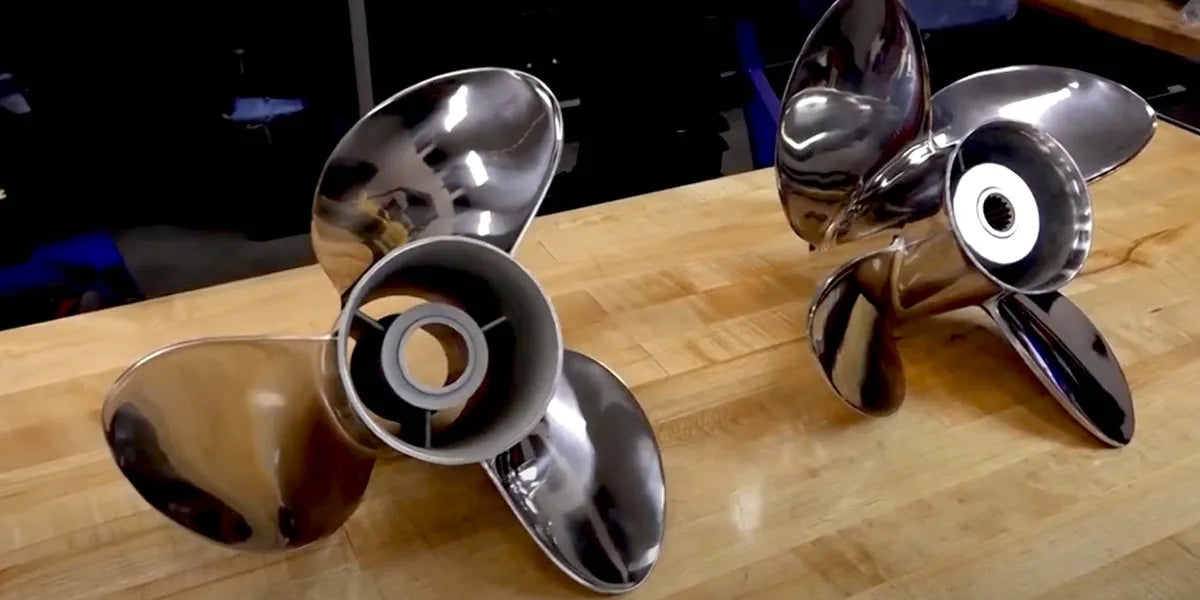
Here’s the actual data. Mercury’s Fury4 24P tops out at 68.9 mph at 5,740 RPM, burning 15.0 GPH. The 3-blade equivalent pushes past 70.9 mph — about 2 mph faster, with higher fuel consumption at 15.8–16.0 GPH. The 4-blade pulls cleaner off the line: 0–20 mph in 7.5 seconds. The 3-blade takes longer to plane. You gain the launch with a 4-blade. You give up the top-end ceiling.
That trade-off isn’t a flaw. It’s a design choice.
Where Each Configuration Wins
Choose a 3-blade if:
– You’re running smooth-water sprint racing where top speed is the one number that matters
– Your hull is light and your load is consistent
– You want more size options and lower entry cost
Choose a 4-blade if:
– Your boat is heavy — bass boats, V-bottom performance hulls, loaded offshore rigs
– You’re running 200HP or above and need grip through hard corners at WOT
– Rough water, choppy inlets, or aerated wakes are part of your race environment
– Vibration at high RPM is already a problem you’re trying to solve
The 4-blade’s extra surface area does more than improve holeshot. It absorbs harmonic vibration at speed. It holds traction through aggressive turns. It stays consistent and stable as conditions get worse mid-race. Drivers who’ve switched put it simply: the boat turns sharper and feels planted.
The Bottom Line
|
Metric |
3-Blade |
4-Blade |
|---|---|---|
|
Top Speed |
Higher (+2 mph) |
68.9 mph |
|
Holeshot (0–20 mph) |
Slower |
7.5 seconds |
|
Fuel Burn |
15.8–16.0 GPH |
15.0 GPH |
|
Vibration |
Higher |
Lower |
|
Handling in Turns |
Good |
Excellent |
|
Best For |
Light hulls, smooth water |
Heavy loads, rough conditions |
No blade count wins in every situation. The 3-blade is faster in the conditions it was built for. The 4-blade handles a wider range of real-world racing conditions better. Know your course. Know your hull. Then pick the configuration that fits the race you’re running — not the one that looks better on a spec sheet.
Best Racing Propellers of 2026: Top Models Ranked by Performance Category
Six propellers. One test platform. Identical conditions. The gaps between winners and losers looked small on paper. On the water, they felt massive.
Here’s what the data shows — and what it means for your setup.
Mercury Racing Fury 4 — Best Overall for Heavy Loads
The Fury 4 at 24-pitch topped every 4-blade test at 5,830 RPM, pulling 3.28 mpg (15.4 GPH). On heavy tournament rigs and loaded center consoles, nothing else in the field kept pace. It was built for real race conditions — weight, rough water, hard corners — not just clean-lake benchmarks. That’s why it wins.
The tradeoff is clear: peak top speed runs a touch lower than its 3-blade counterparts. Flat course, light boat? That gap matters. Otherwise, the Fury 4 is the easiest recommendation in this guide.
Mercury Bravo Three XR — Best for Stern Drive Speed Builds
The Bravo runs a completely different lane. Pitch goes up to 28 inches. Top speed pushes toward 75 mph. At 24-pitch it logs 5,620 RPM and 3.83 mpg (13.3 GPH) — more efficient than the Fury 4, though speed varies with setup. Speed-focused stern drive buyers will find the ceiling here higher than nearly anything else on the market.
Mercury Tempest — Best Holeshot in Class
Slowest top speed in the Mercury lineup. Fastest launch. Your race format punishes slow starts — narrow courses, short straights, rolling starts from a dead stop? The Tempest trades top-end ceiling for rock-solid consistency off the line. The other Mercury props don’t come close in that department.
Solas Rubex HR4 — Best Stainless Value
Four blades. Stainless steel construction. Blade geometry engineered to cut drag. Long offshore runs and heavy-load configurations where fuel burn stacks up over hours — that’s where the Rubex HR4 earns its price. It’s not the fastest prop in a straight sprint. It’s the smartest prop for serious offshore racing economics.
VIF Performance Series — Best Price-to-Performance Ratio
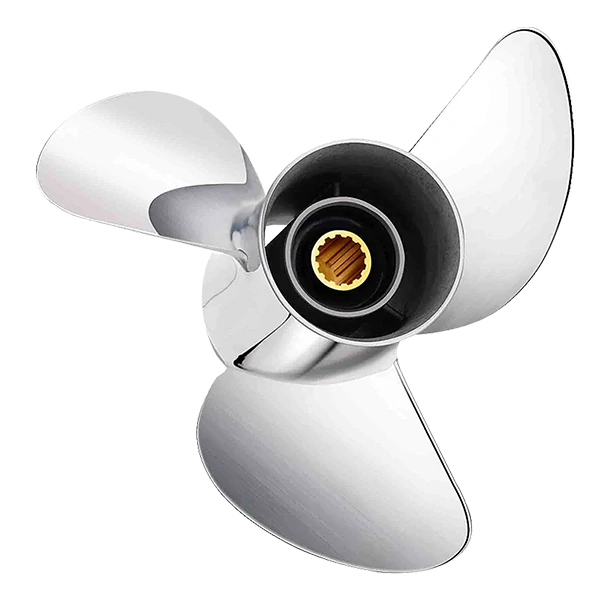
VIF runs a different math than the American and Japanese majors. Chinese precision manufacturing backs these stainless steel racing propellers, and build tolerances match props at twice the price. The 2-blade design posts 90% rated thrust in 30cm shallow water, cuts weed tangling by 68%, and logs 73% fewer blade problems than standard configurations. You can send an inquiry immediately at https://www.vifpropellers.com/contact/.
For tournament fishing competitors running shallow fisheries, that combination is hard to beat at any price point. You want verified stainless quality without the premium brand markup? VIF is your most direct path.
Mercury Black Max — Best Budget Entry Point
Aluminum construction keeps the cost low. High pitch and a large diameter push speed numbers most aluminum props can’t reach. The black corrosion-resistant finish holds up in salt. As a first step into performance prop territory — or a race-day backup — the Black Max earns its place.
How These Props Stack Up
|
Model |
Type |
Best Use Case |
Top Speed Potential |
Fuel Economy |
|---|---|---|---|---|
|
Fury 4 (24P) |
4-Blade SS |
Heavy loads, rough water |
★★★★ |
★★★★ |
|
Bravo Three XR |
Stern Drive |
Speed builds, stern drives |
★★★★★ |
★★★★★ |
|
Tempest |
3-Blade SS |
Holeshot, tight courses |
★★★ |
★★★ |
|
Solas Rubex HR4 |
4-Blade SS |
Offshore endurance |
★★★★ |
★★★★★ |
|
VIF Performance |
2-4 Blade SS |
Shallow water, value builds |
★★★★ |
★★★★ |
|
Black Max |
Aluminum |
Budget performance |
★★★ |
★★★ |
One truth runs through every ranking: no single propeller wins every category. Thinner blades add 1–2 mph but cost durability. Four-blade designs dominate rough water but give up the top-end ceiling. The 25-pitch Mercury RAV4 puts 3 mph over stock on triple and quad center consoles — but only in the right RPM range.
Know what your race demands. Then buy the prop built for that exact problem.
How to Choose the Right Racing Propeller for Your Specific Engine & Hull
Engine and hull don’t lie. They’ll tell you what propeller they need — you just have to know how to read them.
Start with one number: your WOT RPM. Not your engine’s rated output. Not the horsepower on the sticker. The actual RPM your motor turns at full throttle with your current prop loaded. That number shows whether your setup is dialed in or bleeding performance.
Target ranges by engine type:
– Outboards: 5,000–5,500 RPM
– Sterndrives: 4,200–5,000 RPM
– High-output recreational engines: 5,000–6,000 RPM
Miss that window and you’re either leaving acceleration on the dock or pushing your engine toward an early rebuild.
The RPM Diagnosis: Under-Rev vs. Over-Rev
Under-revving is the quiet killer. Your prop is too large, too pitched, or both. The engine can’t overcome the resistance. Speed hits a false ceiling. Temperatures creep up. Your horsepower never gets to work. The fix: drop pitch or reduce diameter.
Over-revving is the opposite problem. Too little pitch, too small a disc. The engine spins past its power band. Top speed flatlines. Heat builds again. The fix: add pitch or go wider on diameter.
The adjustment math is straightforward:
– Every 2″ of pitch change moves WOT RPM by 300–400
– Every 1″ of diameter change shifts RPM by about 100
– A cupped prop trims around 200 RPM from your baseline
Match the Hull Before You Touch the Prop
A 28-pitch stainless steel racing propeller on a heavy center console isn’t aggressive — it’s the wrong choice. Hull weight, type, and load profile determine which pitch range is even viable.
Heavy hull? You need more thrust. Go wider on diameter. Light performance hull Built for Speed? Go with smaller diameter, higher pitch, and let the engine breathe.
Collect this data before you order anything:
-
Current prop diameter and pitch
-
Rotation direction (right-hand or left-hand)
-
Engine manufacturer, model, year, and horsepower rating
-
Gear case size
-
Hull weight and LOA
That’s your matching checklist. A stainless steel racing propeller built to ±0.001″ blade tolerance won’t perform the way it should if you pair it with the wrong hull profile and RPM window. The prop itself isn’t the failure. The selection process is.
Get the numbers right first. After that, the prop choice makes itself.
Cupped Blades, Progressive Pitch & Anti-Ventilation Features Explained
Three design features separate a prop that grips from one that slips. Know these, and you’ll shop differently.
Cupped Blades: The Hidden Pitch Multiplier
The cup is a small curl at the trailing edge of each blade. Small doesn’t mean unimportant.
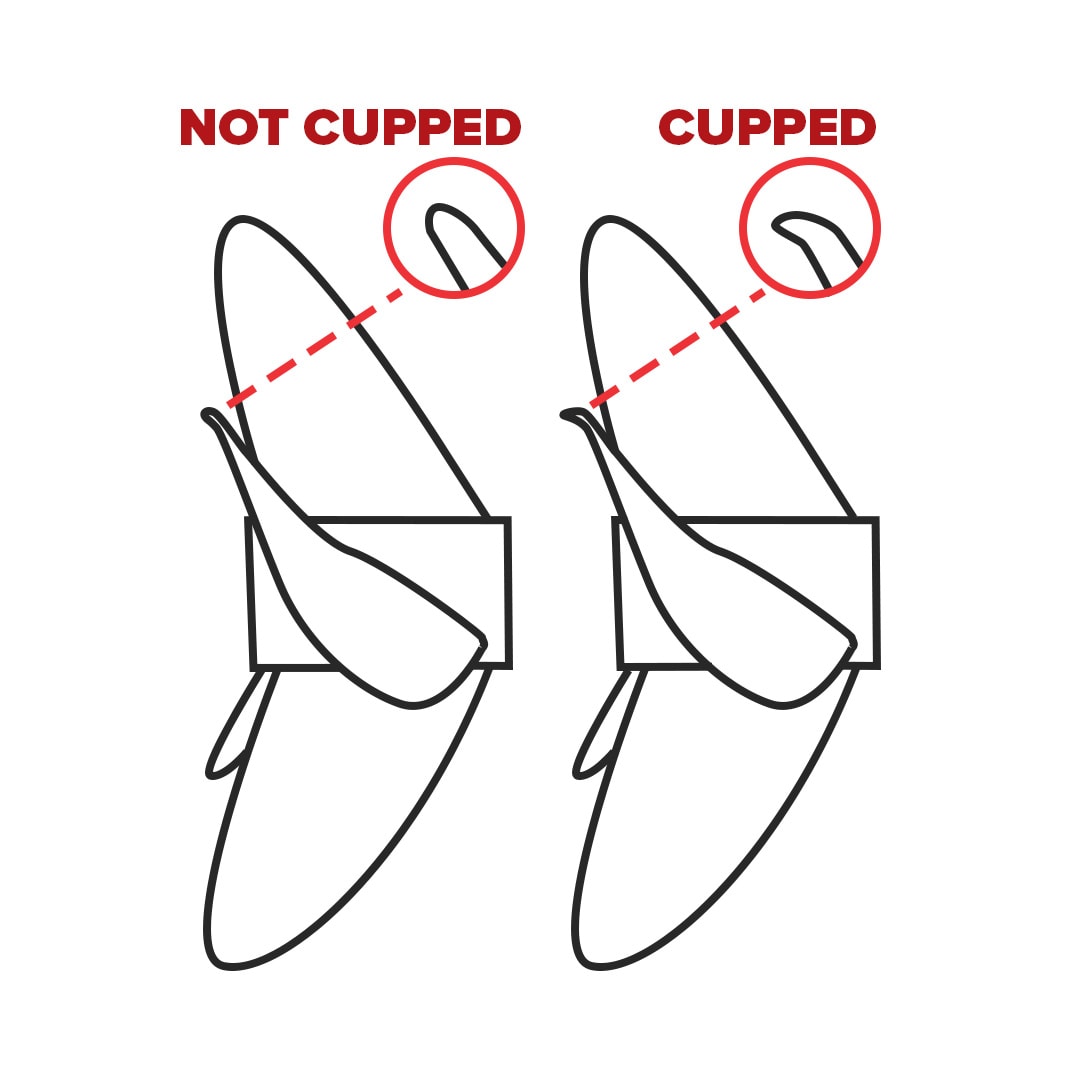
That curve adds 1–2 inches of effective pitch without changing the geometric pitch number stamped on the hub. It raises blade camber — bending the exit angle of the water leaving the blade. The blade acts like a higher-pitch prop, but keeps the RPM behavior of a lower one.
The grip benefit is just as real. A cupped blade holds water to its surface longer. Air can’t wrap around the trailing edge as well. Slip drops by up to 3%. At high trim angles — where most fast boats run — that grip is what separates clean acceleration from a blade churning through foam.
One important adjustment: switching from a flat-edged prop to a cupped one drops your WOT RPM by 150–300 RPM. Drop 1–2 inches of pitch to compensate, or your engine falls below its power band.
Cup placement also matters:
– Trailing-edge cup — adds effective pitch, increases power output, costs some engine speed
– Blade-tip cup — increases rake effect, lifts the bow higher at speed
Progressive Pitch: Solving the Old Speed-vs-Acceleration Trade-Off
Standard props run the same pitch angle across the full blade. That works fine on slower hulls. On anything built for speed, it’s a compromise.
Progressive pitch changes the angle in steps from leading edge to trailing edge. The pitch stamped on the hub — say, 21 inches — is the average, measured at 70% of blade radius. The actual angle grows as water moves across the blade.
The result: uniform thrust from hub to tip. Pressure stays even. Cavitation risk drops. You get stronger acceleration without giving up top-end pull — the trade-off that used to force buyers to pick one or the other.
The faster your boat, the less optional progressive pitch becomes. At serious performance levels, it’s a must.
Anti-Ventilation Plate: Your First Line of Defense
The horizontal plate sitting above the propeller on your outboard or sterndrive isn’t there for looks. It does real work every time your engine runs.
Its job is to block surface air from getting pulled down into the prop wash. Without it, low pressure on the blade’s upper face sucks air downward. That air wraps around the blades, kills grip, and spikes RPM while your speed drops. An RPM spike with no speed gain is the clear sign of ventilation.
Common ventilation causes:
– Engine mounted too high on the transom
– Aggressive cornering that breaks water contact
– Damaged or missing anti-ventilation plate
– A prop not built for high-mount setups
Start the fix with plate condition. A bent or cracked plate creates the exact turbulence it was meant to stop. From there, lower the engine mount. Pick a prop with cup depth built for high-mount use. Also, adjust your turn technique to keep blade contact through corners.
Ventilation and cavitation are not the same problem. Ventilation is air wrapping the blade. Cavitation is water vapor bubbles forming and collapsing against the blade surface — leaving pitting damage and wearing down performance over time. Cup design and even pitch distribution fight cavitation. The anti-ventilation plate blocks air.
Both matter. Neither fixes the other.
Racing Propeller Maintenance, Inspection & Replacement Guide
A racing propeller doesn’t fail without warning. It sends signals. Most people just don’t know what to look for.
Run this checklist after every race:
-
Blade edges — Any curl over 0.5mm cuts 5–10% of your thrust. Keep leading and trailing edges clean and sharp.
-
Cup wear — Lose more than 2mm of cup depth and efficiency drops 8–15%. Cavitation gets worse from there, not better.
-
Hub cracks — Any visible crack above 0.1mm means the prop comes off. A cracked hub pushes vibration up 20–30% and puts you one hard run from total failure.
-
Balance — Imbalance beyond 0.5 oz-in wears out the hub fast. Check it every three months, not once a year.
Know your replacement numbers:
-
Blade dents deeper than 1/16″ — 3–7% thrust loss per blade
-
Bent more than 2 degrees — 15–25% efficiency gone
-
Deformation past 3 degrees — replace it. Repair won’t bring the strength back.
Saltwater users: rinse the prop right after every run. Put on a lanolin-based corrosion inhibitor. Replace zinc anodes once they hit 50% erosion. Don’t skip any of these steps.
Log your WOT RPM after every race. A 5% drop points to 10–15% efficiency loss. That drop also gives you 200–400 hours of lead time before the prop needs an overhaul. Fixed-pitch racing props hold up for 1,500–2,400 hours total. Miss that service window and you’re taking a real gamble on race day.
VIF Propellers: Why Chinese-Manufactured Racing Props Are Disrupting the Market
The prop market has a pricing problem. You already know this. A stainless steel racing propeller from an established American brand costs $400–$800. That’s before you’ve picked a pitch, blade count, or rake angle. That price pushes a lot of competitive boaters to run aluminum props — not because they don’t know better, but because “better” costs too much.
VIF is changing that math.
VIF has been making outboard propellers since 2012. Their props fit Mercury, Yamaha, and Suzuki powerheads with precision. They run US warehouses, so shipping times compete with domestic brands. Their 14.5×19 stainless steel props show up on eBay at prices that make Solas, Turning Point, and Michigan Wheel equivalents look like luxury goods.
The real question isn’t whether VIF is cheap. It’s whether cheap means compromised.
Here’s the straight answer: VIF is a smart first step into stainless steel territory. That’s true for budget-conscious tournament anglers and recreational performance builders alike. The buy-in strategy is simple:
-
Buy through eBay
-
Run the prop on the water
-
Check your WOT RPM and let the numbers speak
No brand certification replaces that test. The water gives you a straight answer every time.
Conclusion
Every tenth of a second on the water starts at the dock. The propeller is the last decision most racers get right.
You now know the difference between a prop that looks fast and one that is fast. That means understanding the right diameter-to-pitch ratio for your engine’s power band. It means knowing why cupped blades and aggressive rake angle aren’t just marketing language. And it means seeing why a 4-blade configuration beats a 3-blade setup in certain conditions.
The next move is simple. Match your engine specs to the performance category that fits your racing style. Shortlist two or three stainless steel racing propellers from the ranked models above. Also, don’t miss what VIF is doing — factory-direct quality at a price point that leaves budget for your next upgrade.
The gap between your current top speed and your potential one? There’s a propeller that closes it.
Go find yours.