
Replacing a damaged Prop or chasing more speed from your Tohatsu — the wrong Propeller costs you more than money. It drains your RPMs, burns extra fuel, and kills your confidence on the water. That changes how every trip feels.
The problem is simple. Most buyers face a wall of diameter numbers, pitch specs, and blade counts. So they guess.
This guide fixes that. Running a Tohatsu 9.8 HP on an aluminum skiff? Pushing a 60 HP four-stroke on open water? You’ll find a straight answer here either way. That includes a full size chart, a real aluminum-vs-stainless breakdown, and the exact questions to ask before you buy.

What This Guide Covers — And How to Use It
Six sections. Each one built around a real decision you’ll face.
Here’s the structure:
-
Propeller Basics — pitch, diameter, and blade count explained without the jargon
-
Size Chart by HP — from the 9.8 HP to the 60 HP, matched to the right specs
-
Aluminum vs. Stainless Steel — a real comparison, not a sales pitch
-
Top Picks by Model — recommended props with pricing, specs, and use cases
-
FAQ — how to measure, how to install, and what a 38 ft-lb torque spec means in practice
-
Where to Buy — OEM options alongside aftermarket alternatives worth a look
No need to read it straight through. Find your engine size. Check the chart. Then look at the material differences if you’re still on the fence. That’s all you need to buy with confidence.
What Makes a Tohatsu Propeller Fit Your Engine (Diameter, Pitch & Blade Count Explained)
Three numbers tell the whole story. Every Tohatsu propeller has a marking on its hub — something like 11×15. Learn to read it, and most of the confusion clears up fast.
Diameter: How Much Water Your Prop Moves
The first number is diameter — the full width of the circle your blades sweep through. A bigger diameter moves more water per revolution. That’s what heavier loads need. Running a light aluminum skiff? A smaller diameter keeps drag low and RPMs climbing. Hauling gear or passengers? You’ll want that extra reach.
Pitch: The Number That Controls Your RPMs
The second number is pitch — the distance your boat travels forward per propeller revolution, measured in inches. A 15-pitch Prop is designed to move 15 inches forward per revolution. In practice, slippage trims that down. But pitch is still the most direct lever you have over engine performance.
Here’s the rule that matters most:
-
WOT RPM too low (engine lugging)? Drop pitch by 2–3 inches
-
WOT RPM too high (engine over-revving)? Add pitch by 2–3 inches
A practical example: the Tohatsu 50 HP targets 5,000–6,000 RPM at wide open throttle. Your current prop gets you to 4,500 RPM? That means too much pitch. A gap of 300–400 RPM off-target is worth correcting — don’t leave it.
Blade Count: Speed vs. Smoothness
|
4-Blade |
||
|---|---|---|
|
Top speed |
✅ Higher |
Lower |
|
Low-speed thrust |
Lower |
✅ Higher |
|
Hole shot / planing |
Slower |
✅ Better |
|
Vibration |
More noticeable |
✅ Smoother |
Three blades win on top-end speed. Four blades win on everything else — smoother ride, stronger pull at low RPM, better planing with a loaded boat. Neither choice is wrong. It comes down to how you use the water.
One more thing to know: standard Tohatsu outboards use right-hand rotation. Running a dual-engine setup? Mismatched rotation directions cause handling problems. No pitch adjustment fixes that. Match the rotation direction before anything else.
Tohatsu Propeller Size Chart by Engine HP (9.9 HP to 250 HP)
Every engine has a prop that belongs to it. Not close — actual fit. This chart matches Tohatsu outboards from 9.9 HP up to 250 HP to their correct diameter, pitch range, and spline count. Bookmark this page before you order anything.
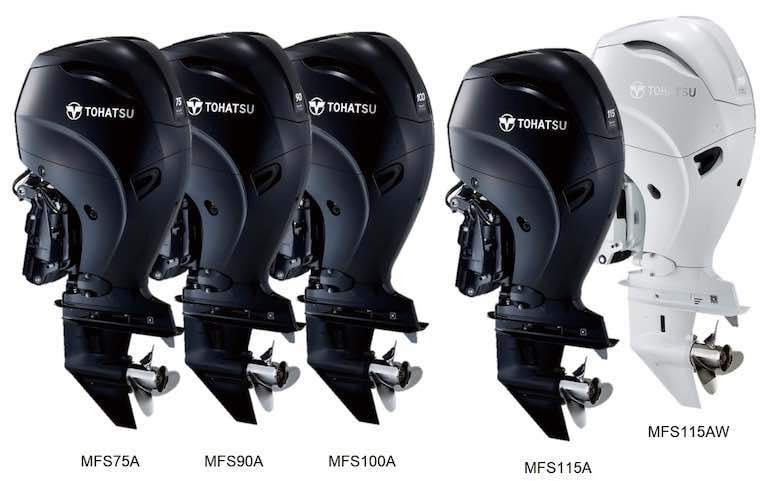
9.9 HP – 30 HP
9.9–20 HP (MFS9.9, MFS15, MFS20 — 2-stroke and 4-stroke)
– Spline: 14-tooth
– Diameter: 9.25″
– Pitch range: 7″–11″
|
Part Number |
OEM Reference |
Spec |
|---|---|---|
|
SOL5111-093-07 |
362-64105-0 |
9.25 × 7 |
|
SOL5111-093-08 |
362-64103-0 |
9.25 × 8 |
|
SOL5111-093-09 |
362-64101-0 |
9.25 × 9 |
|
SOL5111-093-10 |
362-64108-0 |
9.25 × 10 |
|
SOL5111-093-11 |
— |
9.25 × 11 |
8/9.9 HP 4-stroke: 12-tooth spline. The Quicksilver 7.8×9 RH aluminum 3-blade is a well-proven fit here.
25–30 HP 4-stroke (MFS25, MFS30): 10-tooth spline. Turning Point kit 11200600 covers this full range with no gaps.
9.9–18 HP 2-stroke (1984–2005 models): 14-spline. Turning Point kit 11100701.
40 HP – 70 HP
MFS40C, MFS50, MFS60A, MFS70: 10-spline. One thing worth knowing — there are no 12″ diameter props in this range. Don’t waste time searching for one.
-
Turning Point kit 11300101 covers 40–60 HP
-
Turning Point kit 11500300 covers 50–70 HP
-
VIF Stainless Steel Series (40-60 HP): If you really want to wake up an MFS50 or 60, this is the way to go. VIF’s stainless options give you noticeably better bow lift and practically zero blade flex under heavy loads.
-
Bigfoot/CT gearcase (40–60 HP): 4.25″ gearcase diameter
90 HP – 140 HP
MFS115, MFS120, MFS140 (1988 and newer): Spline count varies by model. Some PARSUN-compatible builds run 15-spline. You’ll find both aluminum and stainless steel options at this power level.
Quicksilver lists house and work props for the 115–140 HP range. Michigan Wheel also builds stainless and aluminum props made for Nissan/Tohatsu in this tier.
115 HP – 250 HP
MFS150, MFS250 (2-stroke and 4-stroke): 15-spline. Stainless steel props make the most sense across the full MFS115–250 range. These larger outboards generate massive horsepower and torque loads. Aluminum props struggle to handle this extreme force. Hit the throttle, and aluminum blades will bend. A stainless steel upgrade pays off fast on the water.
Pushing a heavy hull requires maximum grip out of the hole. The VIF 4-Blade Stainless Steel Propeller for Tohatsu 115-250HP delivers top-tier performance for these demands. It slides straight onto the 15-spline shaft. You skip the headache of complicated aftermarket hub kits. This rigid 4-blade setup forces the boat to track better in rough offshore conditions. Plus, it puts your hull on plane much faster than a standard 3-blade model. You get an incredible price advantage compared to buying original factory parts. Many twin-engine towboat owners run this exact VIF prop. It instantly solves their slipping issues under heavy loads.
Quick WOT RPM Reference (All HP Ranges)
Target RPM at wide open throttle under load: 5,000–6,000 RPM.
|
WOT Reading |
What It Means |
Fix |
|---|---|---|
|
Below 5,000 RPM |
Pitch too high |
Drop pitch by 2″ |
|
Above 6,000 RPM |
Pitch too low |
Add pitch by 2″ |
Rule of thumb: every 1″ of pitch change moves RPM by 150–200. A 2″ correction shifts you 300–400 RPM. That’s enough to land you in the target range.
Aluminum vs Stainless Steel Tohatsu Propellers: Which Should You Buy?
Material choice is the decision most buyers underestimate. It affects every single trip after the purchase.
The price gap is real: aluminum runs $80–$200, stainless steel $250–$600. That number alone doesn’t tell you what you’re getting. Here’s what does.
Side-by-Side Comparison
|
Factor |
Aluminum |
Stainless Steel |
|---|---|---|
|
Price |
$80–$200 |
$250–$600 |
|
Weight |
Lighter (50% less) |
2× heavier |
|
Top Speed |
2–5% lower |
Up to 5% gain |
|
Impact Response |
Bends (protects engine) |
May shatter |
|
Saltwater Use |
Prone to pitting |
Excellent (add anodes) |
|
Best HP Range |
≤125 HP |
125 HP and above |
|
Lifespan |
Shorter in abrasive conditions |
2–3× longer |
The Straightforward Call
Choose aluminum for freshwater use, lighter engines, rocky or obstacle-heavy areas, or keeping your budget under $200.
Choose stainless for offshore use, higher horsepower, better performance, or serious hours on saltwater.
One last thing worth knowing: stainless props hold real resale value. Lock them up or secure them well any time the boat sits unattended. Prop theft is a real thing, and stainless makes an easy target.
Top Tohatsu Propeller Recommendations for 2026 (By Use Case & Budget)
Five props. Four use cases. One clear answer for wherever you land.
These recommendations are sorted by budget and purpose — not by brand loyalty or margin. Aftermarket options run 20–50% cheaper than OEM. You won’t see meaningful durability losses on 30–60 HP EFI models either. That’s a real $200–$400 difference per prop. Worth knowing before you default to the factory part number.
Under $300 — Best Budget Pick
VIF Propellers Stainless Series — 3-blade stainless steel, fits 40–60 HP, priced around $199.99–$250.
Honestly, VIF has been changing the math on budget upgrades lately. You’re getting genuine aftermarket stainless steel—meaning cleaner acceleration and virtually zero blade flex under load—for what an OEM aluminum prop usually costs. If you want the durability and top-end speed of stainless without the premium price tag, this is exactly where I’d start looking.
PowerTech ILB3 — 3-blade stainless steel, fits 25–30 HP, priced at $279.
Stainless steel for under three hundred dollars. You get clean acceleration and better pitch retention than aluminum at the same price point. Running a 35–60 HP setup? GetAProp lists the extended ILB3 range — same line, scaled up.
$300–$500 — Performance Upgrades Worth the Jump
Three options here, each built for a different kind of use:
-
Solas Rubex (3-blade aluminum, 40–90 HP, ~$350–$420): Adds 2–5 MPH on top end and cuts fuel burn by 10% at WOT (around 4.5 GPH on a 40 HP). The hole shot improvement over stock is easy to feel right away.
-
PowerTech SS 4-blade (stainless, 50–140 HP, ~$400–$480): Four blades give you 15–20% more low-end torque. That’s the right pick for towing or carrying loads under 1,500 lbs. You also gain about 2 MPH off the line.
-
Michigan Wheel Vortex (4-blade stainless, 30–250 HP, ~$450–$550): The progressive pitch design holds 25–30 knots loaded. It cuts ventilation on hard turns and adds 3–4 MPH at cruise. On twin-engine setups, slip drops by 20%.
$500+ — OEM Replacement
Tohatsu OEM props run $520–$750 for the 25–60 HP range. They’re exact fits — no compatibility questions, no cross-referencing needed. For 40 HP EFI models (866cc, 209 lbs), the factory part number is 48-815083A01. Always check the current Tohatsu prop chart before ordering to confirm.
The honest trade-off: you’re paying a premium for certainty. Cross-check the aftermarket options above against your shaft spline (15-spline is standard across 25–60 HP) and your target WOT range of 5,000–6,000 RPM. You’ll get the same result for less money.
Quick-Reference Table
|
Model |
HP Range |
Blades / Material |
Pitch Range |
2026 Price |
Best For |
|---|---|---|---|---|---|
|
PowerTech ILB3 |
25–30 HP |
3 / Stainless |
9–11″ |
$279 |
Budget, acceleration |
|
Solas Rubex |
40–90 HP |
3 / Aluminum |
10.5–12″ |
$350–$420 |
Speed + fuel economy |
|
PowerTech SS |
50–140 HP |
4 / Stainless |
11–13″ |
$400+ |
Heavy loads, towing |
|
Michigan Wheel Vortex |
30–250 HP |
4 / Stainless |
10.8–14″ |
$450+ |
Cruise, multi-engine |
|
Tohatsu OEM |
35–60 HP |
3 / Aluminum or SS |
Per chart |
$520+ |
Guaranteed exact fit |
One rule covers all of them: confirm your part number against the Tohatsu Propeller Chart before you buy. Match HP, shaft spline, and target RPM. That one step cuts out most compatibility issues — and keeps your return shipping label in the drawer where it belongs.
How to Choose the Right Pitch for Your Tohatsu Outboard (RPM-Based Method)
Pitch selection isn’t guesswork — it’s arithmetic. Your engine tells you what it needs. You just have to listen.
Every Tohatsu outboard has a target WOT (wide open throttle) RPM range of 5,000–6,000 RPM. Under real load, aim for the upper end of that range. That number is your anchor for everything that follows.The Four-Step Method
Step 1. Check your owner’s manual and confirm the WOT RPM range for your engine model.
Step 2. Head out on calm water with a warm engine. Trim for maximum speed, push to full throttle, and record your RPM with a tachometer.
Step 3. Compare what you see to the target range:
– Below 5,000 RPM — pitch is too high. Drop it.
– Above 6,000 RPM — pitch is too low. Raise it.
Step 4. Calculate how much to change. The math is simple: (Target RPM − Current RPM) ÷ 150–200 = inches of pitch to adjust.
Say your tachometer reads 4,600 RPM and you’re targeting 5,500–6,000. That’s a shortfall of 900–1,400 RPM. You’ll need to drop pitch by 5–9 inches total — but work in 1–2 inch steps. Test after each change. A 2-inch drop gains you 300–400 RPM. That’s a real difference, not a rounding error.
Matching Pitch to How You Use the Boat
|
Use Case |
Pitch Direction |
RPM Target |
|---|---|---|
|
High-speed runs (empty boat) |
Higher (+1–2 inches) |
5,800–6,000 RPM |
|
Heavy loads / towing |
Lower (−1–2 inches) |
5,200–5,600 RPM |
|
Fishing / cruising |
Balanced |
Full WOT range |
For everyday cruising, aim to run at 70% of your max RPM — around 4,200 RPM on an engine with a 6,000 ceiling. At that level, fuel economy, engine life, and comfortable speed all line up well together.
One final note: never exceed your engine’s maximum RPM rating after a pitch change. Re-test on the water before you commit.
OEM vs Aftermarket Tohatsu Propellers: Honest Comparison for 2026 Buyers
The factory prop that came with your Tohatsu was never your only option — it was just the default.
Aftermarket propeller quality has come a long way. The visual difference between an OEM Tohatsu prop and a well-made aftermarket one is small. The performance gap is just as small, at least for most recreational use.
The price gap is a different story. Aftermarket props run $100–$400 less than OEM equivalents, depending on material. That’s real money — enough to cover a full season of fuel.
When OEM Makes Sense
Two situations make the factory part worth the extra cost:
-
Your engine is still under warranty. OEM propellers protect that coverage. Aftermarket options don’t.
-
Your model has proprietary hub specs. The 25–30 HP Tohatsu uses a 10-spline TN30 rubber hub configuration. Not every aftermarket brand replicates that spec correctly.
Outside those two situations, the case for OEM falls apart fast.
What to Check Before Buying Aftermarket
Compatibility is not a given. Before you order, confirm these five specs match your engine:
-
Gear ratio
-
Spline count
-
Tooth pattern
-
Hub hole dimensions
-
Horsepower rating
Mercury or Nissan props sometimes cross-reference with Tohatsu outboards. Still, verify first before buying. “Close enough” is not good enough when you’re 8 miles offshore.
The Bottom Line
Post-warranty engine? Go aftermarket. You get equal performance at a lower cost. Still within the warranty window? Buy the OEM. The peace of mind is part of what you’re paying for.
How to Install a Tohatsu Propeller Yourself (15-Minute DIY Guide)
Four tools. Fifteen minutes. No mechanic required.
Here’s what you’ll need before you start:
– Needle-nose pliers
– A 17mm socket wrench
– A wood block or folded towel
– New stainless steel cotter pins
Remove the old prop first. Put the engine in neutral. Use your pliers to pull out the cotter pin. Press the wood block against the blades to stop them from spinning. Then unscrew the nut with your 17mm wrench.
Installing the new prop is where most people go wrong. Before anything touches the shaft, pack fresh grease into the splines. That one step blocks corrosion and keeps the prop from seizing up six months down the road.
Next, seat the thrust washer. Flat side faces the bow. Lip faces out. Get it wrong — skip it or flip it — and all the propeller thrust shifts onto the outer housing instead of the shaft. That’s the most common install mistake, and it’s easy to miss.
Hand-tighten the nut. Give it one more full turn by hand until the cotter pin holes line up. No torque wrench. No power tools. Light finger pressure is all you need. Over-tightening pulls the holes out of alignment.
Slide in your stainless steel cotter pin. Bend both ends down flat against the nut. Then spin the prop by hand — forward and backward. Smooth rotation, no grinding, no resistance. That means you’re done.
Quick heads-up: some aftermarket props — Solas included — don’t come with cotter pins in the box. Pick up a few extras before you start the job.
Frequently Asked Questions: Tohatsu Propellers (2026 Edition)
Eight questions. The ones that keep coming up, answered straight.
What size propeller fits a Tohatsu 9.8 HP?
For the MFS9.8 four-stroke, start with 9–10″ diameter, 8–11″ pitch. A 9⅜ × 9 aluminum prop is a solid starting point. Test it under your actual load. Higher pitch raises top speed. Lower pitch gives you faster acceleration. Target WOT RPM: 5,000–6,000.
What about the Tohatsu 60 HP?
Go stainless. A PowerTech in 10.5–11″ diameter, 13–17″ pitch handles the load well — the 10.86 × 15 is a strong baseline for the MFS60A. Heavy boat? Stay at 13–14″ pitch. Light hull chasing 35–40 knots? Move to 16–17″.
Are 2-stroke and 4-stroke Tohatsu propellers interchangeable?
Not really. Both use 15-spline shafts. But diameter and pitch needs are different. Swapping without checking puts stress on your bearings. Confirm against the OEM chart before you swap anything.
How do I know which pitch I need?
Each 1″ of pitch change moves RPM by 150–200. Running below your target range? Drop pitch. Over-revving? Add pitch. Change in 1–2″ steps. Check with a tachometer each time.
Will the wrong propeller void my warranty?
Not on its own — warranties cover manufacturing defects, not user choices. That said, a wrong prop that pushes your engine 10%+ over its rated RPM gives a manufacturer reason to call it misuse. Stay within the recommended pitch range. You stay protected.
Do propellers carry their own warranty?
Yes. Most brands — including Tohatsu OEM and PowerTech — cover manufacturing defects for 1–3 years. Normal wear, dings, and impact bends fall outside that coverage. Keep your receipt. Budget 4–8 weeks for any claim to process.
Conclusion
You’ve done the hard part — the research, the comparisons, the second-guessing. Now it comes down to one thing: the right Tohatsu outboard propeller is more than a replacement part. It’s the difference between a boat that works and a boat that sings.
Match your pitch to your RPM range. Push your engine hard? Go stainless steel. Want reliable, affordable everyday performance? Aluminum is your answer. Also, watch out for an ill-fitting prop. It drains your fuel economy all season without you noticing.
Replacing a damaged blade? Chasing that perfect top-end speed? VIF Propellers carries a focused selection of Tohatsu propellers built to spec. The team there knows their stuff — they can tell you exactly why a 13-pitch and a 15-pitch perform differently on the water.
Go find your prop. Your next day on the water is waiting.