
Using the wrong Propeller for your Volvo Penta sterndrive or IPS system doesn’t just hold back your top speed. Honestly, it can quietly tear your engine apart over thousands of hours on the water.
The confusion is understandable. Volvo Penta’s lineup covers several very distinct systems. Each requires a specific Prop geometry, material, and pitch range. To make matters worse, factory spec sheets are normally packed with technical jargon that most of us don’t have time to decode.
Got a chewed-up blade after a close call with a sandbar? Or maybe you’re just trying to squeeze better fuel economy out of your current setup? This 2026 guide cuts out the fluff. We’ll show you exactly how to find the right Volvo Penta Propeller—no guesswork required.
1. Which Volvo Penta Drive System Do You Have?
Before you even look at a part number, you need to know which drive system is bolted to your transom. This is crucial because an SX propeller will absolutely not fit a DPS drive. Mixing up systems causes serious mechanical damage.

-
SX Drive: Single propeller, straight shaft. Reliable and straightforward, mostly used on boats under 25 feet. Props are replaced one at a time.
-
DPS (Duoprop): Two counter-rotating propellers on a single sterndrive. You get sharper acceleration and better grip. Crucial rule: DPS props must be installed as matched pairs.
-
IPS Drive: These are pod-mounted systems placed under the hull with forward-facing dual props. Typically found on larger yachts. They require pod-specific hubs.
-
DP (Duoprop): The older version of the twin-Prop sterndrive. Similar to DPS, it requires matched counter-rotating props.
Quick ID check: Just look at your boat. One rear-facing prop? That’s an SX. Two rear-facing props? DPS or DP. Pods under the hull with forward-facing props? That’s IPS. You can also check the cowl’s engine plate.
2. Decoding the Numbers: Diameter × Pitch
Every propeller has a spec stamp, like 14.3 × 21 RH. That’s your sizing DNA.
Diameter (14.3″): The total width of the prop circle. A larger diameter pushes more water but places a heavier load on your engine.
Pitch (21″): The theoretical distance (in inches) the prop moves forward in one full spin. Pitch is your primary tool for tuning engine RPM.
-
Too Much Pitch: Engine “lugs”; doesn’t make it into its powerband (WOT falls below 4,500 RPM). Results in overheating.
-
Too Little Pitch: Engine over-revs (exceeds 5,500 RPM), resulting in high fuel burn rates and risk of drive train failure.
The Desired Outcome: Achieving RPM range of 4,500–5,500 RPM under WOT conditions. Tip: Each inch change in pitch translates to 400 RPMs of change at WOT.
3. Three Blades or Four: It’s Your Call!
Your choice between using a propeller with either three or four blades depends entirely on how you’ll be boating.
-
Three Blade Props: Designed to optimize boat speed and fuel efficiency when cruising. If you typically operate the boat lightly loaded or if you simply desire to reach optimal speeds in calm waters, choose three blades.
-
Four Blade Props: You sacrifice a small amount of speed for superior low-end torque. If you often haul a heavy load, including family, towing skiers, and navigating through rough water conditions, then go with four blades. (Note: If you have a pontoon, you should always opt for four blades.)
|
Attribute |
4-Blade |
|
|---|---|---|
|
Top Speed |
✅ Higher |
Slightly lower |
|
Hole Shot & Planing |
Slower |
✅ Faster / Better under load |
|
Handling in Chop |
Average |
✅ Smoother, less vibration |
4. Propeller Materials: Aluminum, Stainless, or Bronze?
That is where most people make costly errors. Get the wrong kind of material, and you either lose money or are guaranteed a breakdown midway through the season.
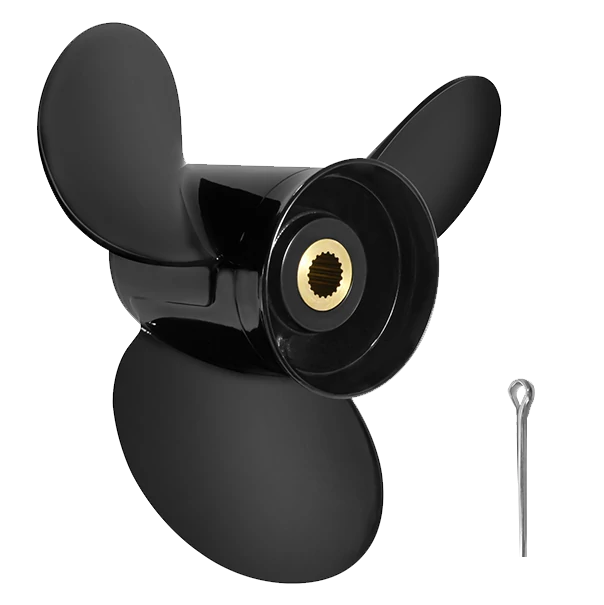
Aluminum: Cost-effective material. Truth be told, if you are in a small recreational boat on the freshwater, aluminum will serve you just fine. However, keep in mind that the material corrodes easily when used in saltwater.
Stainless Steel: Resistant to wear and tear, thin blades, lower drag. Despite being expensive, it outperforms aluminum blades because of its strength, especially when used in offshore areas where salty water is encountered.
Ni-Al Bronze (NAB): Best material for heavy-duty purposes. Compared to stainless steel, this material is lightweight, cavitation resistant, and best for IPS and large yachts.
5. OEM vs. Aftermarket Brands
Would you invest in the genuine Volvo Penta propeller, or would you rather save some cash and choose something less expensive? Undoubtedly, this question is raised most often by customers. So let us see what makes the difference between these two choices. After all, there is no such thing as an identical propeller.
Volvo Penta (OEM)
If your boat is still under warranty, or if you run an advanced IPS drive, just bite the bullet and buy OEM. Volvo’s engineering matches their specific pod geometry perfectly. No exceptions here.
-
The Good: Absolutely flawless fit, zero warranty headaches, and they are engineered to maximize the exact power curve of your engine.
-
The Bad: The painful price tag. You are definitely paying a steep premium just for that brand stamp on the hub.
Solas
Solas is a massive name in the aftermarket world and a frequent go-to for independent marine mechanics.
-
The Good: Their unique squeeze-casting process makes their aluminum props surprisingly dense and durable. They are a very reliable, middle-of-the-road budget alternative.
-
The Bad: They can run just a tiny bit heavier than stock. Many boaters report dropping about 1-2 mph off their top-end speed when switching from OEM to Solas.
Michigan Wheel
This is a classic brand that practically wrote the book on recreational boating propellers.
-
The Good: They have a huge catalog. If you are trying to prop an older, hard-to-find DP or SX setup, Michigan Wheel probably has exactly what you need.
-
The Bad: Their modular hub kits can sometimes be a bit confusing to assemble for beginners. Also, the paint finish on their base aluminum models tends to flake or chip a bit faster if you frequently run in harsh saltwater.
VIF Propellers (The Crowd-Tested Favorite)
If you’re simply replacing a damaged recreational sterndrive prop and want the smartest use of your money, this is the modern solution. VIF has rapidly taken over the aftermarket space. In fact, they consistently rank as a top seller on major retail platforms like Amazon and eBay. That isn’t just clever marketing—that means thousands of real everyday boaters have bought them, bolted them on, pushed them hard, and verified their quality through overwhelming positive reviews.
-
The Good: Unbeatable price-to-performance ratio. VIF matches OEM specs and blade geometries incredibly strictly, but they usually cost 20–50% less than a Volvo factory prop. It’s mass-market proven quality without the OEM markup.
-
The Bad: You probably won’t find them sitting on the dusty shelf of your local marina’s repair shop; they are primarily a direct-to-consumer online brand.
If you’re ready to bypass the heavy retail markups and want to compare verified, exact-fit setups for your Specific Volvo drive, you can easily grab what you need over at vifpropellers.com.
6. Quick Sizing Reference Chart
Match your horsepower to find your starting point for pitch and diameter. Always verify with an on-water RPM test.
|
HP Range |
Drive System |
Common Specs / Notes |
|---|---|---|
|
100–150 HP |
SX (19-spline) |
14.6″ to 15.5″ Dia. Pitch varies (19″ to 23″) based on weight. |
|
200–250 HP |
DP / DPS |
Type F/FH or Type H (Stainless). Buy matched pairs only. |
|
300+ HP |
DPH / DPI / IPS |
Type H Stainless. Do not mix hub types. IPS is factory-set. |
7. Installation & Maintenance Essentials
Most propeller failures actually start at the dock due to sloppy installation. A reused tab washer backing off can lead to your prop instantly sinking to the bottom.
Installation Steps (SX Drive):
-
Shift into forward gear and block the prop with a piece of wood.
-
Remove the cotter pin, nut, and old prop. Never reuse the tab washer.
-
Clean the shaft. Apply a light coat of marine grease (splines only).
-
Slide the new prop on. Install the thrust ring, new tab washer, and nut.
-
Torque to 70–80 ft-lbs. Fold the tabs into the nut slots securely. Insert a new cotter pin.
Maintenance tip: Inspect your prop after every weekend. See dents or cavitation pitting? Have it balanced before that vibration wreaks havoc on your lower unit bearings.
8. Where to Buy & Avoiding Fakes
Counterfeit props are a real issue right now. They look identical, cost 40% less, and snap under pressure. When buying, ensure the seller is an authorized dealer or a vetted specialist.
You can purchase directly from Volvo Penta (at full MSRP), or look to trusted marine suppliers. For a solid inventory of both OEM and verified aftermarket options tailored to SX, DPS, and IPS drives, check out the fit guides at vifpropellers.com.
Conclusion
Selecting the right propeller for a Volvo Penta boat is all about understanding what drive type you have, what RPM you should run, and the material you require based on how you use the boat. Watch out for the pitch, use new hardware, and you will enjoy years of trouble-free boating.