
Every spring, thousands of boat owners turn the key and hear nothing — or worse, a grinding protest from an engine that spent the winter eating itself from the inside out. The culprit isn’t always neglect. Sometimes it’s not knowing about one critical step in the Boat Engine winterization process: fogging.
Have you never heard this phrase before? Maybe you are an experienced boater who just wants to double-check their knowledge? Whatever the case, you have come to the right place. In this article, you will find out what engine fogging is all about. Moreover, we will explain why not doing so might leave you with a bill that could run into thousands of dollars.
What Does It Mean To Fog The Engine?

Fogging an engine is pretty much what it sounds like — you’re creating a protective fog inside the engine itself.
To do it, you spray fogging oil into your engine’s air intake or spark plug holes before storing your boat for the season. This oil has been formulated to be viscous and sticky. It forms a protective layer on the walls of the cylinder, pistons, rings, valves, and exhaust ports. This layer stays put for months.
That film does one job: it keeps oxygen and moisture away from bare metal surfaces.
What is the importance of this? Metal without a protective coat, when exposed to moisture, leads to rust and pitting. Rust and pitting is not something that stays little. This is something that will freeze piston rings and score the cylinder walls.
The name “fogging” comes from what you actually see. Spray fogging oil into a running engine’s intake and dense white smoke pours from the exhaust. You’re fogging the engine — plain and simple.
Think of fogging as a preservation spray for your engine’s internals — not a repair, not a cleaning step, but a protective measure before months of storage.
Fogging an engine means spraying fogging oil — a thick, petroleum-based aerosol — straight into the engine’s air intake or through the spark plug holes. It gets dispersed in fine particles. These settle down on all the interior surfaces of metal that they can come into contact with such as cylinders, pistons, rings, valve ports, and exhaust ports. They will form a protective layer which is not easily washed off or evaporated.
That film has one job: keeping oxygen and moisture away from bare metal so rust never gets a foothold.
How the Name “Fogging” Came About
The term isn’t marketing language — it’s descriptive. Spray fogging oil into a running engine’s intake at idle (around 1,100–1,200 rpm), and dense white smoke rolls out of the exhaust within 10 to 20 seconds. You’re fogging the engine — that’s the whole picture. The cloud confirms the oil mist has worked its way through the top end.
Fogging vs. Your Regular Oil Change
These are not the same thing — not even close.
|
Fogging |
Routine Oil Change |
|
|---|---|---|
|
Purpose |
Coats internal surfaces against rust during storage |
Replenishes bulk lubrication for regular operation |
|
When |
Once, before storage longer than one month |
Every 50–100 hours of use |
|
What it reaches |
Cylinder walls, pistons, rings (top-end mist) |
Oil pan and sump |
|
Engine state |
Protects a stored, non-running engine |
Sustains a working engine |
Fogging is for gasoline engines only. Diesel engines run at much higher compression ratios. An oil mist entering a diesel cylinder can cause detonation or a runaway engine. Running diesel? Skip the fogging oil.
Why Engine Fogging Is Non-Negotiable for Stored Boats
Here’s what happens inside an unfogged engine the moment you walk away from it.
Oil drains off the cylinder walls within days of shutdown. Bare metal sits exposed. In humid or salt air, moisture starts condensing on those surfaces through each day’s heating and cooling cycle. Salt crystals — if you run in saltwater — pull moisture straight toward bare metal. Within one to two weeks, rust spots form. Piston rings and valves hold that moisture against the precision-honed crosshatch surfaces, etching them away. That first crank in spring scrapes rust across the cylinder walls. The damage is permanent. Compression drops. It doesn’t come back.
That chain reaction doesn’t require a harsh winter. It just requires time.

The Saltwater Penalty
Saltwater boaters face a different level of risk. Salt accelerates corrosion two to five times faster than freshwater environments. A freshwater boat exposed to humidity alone might go weeks before serious damage sets in. A saltwater boat stored outdoors on a humid rack? Rust can show up within days.
Coastal storage past 30 days isn’t a gray area. Fogging is mandatory — not optional.
Do You Actually Need to Fog?
Not every situation calls for it. A heated shop, regular start-ups each month, and storage under one month? You can skip it. But most boat owners aren’t in that situation.
|
Storage Condition |
Fogging Required? |
|---|---|
|
Under 1 month, heated shop, monthly starts |
Skip |
|
5–8 weeks, garage under 50°F |
Recommended |
|
Outdoor storage, salt or humid climate |
Essential |
|
Saltwater boat, 30+ days idle |
Mandatory |
The Math Is Simple
Fogging oil runs $10–$20 and takes about 20 minutes. Skip it and face a stuck-ring, scored-cylinder rebuild on a 90hp Mercury outboard? That’s $2,500 to $4,500 — and that’s a midsize engine. Piston rings can seize after just four to eight weeks of sitting idle. There’s no warning sign. The first symptom is a boat that won’t start in April.
Twenty minutes and twenty dollars. That’s the trade-off.
Carbureted gasoline engines are the clearest case. This covers most older outboards, stern drives, and inboard gasoline engines. No fuel injection means no protective oil film on the intake tract after shutdown. Cylinder walls go bare fast. Fog them.
Even two stroke engines with carburetors that have the oil-to-fuel ratios built-in (24:1 or 50:1), require fogging when storing the engine beyond one month. The fuel-to-oil ratio is only helpful when the engine is running; once the engine is off, the protection ends. If you store outside, in salty air, or for more than one month, don’t rely on the oil-to-fuel ratio alone.
Older throttle-body fuel injection engines sit in the same category as carbureted setups for storage. Fog them for anything over one month.
Direct-injected two-strokes need fogging too. Spray through the throttle while the oil pump keeps feeding the bearings.
|
Engine Type |
Fog It? |
|---|---|
|
Carbureted gasoline (outboard/inboard) |
Yes |
|
Two-stroke outboard (any ratio) |
Yes, if >1 month or outdoors |
|
Older throttle-body EFI |
Yes |
|
Direct-injected two-stroke |
Yes, via throttle |
|
Modern multi-throttle EFI |
Use fog-port only |
|
Diesel inboard |
No (check residue; optional insurance spray) |
|
Any engine, <1 month, climate-controlled |
Skip |
Not sure? Check your engine manual for a fog-port fitting before touching the intake. That one check can save your injectors — and your season.
Fog Your Boat Engine: Timing & Triggers
The calendar tells you everything. Your boat sits untouched for 30 days or more? Fogging is not optional — it’s the next step.
Here’s a quick reference for your situation:
Fog your engine if:
– The boat goes into offseason storage
– It sits unused for 30+ days
– You run in saltwater — even once in a while
– Storage conditions are humid, outdoor, or unheated
Safe to skip if:
– Storage lasts under one month in a climate-controlled space
– The engine runs under load every three weeks — it must reach full operating temperature. Idling on a trailer does not count.
Getting the Timing Right
Fogging prior to the first frost – 32°F (0°C) or lower. Marine services are fully booked at the end of October. By November, they will not take any new appointments. Arrange your appointment beforehand.
It requires only 20 minutes for each engine. No more no less. What you’ll need are some gas stabilizer, a canister of aerosolized fogging oil, spark plug wrench, and some clean cloths. That’s all.
How often?
– Seasonal boats: once per offseason.
– Salt water boats: whenever the engine remains idle.
– Less frequent use boats: once every month or two months.
Not sure about fogging? Do it anyway. There is absolutely nothing to lose from it.
How to Fog a Boat Engine: Step-by-Step Process
The whole job takes about 20 minutes. Do it wrong, and you’ve wasted a can of fogging oil. Do it right, and your engine wakes up in spring the same way you left it.
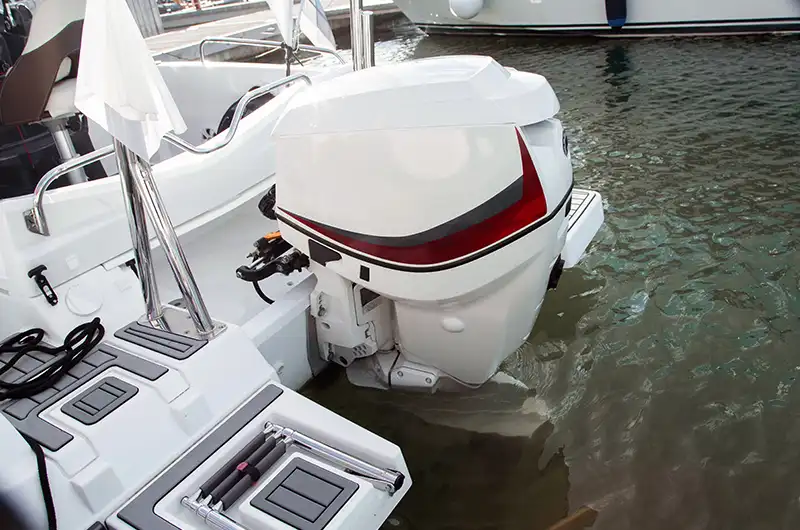
Before anything else: warm the engine up. Run it for 5 to 10 minutes until it hits normal operating temperature. A warm engine burns off condensation sitting inside. Warm cylinder walls also absorb the fogging oil film more evenly. On land, hook up flushing muffs to a garden hose first — never run a marine engine dry, even for a few minutes.
For Carbureted Engines (The Standard Process)
All old outboards, sterndrives, and carbureted inboards use the same procedure.
This is the most frequently encountered configuration.
Allow the engine to reach its idle speed; 1,100 – 1,200 RPM will do just fine.
If it is a disconnect the fuel line since the engine runs for a short period with the fuel already accumulated in the carburetor
Hold the aerosol bottle with the fogging oil at the engine air intake. Spraying should be done in bursts lasting 2 seconds, with a pause of 10-15 seconds in between. Do not press the bottle constantly since that would flood the engine due to insufficient dispersion of the oil.
Continue spraying until you see thick white smoke pouring from the exhaust port and the engine begins to falter or even stall. This stumbling is the required indicator that the oil has permeated through the upper parts.
On land with flushing muffs, this will take approximately 10 minutes.
Spark Plug Hole Method (For Long-Term Storage)
Storing the boat for more than one season? Or just want extra protection? Add this step after the intake fogging.
-
Remove all spark plugs with a plug wrench.
-
Spray 2 to 3 seconds of fogging oil into each hole.
-
By hand, rotate the flywheel or crankshaft several full turns. This spreads the oil across every cylinder wall instead of letting it pool in one spot.
-
Reinstall the plugs. Hand-tight first, then snug — don’t overtorque them.
For Fuel-Injected (EFI) Engines
Skip the intake spray. On modern EFI engines, forcing oil through the throttle body can clog injectors or cause an uncontrolled fuel event. Neither outcome is good.
The correct method: mix fogging oil into fuel.
-
Combine 1 quart of marine fogging oil with 2 gallons of fresh gasoline in a portable fuel tank.
-
Connect that tank to the engine and run it at idle for 10 to 15 minutes — until you see heavy exhaust smoke.
-
Or, disconnect the main fuel line and connect the fogging mixture straight to the water-separating fuel filter inlet. Run the engine until it stalls on its own.
Check your owner’s manual for a dedicated fog-port fitting. Many newer engines have one built in — using it makes the whole process cleaner and safer.
What you’ll need:
– Aerosol marine fogging oil (one can per engine)
– Spark plug wrench
– Flushing muffs + garden hose (for on-land fogging)
– Portable fuel tank (EFI engines)
– Fuel stabilizer
– Owner’s manual — a must for EFI and direct-injection setups
That’s the full process. Nothing complicated. The tools are cheap, the steps are easy to repeat, and the result — a cylinder wall that looks the same in April as it did in October — is worth every minute of it.
Frequently Asked Questions About Engine Fogging
Good questions pile up fast once you start digging into engine storage. Here are the ones that come up most.
Can I use WD-40 instead of fogging oil?
No. WD-40 is a penetrating solvent. It loosens rust, pushes out moisture, then evaporates in minutes. Fogging oil is built around tackifiers — sticky compounds that cling to metal surfaces for months. These are two different products doing two different jobs. WD-40 leaves no protective film behind. That’s the problem.
Will fogging oil void my warranty?
The opposite. Most OEM manuals recommend fogging for any storage beyond one month — as long as you use an approved oil. Check the spec in your manual, follow it, and you’re covered.
What if the engine doesn’t stall when I spray?
Don’t panic. Modern ECUs are built to resist stalling. Heavy white smoke from the exhaust is your real confirmation — not a stumble or hesitation. Dense smoke coming out means the oil reached where it needed to go.
Do I have to remove the spark plugs?
No. Spraying through the intake is standard procedure. Removing the spark plugs gives extra cylinder coverage — useful for long-term or multi-season storage. For a typical offseason, it’s optional.
When can I skip fogging?
Two situations qualify. First, storage under one month in a climate-controlled space. Second, a two-stroke you run every three weeks on a 24:1–50:1 oil-fuel mix. That mix coats the internals on every run. Stop the engine for a full month, though? Fog it.
Still not sure whether your situation calls for it? Fog anyway. It takes less time than sorting through edge cases — and skipping it risks a repair bill, not just a wasted afternoon.
Conclusion
Your engine kept you moving all season. Now it’s your turn to return the favor.
Fogging an engine isn’t just a habit for obsessive boat owners. It’s the cheapest insurance you can buy before winter storage. A $15 can of fogging oil for your outboard motor protects your cylinder walls from months of rust. No springtime fix will undo that damage. Skip it once, and you might get lucky. Skip it twice, and you’re paying for a rebuild.
The process takes twenty minutes. The protection lasts all winter. Come spring, you turn the key and the engine fires on the first try. That’s not luck. That’s what preparation does.
So before you throw that cover over the boat and walk away for the winter, grab your fogging oil and work through the steps. Finish the job right. And honestly, don’t forget to inspect your propeller. Good off-season storage runs bow to stern — not just engine-deep. If you notice your prop has seen better days and you’re looking for a professional, reasonably priced replacement, reaching out to VIF Propellers is a smart move. Getting it swapped out now means zero headaches when launch day rolls around next spring!