
The wrong Boat Propeller doesn’t just hurt performance — it drains your fuel, strains your engine, and leaves you wondering why your boat never feels right. Most boaters pick a propeller the way they pick a restaurant: by guessing, then hoping for the best.
Propeller blade design is a detailed science. The difference between a 3-Blade aluminum propeller and a 4-blade stainless steel one goes beyond looks or price. It comes down to what your boat needs to run at its best.
Replacing a damaged Prop? Chasing better top-end speed? Fine-tuning for heavy loads? This guide cuts through the confusion and gives you a clear, practical framework for making the right call.
What’s Inside This Guide
Boat propellers come in far more varieties than most boaters expect. Each type exists for a specific reason. This guide covers blade count, blade design, materials, and specialty propeller types — all tied to real-world use cases.
Here’s what you’ll find:
-
Blade count breakdowns — 2-blade through 5-blade options, with clear trade-offs between efficiency, thrust, and drag
-
Blade design types — cupped, cleaver, high-thrust, feathering, surface-piercing, and more
-
Material comparisons — aluminum vs. stainless steel, and which one fits your needs
-
Specialty propellers — dual counter-rotating props, variable pitch, ducted, and weedless designs built for specific conditions
-
Matching frameworks — how to pair propeller type with your boat, engine, and on-water goals
No filler. No vague generalities. Just the specifics you need to go from confused to confident — upgrading, replacing, or starting fresh.
What Makes a Boat Propeller Work — And Why the Right Type Matters
Physics runs the show here. Each propeller blade has two sides. Each side does a different job. The pressure side pushes water backward. The suction side pulls the blade forward. Those two opposing forces create thrust — that’s Newton’s Third Law working beneath your hull every time you leave the dock.
Three things determine how well that thrust gets delivered:
-
Diameter — a larger diameter moves more water per revolution, producing stronger raw thrust
-
Pitch — this is the distance your boat should travel with each full rotation. A 19-inch pitch should move 19 inches per turn, but real-world slip runs 10–40% due to water resistance
-
Blade design — the twisted foil shape works like a wing, generating lift. A cupped trailing edge grips water tighter and cuts slippage, which matters most at speeds above 35 knots
Get all three right for your engine and hull, and everything clicks. Get them wrong, and the problems add up fast.
Pitch too high, and your engine blows past its RPM ceiling — burning 20–30% more fuel and grinding down bearing life. Too low, and your engine bogs below 80% of its power band, costing 15–25% efficiency. A diameter mismatch can strip 5–10 knots off your speed or pile on a 30% fuel penalty from overload strain.
The propeller type you choose isn’t a minor detail. It’s the final link between engine power and actual forward motion. Nail it, and every other variable on your boat starts working better.
Types of Boat Propellers by Blade Count — Which Number Is Right for You?
Blade count is the first decision most boaters face — and the easiest one to get wrong without a clear framework.
Most recreational boats run on 2 to 5 blades. That’s a narrow range, but the performance differences between each option are real and significant. Each extra blade shifts the balance between speed, smoothness, thrust, and drag. Add one blade and you gain grip. You give up a little top-end speed to get it.
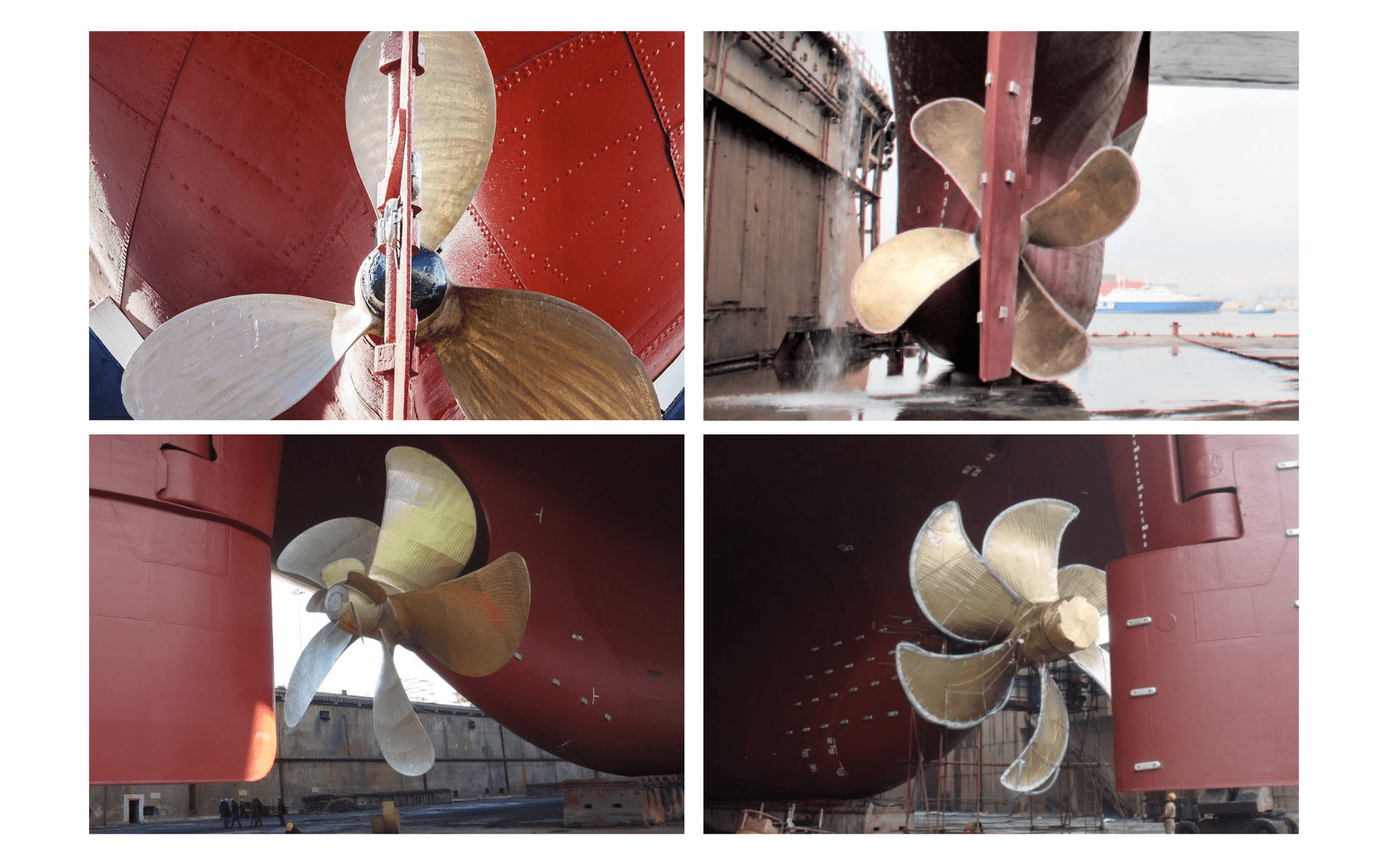
Here’s how each option performs:
2-Blade Propellers
Built for sailboats and trolling motors. Two blades create the least drag of any configuration. That’s the whole point — you need an auxiliary engine that stays out of the way. The tradeoff is real, though. Vibration runs high, and thrust is too limited for heavier hulls.
3-Blade Propellers
The default choice across recreational boating — and for good reason. Three blades cover 50–55% of the rotational circle. That delivers the highest top speed of any blade count while keeping efficiency solid. Speedboats, fishing boats, and watersports rigs almost always start here.
4-Blade Propellers
Choose four blades when your priorities shift toward hole-shot acceleration, stern lift, and rough-water control. Vibration drops compared to a 3-blade propeller — you’ll feel the difference on longer runs. Offshore fishing boats and cabin cruisers benefit most. These vessels give up a fraction of peak speed and get real stability and low-speed thrust in return.
5-Blade Propellers
Five blades are built for feel as much as function. Acceleration is strong. Vibration is minimal. The ride quality is smoother than any lower blade count. Wakeboard boats, luxury yachts, and high-performance applications favor this setup — especially where engine elevation runs high and surface grip matters most.
|
Factor |
2-Blade |
3-Blade |
4-Blade |
5-Blade |
|---|---|---|---|---|
|
Top Speed |
Moderate |
Highest |
High |
Lower |
|
Acceleration |
Low |
Moderate |
Enhanced |
Strong |
|
Vibration |
High |
Moderate |
Low |
Lowest |
|
Drag |
Lowest |
Low |
Moderate |
Higher |
|
Low-Speed Thrust |
Low |
Moderate |
High |
High |
One rule applies across all configurations: match blade count to engine size. A high-horsepower engine paired with too few blades doesn’t just underperform — it strains the motor and speeds up wear. Check your gearbox ratio and horsepower output first. Everything else follows from there.
Propeller Designs Explained — From Fixed Pitch to Surface-Piercing

Blade count gets all the attention. Propeller design does most of the actual work.
The shape, angle, and position of your blades control how well engine power turns into forward
motion. This applies across every speed, load, and sea condition your boat faces. These design categories are worth knowing. They’ll save you from buying the wrong Prop — and then buying another one.
Fixed-Pitch Propellers — Simple, Reliable, Inflexible
Fixed-pitch propellers do what the name says. The blades lock at a set angle. Nothing moves. Nothing adjusts.
That simplicity has real value. Fewer moving parts means lower maintenance costs and fewer failure points. You also get long-term durability that more complex designs can’t beat at the same price. Vessels on consistent routes at consistent speeds — ferries, cargo ships, workboats — are a natural fit for fixed-pitch designs.
The drawback is just as clear. A blade angle built for cruising speed will underperform at low speed — and the reverse is also true. Fixed-pitch propellers can’t adapt to you. You adapt to them.
If you’re actually in the market for a reliable replacement that perfectly fits your setup, you might want to check out VIF. Honestly, they’ve hit a pretty great balance between solid build quality and pricing that makes sense. They are currently moving a massive volume on Amazon, backed by a flood of rave reviews from real boaters. It’s not just about getting a durable piece of metal, either—people genuinely appreciate their responsive after-sales support, which saves you a lot of headaches if you ever need sizing help or run into fitting issues.
Pitch Itself — The Number That Shapes Everything
Pitch controls how your boat behaves at both ends of the speed range. It’s worth understanding on its own.
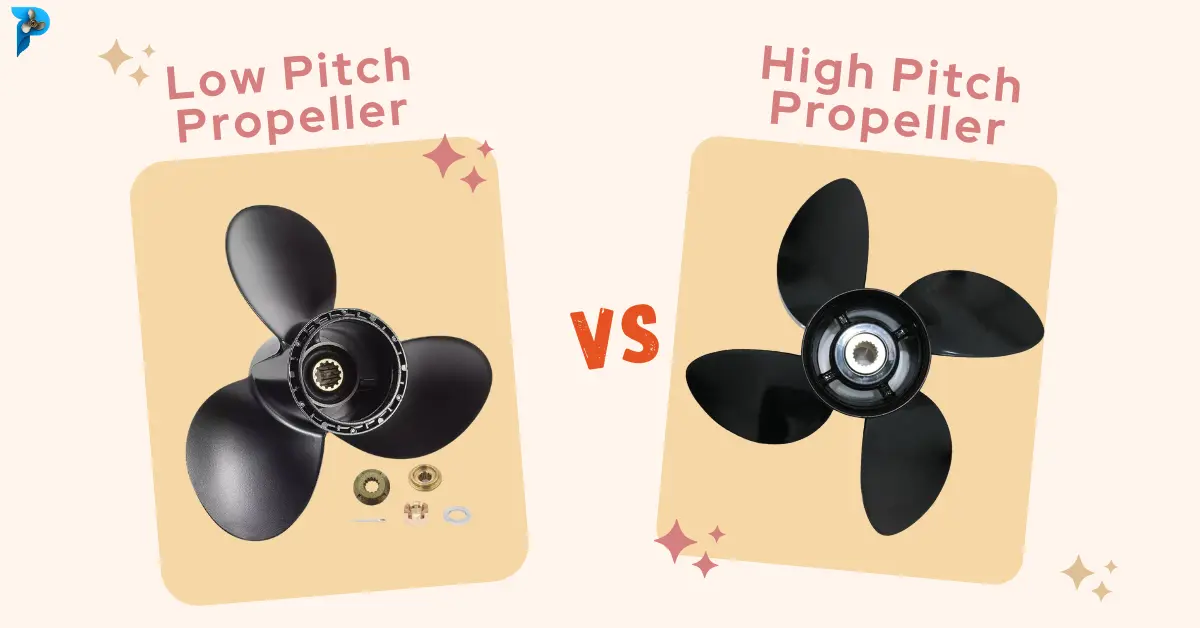
Low-pitch designs build speed fast and produce strong initial thrust. They’re the right pick for towing, heavy loads, and rough-water work where low-end pulling power matters more than top speed.
High-pitch designs trade that low-end pull for more distance per revolution. Every rotation covers more water. Top speed goes up. But low-speed thrust drops. Haul weight often or fight chop on a regular basis, and high pitch will let you down.
Surface-Piercing Propellers — Built for Speed, Not Subtlety

Surface-piercing propellers work in a way no other design in this guide does. The propeller sits at the waterline — not below it. Blades enter and exit the water with every revolution. This creates a ventilation effect that replaces the vacuum cavities standard submerged props produce.
The efficiency gains are real and measurable. Blade surface friction drops by a noticeable margin. Cavitation erosion — a persistent problem in high-speed use — is mostly eliminated. Ventilation takes care of what cavitation would otherwise destroy.
Two design details make this system work well:
-
Shaft inclination runs just a few degrees off parallel to the water surface. That small angular shift improves efficiency by 3–5% compared to a fully parallel alignment.
-
Blade sections are symmetric and without camber. This keeps thrust balanced in both port and starboard directions.
Surface-piercing designs got their start on vessels running 35–45 knots. Today they remain the standard pick for racing boats and any high-performance build where speed is the main goal.
Variable-Pitch Propellers — Flexibility at a Cost

Variable-pitch propellers fix the core problem with fixed-pitch designs. The blade angle adjusts during operation. It responds to changing speeds, loads, and sea conditions in real time.
Ferries and tugboats rely on them for good reason. These vessels need precise control in tight spaces and solid cruising performance across long distances. Adjusting blade angle for each condition — rather than locking in one fixed setting — produces clear performance advantages.
The tradeoff is mechanical complexity:
-
More moving parts means more maintenance
-
Upfront costs run higher than fixed-pitch options
For recreational boaters, variable-pitch designs don’t make much economic sense. For commercial operators running hard duty cycles, the added flexibility is worth the cost.
The short version: Fixed-pitch for simplicity and consistency. High-pitch for speed. Low-pitch for thrust and heavy work. Surface-piercing for serious performance above 35 knots. Variable-pitch for boats where operating demands shift constantly.
Dual & Contra-Rotating Propellers — When One Prop Isn’t Enough

Every single propeller has a limit. Push power high enough, and that limit hits hard. The prop starts fighting you — spinning slipstream bleeds energy, torque yanks the hull sideways, and cavitation tears into both performance and hardware. A better single propeller won’t fix this. The answer is two propellers, each spinning in the opposite direction.
That’s the core idea behind dual and contra-rotating systems. Two propellers share the same shaft, spinning in opposite directions. The front prop does the heavy lifting first. The rear prop then takes the churned-up water left behind and re-energizes it — pulling back the lost energy and turning it into usable thrust.
The numbers show what that recovery is worth: 6–16% higher efficiency than a single-propeller setup, with propulsion gains topping 10% in well-tuned configurations.
Two more advantages come with the setup:
-
Torque cancellation — opposite rotation wipes out the yaw and roll that high-power single props tend to produce
-
Reduced cavitation — mixing odd and even blade counts between the two props cuts noise and mechanical stress
The real trade-off? Complexity. A shaft-within-a-shaft system needs tight engineering — diameter ratios, revolution matching, flow parameters. None of it is easy to get right. That’s why contra-rotating designs stay rare in commercial use, even with the clear efficiency edge they carry.
For high-performance vessels, the math starts to shift. Fuel savings above 10% or solid speed gains can justify the engineering cost. Hurtigruten’s Sea Zero coastal cruise ships chose contra-rotating systems for exactly this reason — energy efficiency at scale. That choice tells you who this technology is built for.
Ducted & Propulsor Propellers — The Heavy-Duty Specialists
You won’t find these propellers discussed in recreational boating forums. They don’t appear on fishing boat spec sheets or watersports catalogs. What they do is handle the hardest, most punishing work on the water — holding dynamic-positioning vessels steady, driving rock installation ships through brutal conditions, and pulling tugboats against currents that would stop most setups dead.
That’s where ducted propellers operate.
The core idea is simple. Enclose the propeller inside a nozzle, and the duct speeds up water flow across the blades. More flow over the same blade area produces more thrust from the same input power. At low speeds — where bollard pull and station-keeping matter most — that efficiency gain becomes massive.
The Kaplan-style ducted propeller, housed inside a Kort nozzle, is the workhorse of this category. High blade-area geometry and CNC-precision pitch control let units like VEEM’s Kaplan series pull maximum output from every kilowatt, even under heavy load. For tugboats, workboats, and rock installation vessels, this isn’t optional — it’s the right engineering for the job.
A refinement worth knowing: the U-duct design, developed by Brunvoll, doesn’t produce quite as much thrust as a full nozzle. But it delivers something just as useful:
-
Reduces propeller load
-
Lowers total power demand
-
Improves course stability with less rudder input
-
Protects the propeller in contra-rotating setups
Less raw force. More controlled, consistent efficiency.
Steerprop builds ducted propulsor units at 3.6 meters in diameter, each pulling over 3MW. Those numbers put their bollard pull capability in a category that open recreational propellers never reach.
This is industrial engineering, not recreational gear. Your operating profile involves low-speed heavy loads, dynamic positioning, or restricted-speed commercial work? Ducted propellers aren’t an upgrade. They’re the correct tool — full stop.
Aluminum vs Stainless Steel vs Bronze — Choosing the Right Propeller Material
Most boaters leave real performance on the table. Not because they make bad choices — but because no one clearly explained what each material actually does differently.
Three materials dominate the propeller market. Each one trades off durability, weight, corrosion resistance, and cost in its own way. None of them wins across every category. The right pick depends on your engine, your water type, and how you use your boat.
Aluminum Propellers — The Practical Starting Point
Aluminum is light, affordable, and easy to work with. That makes it the go-to choice for outboards under 125HP. The blades are thicker than stainless, so you get a bit more drag. That limits your top speed and fuel economy. For general recreational boating, though, that trade-off is fair.
Aluminum’s biggest strength shows up in shallow, sandy, or debris-heavy water. It works as a sacrificial material — it takes the hit first. The prop absorbs impact and fails before your shaft and seals do. Replacing a dented aluminum prop costs very little. Fixing gear damage does not. That difference adds up fast.
Stainless Steel Propellers — Built for Performance and Longevity
Stainless steel props run thinner blades. Less drag. Better pitch retention at high RPM. Aluminum blades flex under load and lose efficiency — stainless holds firm. You get stronger acceleration, sharper handling, better fuel economy, and a longer service life. This shows up most in saltwater and high-horsepower setups.
The price gap is real. Stainless runs more than twice the cost of aluminum, and repairs aren’t cheap either. Still, for performance-focused boaters, the long-term value is solid.
Bronze (Aqualloy/Nibral) — The Inboard Standard
Bronze props — Aqualloy and Nibral alloys in particular — are the standard choice for inboard engines, tow boats, and larger cruisers. They’re lighter than stainless steel, which delivers a 1.5–3.0% efficiency gain. That gain compounds over long commercial duty cycles and adds up to real fuel savings. Corrosion resistance beats both aluminum and stainless. Surface smoothness lasts longer. Lower load stress also means you can run smaller shaft diameters.
Quick Selection Guide
|
Factor |
Aluminum |
Stainless Steel |
Bronze (Nibral) |
|---|---|---|---|
|
Best For |
<125HP, general use |
High-HP, performance |
Inboards, commercial |
|
Durability |
Moderate |
High |
High |
|
Weight |
Lightest |
Heaviest |
Mid-range |
|
Corrosion Resistance |
Low |
Good |
Best |
|
Cost |
Lowest |
High |
Mid-to-high |
|
Repair Cost |
Cheap |
Expensive |
Moderate |
Under 125HP in fresh water? Go with aluminum. High-horsepower saltwater setup? Stainless steel is the call. Inboard engine or a harsh marine environment? Bronze Aqualloy or Nibral — full stop.
How to Choose the Right Boat Propeller — A Practical Selection Guide
Here’s what most boaters figure out after a frustrating season: picking a propeller isn’t about finding the “best” one. It’s about finding the right one — for your engine, your load, and how you actually use your boat.
Start with the prop notation stamped on your current propeller: Diameter x Pitch (e.g., 13 x 21). The manufacturer locks in your diameter. Your real variable — the one you control — is pitch.
Dial In Pitch Using Your WOT RPM
Look up your engine’s recommended wide-open-throttle (WOT) RPM range in your owner’s manual. Test your current prop under normal load and conditions. Then read your tachometer at WOT.
-
RPM too low? Drop 1 inch of pitch. You’ll gain 150–200 RPM.
-
RPM too high? Add 1 inch of pitch. You’ll lose 150–200 RPM.
-
Running at altitude? Reduce pitch to make up for thinner air.
One inch of diameter change shifts RPM by about 100. Adjust pitch first. Adjust diameter second.
Match Blade Count to Your Priority
|
Your Priority |
Best Choice |
|---|---|
|
Top speed, general use |
3-blade |
|
Heavy loads, watersports, rough water |
4-blade |
|
Towing, vibration reduction |
5-blade |
Slapping a high-pitch 3-blade cleaver on a Pontoon Boat is a classic error. The engine lugs, planing suffers, and you lose ground on every front. A 4-blade aluminum prop at mid-pitch fixes that problem straight away.
Test Before You Commit
Run 2–3 candidates under the same conditions — same load, same trim, same water. Adjust engine height one hole at a time until performance peaks. The right prop isn’t a guess. It’s a result you earn through testing.
Boat Propeller FAQs — Quick Answers to Common Questions
Boaters ask the same questions over and over — not because they’re not paying attention, but because the answers are never simple.
Here are the ones that matter most.
Is a 3-blade or 4-blade propeller faster?A 3-blade prop wins on top speed — less drag, higher RPM. A 4-blade gets you off the line 2–3 seconds faster (hole shot) and handles rough water better. The trade-off is about 1–2 mph of peak speed. Switching to a 4-blade? Drop pitch by 1–2 inches to keep your RPM in range.
What does adding 1 inch of pitch do?
You gain about 2 mph at top end. You also lose 200 WOT RPM. Acceleration slows down. Propeller slip goes up 5–10%. Retest after every adjustment — don’t skip this step.
When does a propeller need replacing?
Look for these warning signs:
– Dents deeper than 1/8 inch
– Cracks anywhere on the blade
– Blade erosion covering more than 10% of the surface area
– Hub slippage that drops WOT RPM by more than 400
Also check your RPM at wide-open throttle. On a 50HP engine, a reading below 4,800 or above 6,200 means the prop is no longer doing its job. Time to replace it.
What do diameter and pitch changes shift?
Here’s a quick breakdown:
– +1 inch diameter → gain 5% thrust, lose 200 RPM
– +2 inches pitch → gain 4 mph top speed, lose 400 RPM and 10% acceleration
Got a ballast-heavy boat? The sweet spot is +1 inch diameter and −2 inches pitch. That combo cuts 2–3 seconds off your plane time.
Conclusion
Picking the right Boat Propeller isn’t about buying the most expensive option. It’s not about copying what works on someone else’s boat either. It’s about knowing your specific boat, engine, and goals on the water — then matching those to the right blade count, propeller blade design, and material.
Here’s the bottom line: a 3-blade aluminum prop can be perfect for a weekend fishing boat. A 5-blade stainless steel cupped propeller can transform a performance hull. Neither is the “better” choice across the board. Your setup decides what works.
You now have the knowledge to make that call with confidence.
So don’t let the wrong prop ruin your next outing. Browse our full propeller catalog, use our selection guide, or reach out to our team — because the best propeller for your boat isn’t a guess. It’s a decision. And now, it’s yours to make.